





Risk-Based Inspection (RBI) is a methodology that rates manufacturing sites by the risk they may pose to patients and product quality, and then determines the frequency, depth and scope of GMP inspection accordingly. CDSCO For Schedule M points 15.1–15.5 (Sanitation in Manufacturing Areas), RBI treats sanitation as a high-priority system because sanitation failures directly drive cross-contamination, mix-ups, microbial contamination, pest issues, and batch quality failures.
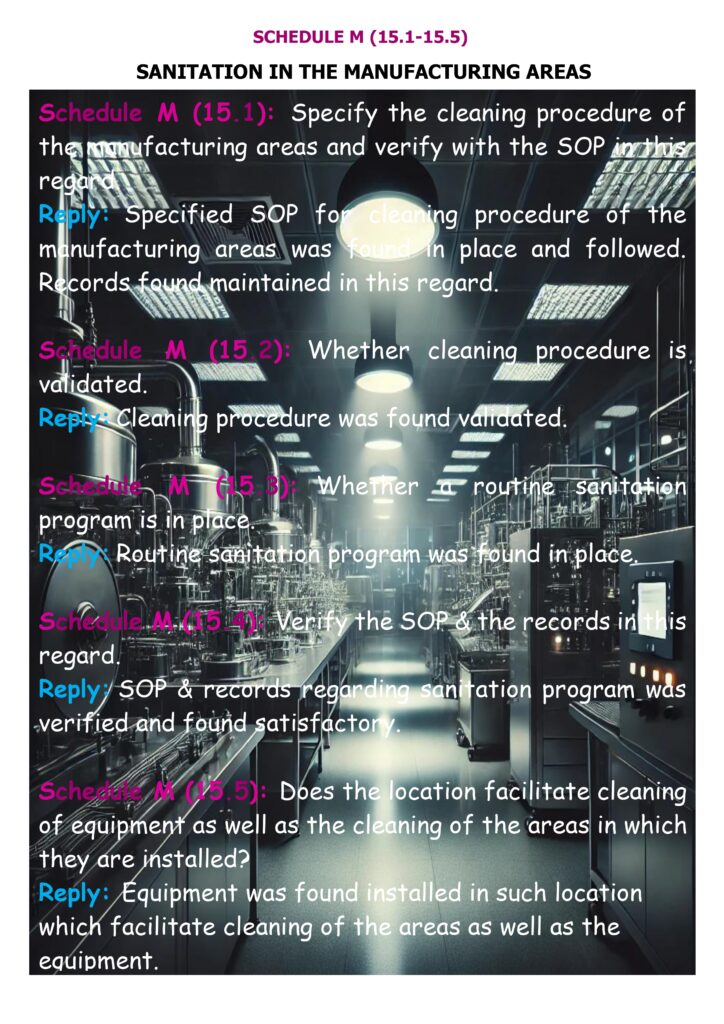
15.1 Cleaning procedure for manufacturing areas (SOP compliance)
Inspectors confirm the firm has a defined cleaning procedure for manufacturing areas and that it is followed as per SOP (including records). RBI checks whether the SOP is area-specific (dispensing, granulation, compression, coating, packing corridors), defines responsibilities, cleaning agents, dilution/preparation controls, tools/mops segregation, cleaning sequence (top-to-bottom/clean-to-dirty), and post-clean checks (visual + documented).
15.2 Validation of cleaning procedure
RBI verifies whether the cleaning procedure is validated. Practically, inspectors review the cleaning validation strategy: worst-case selection (most potent/least soluble/most difficult-to-clean), acceptance limits, swab/rinse methodology, hold times (dirty/clean hold), recovery studies, and revalidation triggers (change in product/equipment/cleaning agent).
15.3 Routine sanitation program
Inspectors confirm a routine sanitation program exists. RBI expects an area-wise sanitation schedule (daily/weekly/monthly), rotation of disinfectants where relevant, cleaning of ancillary areas (change rooms, airlocks, warehouses), and integration with pest control and waste flow.
15.4 SOP and records verification
The checklist specifically requires verifying SOPs and records for the sanitation program. RBI checks ALCOA+ behaviors: contemporaneous entries, signatures, traceability to room/equipment, deviation recording for missed/partial cleaning, and QA/IPQA review of trends (repeat observations, recurring failures).
15.5 Equipment location facilitates cleaning
Inspectors assess whether equipment placement allows cleaning of both equipment and surrounding areas. RBI looks for adequate clearance from walls/floors, no inaccessible “dead spaces,” controlled utilities routing, and design features that prevent dust build-up.
Common RBI gaps: SOP exists but not followed, “signature-only” logs, unvalidated cleaning for shared equipment, and poor equipment placement creating non-cleanable zones.