






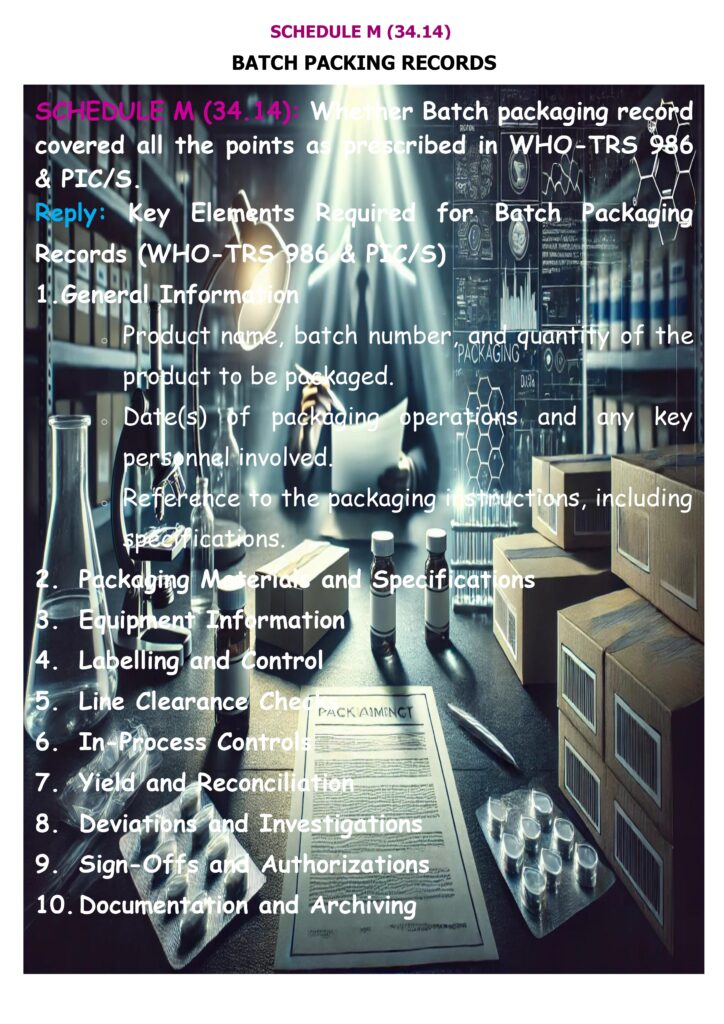
In Risk-Based Inspection (RBI), Schedule M checklist point 34.14 is used to verify whether the Batch Packaging Record (BPR) is complete against global GMP expectations, i.e., it “covers all the points as prescribed in WHO TRS 986 & PIC/S.” CDSCO Because packaging failures can cause wrong label/strength/batch/expiry (direct patient risk), RBI usually samples BPRs more deeply than many other records.
What “covers all points” means (WHO TRS 986 + PIC/S expectations)
A compliant BPR must be built from approved packaging instructions and designed to avoid errors (copying/validated systems preferred). It must include documented line clearance checks before packaging starts (workstation/equipment free from previous product/material/documents; equipment clean and suitable) and those checks must be recorded.
The BPR should capture, at the time of each activity (with clear identification by signature/electronic password): product name and batch number; dates/times; responsible packer; operator initials; in-process checks for identity and conformity; references to packaging lines/equipment used; and details of any special problems/deviations with authorization. A key RBI focus is reconciliation: quantities of bulk and printed packaging materials issued/used/returned/destroyed and the finished output quantities, sufficient to prove an adequate reconciliation (unless robust electronic controls justify an alternative). PIC/S also expects inclusion of specimens of printed packaging materials and overprints (batch coding/expiry dating) wherever possible. PIC/S
How RBI inspectors verify 34.14 (typical approach)
Inspectors select high-risk SKUs (look-alike packs, multiple strengths, recent artwork changes, export packs) and test whether the executed BPR is traceable and real, not “signature-only”: line clearance evidence, printed-material control, coding verification, deviation handling, and QA/IPQA review before release. Any reconciliation mismatch, missing specimens, uncontrolled attachments, or weak deviation investigation is treated as a high-risk packaging system weakness under RBI.