






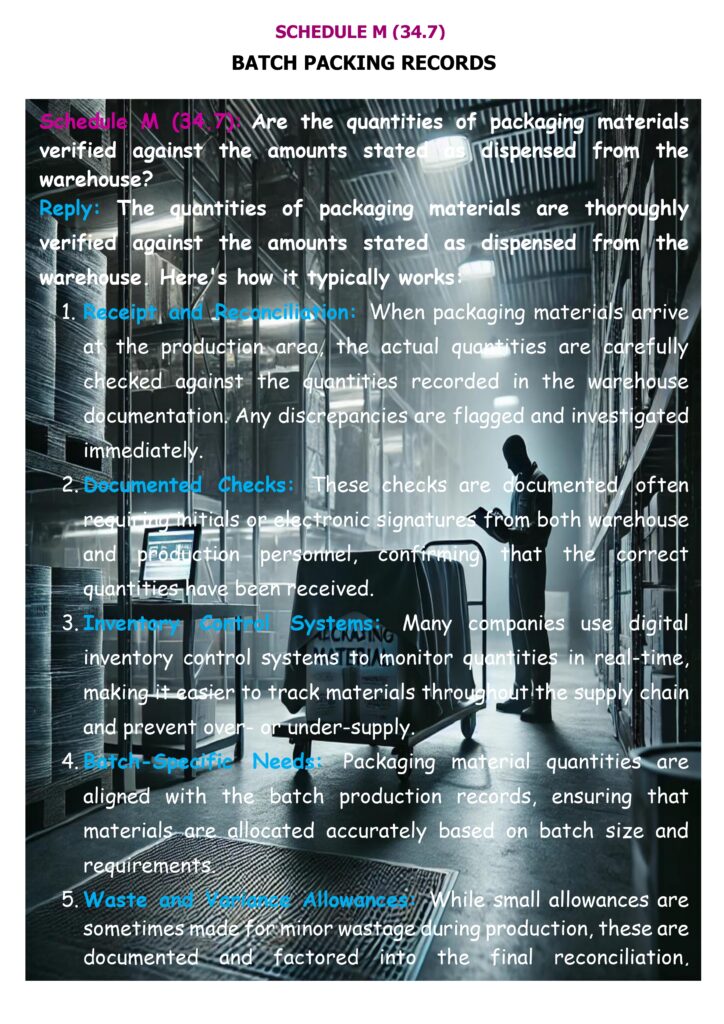
Risk-Based Inspection (RBI) – Schedule M Point 34.7 (Packaging material quantity verification) focuses on a high-patient-risk failure mode: printed/primary packaging material mismatch leading to mix-ups, wrong-label packs, missing labels, or unaccounted printed components.
What Schedule M 34.7 asks
Point 34.7 (Sch-M) checks: Are the quantities of packaging materials verified against the amounts stated as dispensed from the warehouse? CDSCO+1
In RBI, this is treated as a materials accountability control for cartons, labels, foils, leaflets, bottles, caps, etc.—especially printed components.
Why this is critical in RBI
Packaging is a top recall driver. If issued quantities are not verified and reconciled, leftover or missing printed items can be unintentionally used in another batch or leave the facility. PIC/S GMP expects the batch packaging record to document quantities and IDs of printed packaging materials issued, used, destroyed/returned, sufficient for adequate reconciliation. PIC/S WHO TRS 986 similarly requires reconciliation to permit adequate accountability.
What RBI inspectors typically verify (evidence-based)
- Warehouse issue control
- Authorized issuance only; material code/version/market verified.
- Issue documents show material name/code, supplier lot, quantity issued, date/time, and batch/line linkage.
- Line-side verification and usage tracking
- Physical count of issued components received at line versus issue note.
- Real-time recording of used, rejected, damaged, returned, and destroyed quantities (with reason).
- Reconciliation and discrepancy handling
- Final reconciliation: issued = used + returned + destroyed + rejects/samples (as applicable).
- Any significant discrepancy is investigated and assessed for batch impact before release (common GMP expectation).
- Controls for leftovers and destruction
- Unused coded/damaged labels and packaging materials are destroyed and recorded, preventing reuse/mix-up.
Common RBI observations (typical)
- “Signature-only” reconciliation without physical count.
- Uncontrolled leftovers in line drawers/trolleys.
- Quantity adjustments without deviation/investigation.
- Weak destruction records for printed materials.
A strong 34.7 system proves tight end-to-end accountability from warehouse dispensing to line reconciliation, with documented investigations whenever numbers don’t match.