






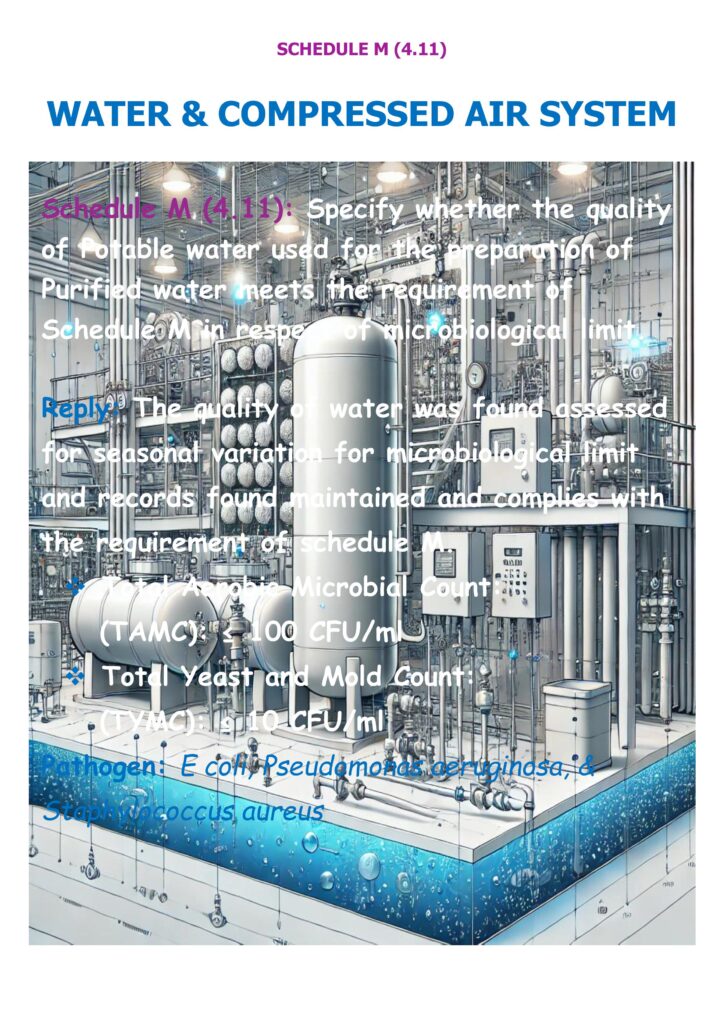
In a risk-based inspection (RBI), Schedule M point 4.11 (Water & Compressed air system section of the CDSCO benchmark checklist) requires the inspector to confirm whether the quality of potable water used for preparation of Purified Water meets Schedule M requirements for microbiological limits. CDSCO
Why it is high risk: Potable water is the feed to the purified water system. If its bioburden is high or highly variable, it can overload pre-treatment, promote biofilm in tanks/lines, reduce purifier performance, and ultimately increase the risk of microbial/endotoxin contamination in Purified Water—impacting cleaning, product contact rinses, and any process depending on PW.
What RBI verifies on-site (evidence-based):
- Defined specifications for potable water used as feed, including microbiological limits, sampling method, and test frequency aligned to risk (source variability, storage time, historical trends).
- Seasonal variation assessment: the checklist explicitly expects the firm to assess potable water microbiological quality for seasonal variation and maintain records showing compliance.
- Sampling plan & points: inlet to facility, after storage tank, after any treatment (softener/filters/UV/chlorination), and “worst-case” distal points—supported by drawings and rationale.
- Controls to keep potable water microbiologically stable: tank design (closed/vent filtered where applicable), periodic cleaning/sanitization, flushing routines, filter management, and prevention of stagnation.
- Data integrity & trending: raw data, COAs (if outsourced), lab controls, trend charts, and QA review demonstrating the system is under statistical control.
- Excursion handling: documented alert/action limits (even for potable water), deviation investigations, batch impact assessment (if potable water was used during excursions), CAPA effectiveness checks, and change control for any municipal/source change.
Common RBI red flags: no records for potable water microbiology, no seasonal study, infrequent sampling despite variable source, poorly maintained tanks/filters, repeated high counts without CAPA, or treating potable water as “outside GMP” even though it directly impacts PW quality.