





In Risk-Based Inspection (RBI), Schedule M points 4.14–4.15 are treated as critical utility controls because failures in WFI storage/sanitization or WFI quality can directly cause microbial/endotoxin contamination in sterile products.
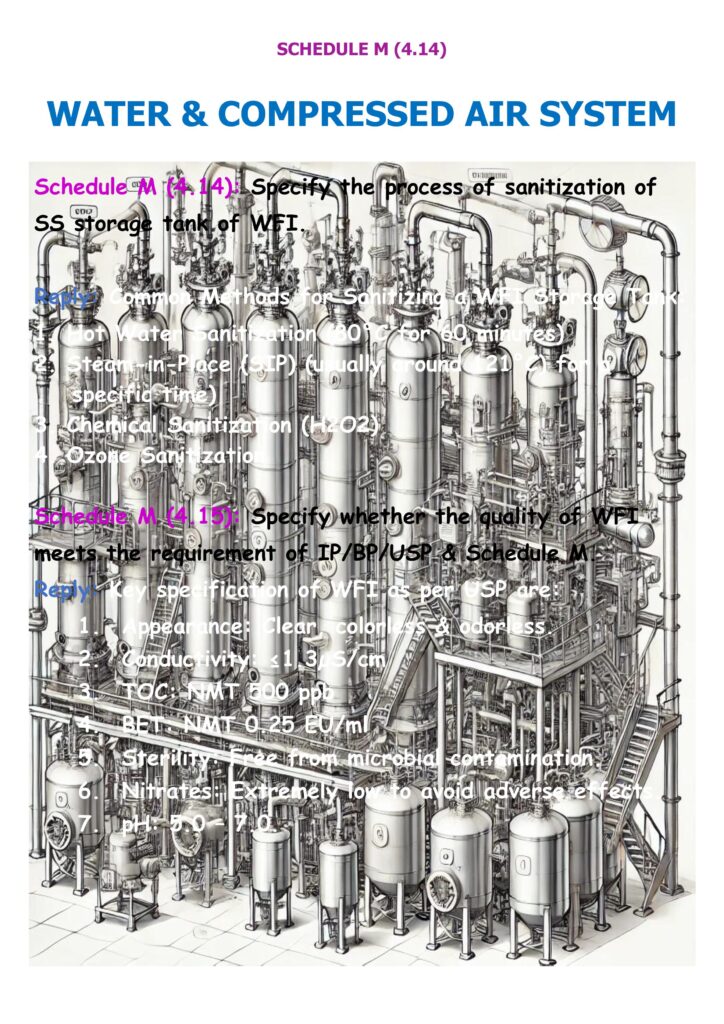
4.14: Sanitization process of SS WFI storage tank
This checkpoint asks you to specify the sanitization process for the stainless-steel WFI storage tank. Under RBI, inspectors verify not only the method (e.g., hot water/steam sanitization, ozone, or chemical sanitization), but whether it is validated/qualified, executed on a defined schedule, and supported by contemporaneous records.
Typical RBI evidence checks include:
- SOP details: preparation, safety precautions, step-by-step sequence, critical parameters (time/temperature/concentration), acceptance criteria, and “return-to-service” conditions.
- Tank design and hygiene: sanitary spray ball coverage (including headspace), vent filter integrity/sterilization, drainability, dead-leg minimization, and condensate removal.
- Record review: sanitization logbooks, deviations (e.g., low temperature, short hold time), investigations, CAPA, and effectiveness checks (trend improvement in micro/endotoxin).
This aligns with Schedule M’s general expectation of a written sanitation program for water systems including storage tanks, with records maintained.
4.15: WFI quality meets IP/BP/USP and Schedule M
This checkpoint asks whether WFI quality meets IP/BP/USP and Schedule M requirements. Schedule M specifies that WFI must be prepared by distillation and meet key limits such as ≤10 cfu/100 mL microbiologically and endotoxin ≤0.25 EU/mL, and be suitable for high-risk uses (bulk parenteral solutions, final rinse, disinfectant prep for aseptic areas).
RBI verification typically includes:
- Routine test results (conductivity/TOC where applicable, micro, endotoxin), alert/action limits, and trend charts.
- Sampling strategy that includes storage tank and worst-case points-of-use.
- Controls ensuring WFI is stored/handled to prevent microbial growth (e.g., hot storage/recirculation expectations where applicable).
If repeated excursions occur, RBI usually expands into loop design, investigation quality, batch impact assessment, and overall contamination control strategy.