






Risk-Based Inspection (RBI) under India’s CDSCO approach uses Quality Risk Management to decide the frequency, depth and breadth of inspection based on the site’s risk to patients/product quality, and then applies a structured checklist (Schedule M + WHO + PIC/S references). CDSCO
In the RBI checklist for sterile-preparation utilities, Points 4.18–4.25 focus on Purified Water (PW) and Water for Injection (WFI) storage and distribution controls—because failures here can drive biofilm formation, microbial/endotoxin risk, contamination, and batch impact.
What 4.18–4.25 require and how inspectors verify
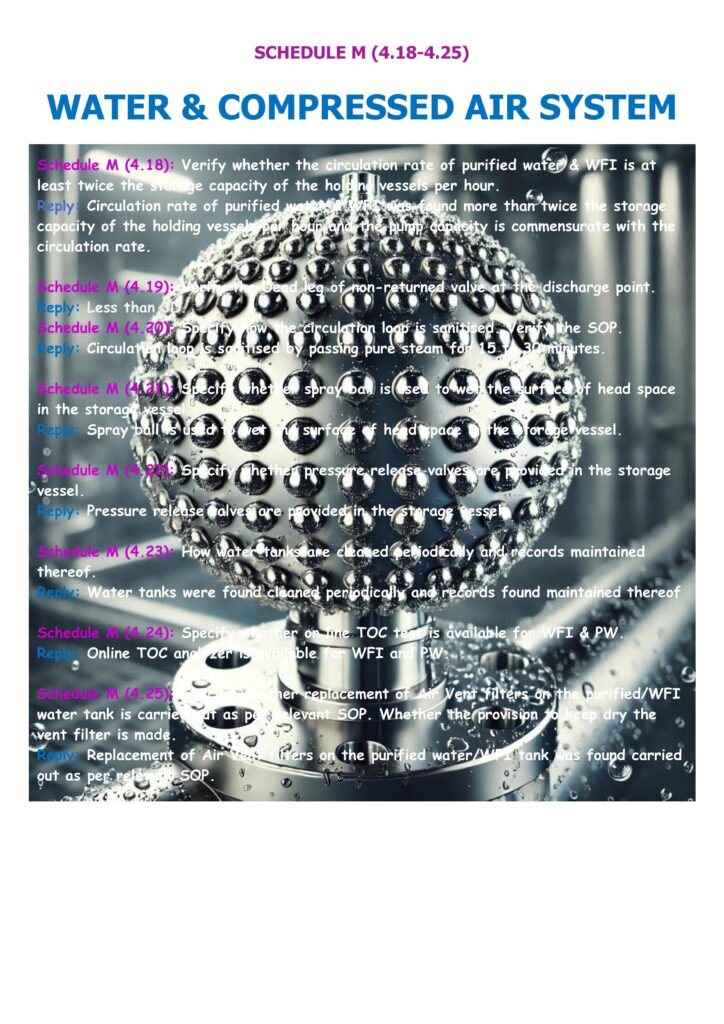
4.18 (PW/WFI circulation rate): Verify that the circulation rate of PW & WFI is at least twice the holding-vessel storage capacity per hour. Inspectors typically check loop design/P&ID, pump capacity vs actual flow, flowmeter records, and whether low-flow conditions are alarmed or investigated.
4.19 (dead legs at discharge): Verify the dead leg of a non-return valve at the discharge point. RBI will physically verify piping layout, measure dead-leg length vs pipe diameter (common expectation is very short dead legs, e.g., “≤3D”), and confirm corrective action for poor hygienic design.
4.20 (sanitization of circulation loop): Inspectors ask how the loop is sanitized and verify the SOP—including method (hot water/steam/ozone/chemical), parameters (time/temperature/concentration), and sanitization records with deviations/CAPA.
4.21 (spray ball for headspace wetting): Confirm whether a spray ball is used to wet the headspace surface of the storage vessel (a known risk area for contamination). Inspectors check design drawings and maintenance/cleaning evidence.
4.22 (pressure release valves): Verify pressure release valves are provided on the storage vessel and are maintained/calibrated where applicable.
4.23 (tank cleaning records – Schedule M): Confirm water tanks are cleaned periodically and records are maintained (frequency, method, verification).
4.24 (online TOC): Check whether online TOC testing is available for WFI & PW, and whether results are trended with alert/action handling.
4.25 (vent filter control – PIC/S reference): Verify air vent filter replacement is done per SOP and that provisions exist to keep the vent filter dry (wet vent filters can become contamination sources).
In RBI, repeated excursions (micro/TOC), weak sanitization records, or poor hygienic design typically expand the inspection scope into investigations, change control, and batch impact assessments.