




Risk-Based Inspection (RBI) means inspectors spend more time and deeper sampling on GMP systems that present higher patient/product-quality risk (e.g., contamination, mix-ups), and they test whether controls are effective in practice, not just written. ECA Academy+1
Schedule M + WHO TRS 986 (12.1–12.3): Premises design and dust-risk control
12.1 Premises must suit intended operations
WHO TRS 986 states the principle: premises must be located, designed, constructed, adapted and maintained to suit the operations performed.
Revised Schedule M repeats this expectation and additionally requires premises to conform to applicable conditions of the Factories Act, 1948.
RBI focus: Inspectors assess whether the facility design prevents contamination and errors for the actual product/process risk (e.g., hormones, β-lactams, potent powders). They verify zoning, segregation concepts, and whether the building condition/finishes support sanitation and controlled operations.
12.2 Layout/design must minimize errors and enable cleaning
WHO requires layout/design that minimizes errors and permits effective cleaning and maintenance to avoid cross-contamination and dust/dirt build-up.
Revised Schedule M similarly requires layout/design that minimizes errors and permits effective cleaning/maintenance to avoid cross-contamination and adverse product quality impact.
RBI focus: Inspectors “walk the flow” (people/material/waste) and challenge:
- Are flows logical and one-way where needed?
- Are there mix-up barriers (line/area status labeling, physical segregation)?
- Are cleaning access, drains, surfaces, and maintenance practices preventing contamination introduced during repairs?
12.3 Dust generation must be controlled
WHO TRS 986 requires that where dust is generated (sampling, weighing, mixing, processing, powder packaging), measures are taken to avoid cross-contamination and facilitate cleaning.
Revised Schedule M explicitly calls for measures to avoid cross-contamination and facilitate cleaning where dust is generated in similar operations.
RBI evidence checks (typical):
- Containment/dust extraction effectiveness at dispensing/blending (capture velocity, housekeeping, “no dust travel”).
- HVAC/pressure regime supporting segregation; maintenance records and deviations when controls fail.
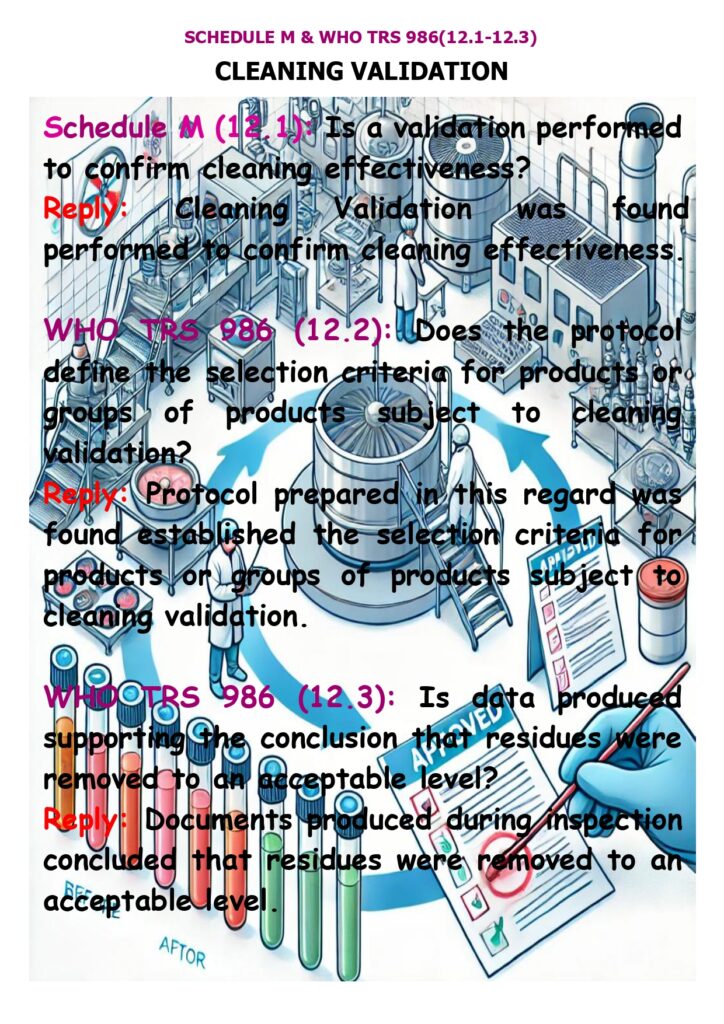
- Cleaning procedures + logs, and where justified, cleaning validation/verification for shared equipment/areas.
If dust controls are weak, RBI usually expands into cross-contamination risk assessment, sanitation effectiveness, and deviation/CAPA robustness.