






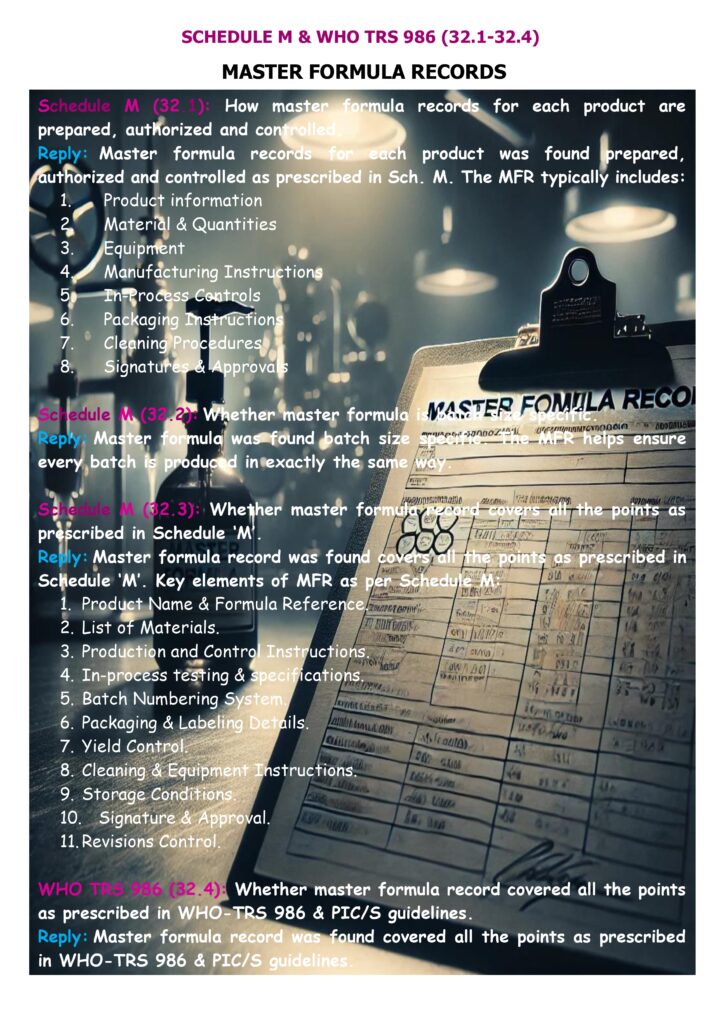
In a risk-based inspection (RBI), Schedule M & WHO TRS 986 (Points 32.1–32.4) are evaluated under Master Formula Records (MFRs) because weak master documentation is a top driver of wrong process execution, wrong quantities, mix-ups, and repeat deviations.
32.1 – Preparation, authorization, and control of MFRs (Schedule M): Inspectors verify how MFRs are created, reviewed, approved, issued, and revised (document control). They check whether only the current effective version is available at the point of use and whether obsolete versions are withdrawn, traceable, and prevented from use. The CDSCO checklist explicitly expects MFRs to be “prepared, authorized and controlled.” CDSCO
32.2 – Batch-size specific master formula (Schedule M): Inspectors confirm the master formula is batch-size specific (or has validated scaling rules). RBI focus is on high-risk products where wrong scaling can cause dose non-uniformity, OOS, yield loss, or safety risks. Evidence includes distinct MFRs for each batch size, or controlled scaling tables with QA approval and validation justification.
32.3 – MFR covers all Schedule M elements: Inspectors verify the MFR is complete as per Schedule M (not just a “recipe”). They sample multiple products/strengths and compare MFR content vs actual practice (SOPs, logbooks, IPC sheets). Missing steps, missing IPC limits, missing equipment references, or unclear instructions are treated as higher risk when they can affect CQAs.
32.4 – MFR covers WHO TRS 986 (and PIC/S-aligned) elements: RBI checks completeness against WHO expectations: a formally authorized master formula should exist for each product and batch size, and should include product name/code, dosage form/strength/batch size, starting materials and quantities, expected yields/limits, processing location/equipment, equipment preparation/cleaning references, stepwise processing instructions, IPCs with limits, storage/labeling needs, and special precautions. CDSCO+1
Common RBI red flags: uncontrolled Excel masters, mismatched effective dates, “handwritten permanent changes,” and repeated deviations showing the master formula is not maintained in a state of control.