






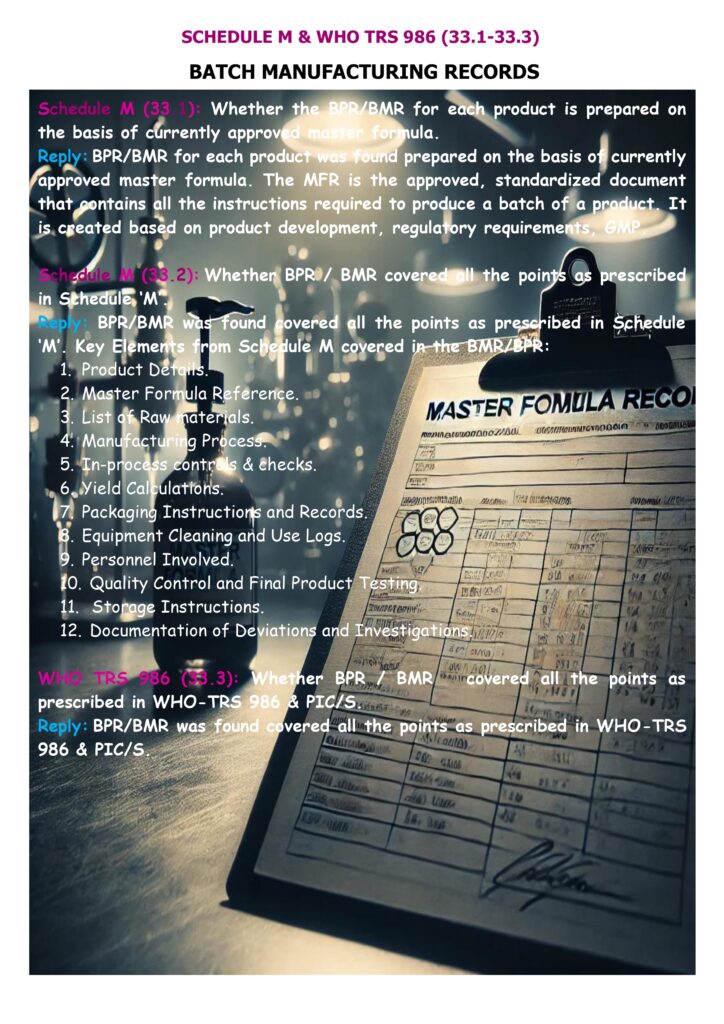
In Risk-Based Inspection (RBI), Schedule M & WHO TRS 986 points 33.1–33.3 are used to judge whether your Batch Production/Manufacturing Record (BPR/BMR) is a reliable, end-to-end “story” of how the batch was made—strong enough to prevent/trace mix-ups, contamination, and undocumented deviations. The CDSCO RBI checklist frames these three checks as: (33.1) BPR/BMR is based on the currently approved master formula; (33.2) BPR/BMR covers all points prescribed in Schedule M; (33.3) BPR/BMR covers points prescribed in WHO TRS 986 & PIC/S.
33.1: Prepared from the currently approved Master Formula (version control)
Schedule M requires that a Batch Processing Record exists for each product and is based on the relevant parts of the currently approved Master Formula, designed to avoid transcription errors.
RBI focus: correct master version in use, change-control linkage (formula/equipment/IPC updates), controlled blank record issuance, and prevention of unofficial “shadow” formats.
33.2: BPR/BMR contains all Schedule M-required information (completeness + traceability)
Schedule M expects pre-start line clearance checks to be performed and recorded and, during processing, contemporaneous recording of batch details, operator/checker initials, quantities weighed, equipment used, in-process controls and results, yields, deviations, and special problems with authorization.
RBI focus: missing annexures, back-dated entries, unexplained corrections, incomplete IPC sheets, absent equipment cleaning/usage evidence, and weak deviation documentation (impact not assessed).
33.3: BPR/BMR aligns with WHO TRS 986 (and PIC/S-style expectations)
WHO TRS 986 similarly requires that key processing information is recorded at the time each action is taken, with clear identification (signatures), including product/batch, dates/times, responsible persons, quantities, major equipment, IPCs/results, and yields.
RBI also checks batch release readiness: WHO expects QC records to be reviewed as part of batch release approval, and any failures/divergences to be thoroughly investigated with written conclusions and follow-up actions.
Typical RBI testing method: inspectors “trace” 1–3 batches from dispensing → processing → IPC → deviations → QC review → QA release, looking for gaps where risk could hide.