



In a risk-based inspection (RBI), WHO TRS 986 checklist points 12.4–12.5 are assessed under cleaning validation because inadequate cleaning is a major driver of cross-contamination, mix-ups, and microbial/particulate carryover—especially during product changeovers and stop–start operations.
12.4 — Evidence that validation covers the real cleaning risks
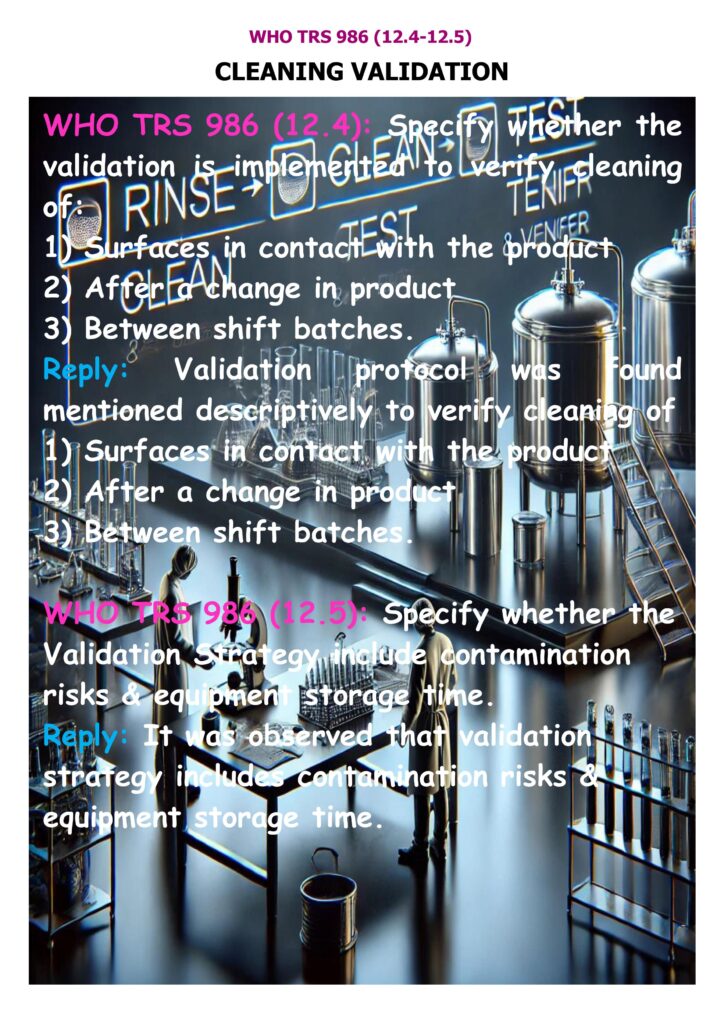
Inspectors verify that cleaning validation is actually implemented to demonstrate effective cleaning of:
- Surfaces in contact with product, 2) after a change in product, and 3) between shift batches.
RBI emphasis is on worst-case selection and scientifically justified sampling: hardest-to-clean equipment, lowest solubility actives, highest potency/toxicity, largest batch sizes, maximum dirty hold times, and maximum campaign length. Inspectors review:
- cleaning validation protocol/report, equipment matrix, and rationale for “worst case”
- swab/rinse sampling locations (hard-to-clean points), recovery studies, LOD/LOQ
- acceptance criteria (e.g., toxicological/PDE or dose-based limits) and visual cleanliness
- controls for between shift batches (when equipment is reused without full teardown) and for changeover (line clearance + verified cleaning)
- revalidation triggers (product/formulation/equipment/cleaning agent/parameter changes)
This aligns with WHO GMP expectations that cross-contamination be prevented using validated cleaning procedures. ECA Academy
12.5 — Validation strategy includes contamination risks and equipment storage time
Inspectors confirm the validation strategy explicitly addresses contamination risks and equipment storage time (hold times)—i.e., how long equipment may remain dirty before cleaning and clean before use, without loss of control.
RBI checks: documented dirty/clean hold-time studies, microbial risk controls (especially for aqueous residues), protection of cleaned parts (covers, storage conditions), and “restart” rules after extended downtime. Strong systems trend results, investigate excursions, and demonstrate that equipment and processes permit effective cleaning and maintenance to minimize contamination risk.