






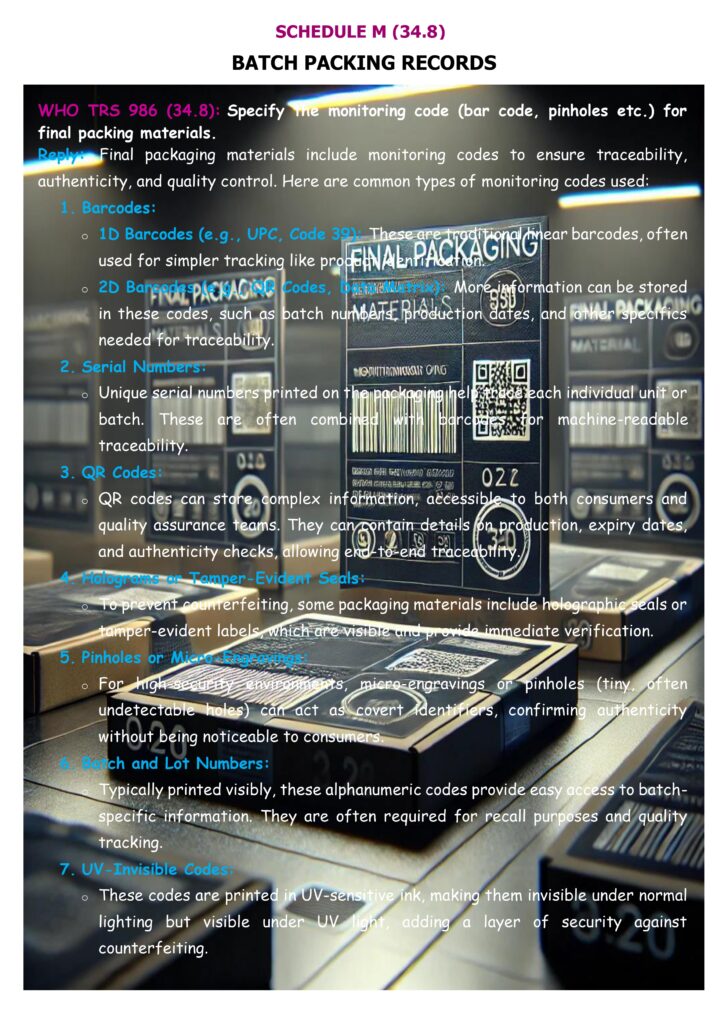
WHO TRS 986 – Point 34.8 (as used in RBI checklists): “Monitoring code for final packing materials” means the site must define and implement a code-based control (e.g., bar code, pinholes, 2D code, colour/emboss coding, hologram/OVD) to identify and verify final packaging materials on the packaging line, as per a written SOP. CDSCO
Why this is critical in Risk-Based Inspection (RBI)
Packaging is a high patient-risk step because errors lead to wrong label/strength/batch/expiry, mix-ups, and recalls. WHO GMP treats printed packaging materials as critical and requires secure handling and strong controls to prevent mix-ups and unauthorized access. Under RBI, any history of label deviations, market complaints, or reconciliation issues increases sampling depth for Point 34.8.
What RBI inspectors typically verify for 34.8
- Defined “monitoring code” in the system
- Code type(s) used for each pack (cartons, labels, foils, leaflets, shipper labels).
- Master data linkage: artwork approval, correct code version, and change control.
- SOP + line implementation evidence
- Procedure describes where the code is checked (incoming, issuance, at-line, during run, end-of-run).
- In-process verification records show checks actually occurred.
- Automated verification controls
WHO recognizes online verification by automated electronic means as helpful to prevent mix-ups, but requires checks to ensure code readers, label counters and similar devices operate correctly.
Inspectors check calibration/qualification, challenge tests, alarms/interlocks, and actions taken when the reader rejects a code. - Line clearance + “right material on line” controls
Before packaging starts, checks must confirm the line/equipment is clear and suitable; these checks are recorded.
During packaging, WHO expects online controls to include confirmation that correct products and packaging materials are used, correct overprinting, and correct functioning of line monitors. - Deviation handling and reconciliation
If code mismatches, unreadable codes, repeated rejects, or reconciliation discrepancies occur, RBI expects deviation investigations, batch impact assessment, CAPA, and effectiveness checks (not just “operator retrained”).
Common RBI gaps: “code defined but not verified at line,” unqualified scanners, weak artwork/change control, and poor documentation proving checks were performed.