





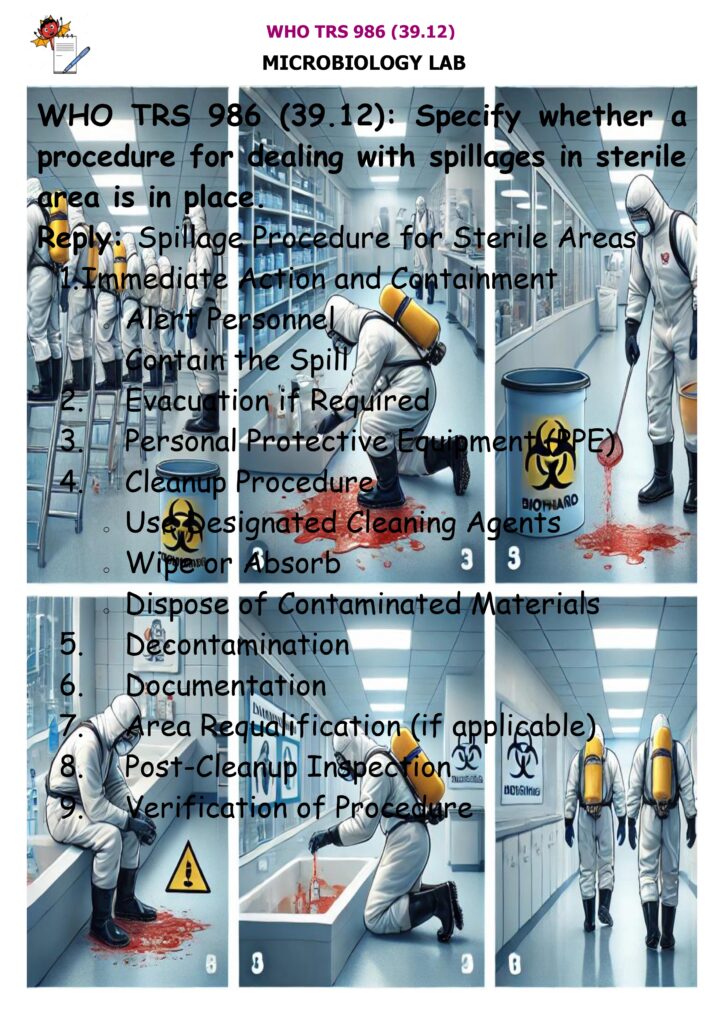
WHO TRS 986 – checklist point 39.12 (RBI focus): the risk-based inspection checkpoint asks inspectors to verify that a documented procedure exists for dealing with spillages in a sterile area.
In RBI, spillages are treated as a high-severity, time-critical contamination event because a spill can rapidly spread viable microbes, particulates, residues, and endotoxin/pyrogen risk through air turbulence, personnel movement, and contact surfaces—potentially impacting product sterility assurance and environmental control.
What inspectors expect to see (and how they test it):
- A written SOP defining spill types (e.g., powder, liquid, broken container/glass, microbiological culture/media, disinfectant/chemical), who responds, and escalation rules (minor vs major spill; when to stop operations and quarantine). World Health Organization
- Immediate containment steps: restrict access, stop non-essential movement, protect critical zones (Grade A/B), and prevent spread into airlocks or adjacent grades.
- Spill kit readiness: dedicated sterile-area spill kits with approved disinfectants (including contact time), sterile wipes/mops, absorbents, sharps tools, waste bags, and PPE; kit locations mapped and periodically checked.
- Cleaning/disinfection method: directionality (clean-to-dirty), removal of gross contamination first, then disinfection with validated agents and contact times; precautions to avoid aerosolization and recontamination.
- Batch impact assessment: definition of “product at risk,” hold-time/line-stop criteria, and when to reject or reprocess; linkage to deviation/OOS and CAPA.
- Post-spill verification: additional environmental monitoring (air/surfaces/personnel) and documented recovery before restart, aligned with the site contamination control approach. World Health Organization
- Waste handling: segregation and safe disposal (biohazard/sharps/chemical), with traceable records.
High-risk red flags: “informal” spill handling, missing contact times, no restart criteria, no EM follow-up, or repeated spills without CAPA effectiveness.