





Brief Description
This SOP describes the standardized procedure for sampling of raw materials received in the Warehouse to ensure that the samples collected are representative of the entire batch or consignment. The procedure is executed by the QC Chemist, while QC/QA management is responsible for its effective implementation. Before sampling, the material specification, storage condition, safety precautions, container condition, labeling, sampling area cleanliness and required PPE are verified. Sampling is performed under suitable controlled conditions such as LAF/RLAF/UDAF, wherever required, using clean or sterile sampling accessories. The SOP defines sampling requirements for APIs, inactive materials, parenteral excipients, solvents, gases, sensitive materials and microbiological samples. It also covers sample labeling, resealing of containers, documentation, storage, cleaning of the sampling area, reanalysis sampling and stock-transfer materials. Proper records and annexures ensure traceability, contamination control and reliable laboratory testing.
Skip to PDF content1. Flow Diagram:
The college-themed flow diagram presents the Raw Material Sampling SOP as a three-floor learning structure, making the procedure simple and easy to understand. The first floor covers receipt and review activities, including receiving the consignment, preparing the GRN, checking documents, verifying labels, COA, storage conditions, container integrity, and quarantine status.
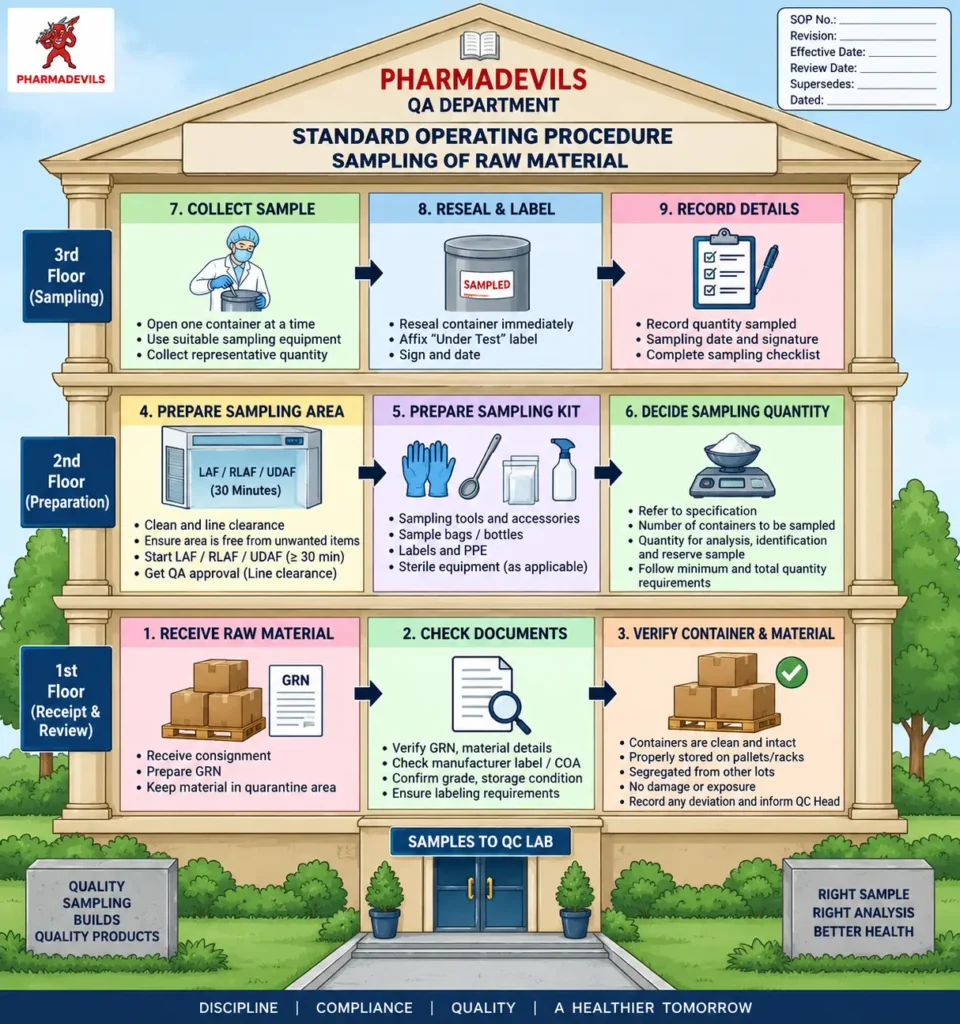
The second floor represents preparation activities such as cleaning and line clearance of the sampling area, operating LAF/RLAF/UDAF before sampling, preparing the sampling kit, PPE, labels, and determining the required sampling quantity.The third floor shows the actual sampling process: collecting a representative sample, immediately resealing containers, applying the Under Test label, and recording sampling details. The process ends with transferring the properly identified sample to the QC laboratory for analysis, supporting traceability, contamination control, and reliable testing.
2. Brainstorming for SOP Failure:
Brainstorming for SOP failure in Raw Material Sampling is a structured team activity used to identify possible reasons why the approved sampling procedure may not be followed correctly. The discussion should consider failures related to personnel, procedure, sampling area, equipment, documentation, materials, and supervision. Examples may include inadequate training, incorrect sample quantity, use of unsuitable sampling tools, improper line clearance, failure to operate LAF/RLAF/UDAF as required, incorrect labeling, poor documentation, damaged containers, and cross-contamination risks. These points are directly relevant to the controls described in the SOP for sampling preparation, equipment, labeling, container handling, and documentation.
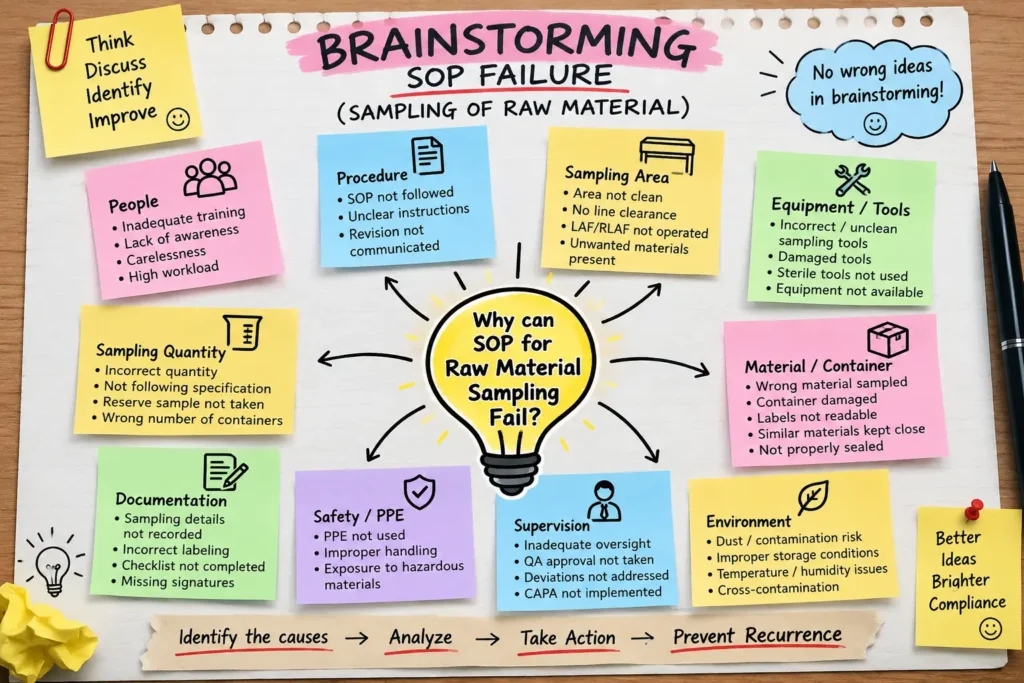
The purpose of brainstorming is to collect all possible causes without immediately rejecting ideas, then group and evaluate them to identify the most likely root causes. The outcome can support further analysis using tools such as 5-Why, Fishbone, FMEA, or CAPA, helping prevent recurrence and improve SOP compliance.
3. 5-Why Analysis for SOP Failure:
The 5-Why Analysis is a simple root-cause investigation tool used to determine why the SOP for Sampling of Raw Material may fail during execution. The analysis begins with the main problem: the sampling SOP was not followed correctly. It then repeatedly asks “Why?” to move from the visible failure toward the underlying cause. In the illustrated example, the failure progresses from a sampling step not being followed, to unclear understanding of instructions, inadequate training or communication, weak supervision and checklist review, and finally an ineffective training and compliance-monitoring system as the potential root cause.
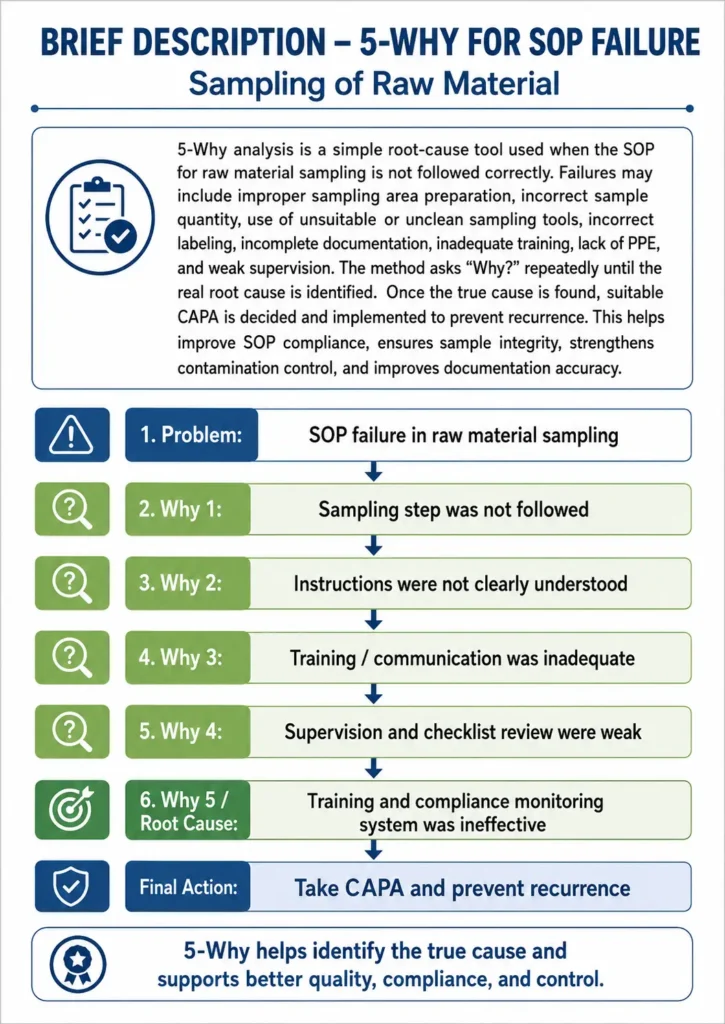
Once the root cause is identified, appropriate Corrective and Preventive Actions (CAPA) can be planned and implemented. These may include retraining personnel, strengthening supervision, improving checklist verification, and monitoring SOP compliance. The 5-Why method helps improve sample integrity, contamination control, documentation accuracy, regulatory compliance, and prevention of repeated sampling errors.
4. Fishbone Analysis for SOP Failure:
The Fishbone (Cause-and-Effect) Analysis is used to identify possible reasons for failure of the SOP for Sampling of Raw Material. In the car-themed diagram, the main effect is “SOP Not Followed in Sampling of Raw Material,” while the possible causes are grouped into six major categories: Man, Method, Material, Machine, Measurement, and Environment.
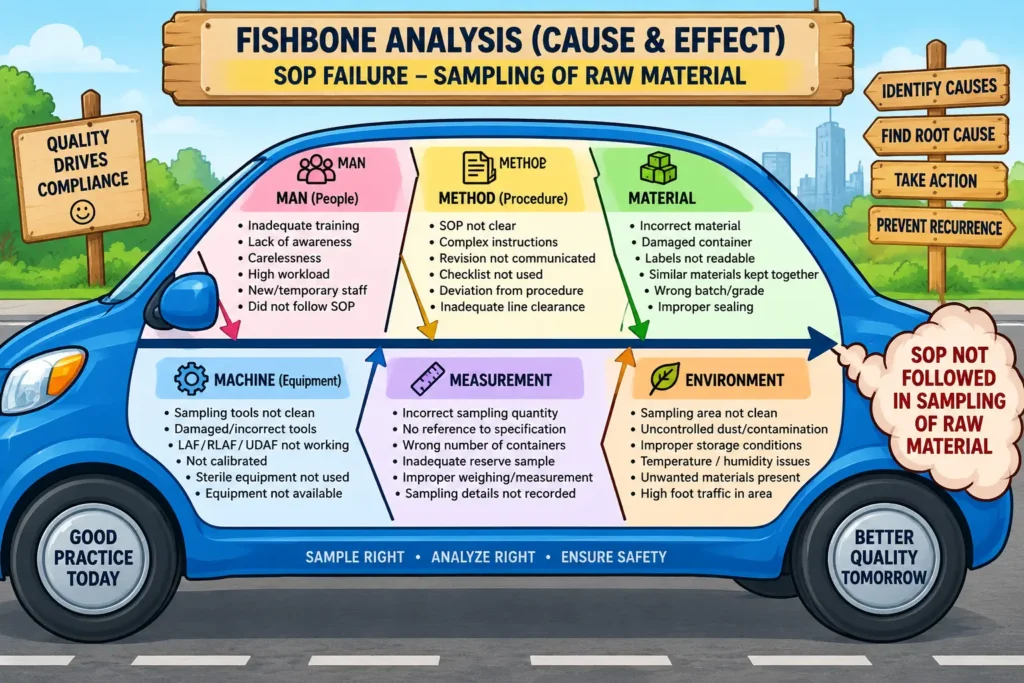
Potential causes include inadequate training, lack of awareness, unclear instructions, deviation from the approved procedure, damaged or incorrectly identified material, unclean or unsuitable sampling tools, incorrect sampling quantity, poor documentation, improper storage conditions, and an unclean sampling area. These points relate directly to SOP requirements for checking material details, sampling-area readiness, use of suitable equipment, correct sample quantity, container handling, labeling, and documentation.The Fishbone method helps the investigation team organize potential causes, identify the probable root cause, implement CAPA, and prevent recurrence, thereby improving sampling accuracy, compliance, and sample integrity.
5. Fault Tree Analysis for SOP Failure:
The Fault Tree Analysis (FTA) is a structured root-cause analysis tool used to understand how different failures can lead to SOP failure during Sampling of Raw Material. The top event is defined as sampling not being performed as per the approved SOP.The analysis breaks this top event into major failure pathways such as incorrect or incomplete sampling, contaminated sample, improper documentation, and use of unapproved or misidentified material. These may result from causes like wrong sampling tools, incorrect sampling quantity, unclean sampling area, damaged or non-sterile equipment, cross-contamination, incomplete records, incorrect labels, failure to verify GRN/COA details, and damaged containers.
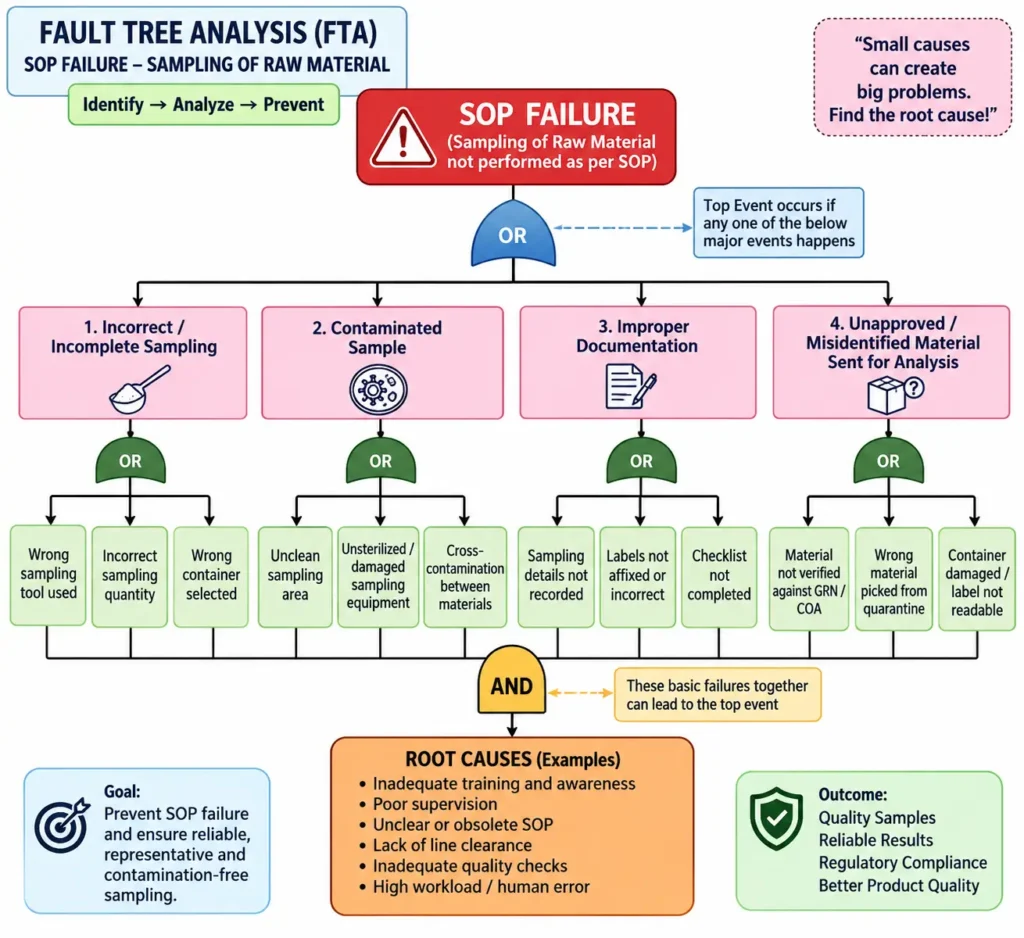
These failure modes reflect the controls required in the SOP for preparation, sampling, container handling, labeling, and documentation.FTA helps trace these events back to possible root causes such as inadequate training, poor supervision, unclear procedures, weak line clearance, insufficient quality checks, and human error. The final objective is to implement suitable CAPA, prevent recurrence, and ensure representative, contamination-free, and reliable raw material sampling.
Questions & Answers – SOP for Sampling of Raw Material
Q1. What is the objective of the SOP for Sampling of Raw Material?
Answer: The objective is to provide the procedure to be followed for sampling of raw materials.
Q2. Where is this SOP applicable?
Answer: It is applicable to sampling of raw materials received in the Warehouse department.
Q3. Who is responsible for execution of this SOP?
Answer: The QC Chemist is responsible for execution of the SOP.
Q4. What is sampling?
Answer: Sampling is the process of taking a representative portion of material from a larger quantity so that the sample can provide information about the complete batch or consignment.
Q5. What should be checked before raw material sampling?
Answer: The material specification, storage conditions, material characteristics, safety precautions, PPE requirements, container condition, labeling, segregation, sampling-area cleanliness, and other relevant requirements should be checked before sampling.
Q6. How long should LAF/RLAF/UDAF be operated before sampling?
Answer: LAF/RLAF/UDAF should be switched ON for at least 30 minutes before commencement of sampling.
Q7. What precautions are required for microbiological sampling?
Answer: Microbiological samples should be collected separately using sterile equipment and accessories. For Bacterial Endotoxin Test sampling, depyrogenated accessories and containers should be used.
Q8. What PPE should be worn during sampling?
Answer: The SOP specifies snood/gown, sterile powder-free hand gloves, and shoe covers/booties, with hand disinfection before sampling.
Q9. How is the quantity of sample determined?
Answer: The respective material specification should be followed. The total quantity required for identification, complete analysis, reserve sample, and minimum withdrawal from each container should be considered.
Q10. How should solid and liquid materials be sampled?
Answer: For solids, portions should be withdrawn from different parts of the bulk to obtain a representative sample. For liquids, the contents should be mixed by gentle swirling and sampled using a suitable liquid sampler or pipette.
Q11. How many containers are sampled for APIs?
Answer: For APIs, all containers are to be sampled.
Q12. What is the sampling plan for inactive materials?
Answer: If there are three or fewer containers, all containers are sampled. If there are more than three and up to 100 containers, sampling is based on √n + 1, where n is the total number of containers.
Q13. How are excipients for parenteral dosage forms or inhalers sampled?
Answer: All containers are to be sampled.
Q14. What should be done immediately after sampling from a container?
Answer: The container should be properly resealed immediately, and the duly signed “Under Test” label should be affixed to the sampled container.
Q15. What details should be recorded after sampling?
Answer: The quantity sampled, sampling date, analyst signature, and relevant checklist/GRN details should be recorded.
Q16. What should be done with used sampling equipment?
Answer: Used sampling equipment should be placed in a self-sealing polythene bag with a “To be cleaned” label and transferred to the QC washing area.
Q17. What is required after completion of each sampling activity?
Answer: The sampling area should be cleaned after each batch, and the cleaning and line-clearance checklist should be completed.
Q18. How should samples be stored after sampling?
Answer: Samples should be taken to the laboratory and stored according to the storage conditions specified in the individual material specification until analysis.
Q19. Who provides training for this SOP?
Answer: The Head QA/QC is the trainer, and Quality Control Chemists are the trainees.
Q20. What records and annexures support the sampling process?
Answer: The SOP includes annexures for the raw material checklist, Under Test label, sampling-room usage record, cleaning and line-clearance checklist, sampled label, general flow chart, pictorial sampling checklist, and raw-material logbook.