






Brief Description
This SOP describes the procedure for the preparation, identification, labeling, documentation, storage, expiry control, and traceability of solutions, reagents, and analytical standards used in the Quality Control laboratory. It covers stock solutions, working standards, calibration standards, chromatography eluents, buffers, and reagents purchased from external vendors. Analytical standard preparations are recorded in designated logbooks with unique serial numbers to maintain complete traceability from preparation through subsequent analytical use. Calibrated instruments used during preparation are also identified in the records. Prepared solutions are labeled with essential information such as identification, concentration, serial number, and expiration date. The SOP also defines expiry and reassay requirements, control of expired materials, acceptance criteria for volumetric reagent standardization, and additional GLP labeling and stability requirements. Storage conditions such as ambient, refrigerated, or frozen are specified where applicable.Overall, the procedure ensures accuracy, traceability, proper identification, controlled storage, and reliable use of laboratory reagents and standards.
Skip to PDF content1. Flow Diagram:
The flow diagram illustrates the systematic procedure for Solutions, Reagents and Standards Preparation & Documentation in the Quality Control laboratory. The process begins by identifying the required solution, reagent, analytical standard, buffer, or chromatography eluent. Suitable raw materials or approved supplier stock solutions are selected, followed by preparation using calibrated laboratory instruments. Each preparation is documented in the designated standards logbook with a unique serial number to ensure complete traceability.
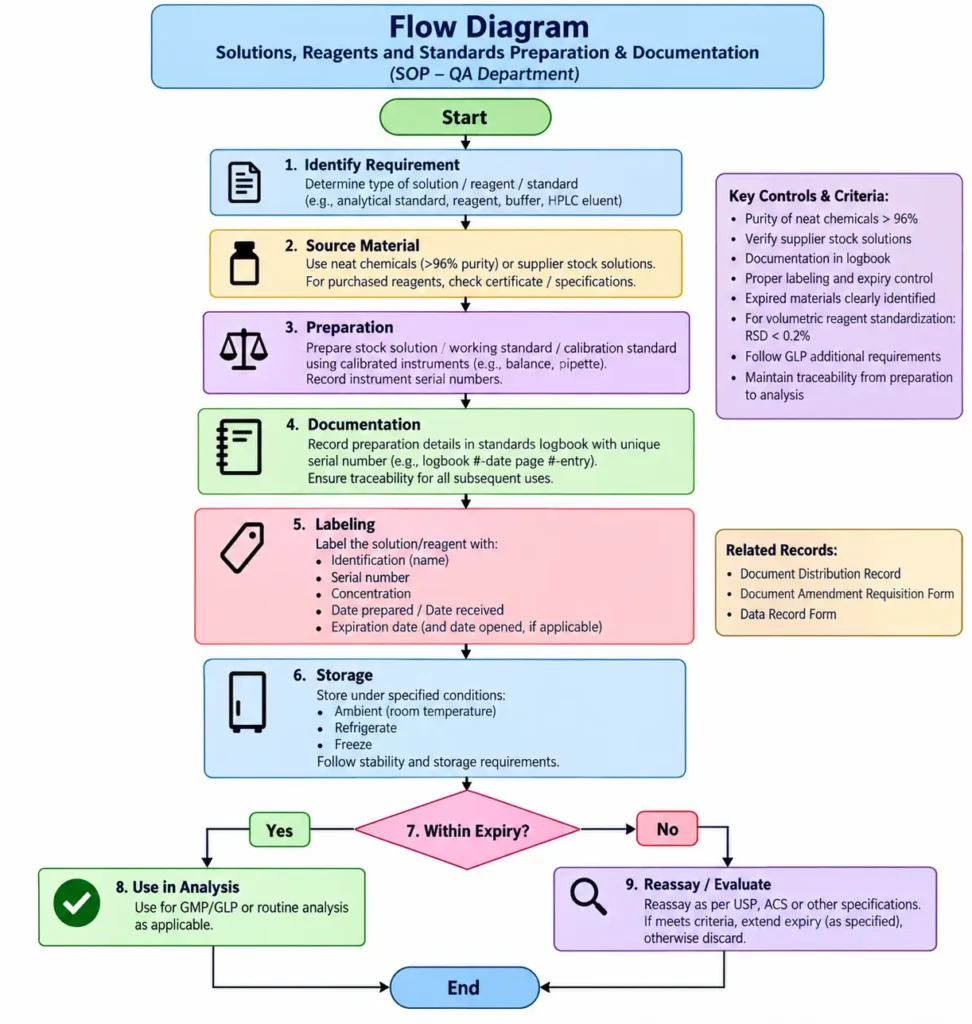
Prepared solutions and reagents are properly labeled with identification, concentration, serial number, preparation or receipt date, and expiration date. Appropriate storage conditions are maintained, including ambient, refrigerated, or frozen storage where applicable. Materials within expiry are released for analytical use, while expired materials are evaluated or reassayed according to applicable specifications before further use or disposition.
2. Brainstorming for SOP Failure:
The brainstorming diagram presents the possible causes of failure in the SOP for Solutions, Reagents and Standards Preparation & Documentation using a school classroom theme with colorful sticky notes. The central SOP failure is connected to potential issues such as inadequate QC training, failure to read or understand the SOP, incomplete logbook entries, missing serial numbers, incorrect labeling, improper storage conditions, use of uncalibrated balances or pipettes, inadequate expiry-date control, poor verification of supplier stock solutions, failure to reassay expired reagents, unclear responsibility, and delayed documentation review.
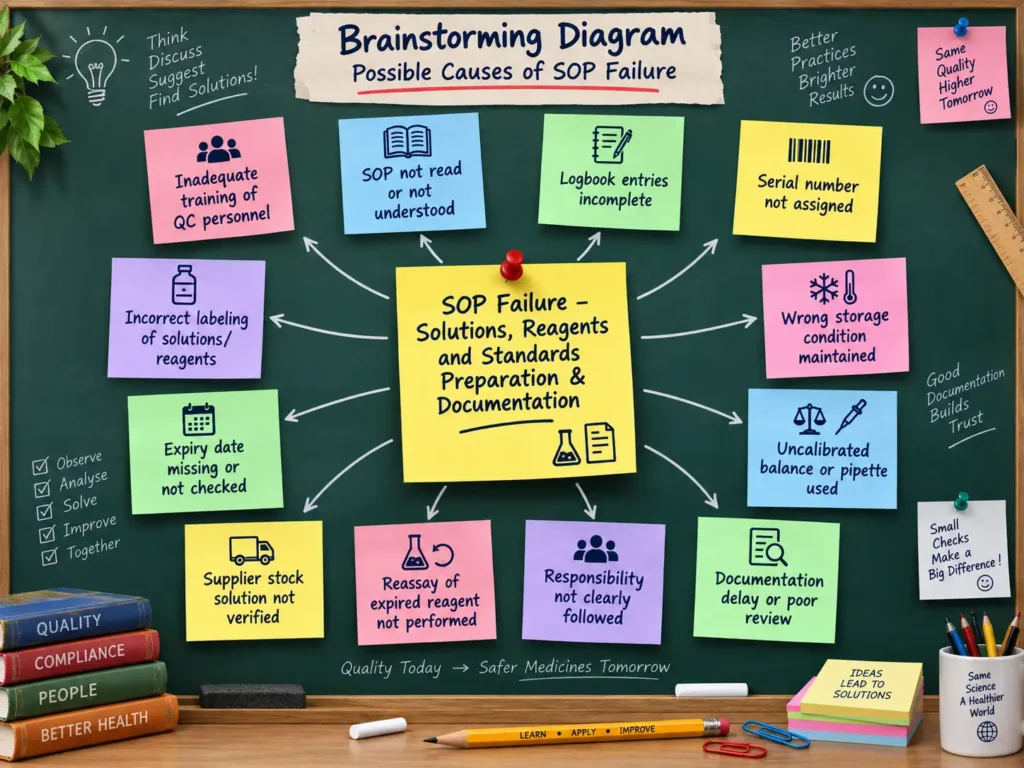
These brainstorming points are closely linked to the SOP requirements for documented preparation, unique serial-number traceability, use of calibrated instruments, and proper labeling of standards and reagents. The SOP also requires control of expiry dates, reassay or evaluation of expired materials, and appropriate storage conditions.The diagram is intended to support root-cause discussion, GMP awareness, training, and CAPA planning by helping QC personnel identify weaknesses that may lead to SOP non-compliance.
3. 5-Why Analysis for SOP Failure:
The 5-Why diagram analyzes the possible root cause of failure in the SOP for Solutions, Reagents and Standards Preparation & Documentation. The identified problem is that required preparation, labeling, and documentation practices were not followed consistently. The analysis progresses from operator-level non-compliance to inadequate understanding of SOP requirements, insufficient training or refresher review, weak supervisory monitoring, and poor document-control follow-up.
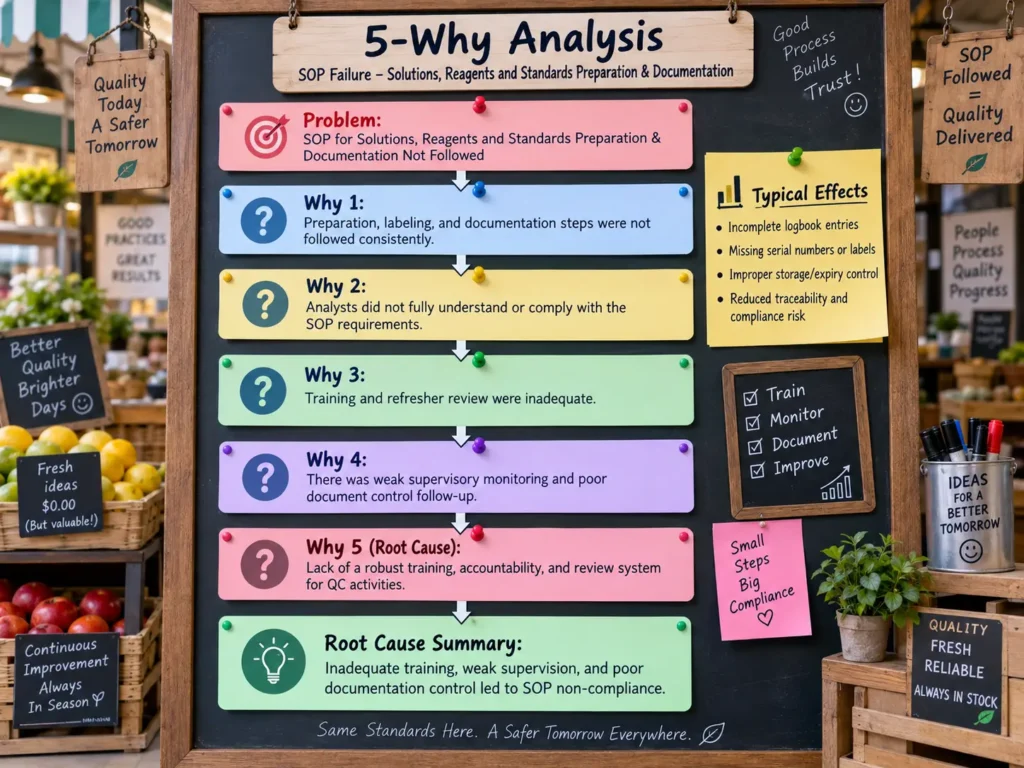
The final root-cause statement identifies inadequate training, weak supervision, insufficient accountability, and ineffective review controls as major contributors to SOP failure. This is relevant because the SOP requires controlled preparation records, unique traceability numbers, identification of calibrated instruments, correct labeling, and proper expiry control.The diagram is useful for supporting root-cause investigation, CAPA development, training improvement, and strengthening QC documentation practices to prevent recurrence and improve compliance.
4. Fishbone Analysis for SOP Failure:
The Fishbone Analysis diagram identifies the potential causes of failure in the SOP for Solutions, Reagents and Standards Preparation & Documentation. The causes are organized into six major categories: Man (Personnel), Method, Machine/Instrument, Material, Measurement/Documentation, and Environment/Storage. Key issues include inadequate QC training, poor SOP understanding, skipped preparation or standardization steps, use of uncalibrated balances or pipettes, unverified supplier stock solutions, incomplete logbook entries, missing serial numbers or labels, delayed documentation review, improper storage conditions, and inadequate expiry control.
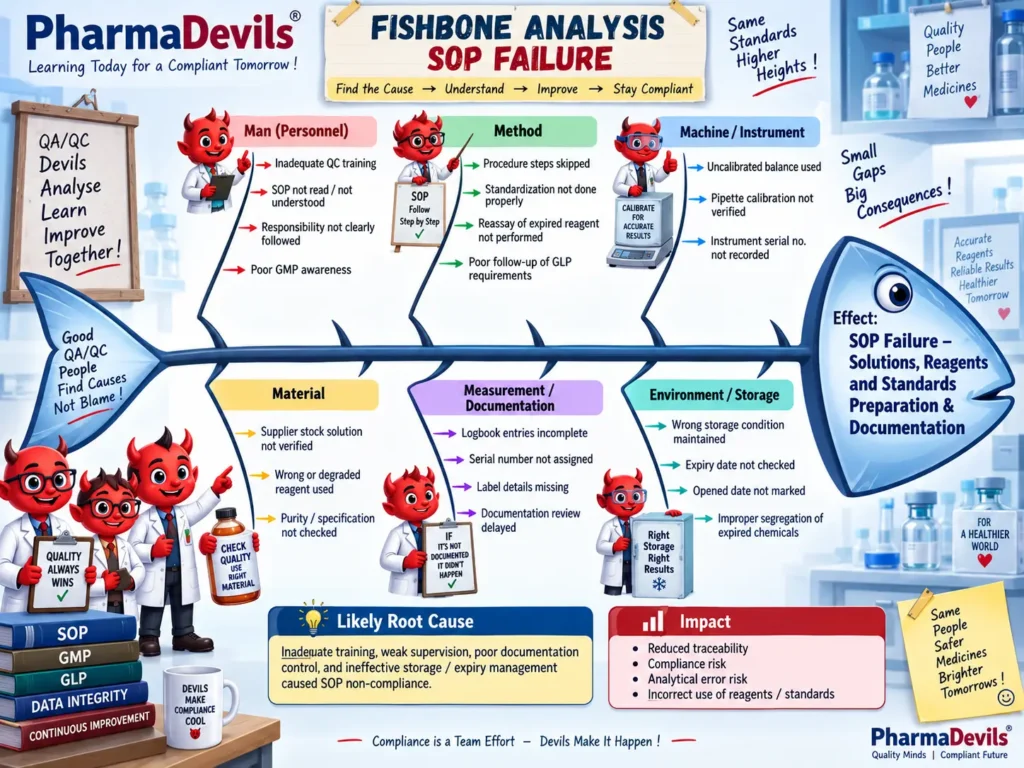
These causes directly affect the SOP requirements for documented preparation, use of calibrated instruments, unique traceability numbers, proper labeling, expiry control, and reagent standardization.The diagram highlights that inadequate training, weak supervision, poor documentation control, and ineffective storage/expiry management can collectively lead to SOP non-compliance, reduced traceability, analytical errors, and increased GMP/GLP compliance risk.
5. Fault Tree Analysis for SOP Failure:
The Fault Tree Analysis diagram illustrates the potential causes leading to failure of the SOP for Solutions, Reagents and Standards Preparation & Documentation. The top event is defined as non-compliance with the SOP, and the possible contributing failures are grouped into four major areas: Documentation/Traceability Failure, Preparation/Standardization Failure, Instrument/Material Control Failure, and Storage/Expiry Control Failure.
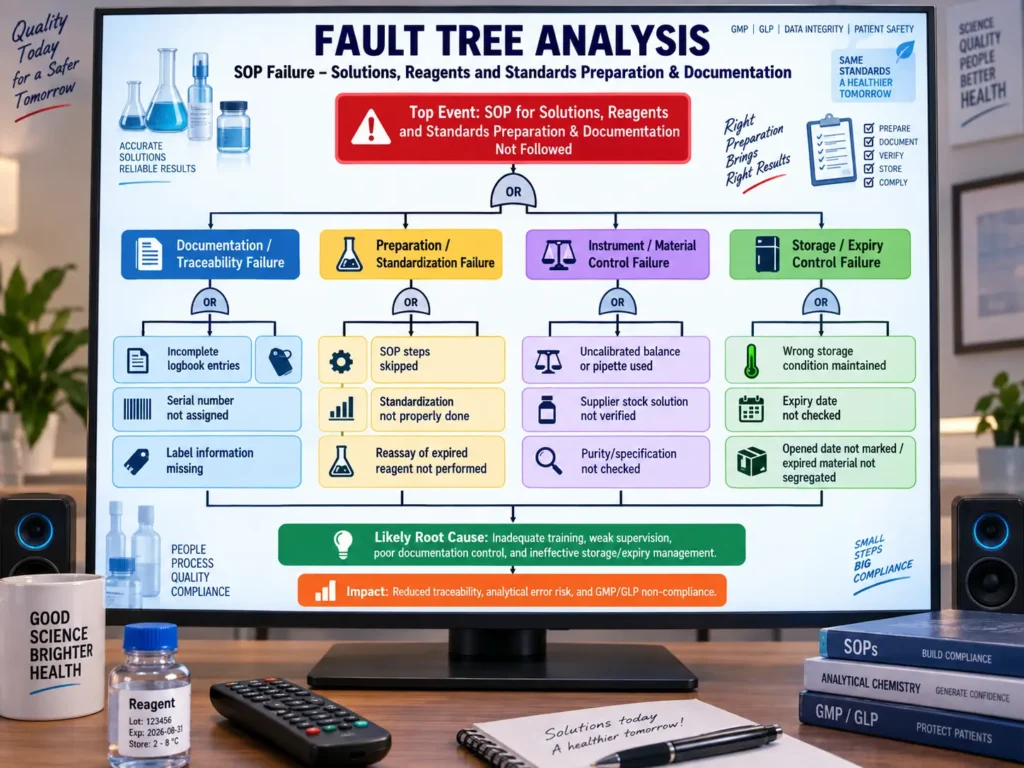
The diagram highlights causes such as incomplete logbook entries, missing serial numbers or label information, skipped SOP steps, improper standardization, failure to reassay expired reagents, use of uncalibrated balances or pipettes, unverified supplier stock solutions, incorrect storage conditions, and inadequate expiry-date control. These points are consistent with the SOP requirements for traceable documentation, calibrated instruments, labeling, reagent standardization, and expiry management.The analysis supports identification of likely root causes and helps guide CAPA, training, supervision, documentation control, and preventive measures to reduce recurrence and improve GMP/GLP compliance.
Questions & Answers – Solutions, Reagents and Standards Preparation & Documentation
- What is the objective of this SOP?
Answer: To establish a procedure for the preparation and documentation of solutions, reagents, and standards used in the Quality Control laboratory. - What is the scope of this SOP?
Answer: It covers preparation and documentation of standards, reagents, chromatography eluents, and other laboratory solutions, including tracking of solutions and reagents purchased from external vendors. - Who is responsible for implementing this SOP?
Answer: QC Chemists, Assistant Manager-QC, and Head-QA/QC are responsible for activities defined in the SOP. - How should analytical standards be prepared when the neat chemical purity is below 96%?
Answer: The concentration of the prepared standard should be corrected according to the actual purity of the chemical. - Can supplier stock solutions be used?
Answer: Yes. Supplier stock solutions may be used, but where possible their concentration should be verified by comparison with laboratory-prepared standards or certified reference materials. - Where should preparation of stock and working standards be documented?
Answer: Preparation of stock solutions, working standards, and calibration standards must be documented in the designated standards logbook. - Why is a unique serial number assigned to each standard preparation?
Answer: The serial number enables traceability of the standard from its preparation through dilution, calibration standard preparation, and analytical use. - What information should be recorded for calibrated instruments used during preparation?
Answer: The serial number of calibrated instruments such as balances and autopipettes should be recorded in the logbook. - What information should appear on the label of a prepared standard solution?
Answer: The label should include standard identification, serial number, expiration date, and concentration. - How should purchased reagents be labeled upon receipt?
Answer: Purchased reagents should be labeled with the date received and expiration date. - What should be done if a reagent or solution has expired?
Answer: It may be reassayed according to USP, ACS, or other applicable specifications. If it remains acceptable, its expiration period may be extended as specified by the SOP. - What is the acceptance criterion for replicate normality during standardization of a volumetric reagent?
Answer: The RSD between replicate normality values should be less than 0.2%. If the RSD exceeds 0.2%, the reagent should be discarded and freshly prepared and standardized. - What additional information is required on GLP solution labels?
Answer: GLP solutions should be labeled with concentration, solvent, preparation date, preparer’s initials, expiration date, and storage conditions. - How should GLP reagent stability be demonstrated?
Answer: Stability and purity should be demonstrated by appropriate testing, including comparison of freshly prepared solutions with older preparations where applicable. - What storage-condition abbreviations are defined in the SOP?
Answer: The SOP defines A = Ambient temperature, R = Refrigerate, and F = Freeze. - Who is accountable for this SOP and how often is it performed?
Answer: All chemists and laboratory personnel are accountable, and the activity is performed as and when required.
Reference Guidelines:
- WHO TRS 1052, Annex 4 – Good Practices for Pharmaceutical Quality Control Laboratories, 2024
Provides specific guidance for pharmaceutical QC laboratories covering reagents, reference substances/materials, equipment calibration, traceability, documentation and laboratory working procedures. (World Health Organization)
WHO Good Practices for Pharmaceutical Quality Control Laboratories - US FDA – 21 CFR Part 211, §211.160 – Laboratory Controls
Requires scientifically sound laboratory controls and documented procedures, including suitable calibration of laboratory instruments and equipment. (Legal Information Institute)
21 CFR 211.160 – Laboratory Controls - US FDA – 21 CFR §211.194 – Laboratory Records
Particularly relevant because it requires complete records of testing and standardization of laboratory reference standards, reagents and standard solutions, along with instrument calibration records. (Legal Information Institute)
21 CFR 211.194 – Laboratory Records - US FDA – 21 CFR Part 58, §58.83 – Reagents and Solutions (GLP)
Requires laboratory reagents and solutions to be identified with identity, titer/concentration, storage requirements and expiration date, and prohibits use of deteriorated or outdated reagents. (Legal Information Institute)
21 CFR 58.83 – Reagents and Solutions - WHO – General Guidelines for the Establishment, Maintenance and Distribution of Chemical Reference Substances
Useful for the establishment, characterization, maintenance and control of pharmaceutical chemical reference substances. WHO lists this guidance among its QC laboratory reference documents. (WHO Extranet) - ICH Q2(R2) – Validation of Analytical Procedures
Applicable where prepared standards and reagents are used in validated analytical procedures. It emphasizes sufficiently detailed analytical procedures and consideration of factors such as reagent quality. (ICH Database)
ICH Q2(R2) Guideline