





Brief Description
This SOP describes the procedure for the preparation, standardization, use, labeling, and control of volumetric solutions and reagents used in the Quality Control laboratory. Its purpose is to ensure that volumetric solutions used in routine analytical work maintain the required strength throughout their period of use. Volumetric solutions are standardized by titration against a certified primary standard or suitable AR-grade chemical. Solutions prepared by dilution of a stronger standardized solution may not require initial standardization but must be periodically re-standardized. Unstable or deteriorated solutions showing sedimentation, discoloration, or crystallization are to be discarded.The SOP also specifies requirements for solution labeling, triplicate determination of normality/molarity, use of purified water, blank correction where applicable, and maintenance of standardization records throughout the solution’s shelf life. Records are retained for at least five years after the solution is expended. The annexure on page 3 provides the Volumetric Solution label format, including solution name, strength, preparation and standardization details, molarity, use-before date, and storage condition.
Skip to PDF content1. Flow Diagram:
The flow diagram explains the systematic process for standardization of volumetric solutions and reagents used in the Quality Control laboratory. It begins with identification of the required solution, followed by accurate preparation using the specified quantity of reagent and suitable solvent. The prepared solution is standardized by titration against a certified primary standard or AR-grade chemical. Normality or molarity is determined in triplicate, and the average value is recorded.
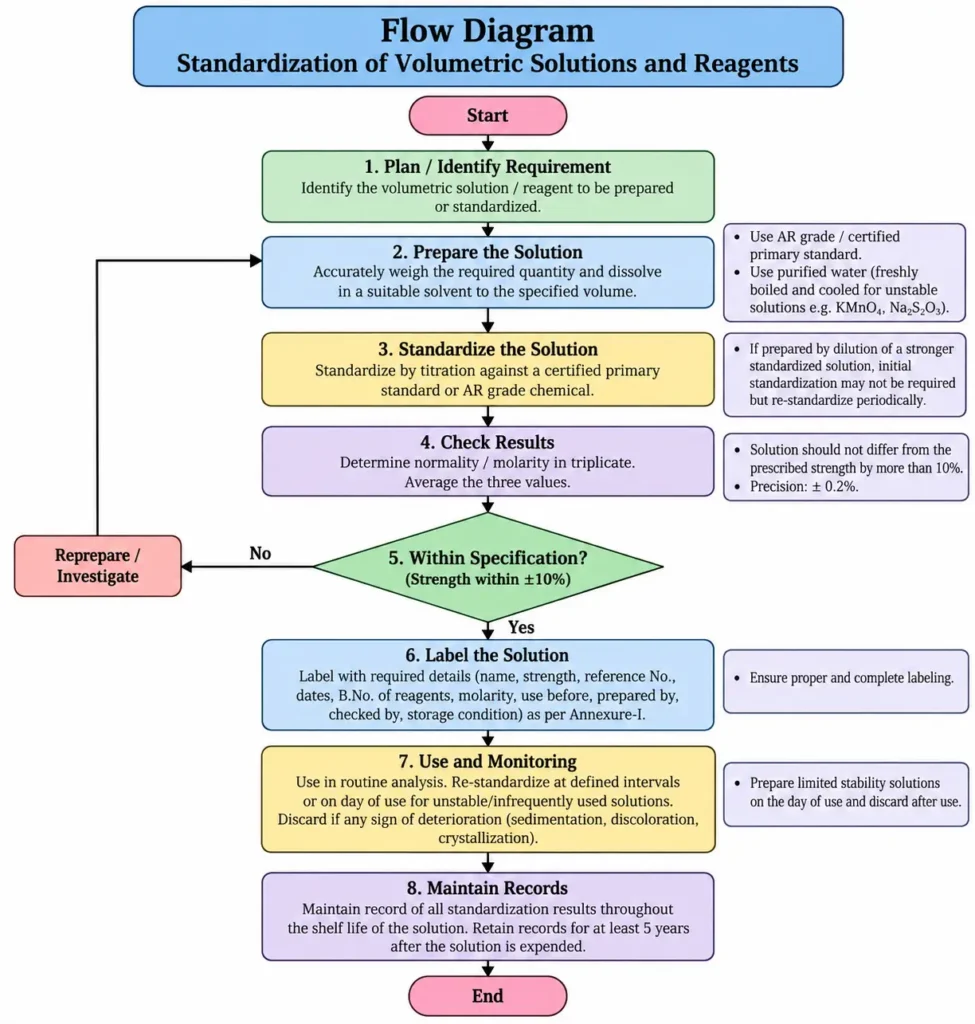
If the solution meets the prescribed strength requirement, it is properly labeled with its name, strength, preparation and standardization dates, reagent batch numbers, molarity, use-before date, and responsible personnel. Solutions are periodically re-standardized based on stability and frequency of use. Unstable or deteriorated solutions are discarded. Standardization results are maintained throughout the solution’s shelf life, with records retained for at least five years after the solution is expended.
2. Brainstorming for SOP Failure:
The brainstorming diagram presents possible reasons why an SOP may not be followed in a pharmaceutical Quality Control environment. Using students, sticky notes, and a training-room setting, it highlights potential factors such as lack of SOP awareness, inadequate training, unclear procedures, failure to read the SOP, absence of practical demonstration, workload pressure, insufficient supervision, poor communication, unavailable equipment or reagents, weak compliance monitoring, and inadequate management support.
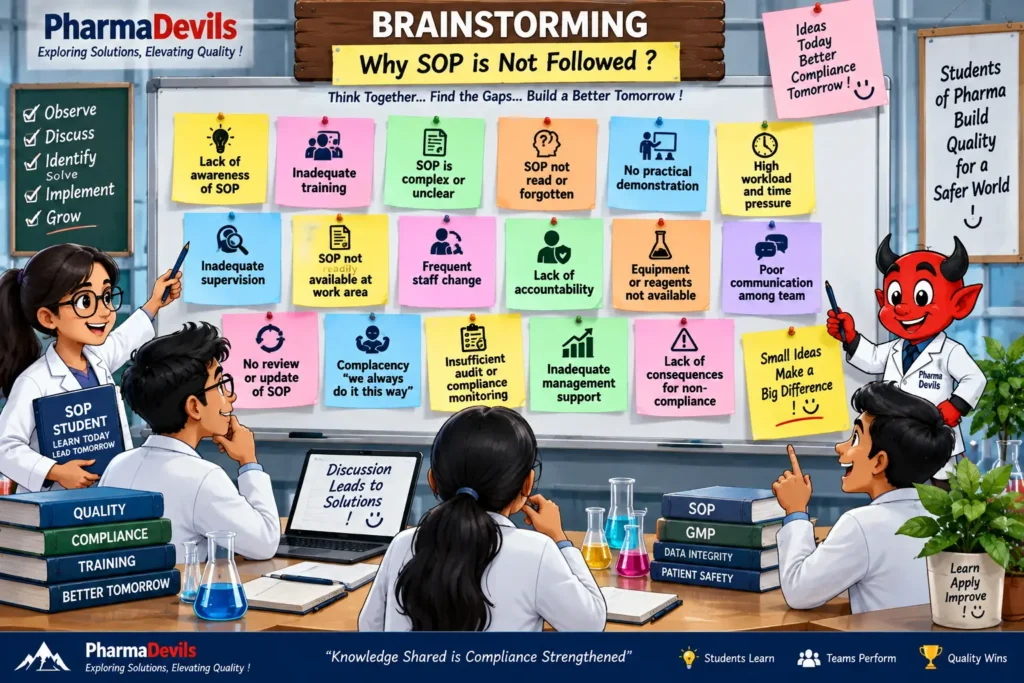
For this SOP, failure to follow requirements could affect the correct preparation, standardization, labeling, re-standardization, and control of volumetric solutions and reagents. The SOP specifically defines standardization requirements, labeling details, and periodic control of solutions. It also requires formal training of Quality Control personnel. The brainstorming exercise helps the team collect multiple potential causes before proceeding to detailed root-cause analysis and CAPA.The causes shown in the diagram are illustrative brainstorming possibilities and are not documented as actual failures in the SOP.
3. 5-Why Analysis for SOP Failure:
The 5-Why Analysis diagram presents an illustrative root-cause investigation for failure to follow the SOP, using a Mussoorie mountain-climbing theme to show how each “Why” leads deeper toward the underlying cause. The analysis begins with personnel not performing the activity according to the approved procedure, followed by lack of awareness or forgotten steps. It then explores inadequate or irregular training, weak planning of the training program, and insufficient management follow-up or assessment of training effectiveness.
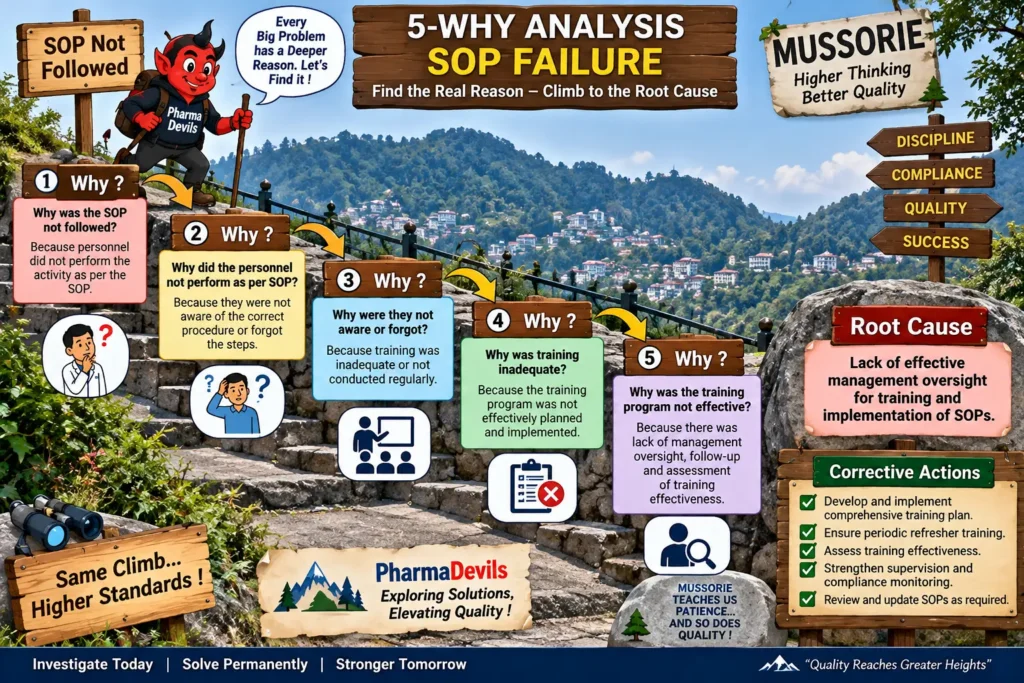
The resulting potential root cause is inadequate management oversight of SOP training and implementation. Corrective actions include establishing a structured training plan, conducting periodic refresher training, evaluating training effectiveness, strengthening supervision and compliance monitoring, and reviewing SOPs when required. The source SOP assigns defined QC responsibilities and includes formal training requirements for QC personnel.This 5-Why chain is an RCA example for SOP failure; the specific causes are not stated as actual failures in the SOP itself.
4. Fishbone Analysis for SOP Failure:
The Fishbone Analysis diagram identifies potential causes that may contribute to failure in following the SOP for standardization of volumetric solutions and reagents. The possible causes are grouped into major categories such as Man, Machine, Method, Material, Measurement, Environment, and Management. These categories help the investigation team systematically examine issues such as inadequate training, unclear procedures, unsuitable or unavailable equipment, incorrect reagents, weak monitoring, workplace distractions, and insufficient supervision.
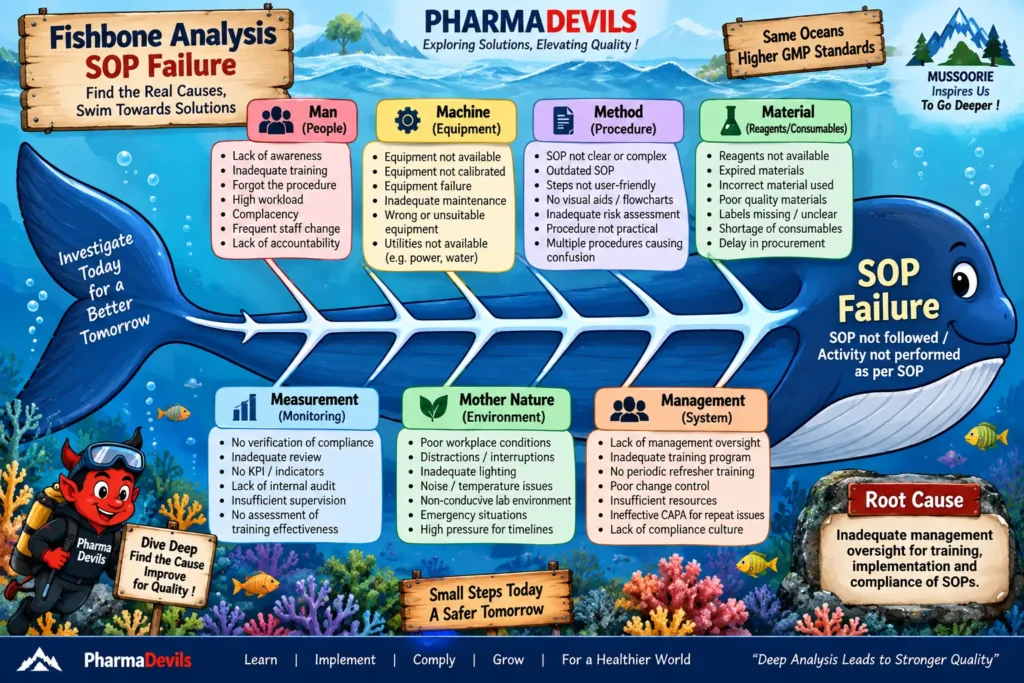
For this SOP, particular attention should be given to correct preparation and standardization, appropriate use of certified primary standards or AR-grade chemicals, triplicate determination of molarity/normality, proper labeling, periodic re-standardization, and disposal of deteriorated solutions.The fishbone diagram is therefore useful as a root-cause investigation tool to identify why an SOP requirement was not followed and to develop suitable CAPA actions such as retraining, improved supervision, stronger compliance monitoring, and better procedural controls.The specific causes shown in the fishbone diagram are illustrative RCA possibilities; they are not stated as actual failures in the SOP.
5. Fault Tree Analysis for SOP Failure:
The Fault Tree Analysis (FTA) diagram presents a structured method for investigating an SOP failure, with the top event defined as the activity not being performed according to the approved procedure. The diagram breaks the failure into major contributing branches such as personnel error, procedural issues, resource-related problems, and management/system weaknesses.
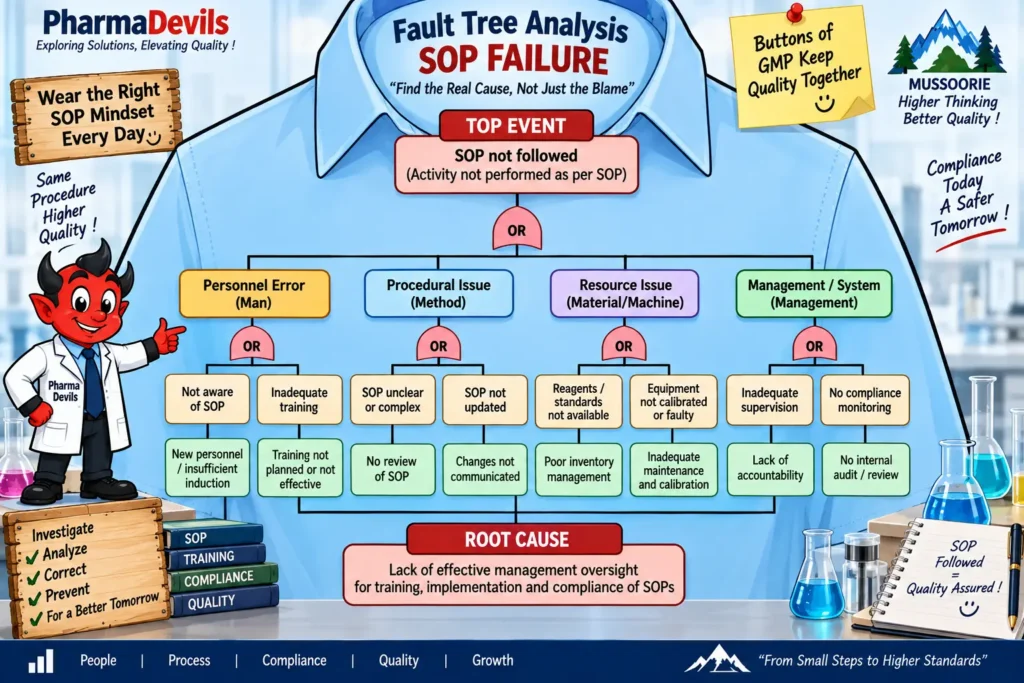
Possible contributing causes include inadequate training, lack of SOP awareness, unclear or outdated procedures, unavailable reagents or standards, faulty or uncalibrated equipment, insufficient supervision, and weak compliance monitoring. For this SOP, these potential failures could affect the correct preparation, standardization, labeling, use, and documentation of volumetric solutions. The SOP itself requires standardization using suitable standards, triplicate determination of molarity/normality, appropriate labeling, periodic re-standardization, and proper record maintenance.FTA helps trace the top event back to underlying system causes and supports development of focused CAPA, such as improved training, stronger supervision, better resource control, and routine compliance verification.The failure causes shown in the diagram are illustrative investigation pathways and are not documented as actual failures in the SOP.
Questions & Answers – Standardization of Volumetric Solutions and Reagents
- What is the objective of this SOP?
To establish a procedure for the standardization of volumetric solutions and reagents used in the Quality Control laboratory. - Who is responsible for implementation of this SOP?
Chemist-QC, Assistant Manager-QC, and Head-QA/QC are responsible for the activities described in the SOP. - How should volumetric solutions be standardized?
They should be standardized by titration against a certified primary standard or an AR-grade chemical. - How is a volumetric solution prepared?
A suitable quantity is accurately weighed and dissolved with the specified solvent to produce the required volume. - Does a solution prepared by dilution of a stronger standardized solution require initial standardization?
According to the SOP, initial standardization is not required, but such solutions must be re-standardized periodically during use. - When should infrequently used or unstable solutions be standardized?
Solutions not used frequently, or whose strength changes by more than 1% in one week, should be standardized on the day of use. - When should a volumetric solution be discarded?
Solutions should be discarded if they show evidence of deterioration such as sedimentation, discoloration, or crystallization. Limited-stability solutions should also be discarded after completion of analysis. - What information should be present on the volumetric solution label?
The label should include the solution name, strength, reference, preparation date, standardization date, reagent batch numbers, molarity, use-before date, and signatures of the preparer and checker. - How many determinations are required for normality or molarity?
Normality or molarity should be determined in triplicate, and the average of the three values may be taken. - What water should be used for preparing volumetric solutions?
Water complying with the requirements of Purified Water should be used unless otherwise specified. For unstable solutions such as potassium permanganate or sodium thiosulphate, freshly boiled and cooled water should be used. - How should a blank determination be performed?
The same quantities of the same reagents should be treated in the same manner as the test preparation, but without the substance being examined. - How long should volumetric solution records be retained?
Records should be maintained throughout the shelf life of the solution and retained for at least five years after the solution is expended. - What is the frequency specified in the SOP?
The frequency is monthly or as and when required. - Who should receive training on this SOP?
Quality Control personnel are the trainees, and the Executive–Quality Control is identified as the trainer. The training period is one day. - Which annexures are provided with the SOP?
Annexure-I is for Volumetric Solution, and Annexure-II is for the Volumetric Solution A.R. No. Register.
Reference Guidelines:
- Indian Pharmacopoeia (IP) 2026 – Indian Pharmacopoeia Commission (IPC)
Follow the applicable pharmacopoeial requirements for reagents, volumetric solutions, titrations, preparation, and standardization used in the analytical method. IP 2026 is the current edition listed by IPC. (Indian Pharmacopoeia Commission)
Indian Pharmacopoeia – IPC - European Pharmacopoeia (Ph. Eur.), General Chapter 4.2.2 – Volumetric Solutions
EDQM specifies that volumetric solutions should be standardized according to Chapter 4.2.2; where an electrochemical endpoint is used, standardization should use the same procedure and an appropriate medium. (EDQM FAQs)
EDQM – Standardisation of Volumetric Solutions - USP General Chapter <541> – Titrimetry
Provides principles for direct and residual titrations using appropriately standardized titrant solutions and calculation using normality/molarity factors. (USP)
United States Pharmacopeia – USP - WHO TRS 1052, Annex 4 – Good Practices for Pharmaceutical Quality Control Laboratories (2024)
Applicable to control of laboratory reagents and volumetric solutions, including preparation, labeling, standardization information, suitability during use, and appropriate water quality. (World Health Organization)
WHO Good Practices for Pharmaceutical Quality Control Laboratories