







1. Brief Description:
This Standard Operating Procedure describes the process for Analytical Method Validation in the Quality Control Department to ensure that analytical methods provide accurate, reliable, and consistent results for pharmaceutical products. It applies to transferred methods, pharmacopoeial methods, standard chromatographic methods, and in-house developed analytical methods. The SOP defines the responsibilities of QC personnel for preparation, checking, approval, protocol development, execution, and evaluation of analytical method validation activities. It covers important validation parameters such as specificity, precision, linearity and range, accuracy, ruggedness, robustness, Limit of Detection (LOD), and Limit of Quantification (LOQ), depending on the type and purpose of the analytical method. The procedure also explains experimental designs, system suitability requirements, acceptance criteria, recovery studies, and intermediate precision. Validation results are documented through approved protocols, data sheets, summary reports, conclusions, and final QA/QC approval before routine laboratory implementation.
Skip to PDF content2. Flow Diagram:
The flow diagram shows the step-by-step process of Analytical Method Validation followed in the Quality Control Department. It starts with identifying the type of analytical method, such as transferred, pharmacopoeial, or in-house developed method. Based on the method category, suitable validation parameters are selected, including specificity, precision, linearity and range, accuracy, ruggedness, robustness, LOD, and LOQ.
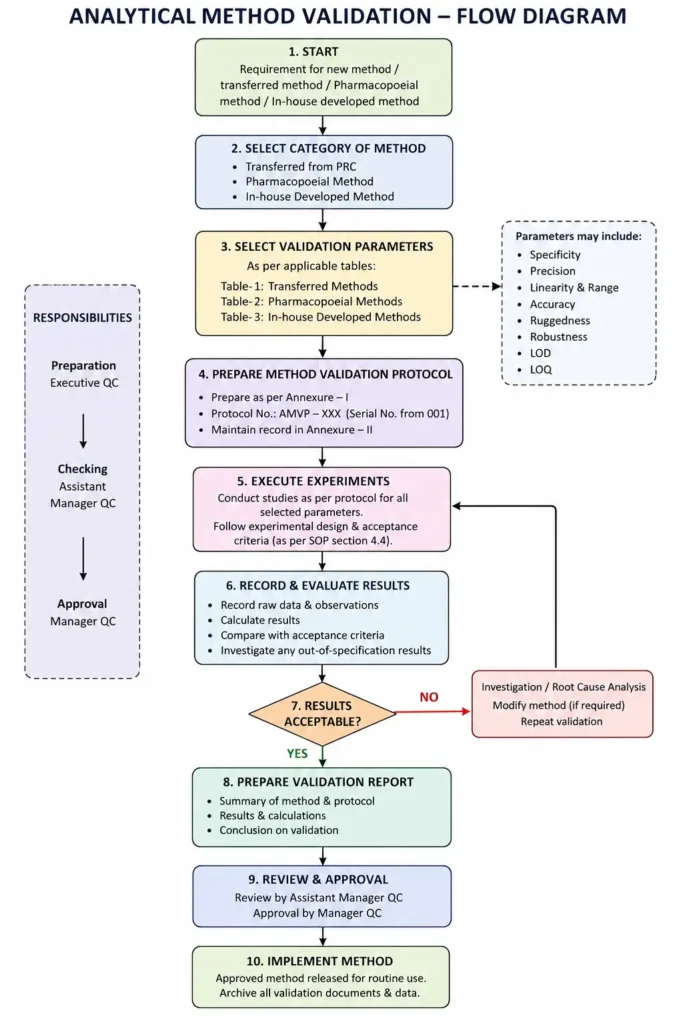
A validation protocol is then prepared, approved, and the required experiments are performed according to defined acceptance criteria. The results and observations are recorded and evaluated. If the results are acceptable, a validation summary report is prepared and reviewed by QC and QA. Finally, the validated analytical method is approved for routine laboratory use. This systematic approach helps ensure that analytical results are accurate, reliable, consistent, and suitable for their intended purpose.
3. Critical Process Parameters (CPP) & Critical Quality Attributes (CQA):
The SOP does not specifically use the terms CPP and CQA. However, for Analytical Method Validation, the critical method/validation parameters can be treated as CPP-like controls, while the expected analytical performance characteristics can be treated as CQA-like outcomes.
| Critical Process / Method Parameters | Critical Quality Attributes | Typical Requirement from SOP |
|---|---|---|
| Mobile phase composition | Robustness | Deliberate minor variation evaluated |
| Mobile phase / buffer pH | Robustness | Variation of ±0.2 pH |
| Column oven temperature | Method consistency | Variation of ±2°C |
| Mobile phase flow rate | Robustness | Variation of ±0.2 mL/min |
| Standard and sample preparation | Accuracy | Assay recovery 98–102% |
| Number of replicate injections | Precision | Assay %RSD NMT 2.0% |
| Concentration levels | Linearity & Range | Minimum 5 levels, generally 50–150% |
| Detector response / peak area | Linearity | Correlation coefficient NLT 0.99 |
| Analyst, day, instrument and column | Intermediate Precision / Ruggedness | Results should remain reproducible under normal variations |
| Blank, placebo and impurity interference | Specificity | No significant interference at analyte retention time |
| Theoretical plates | System Suitability | NLT 2000 |
| Tailing factor | Peak quality | NMT 2.0 |
| Resolution | Separation quality | NLT 1.0 |
| Signal-to-noise ratio | LOQ | S/N ≥10 |
| Signal-to-noise ratio | LOD | S/N ≥3 |
Key Critical Quality Attributes
The main quality attributes demonstrating that the analytical method is suitable are specificity, accuracy, precision, linearity and range, reproducibility/intermediate precision, robustness, LOD and LOQ. These characteristics collectively demonstrate that the method produces reliable, consistent and suitable analytical results for its intended laboratory use.
4. Impact Assessment:
Analytical Method Validation has a direct impact on the reliability of laboratory results and the quality assessment of pharmaceutical products. The SOP is designed to ensure that analytical methods generate accurate, reliable, and consistent data and are suitable for their intended laboratory use. Validation parameters such as specificity, precision, linearity, accuracy, ruggedness, robustness, LOD, and LOQ help confirm that the method performs properly under defined conditions.
If validation is not performed correctly, laboratory results may become inaccurate or inconsistent, which can affect assay, impurities, residual solvent, and cleaning validation results. This may lead to incorrect product release decisions, repeated testing, investigations, regulatory observations, and possible impact on patient safety. Proper protocol preparation, documentation, review, and approval by QC and QA help maintain data reliability and regulatory compliance. Overall, effective analytical method validation reduces laboratory risk and supports consistent product quality.
5. Questions & Answers:
Q1. What is the purpose of Analytical Method Validation?
Answer: The purpose is to ensure that analytical methods provide accurate, reliable, and consistent results for the assessment of pharmaceutical products.
Q2. Which analytical methods are covered under this SOP?
Answer: The SOP covers transferred methods, pharmacopoeial methods, standard chromatographic methods, and in-house developed analytical methods used in the Quality Control Department.
Q3. Who is responsible for preparation, checking, and approval of the SOP?
Answer: Executive QC prepares it, Assistant Manager QC checks it, and Manager QC approves it.
Q4. What are the main validation parameters?
Answer: Depending on the method category, parameters may include specificity, precision, linearity and range, accuracy, ruggedness, robustness, LOD, and LOQ.
Q5. What is specificity in analytical method validation?
Answer: Specificity demonstrates that the method can measure the required analyte without significant interference from diluent, blank, placebo, swab, or impurities.
Q6. What is the acceptance criterion for assay accuracy?
Answer: For assay, the recovery should generally be between 98% and 102%.
Q7. What is the acceptance criterion for assay precision?
Answer: The %RSD for assay should be NMT 2.0%.
Q8. How is linearity evaluated?
Answer: A minimum of five concentration levels between approximately 50% and 150% of the working concentration are evaluated, and the linearity coefficient should be NLT 0.99.
Q9. What is intermediate precision?
Answer: Intermediate precision checks method reproducibility under variations such as different analyst, day, instrument, or column of the same make.
Q10. What is robustness?
Answer: Robustness evaluates the effect of small deliberate changes in critical analytical conditions such as mobile phase composition, pH, column temperature, and flow rate.
Q11. What is the acceptance criterion for LOQ?
Answer: The concentration is acceptable as LOQ when the signal-to-noise ratio is equal to or greater than 10.
Q12. What is the acceptance criterion for LOD?
Answer: The concentration is acceptable as LOD when the signal-to-noise ratio is equal to or greater than 3.
Q13. When should an analytical method be revalidated?
Answer: Revalidation is required when there is a change in the analytical method, a change in qualitative composition, or when a method is transferred from one site to another as described in the protocol.
Q14. Who develops the Analytical Method Validation Protocol?
Answer: The Quality Control Department develops the protocol in coordination with the Quality Assurance Department.
Q15. What happens after completion of validation studies?
Answer: Results are documented in data sheets, summarized in the validation report, reviewed, and finally approved by QC and QA before the method is accepted for routine use.