






1. Introduction – SOP for Artwork Review, Approval, Revision & Destruction Authorization:
The SOP for Artwork Review, Approval, Revision & Destruction Authorization establishes a controlled system for managing pharmaceutical packaging artwork throughout its lifecycle. Its purpose is to ensure that artwork is properly checked, verified, approved, revised, issued, retrieved, and destroyed in accordance with applicable requirements of the Drugs & Cosmetics Act, 1940 and rules thereunder. The procedure defines responsibilities for Quality Assurance, Quality Control, Production, and Packaging Development for artwork preparation, review, approval, and control. The SOP covers new artwork approval, print proofs and shade-card control, artwork revision through change control, and management of obsolete artwork. Revised artwork is evaluated for its impact, while old artwork materials are controlled to prevent unintended use or mixing with newly approved materials. It also provides documented systems for issuance and retrieval of approved shade cards and artwork, helping maintain traceability, regulatory compliance, packaging accuracy, and effective document control throughout the artwork lifecycle.
Skip to PDF content2. Flow Diagram – SOP for Artwork Review, Approval, Revision & Destruction Authorization:
The flow diagram describes the controlled sequence for preparation, review, approval, revision, issuance, and destruction of pharmaceutical artwork. The process begins with an artwork request from Production, followed by development of the text matter and packing-material dimensions by Production/Packaging Development. Packaging Development then prepares the artwork, which is checked and reviewed by QA, QC, and Production before further processing.
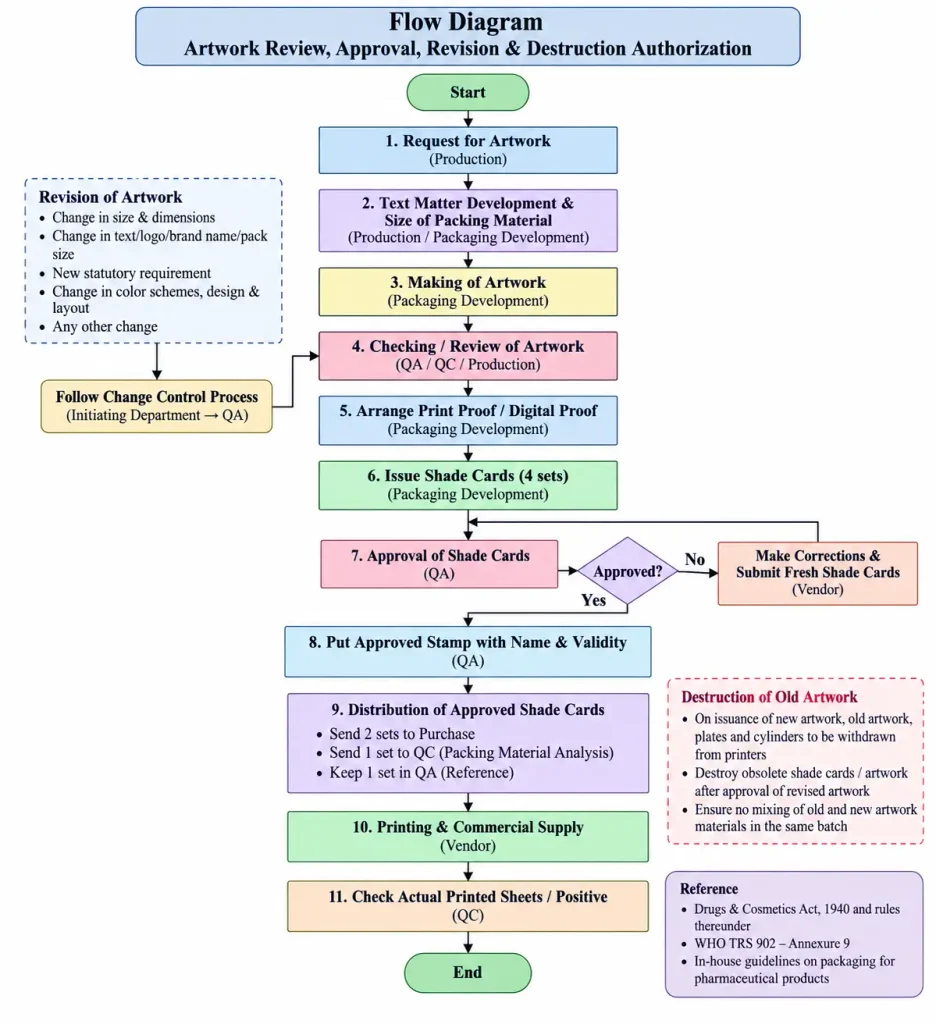
After review, the print proof or digital proof is arranged and shade cards are prepared for approval. QA approves the shade cards, applies the approval status with validity, and distributes controlled copies to the concerned departments. Rejected shade cards are corrected by the vendor and resubmitted for approval. The SOP specifies a two-year validity for shade cards and requires Production and QC checking, with final approval by QA. Whenever artwork is revised because of changes in size, text, logo, brand name, pack size, statutory requirements, colour scheme, design, or layout, the change is processed through the change-control system and assessed by QA. Obsolete artwork and shade cards are retrieved and destroyed, and old and new artwork materials are not permitted to be mixed within the same batch.
3. Benefits of Following SOP – Artwork Review, Approval, Revision & Destruction Authorization:
Following the SOP for Artwork Review, Approval, Revision & Destruction Authorization provides a controlled and systematic approach for managing pharmaceutical packaging artwork. It ensures that artwork is checked and verified by the concerned departments before final approval, helping maintain correct product information, pack details, statutory requirements, and approved design elements. The SOP clearly defines responsibilities for QA, QC, Production, Packaging Development, and vendors, which improves accountability and reduces the possibility of errors or communication gaps. Approved shade cards and artwork copies are controlled and maintained for reference, while rejected or revised artwork is corrected and re-approved before use.
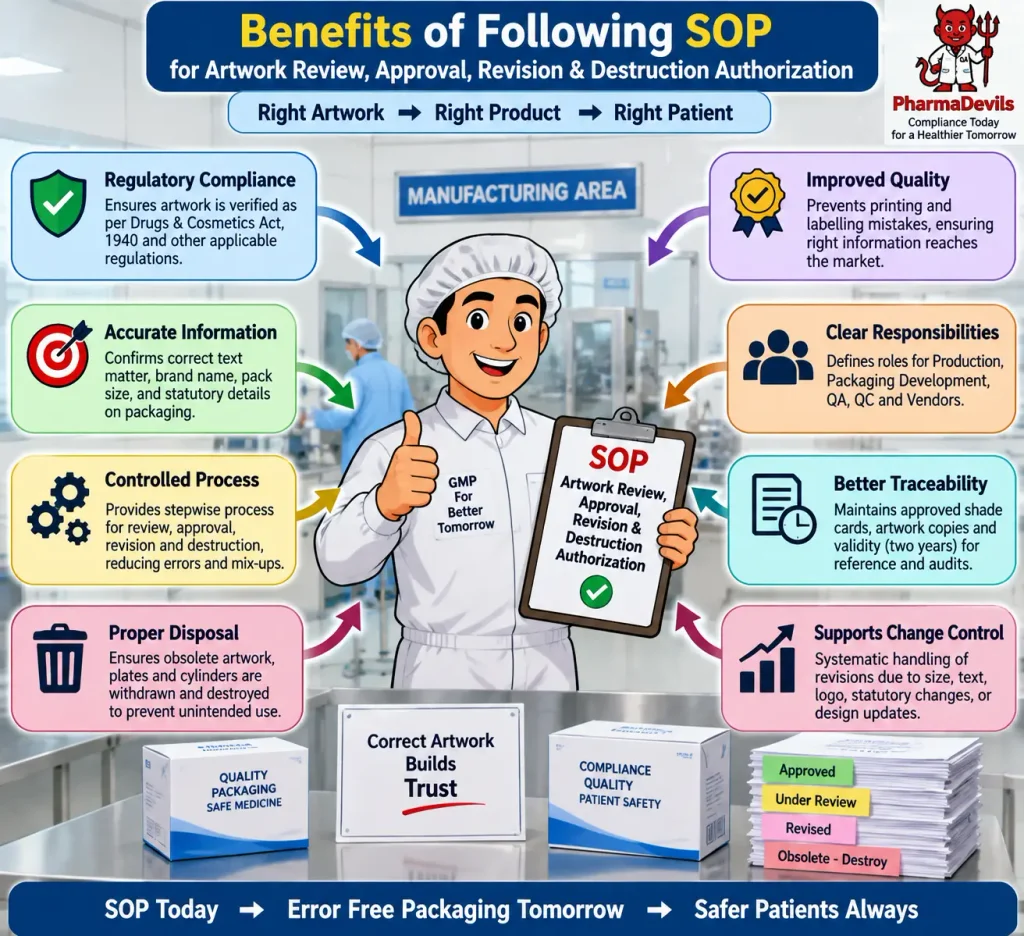
Following this SOP also strengthens change control and traceability. Any artwork revision is formally assessed through the change-control system, and obsolete artwork, plates, cylinders, and shade cards are retrieved and destroyed. This helps prevent accidental use of outdated artwork and avoids mixing old and new artwork materials within the same batch. Overall, effective implementation of the SOP supports regulatory compliance, packaging accuracy, document control, traceability, accountability, and consistent pharmaceutical product presentation.
4. Brainstorming for SOP Failure – Artwork Review, Approval, Revision & Destruction Authorization:
Brainstorming for failure of the SOP for Artwork Review, Approval, Revision & Destruction Authorization helps identify possible reasons why the artwork-control system may not be followed effectively. The discussion should involve Production, Packaging Development, QA, QC, and vendors, because these functions participate in artwork preparation, checking, approval, shade-card control, and revision activities.Potential causes of SOP failure include inadequate review of artwork and text matter, incorrect pack size or logo, poor communication between departments, vendor submission of incorrect print proofs or shade cards, weak recording and traceability, delayed approvals, and unclear responsibilities. Failure to process artwork changes through change control can also result in uncontrolled revisions.
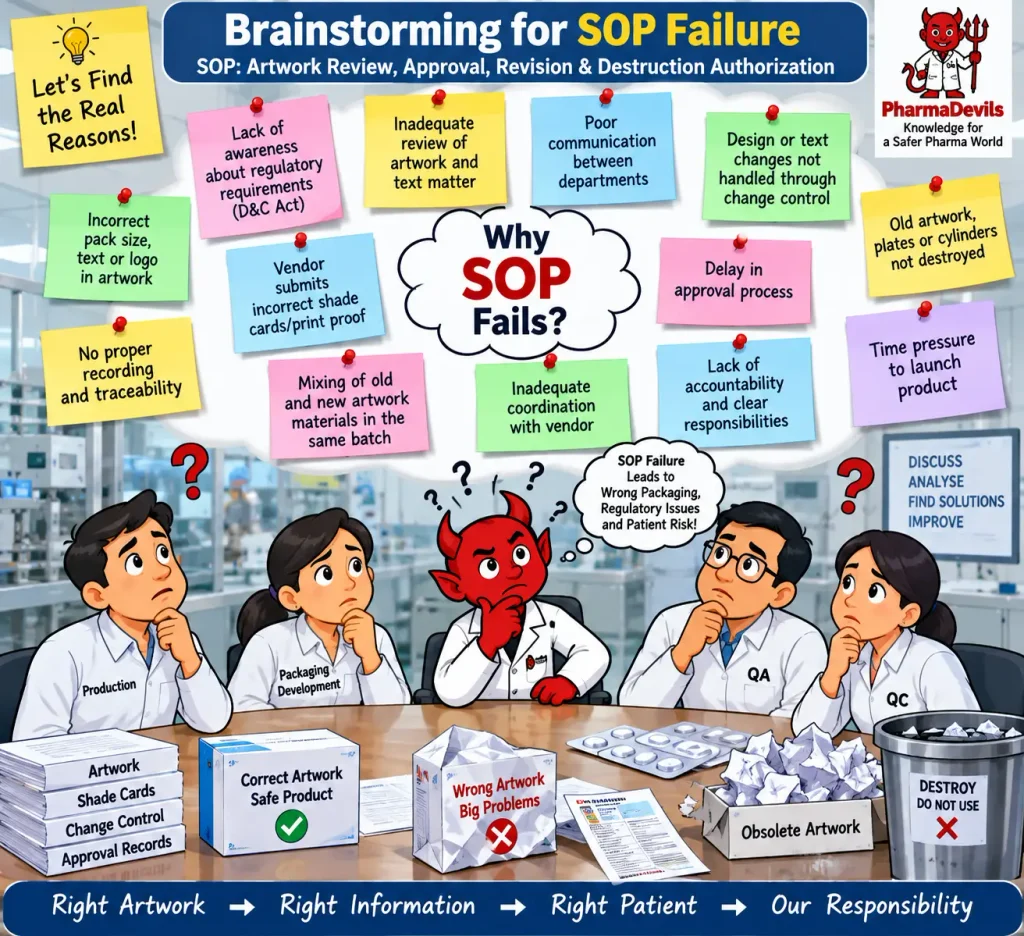
Another important risk is failure to retrieve and destroy obsolete artwork, shade cards, printing plates, or cylinders. Mixing old and new artwork materials may lead to packaging errors, regulatory non-compliance, product mix-ups, and incorrect information reaching the market. Effective brainstorming helps identify these weaknesses and supports appropriate corrective and preventive actions.
5. 5-Why Analysis for SOP Failure – Artwork Review, Approval, Revision & Destruction Authorization:
The 5-Why Analysis helps determine the underlying reason for failure of the SOP for Artwork Review, Approval, Revision & Destruction Authorization. The analysis may begin with the problem of incorrect or obsolete artwork being used during packaging. The first reason may be that the revised artwork was not properly implemented. This can lead to the next question of why the revised artwork was not communicated or distributed to all concerned departments.
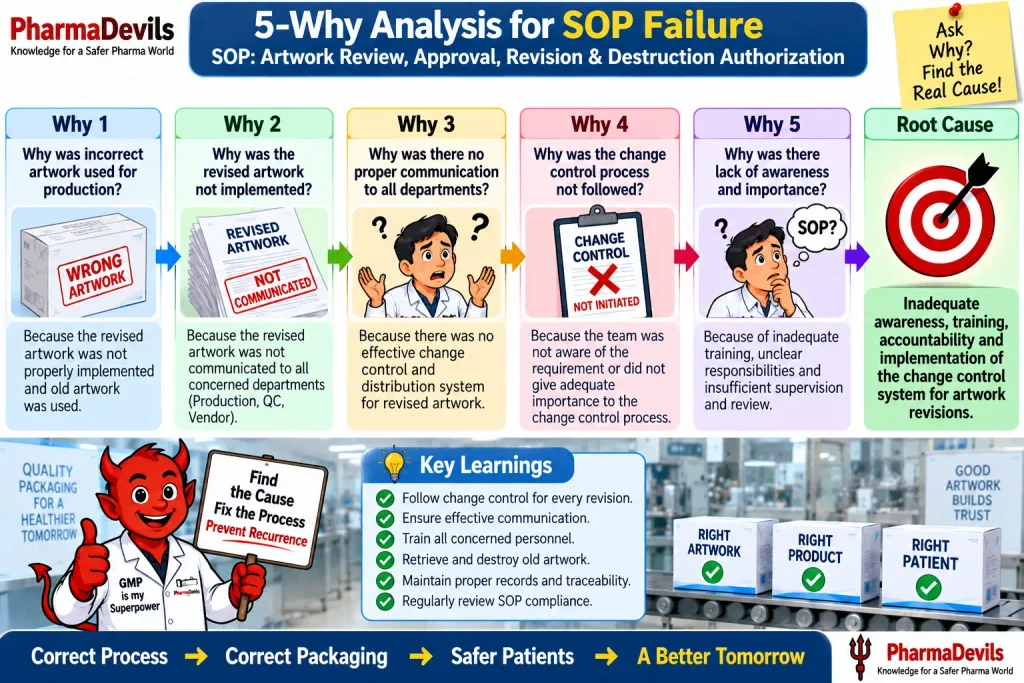
Further questioning may identify weaknesses in the change-control process, departmental coordination, training, responsibility, or supervision. The SOP specifically requires artwork changes to be routed through change control and assessed by QA before implementation. The analysis should also consider failure to retrieve obsolete artwork, shade cards, plates, or cylinders before new artwork is issued. The probable root cause may therefore be inadequate implementation of change control, communication, training, accountability, and obsolete-artwork control, leading to incorrect artwork use and recurrence of packaging errors.
6. Fishbone Analysis for SOP Failure – Artwork Review, Approval, Revision & Destruction Authorization:
The Fishbone Analysis identifies the major potential causes that can lead to failure of the SOP for Artwork Review, Approval, Revision & Destruction Authorization. The causes are grouped into categories such as Manpower, Method, Material, System/Equipment, Measurement/Records, and Environment/Communication. Under Manpower, possible causes include inadequate training, lack of awareness of regulatory requirements, unclear responsibilities, and weak accountability. Under Method, failures may arise from not following change control, inadequate artwork review, improper approval flow, or failure to retrieve obsolete artwork. The SOP specifically requires artwork changes to be routed through change control and old copies to be retrieved before new artwork is issued.
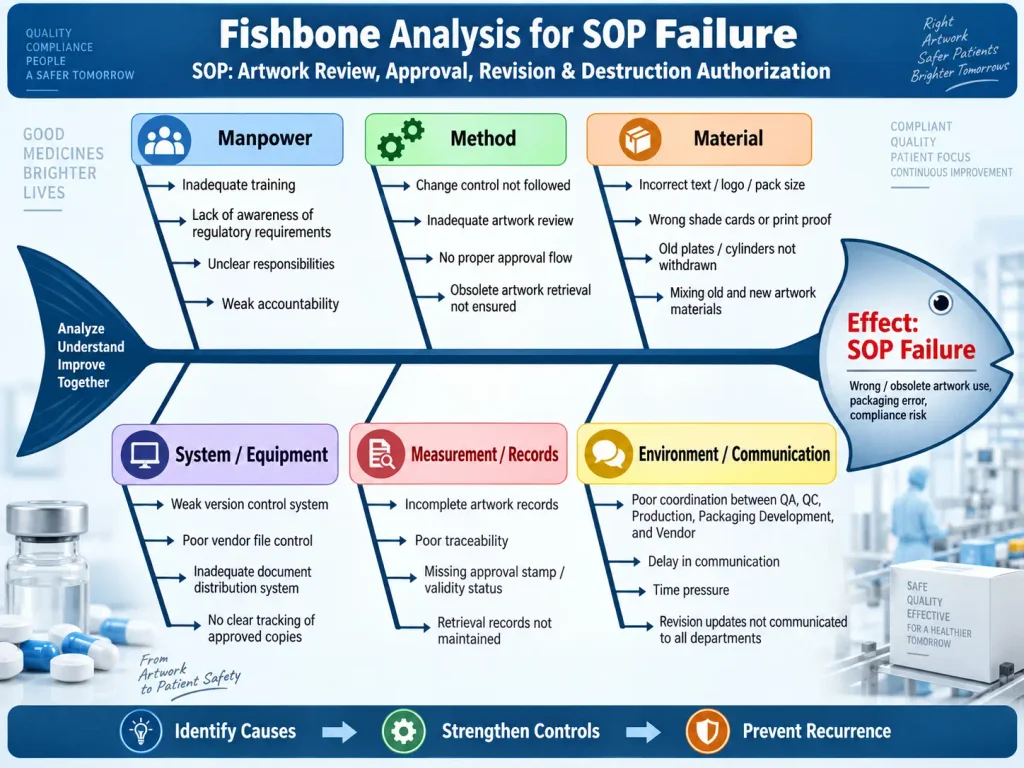
The Material category may include incorrect text, logo, pack size, wrong shade cards or print proofs, and mixing of old and new artwork. The SOP clearly states that old artwork material shall not be mixed with new artwork material in the same batch. The Records and Communication branches highlight incomplete documentation, poor traceability, delayed communication, and weak coordination among QA, QC, Production, Packaging Development, and vendors. Overall, the fishbone analysis helps organize likely causes systematically so that appropriate corrective and preventive actions can be identified to prevent recurrence of artwork-related SOP failures.
7. Fault Tree Analysis for SOP Failure – Artwork Review, Approval, Revision & Destruction Authorization:
The Fault Tree Analysis (FTA) evaluates how different failures can combine and result in the top event: incorrect or obsolete artwork being used during pharmaceutical packaging. The analysis breaks the problem into major contributing branches such as revised artwork not being implemented, obsolete artwork not being controlled, incorrect approval practices, and communication failure. Possible causes include failure to initiate or follow change control, departments not being informed about revised artwork, inadequate training, poor artwork review, improper shade-card approval, delayed or bypassed approvals, weak vendor communication, and lack of coordination among QA, QC, Production, and Packaging Development. The SOP requires artwork changes to be routed through the change-control system and assessed by QA before implementation.
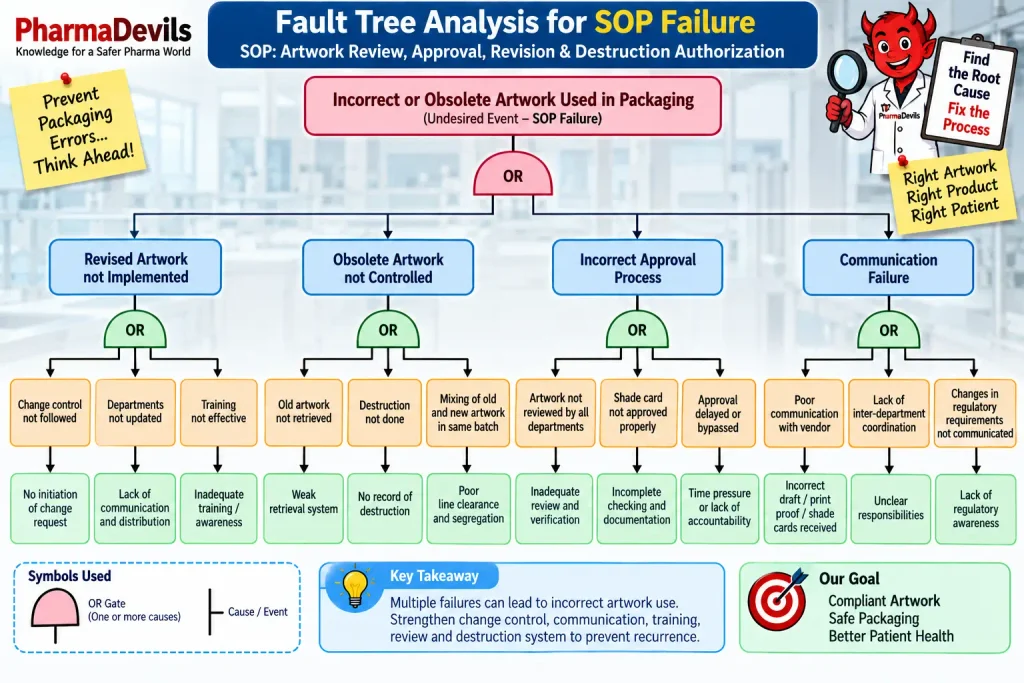
The analysis also highlights risks related to obsolete artwork. Old artwork copies must be retrieved before new ones are issued, and revised artwork requires control of old plates, cylinders, positives, negatives, and related materials. FTA therefore helps identify combinations of system weaknesses that can lead to SOP failure and supports targeted corrective actions to strengthen change control, approval, communication, training, retrieval, destruction, and traceability of artwork.
8. Impact Assessment – SOP for Artwork Review, Approval, Revision & Destruction Authorization:
The Impact Assessment shows the possible consequences when the SOP for Artwork Review, Approval, Revision & Destruction Authorization is not followed effectively. Failure in artwork control may result in use of incorrect, unapproved, or obsolete packaging artwork, which can affect product information, labeling accuracy, and overall packaging compliance. The major impacts include patient safety risk, regulatory non-compliance, financial loss, production delays, damage to company reputation, documentation deficiencies, increased waste, and additional employee workload. The SOP requires artwork changes to be controlled through change control, with QA assessment before implementation.
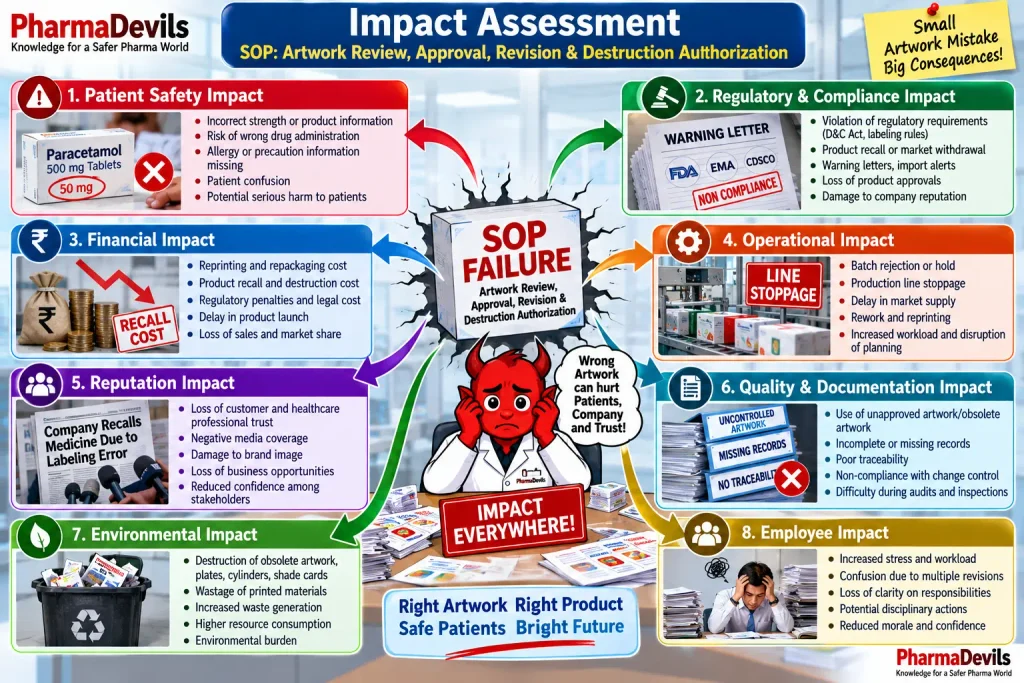
It also requires old artwork copies to be retrieved before new versions are issued and obsolete plates, cylinders, shade cards, and related materials to be controlled and destroyed. Therefore, effective implementation of the SOP helps prevent artwork mix-ups, supports traceability, improves packaging accuracy, strengthens regulatory compliance, and reduces the likelihood of batch rejection, rework, recall, or market complaints.
9. Heat Map Analysis – SOP for Artwork Review, Approval, Revision & Destruction Authorization:
The Heat Map Analysis evaluates the potential risks associated with failure of the SOP for Artwork Review, Approval, Revision & Destruction Authorization by considering the likelihood of occurrence and the severity of impact. The major risks include use of obsolete or incorrect artwork, failure to follow change control, inadequate artwork review, poor interdepartmental communication, improper control of old artwork, incorrect shade-card approval, insufficient training, weak vendor control, incomplete records, and delayed approvals. The highest-risk areas are the use of obsolete/incorrect artwork and failure to follow change control, because these failures may lead to incorrect labeling, uncontrolled revisions, regulatory non-compliance, product complaints, or recall. The SOP requires artwork revisions to be processed through change control and assessed by QA before implementation.
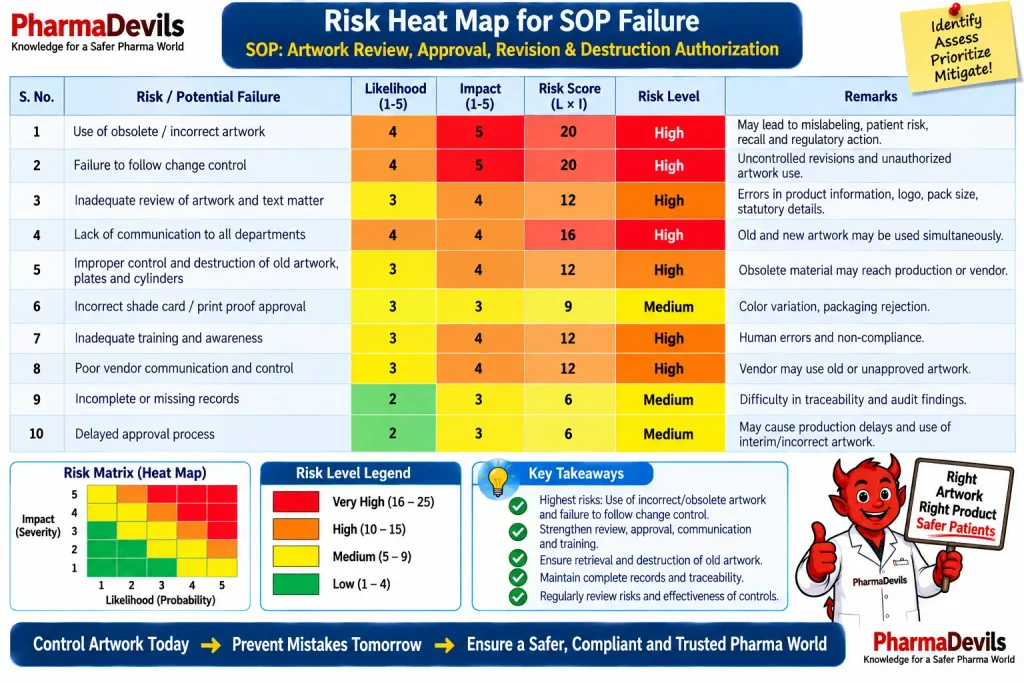
The heat map also highlights the importance of retrieving obsolete artwork before issuing revised versions and preventing old and new artwork materials from being mixed within the same batch. Overall, the heat map helps identify, prioritize, and control artwork-related risks, enabling the organization to focus corrective and preventive actions on high-risk areas and strengthen packaging compliance, traceability, and patient safety.
10. Pareto Chart Analysis – SOP for Artwork Review, Approval, Revision & Destruction Authorization:
The Pareto Chart Analysis helps identify the major causes contributing to failure of the SOP for Artwork Review, Approval, Revision & Destruction Authorization. The chart ranks possible failure causes according to frequency and uses a cumulative percentage line to highlight the “vital few” causes that contribute most to the overall problem. In the illustrated analysis, the major contributors are use of obsolete or incorrect artwork, failure to follow change control, and inadequate artwork review. These issues are consistent with the SOP, which requires proper artwork checking and review by QA/QC/Production, formal control of revisions, and QA assessment through the change-control process.
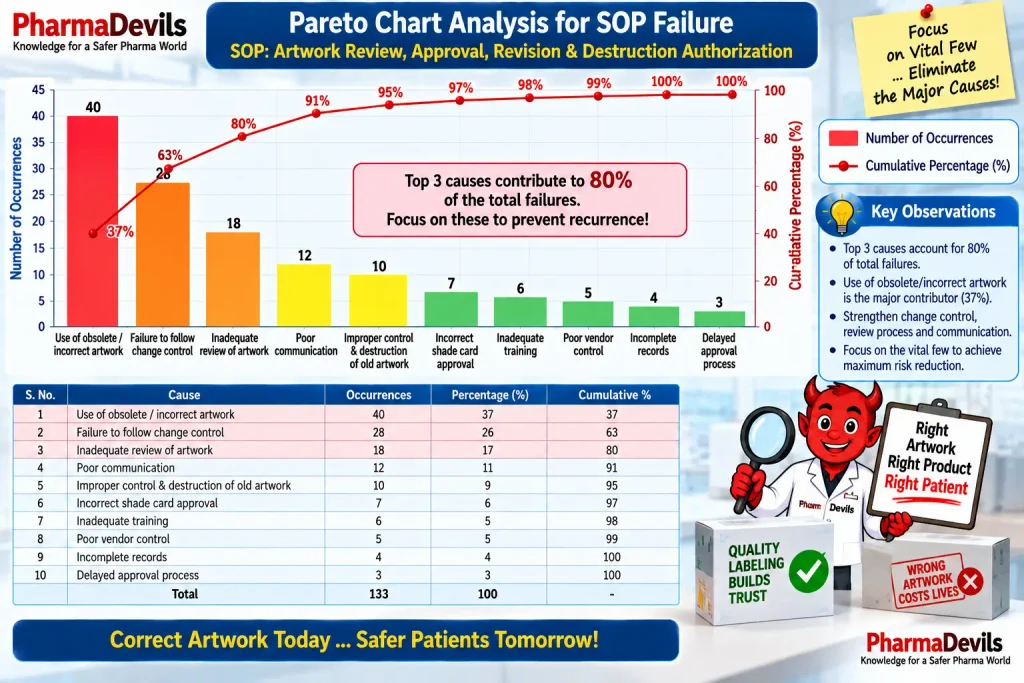
Other contributing factors may include poor communication, improper control and destruction of old artwork, incorrect shade-card approval, inadequate training, weak vendor control, incomplete records, and delayed approval. The SOP specifically requires obsolete copies to be retrieved before new artwork is issued and old artwork-related materials to be controlled and destroyed. Overall, the Pareto analysis helps management focus corrective and preventive actions on the few dominant causes first, thereby improving artwork control, reducing packaging errors, and strengthening compliance.
Questions & Answers – SOP for Artwork Review, Approval, Revision & Destruction Authorization:
Q1. What is the objective of this SOP?
Answer: The objective is to establish a system for handling artwork review, approval, revision, and destruction authorization so that artwork is checked and verified in accordance with the Drugs & Cosmetics Act, 1940 and applicable rules.
Q2. What is the scope of this SOP?
Answer: The SOP applies to artwork review, approval, revision, and destruction authorization activities.
Q3. Who is responsible for execution of the SOP?
Answer: Chemist/Executive-QA is responsible for execution of the SOP.
Q4. Who is responsible for review and effective implementation of the SOP?
Answer: Assistant Manager-QA is responsible for review and effective implementation.
Q5. Who is responsible for revision and destruction of artwork at the vendor end?
Answer: The Packaging Development Head is responsible for revision and destruction of artwork at the vendor end.
Q6. Which departments are involved in checking and reviewing artwork?
Answer: QA, QC, and Production are involved in artwork checking and review.
Q7. How is approval of new artwork given?
Answer: Approval of new artwork is given through email, and approved artwork is maintained by QA.
Q8. What is done after receipt of approved artwork?
Answer: Packaging Development forwards the approved artwork in non-editable format along with the approved PDF to the vendor.
Q9. How many sets of shade cards are arranged for approval?
Answer: Packaging Development arranges four sets of shade cards for approval.
Q10. What happens if a shade card is rejected?
Answer: The vendor must make the required corrections and submit fresh shade cards for approval.
Q11. What is the validity period of approved shade cards?
Answer: The validity of shade cards is two years.
Q12. Who gives final approval of artwork?
Answer: Production and QC check the artwork, while final approval is performed by QA.
Q13. Under what circumstances can artwork be revised?
Answer: Artwork may be revised because of changes in size or dimensions, text matter, logo, brand name, pack size, statutory requirements, colour scheme, design, layout, or any other change.
Q14. How should a change in approved artwork be controlled?
Answer: Any change in approved artwork should be routed through the change-control process, and the initiating department should raise a change control for QA assessment.
Q15. Can old and new artwork materials be used together in the same batch?
Answer: No. Old artwork material must not be mixed with new artwork material in the same batch.
Q16. What should be done with old artwork copies during revision?
Answer: Old artwork and shade-card copies should be retrieved before issuance of the new approved version, and records should be maintained.
Q17. What should happen to obsolete plates, cylinders, positives, and negatives after artwork revision?
Answer: After approval of the new artwork, the Packaging Development Head should collect these materials from the vendor and arrange their destruction at the unit.
Q18. What records are maintained for artwork and shade cards?
Answer: The SOP includes records for item code, product name, vendor name, artwork description, issuance by QA, receipt by QC, retrieval by QA, and remarks.
Q19. What are the major references mentioned in the SOP?
Answer: The references include the Drugs & Cosmetics Act, 1940 and rules thereunder, WHO TRS 902, Annexure 9 – Guidelines on Packaging for Pharmaceutical Products, and in-house requirements.
Q20. Why is this SOP important?
Answer: It provides a controlled process for artwork preparation, approval, revision, issuance, retrieval, and destruction, helping prevent use of obsolete or incorrect artwork and supporting traceability and compliance.
Reference Guidelines – SOP for Artwork Review, Approval, Revision & Destruction Authorization:
- WHO Technical Report Series (TRS) 902, Annexure 9 – Guidelines on Packaging for Pharmaceutical Products – guidance related to pharmaceutical packaging and associated controls.
- In-house requirements/procedures – internal controls followed by the organization for artwork review, approval, revision, issuance, retrieval, and destruction.