







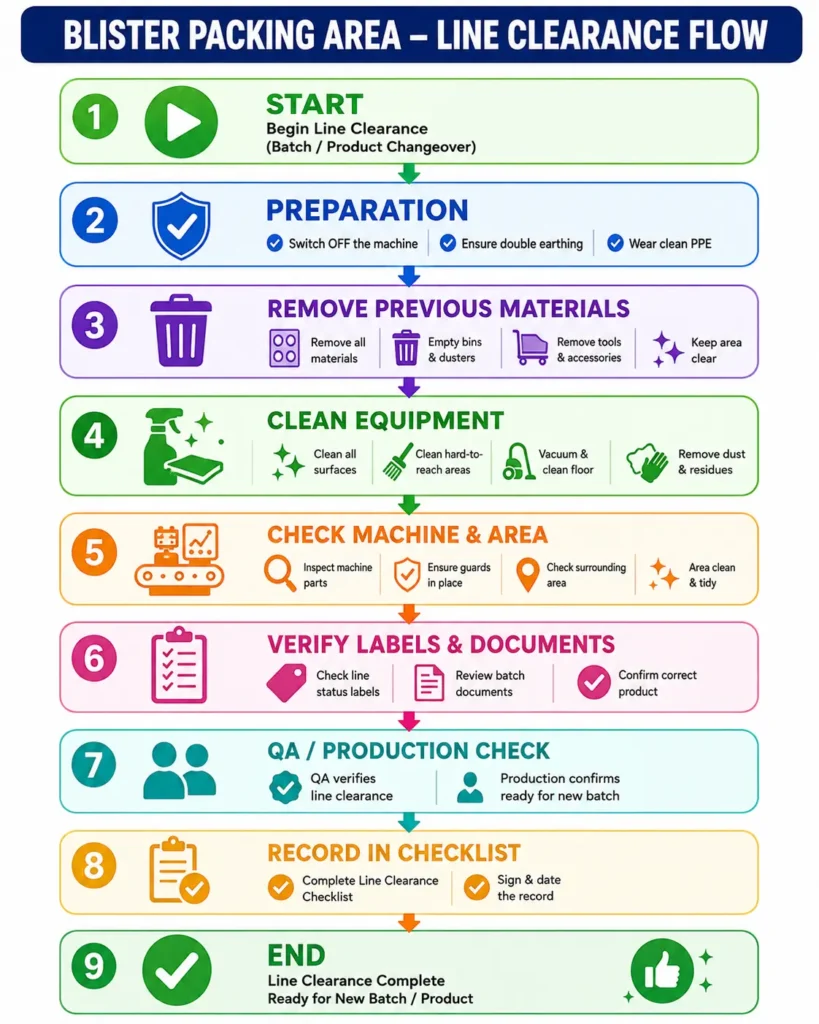
This SOP explains the line clearance procedure for the blister packing area before starting a new batch or product. Its main purpose is to make sure that no material, tablet, capsule, blister, document, or residue from the previous batch remains in the area or equipment. Packing staff must remove unused and rejected packing materials, used gloves, dusters, previous labels, stereos, cartons, and other items. Machines, conveyors, hoppers, tooling parts, rejection boxes, vacuum cleaners, printing units, and nearby surfaces must be checked and cleaned properly. Equipment status labels and area status boards must also be updated. Important locations may be checked with a torch and mirror where required. For product changeover, line clearance is performed by Production and certified by Quality Assurance. For batch changeover, a second Production Officer checks it. The completed checklist is recorded in the applicable annexure and retained with the Batch Packing Record for traceability and documentation.
Impact Assessment
This SOP will have a positive impact on the blister packing area by ensuring proper line clearance before starting a new batch or product. It helps remove all materials, tablets, capsules, blisters, labels, documents, gloves, dusters, and residues from the previous batch. Cleaning and checking of machines, conveyors, hoppers, tools, rejection boxes, vacuum cleaners, printing units, walls, floors, and nearby areas will reduce the risk of product mix-up and contamination. Checking equipment status labels, safety guards, and machine parts will also improve safety and control. The procedure clearly defines the responsibility of Production and Quality Assurance during line clearance and verification. Use of checklists and recording in the Batch Packing Record will improve traceability and documentation. Overall, this SOP will help maintain a clean packing area, prevent errors, improve product quality, support GMP compliance, and ensure that the blister packing line is ready for the next batch or product.
Questions & Answers
Q1. What is the purpose of this SOP?
Answer: The purpose is to define the procedure for proper line clearance of the blister packing area and equipment before starting another batch or product.
Q2. When is line clearance required?
Answer: Line clearance is required during batch-to-batch changeover and product-to-product changeover.
Q3. Who is responsible for line clearance?
Answer: Packing staff and Quality Assurance staff are responsible for line clearance activities.
Q4. What should be removed from the previous batch?
Answer: Excess or rejected packing materials, empty IPCs, used gloves, dusters, tablets, capsules, blisters, cartons, and other previous batch materials must be removed.
Q5. Why is equipment cleaning checked during line clearance?
Answer: Equipment and accessories are checked to make sure they are clean and free from powder, product, or residue of the previous batch.
Q6. What areas around the machine should be checked?
Answer: The area below and around the machine, corners, walls, windows, AHU grills, railings, conveyors, machine platforms, and other difficult-to-reach locations should be checked.
Q7. What should be checked on equipment status labels?
Answer: All equipment status labels and the area status board should be properly updated before starting the next batch.
Q8. Who verifies line clearance during product changeover?
Answer: During product-to-product changeover, line clearance is performed by the Production Officer and certified by the Quality Assurance Officer.
Q9. Who checks line clearance during batch changeover?
Answer: During batch-to-batch changeover, line clearance is performed by one Production Officer and checked by a second Production Officer.
Q10. Where is the completed line clearance checklist kept?
Answer: The completed line clearance checklist is recorded in the applicable annexure and retained with the Batch Packing Record (BPR).