






Brief Description
This SOP describes the method for calculating the required volume of mobile phase for HPLC analysis in the Quality Control department. Its purpose is to ensure that sufficient mobile phase is prepared for sample injections, system flushing, saturation, and standard/sample/blank preparation.The calculation considers the total number of injections (N), run time of each sample (R), flow rate (F), flushing and saturation time (T), and additional mobile phase required for preparation activities. In the example provided, 15 injections, 20 minutes run time, and 1.5 mL/min flow rate require 450 mL, while flushing and saturation require 90 mL. With 200 mL for standard/sample/blank preparation, the total calculated requirement is 740 mL, so 1.0 litre of mobile phase is prepared.The SOP also states that mobile phase should be prepared according to the respective STP and, when more than 1 litre is required, preparation should be increased in 500 mL increments.
Skip to PDF content1. Flow Diagram:
The SOP Failure Flow Diagram explains the step-by-step action to be taken when an error occurs during the calculation or preparation of mobile phase for an HPLC system. The original SOP requires calculation using injection number, run time, flow rate, flushing time, and preparation volume, with not less than 1 litre generally prepared and higher requirements rounded in 500 mL increments.
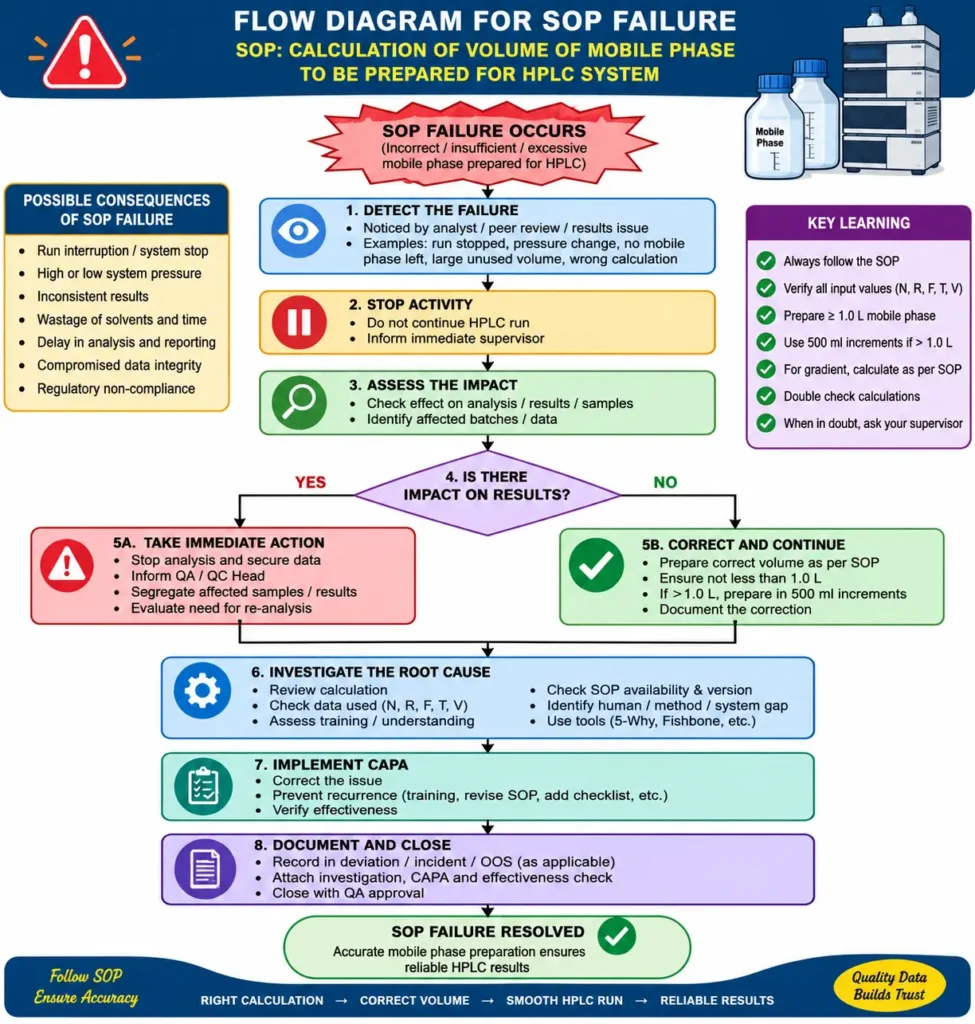
The flow starts with detecting the SOP failure, such as incorrect calculation, insufficient mobile phase, or wrong preparation. The activity should then be stopped and the supervisor informed. The impact on HPLC analysis, samples, batches, and results is assessed. If results are affected, immediate corrective action and possible re-analysis are considered. The root cause is investigated, followed by suitable CAPA such as retraining, SOP revision, or additional checking. Finally, CAPA effectiveness is verified, all actions are documented, and the investigation is closed after QA/QC approval.
2. Brainstorming for SOP Failure:
Brainstorming is used to identify all possible reasons for failure of the SOP “Calculation of Volume of Mobile Phase to be Prepared for HPLC System.” The SOP requires correct use of injection number, run time, flow rate, flushing/saturation time and preparation volume to calculate the total mobile-phase requirement. It also specifies preparation of not less than 1 litre, use of 500 mL increments when more than 1 litre is required, and special consideration for gradient analysis.
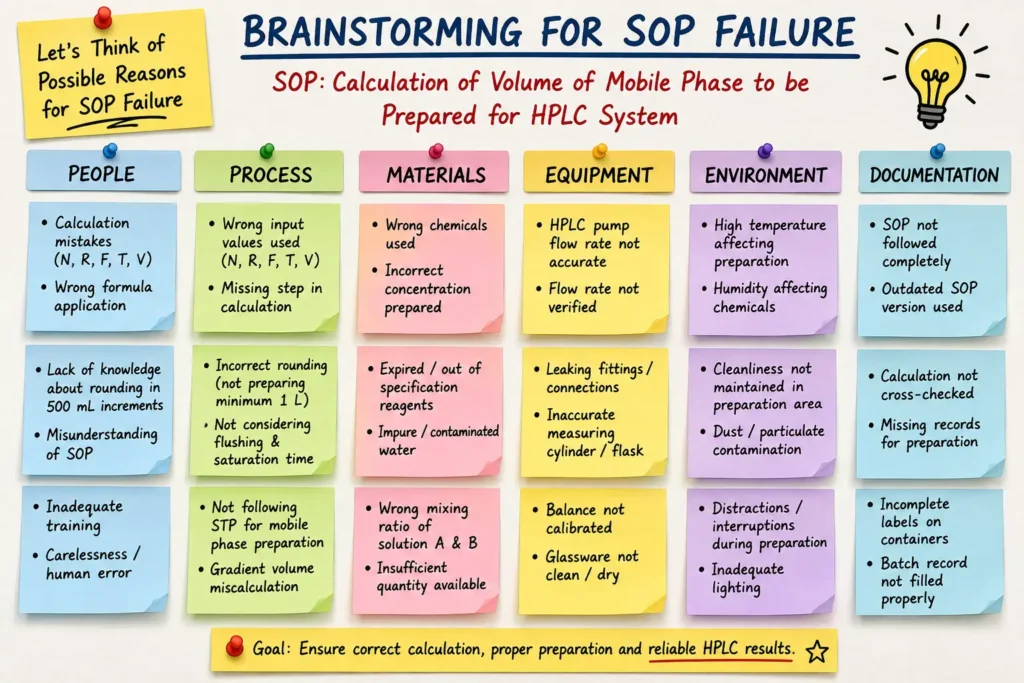
During brainstorming, possible causes may include calculation mistakes, wrong input values, incorrect formula application, inadequate training, misunderstanding of the SOP, failure to consider flushing time, incorrect rounding of volume, improper gradient calculations, wrong chemicals, unsuitable measuring glassware, and incomplete documentation. Ideas from QC analysts, supervisors and QA personnel should be collected without immediately rejecting any possibility. The identified causes can then be grouped under People, Process, Material, Equipment, Environment and Documentation for detailed investigation and root-cause identification.
3. 5-Why Analysis for SOP Failure:
The 5-Why Analysis is a simple root cause analysis tool used to investigate why an SOP failure, deviation, or non-compliance occurred. The investigation starts with the observed problem and repeatedly asks “Why did this happen?” until the underlying or root cause is identified. For this SOP, possible failures may include incorrect calculation of mobile-phase volume, skipped calculation steps, wrong recording of injection parameters, or failure to prepare the required minimum volume. The SOP specifies calculation using factors such as number of injections, run time, flow rate, flushing time, and preparation volume.
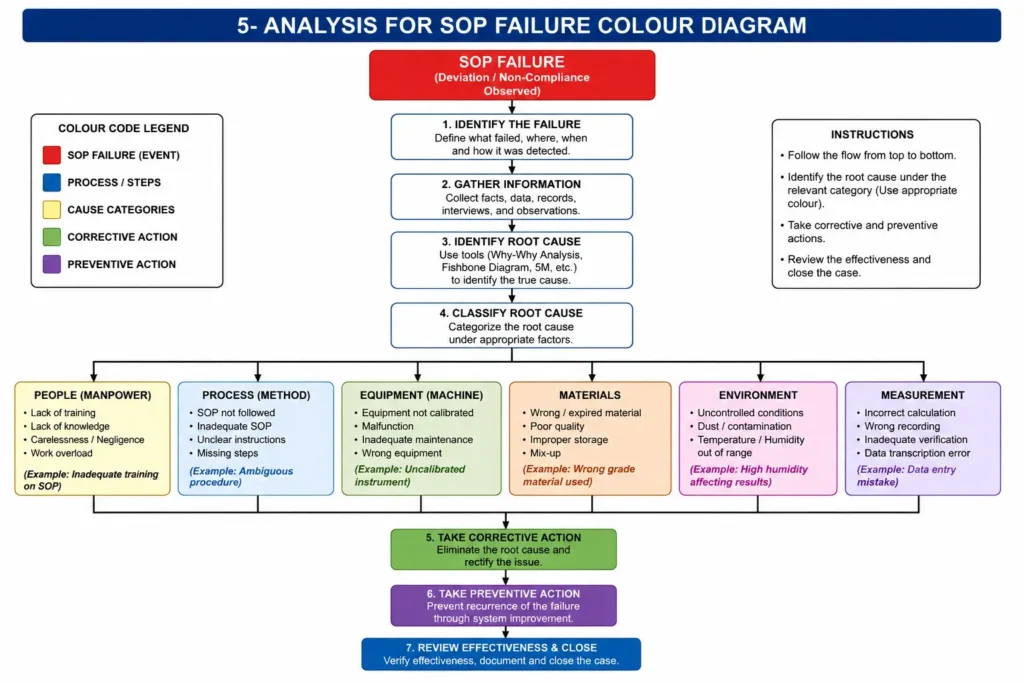
The 5-Why method helps move from the immediate error to deeper causes such as inadequate training, unclear instructions, poor communication, lack of review, or undefined responsibility. Once the root cause is confirmed with evidence, appropriate corrective and preventive actions (CAPA) can be implemented and their effectiveness verified.
4. Fishbone Analysis for SOP Failure:
The Fishbone Analysis (Ishikawa Diagram) is a simple root cause analysis tool used to identify possible reasons for failure of an SOP. For the SOP on calculation of mobile-phase volume for an HPLC system, the investigation can examine six major areas: Manpower, Method, Machine, Material, Measurement, and Environment. The SOP requires correct use of the number of injections, run time, flow rate, flushing time, and preparation volume, and specifies that normally not less than 1 litre of mobile phase should be prepared.
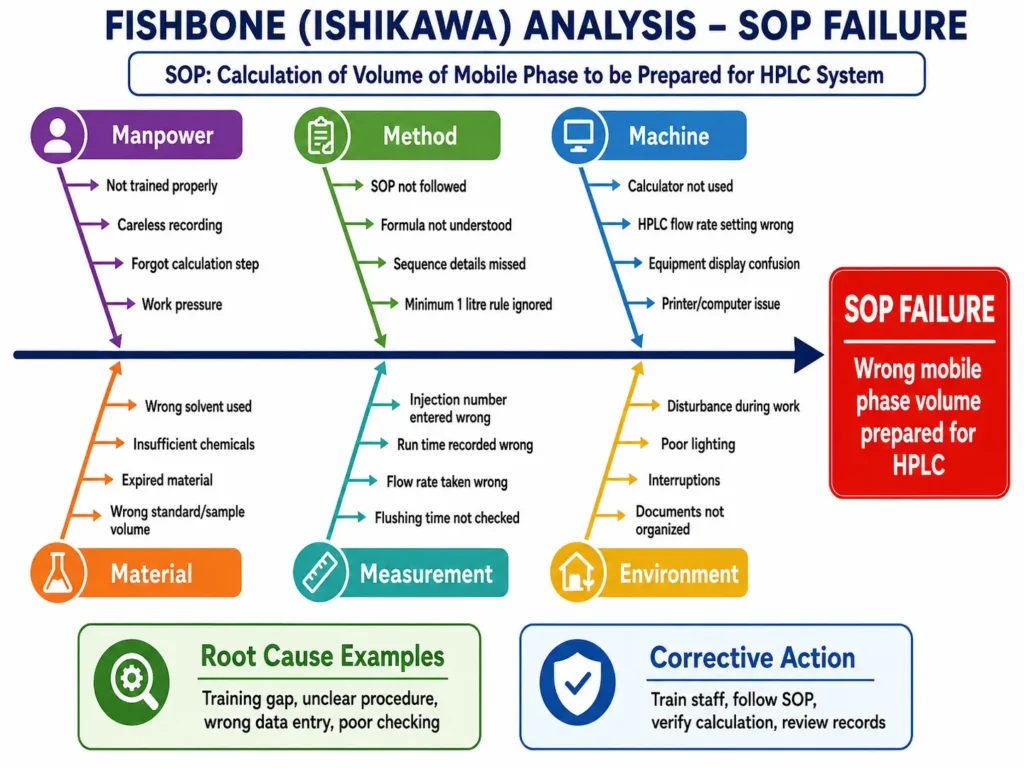
Possible causes of failure may include inadequate training, SOP steps not followed, incorrect calculation, wrong data entry, equipment or computer issues, incorrect materials, or workplace distractions. The Fishbone diagram helps the investigation team organize these causes clearly, identify the most probable root cause, and then implement suitable corrective and preventive actions (CAPA) to prevent recurrence.
5. Fault Tree Analysis (FTA) for SOP Failure:
Fault Tree Analysis (FTA) is a structured root cause analysis tool used to identify the possible reasons behind an SOP failure. The investigation starts with the top event, such as wrong mobile-phase volume preparation, incorrect calculation, failure to follow SOP steps, or incomplete documentation. The causes are then broken down into smaller contributing factors using AND/OR logic.
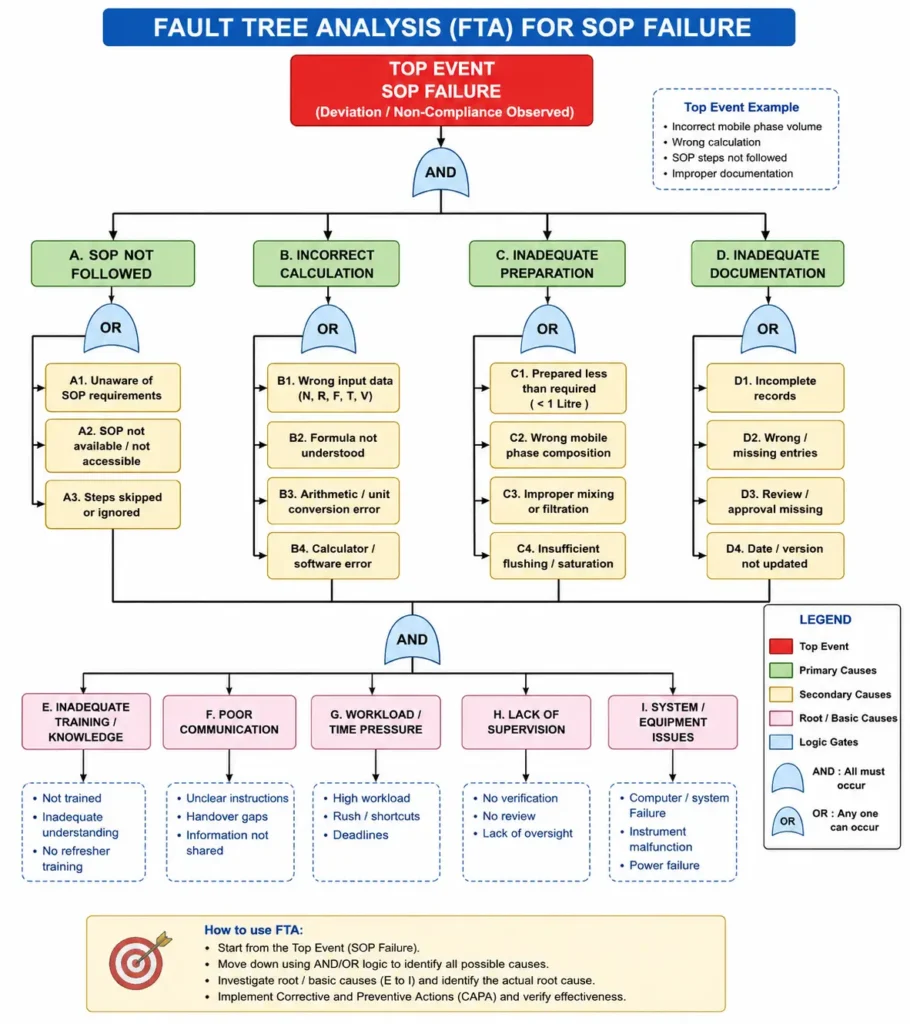
For this SOP, possible causes may include wrong input data such as number of injections, run time or flow rate, misunderstanding of the calculation formula, preparation of insufficient mobile phase, skipped SOP steps, incomplete records, inadequate training, poor communication, workload pressure, weak supervision, or equipment/system problems. The SOP specifically defines the calculation parameters and requires normally not less than 1 litre of mobile phase to be prepared.FTA helps identify the actual root cause, after which suitable corrective and preventive actions (CAPA) can be implemented to prevent recurrence.
Questions & Answers – Calculation of Mobile Phase Volume for HPLC System
Q1. What is the objective of this SOP?
Answer: To define the procedure for calculating the volume of mobile phase to be prepared for the HPLC system.
Q2. Where is this SOP applicable?
Answer: It is applicable to mobile phase preparation in the Quality Control department.
Q3. Who is responsible for following this SOP?
Answer: Executive QC, Assistant Manager QC, and Head QA/QC are responsible.
Q4. What parameters are considered for mobile phase volume calculation?
Answer: Number of injections, sample run time, flow rate, flushing and saturation time, and volume required for standard/sample/blank preparation are considered.
Q5. What is the formula for calculating mobile phase used during injections?
Answer: The formula is A = N × R × F, where N is the number of injections, R is run time, and F is flow rate.
Q6. How is the volume required for flushing and saturation calculated?
Answer: It is calculated using B = T × F, where T is flushing/saturation time and F is flow rate.
Q7. What is the calculated mobile phase requirement in the SOP example?
Answer: The total calculated requirement is 740 mL.
Q8. How much mobile phase should be prepared in the example?
Answer: 1.0 litre of mobile phase should be prepared.
Q9. What is the minimum quantity of mobile phase normally required to be prepared?
Answer: Not less than 1 litre of mobile phase should be prepared.
Q10. What should be done if more than 1 litre of mobile phase is required?
Answer: It should be prepared in increments of 500 mL. For example, 1.2 L requirement should be rounded to 1.5 L, and 1.7 L to 2.0 L.
Q11. How should mobile phase be prepared?
Answer: It should be prepared according to the respective method given in the STP.
Q12. What is the requirement for gradient analysis?
Answer: The total volume of mobile phase should be calculated according to the procedure given in the SOP.
Q13. Can less than 1 litre of a mobile phase be prepared during gradient analysis?
Answer: Yes. If one component is required in a quantity below 1 litre, the required quantity may be prepared; for example, 500 mL of mobile phase B.
Q14. Who provides training for this SOP?
Answer: The Head QA/QC provides the training.
Q15. Who receives training and what is the training duration?
Answer: The HPLC Chemist receives training for a period of one hour.