






1. Brief Description:
The Change Control Management SOP describes a systematic procedure for controlling and documenting changes within a pharmaceutical quality system. Its purpose is to ensure that any proposed change related to procedures, raw materials, packaging materials, products, manufacturing processes, analytical methods, specifications, equipment, utilities, facilities, or operating environments is properly evaluated before implementation.
The process begins when the concerned department raises a Change Control Form with complete details and justification. The change is evaluated by the department Head, Quality Assurance, and the Change Control Committee. Changes are classified as temporary or permanent and further categorized as critical, major, or minor depending on their impact on product quality and safety.
QA performs impact assessment, risk assessment, and determines validation, stability, training, documentation, and regulatory requirements. Approved changes are implemented, tracked, reviewed, and finally closed after confirming completion of all required actions.
Skip to PDF content2. Flow Diagram:
The Change Control Management Flow Diagram explains the step-by-step process used to control and implement changes in a pharmaceutical quality system. The process starts when an intended change is identified and a Change Control Proposal (CCF) is raised. The initiator describes the proposed change along with its justification, after which the department HOD reviews it and forwards it to Quality Assurance.
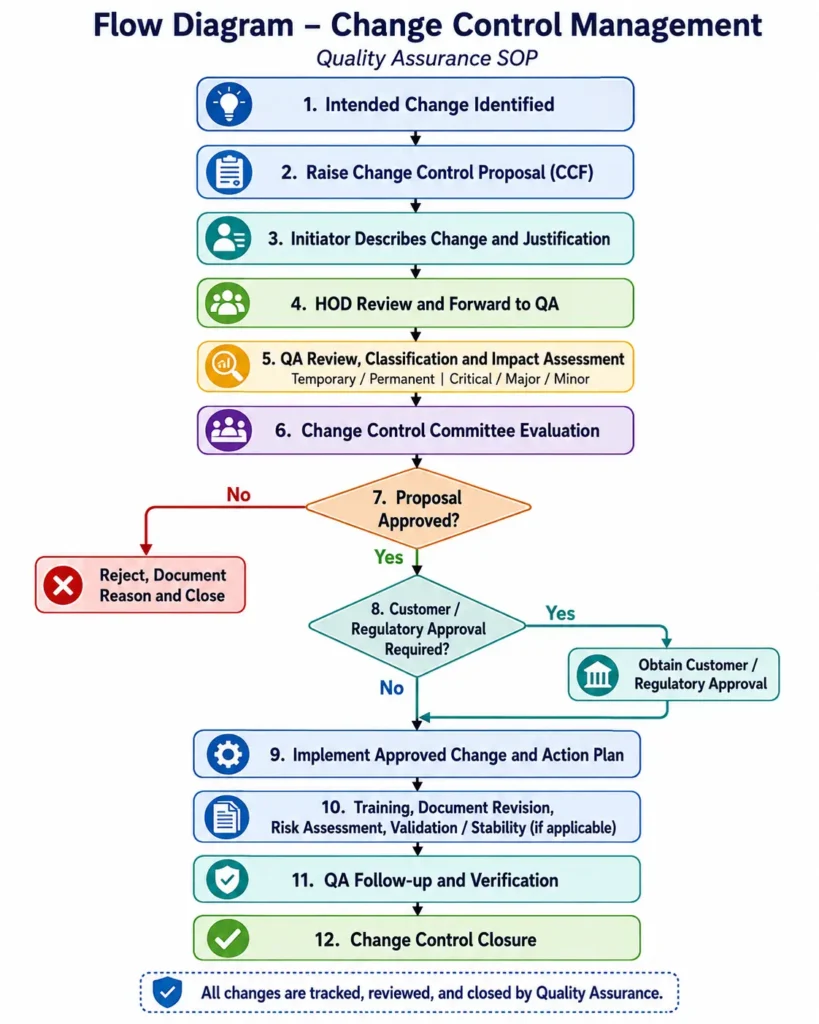
QA evaluates the change, classifies it as temporary or permanent and as critical, major, or minor, and performs the required impact assessment. The proposal is then reviewed by the Change Control Committee. If the proposal is rejected, the reason is documented and the change is closed. If approved, customer or regulatory approval is obtained wherever applicable. The approved change is then implemented with necessary training, document revision, risk assessment, validation, or stability activities. Finally, QA verifies completion of all actions and closes the Change Control.
3. Brainstorming:
Brainstorming is a simple and effective investigation tool used to identify the possible reasons for an SOP failure. When an SOP is not followed correctly or the expected result is not achieved, a cross-functional team discusses all possible causes without immediately judging or rejecting any idea. The team may consider factors such as unclear SOP instructions, inadequate training, human error, missing resources, equipment problems, poor communication, documentation gaps, workload, and ineffective supervision. Each possible cause can be written on separate sticky notes so that the team can easily review, group, and prioritize them.
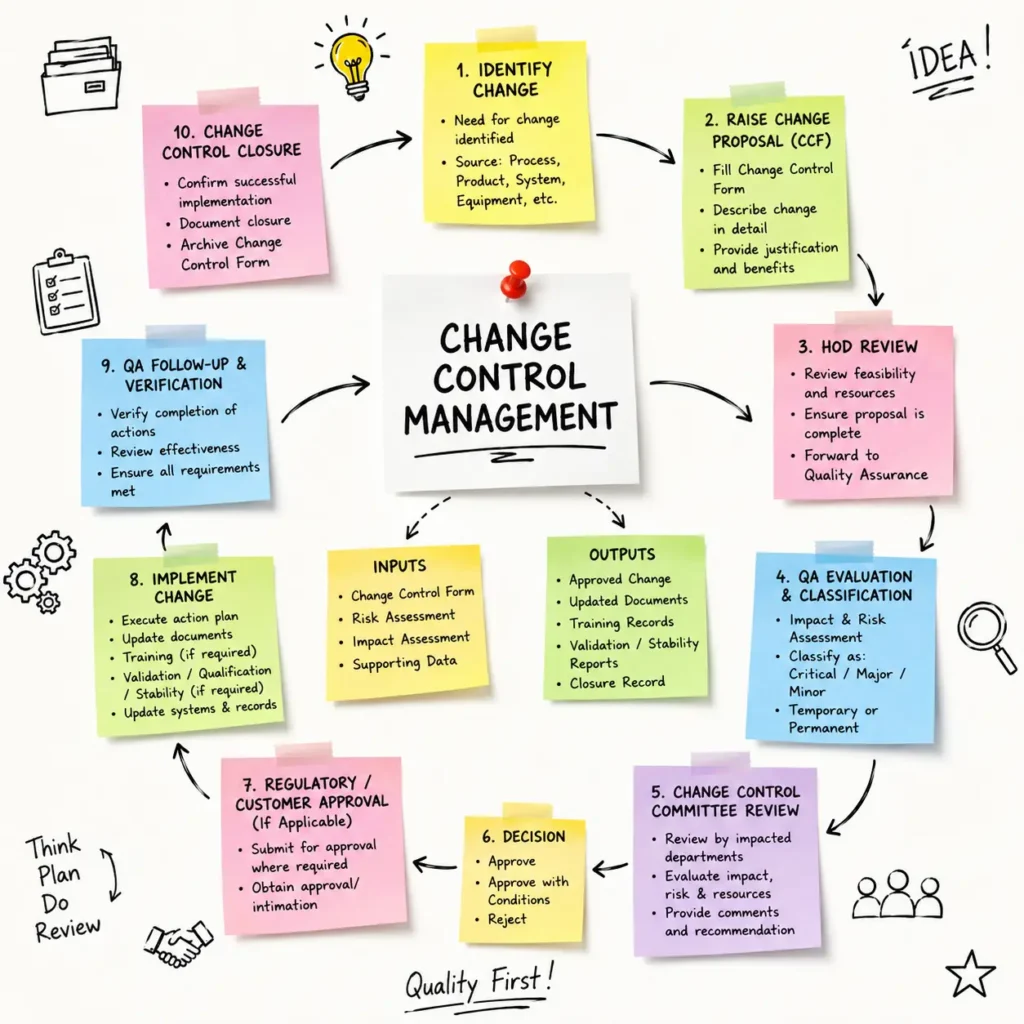
After collecting the ideas, the team evaluates which causes are most likely to have contributed to the failure. These causes can then be investigated further using tools such as 5-Why Analysis, Fishbone Diagram, or FMEA. Brainstorming helps ensure that different viewpoints are considered and supports identification of the most probable root cause for appropriate corrective and preventive actions.
4. 5 Why Analysis:
The 5 Why Analysis is a simple root cause investigation tool used when the Change Management SOP is not followed effectively. It helps the investigation team move beyond the immediate problem by repeatedly asking “Why?” until the underlying cause is identified. For example, a change may be implemented without proper evaluation or approval. The next “Why?” may show that the Change Control process was not followed, followed by inadequate awareness, insufficient training, weak monitoring, or unclear accountability. The Change Control SOP itself requires QA evaluation, impact and risk assessment, implementation planning, departmental review, and proper tracking before closure.
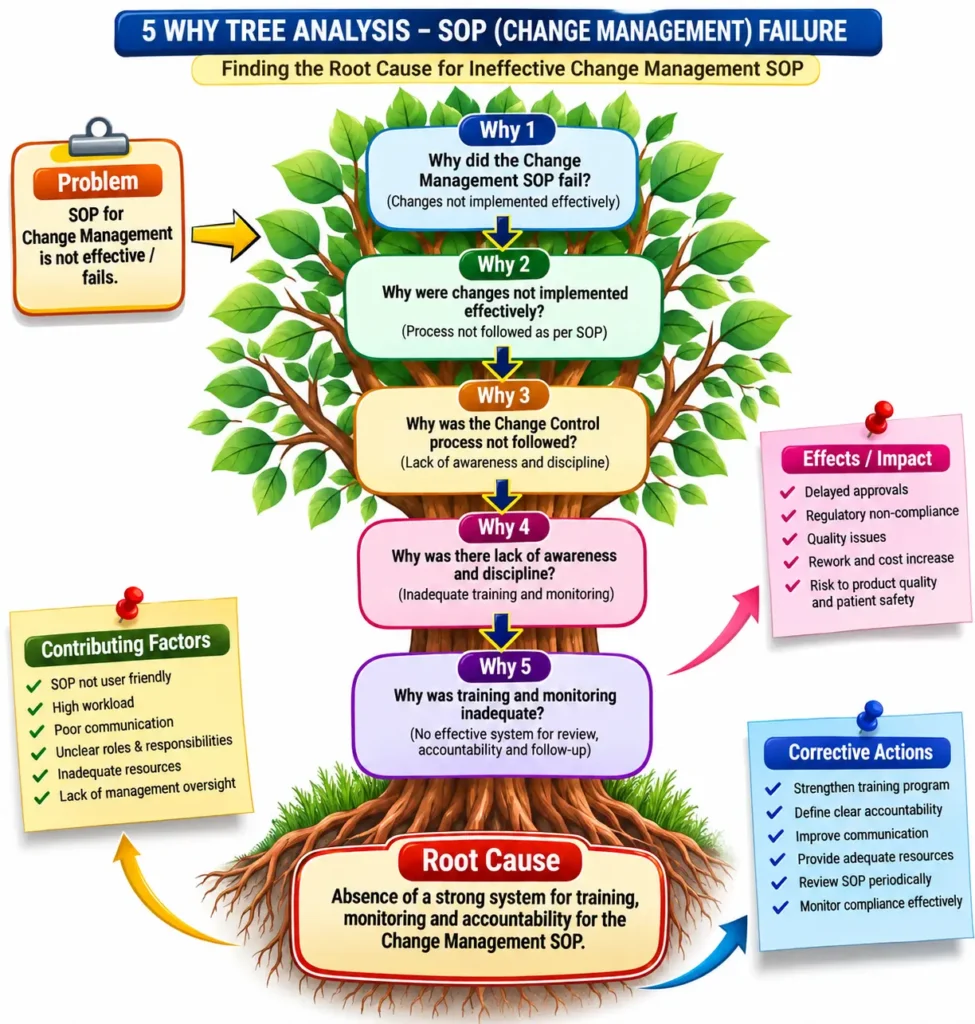
The final root cause may therefore be linked to an ineffective system for training, monitoring, accountability, and periodic review. Once identified, appropriate CAPA can include retraining personnel, defining responsibilities, strengthening compliance monitoring, improving documentation, and periodically reviewing the Change Management process to prevent recurrence.
5. Heat Map – FMEA:
The FMEA Heat Map provides a visual method to identify and prioritize risks associated with failure of the Change Control Management SOP. It compares the severity of a failure with its occurrence to show which problems require the most attention. Low-risk conditions are generally shown in green, moderate risks in yellow or orange, and high-risk conditions in red.
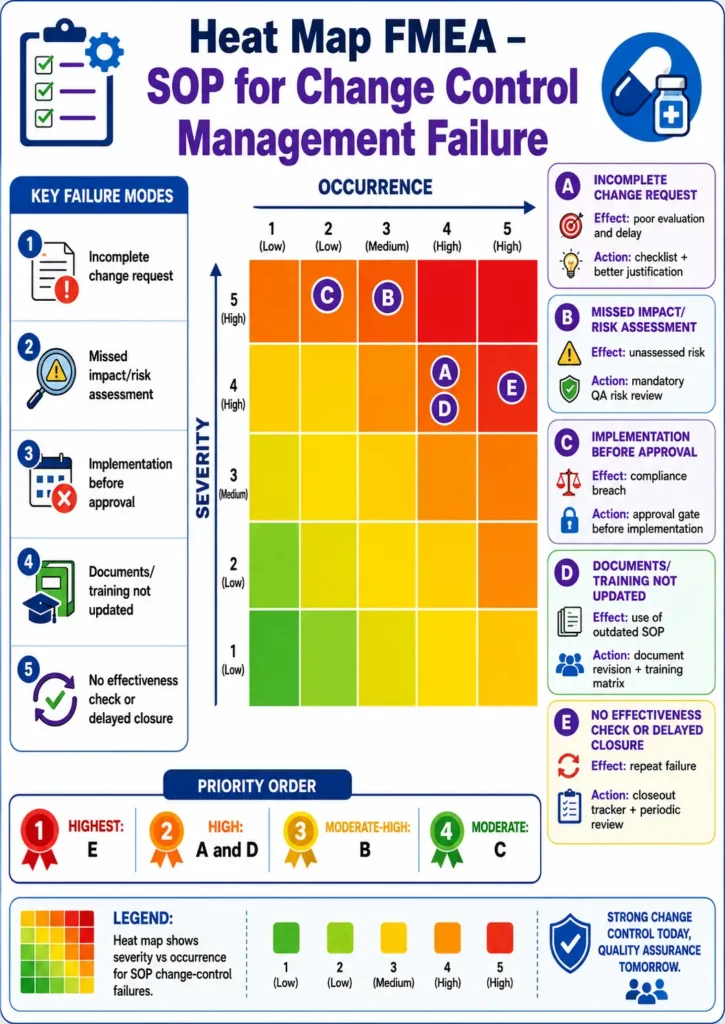
For Change Control failure, important risks may include incomplete change requests, missed impact or risk assessments, implementation before approval, failure to update documents or training, and delayed closure or missing effectiveness checks. The heat map helps the QA team quickly recognize high-priority failures that could lead to compliance gaps, product-quality risks, delays, or recurrence of problems. Based on the risk level, suitable actions can be planned such as stronger review checklists, mandatory risk assessment, approval controls, training updates, action tracking, and periodic QA follow-up.