







Brief Description
The SOP for Daily Work Allocation describes the systematic method for assigning and monitoring routine work in the Quality Control Department. Its main objective is to ensure that QC activities are distributed properly among analysts according to their job responsibilities. The Executive–QC is responsible for execution of the SOP, while the Department Head ensures its effective implementation.The procedure starts when bulk and finished product samples, raw materials, and packing material samples are received in QC along with the respective sample requisition slips. The Department Head controls the raw data sheets and allocates work to analysts at the beginning of each shift. After completing the assigned analysis, the analyst prepares the Certificate of Analysis (COA) and submits it to the Department Head or Section Head. At the end of the shift, the Department Head reviews the daily work allocation report.The annexure records the section, analyst, work allotted, status, and remarks for effective daily tracking.
Skip to PDF content1. Flow Diagram:
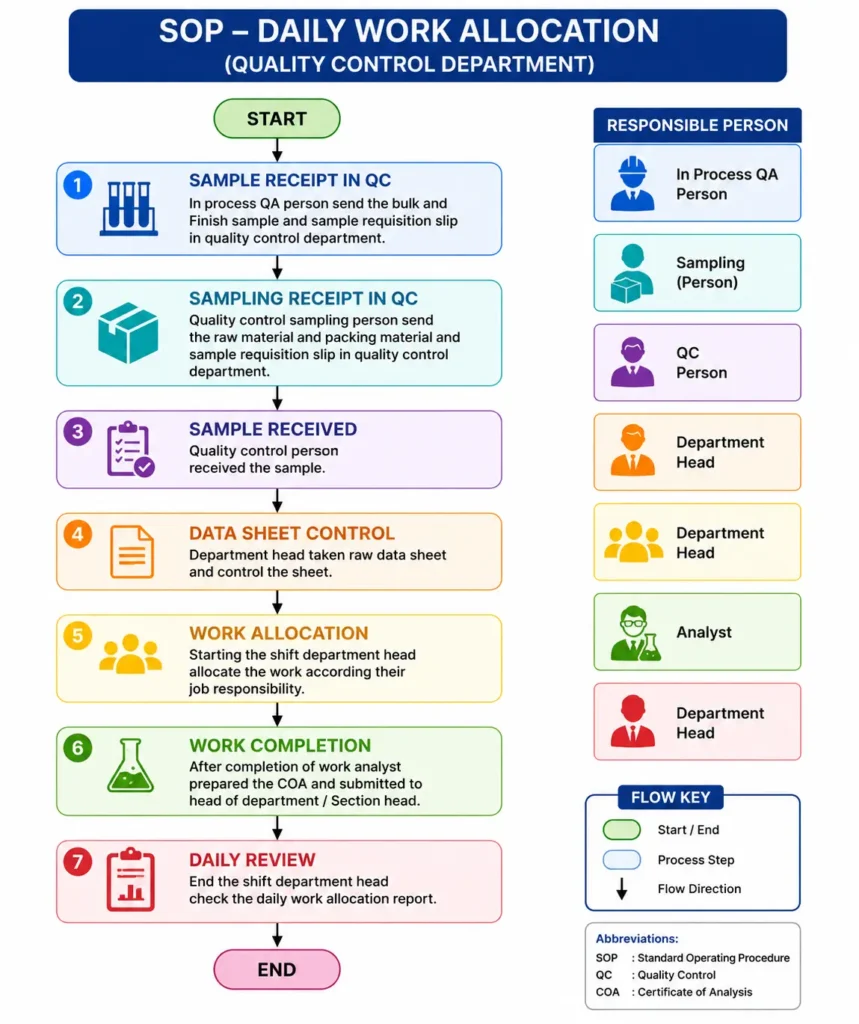
The Daily Work Allocation Flow Diagram explains how work is planned, assigned, completed, and reviewed in the Quality Control Department. The process starts when bulk and finished product samples are received from In-Process QA and raw material and packing material samples are received through the QC sampling person along with sample requisition slips. The QC person receives the samples, after which the Department Head controls the raw data sheets and allocates work to analysts according to their job responsibilities at the beginning of the shift.
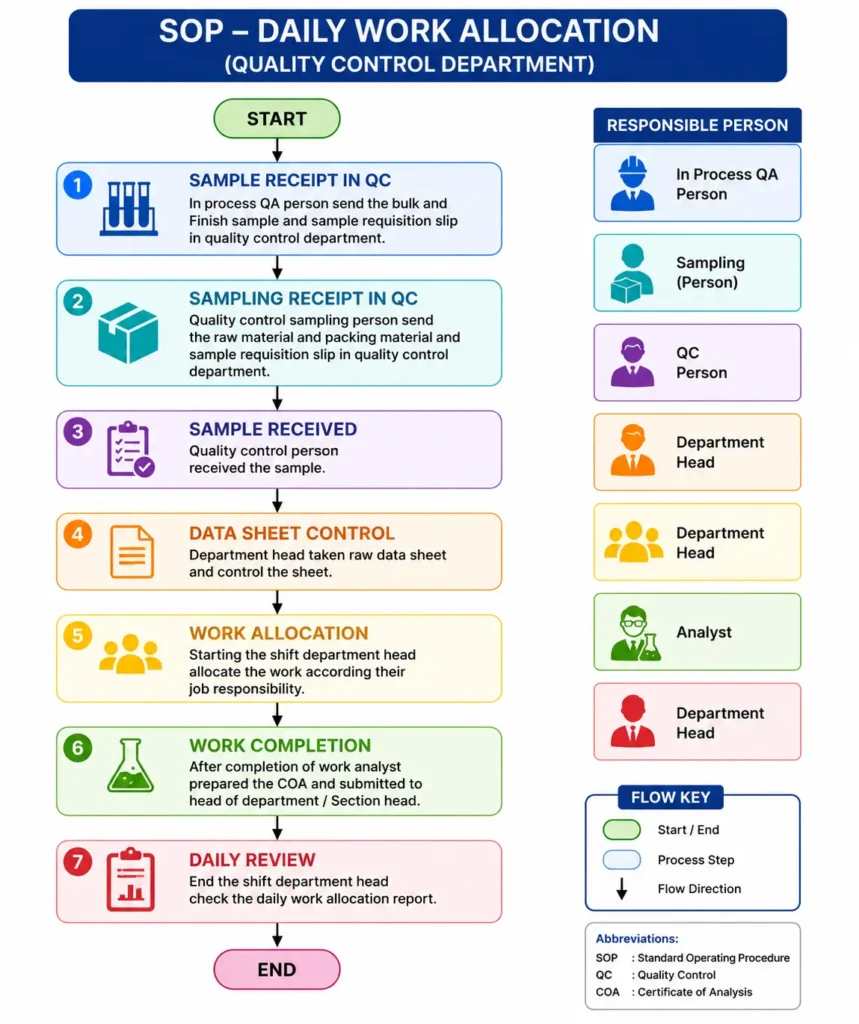
After completing the assigned analysis, the analyst prepares the Certificate of Analysis (COA) and submits it to the Department Head or Section Head. At the end of the shift, the Department Head reviews the daily work allocation report to confirm the status of assigned activities and ensure proper completion of QC work.
2. Brainstorming for SOP Failure:
Brainstorming for SOP Failure is a simple investigation technique used to identify all possible reasons why an SOP may not be followed correctly or may fail to achieve its intended purpose. During brainstorming, concerned personnel from Quality Control, Quality Assurance, Production, and other relevant departments openly discuss possible causes without immediately rejecting any idea.
For the Daily Work Allocation SOP, potential causes may include lack of training, unclear SOP instructions, poor awareness, improper implementation, excessive workload, time pressure, inadequate resources, outdated procedures, human error, poor supervision, communication gaps, and system or process issues. Environmental conditions and lack of management follow-up may also contribute to failure. After collecting all ideas, the team groups similar causes and identifies the most probable root causes for further investigation. Appropriate corrective and preventive actions such as SOP simplification, retraining, improved communication, adequate resources, regular monitoring, and periodic SOP review can then be implemented to prevent recurrence.
3. 5-Why Analysis for SOP Failure:
5-Why Analysis is a simple root cause analysis technique used to identify the actual reason behind failure of an SOP by repeatedly asking the question “Why?”. For the Daily Work Allocation SOP, the failure may occur when work is not properly assigned, recorded, completed, or reviewed as required.The analysis may identify causes such as unclear responsibilities, inadequate SOP training, poor communication, lack of refresher training, insufficient supervision, or weak monitoring by the Department Head. By asking “Why?” step by step, the investigation moves from the visible problem to the underlying system-related cause.
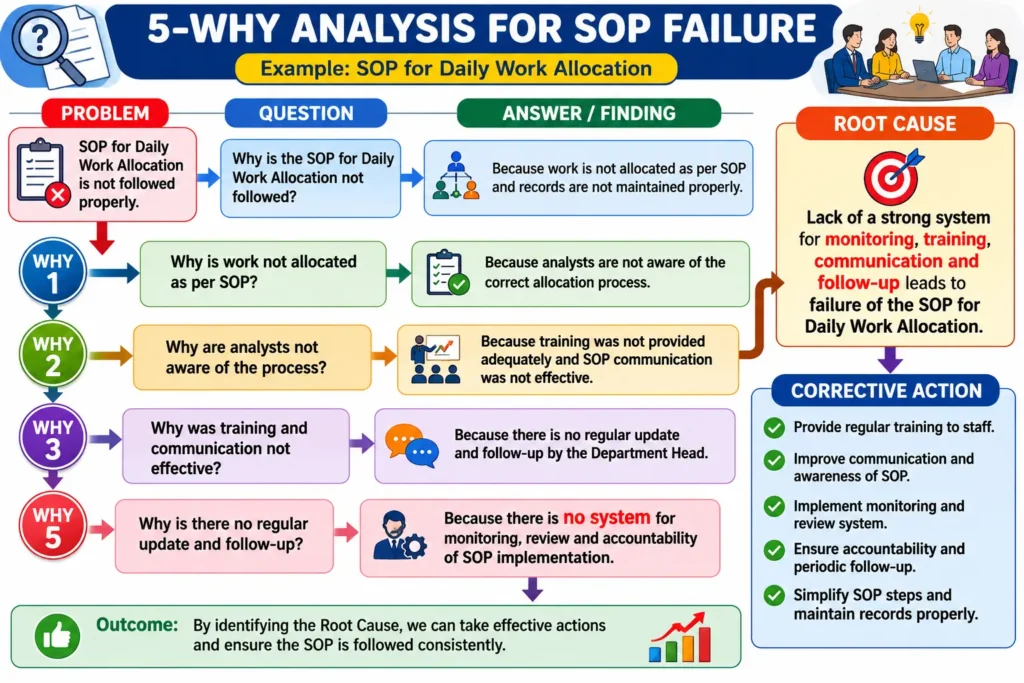
In this SOP, the Department Head is required to allocate work according to job responsibilities, while the analyst completes the assigned activity, prepares the COA, and submits it for review. At the end of the shift, the Department Head checks the daily work allocation report. The identified root cause can then be addressed through suitable CAPA, such as improved training, clearer responsibilities, regular monitoring, and periodic SOP review.
4. Brief Description – Fishbone Analysis for SOP Failure:
Fishbone Analysis, also known as the Ishikawa or Cause-and-Effect Diagram, is used to identify and organize possible causes behind failure of the Daily Work Allocation SOP. The problem is placed at the head of the fishbone, while possible causes are grouped into major categories such as Manpower, Method, Training, Communication, Management/Supervision, and Resources/Documentation.
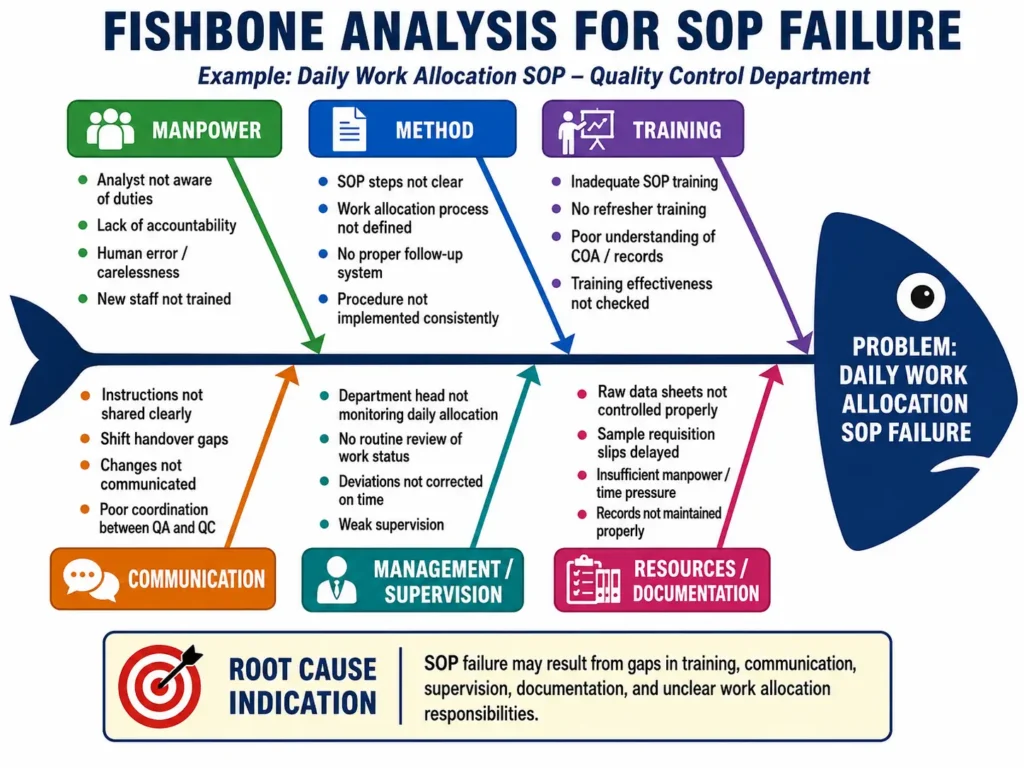
For this SOP, possible causes may include lack of awareness of duties, unclear work allocation steps, inadequate or missing refresher training, communication gaps between QA and QC, weak supervision, delayed sample requisition slips, improper control of raw data sheets, and incomplete records. These points are directly relevant because the SOP requires proper sample receipt, data-sheet control, work allocation by the Department Head, COA preparation, and end-of-shift review. The Fishbone Diagram helps the investigation team view all possible contributing factors together, identify the most probable root cause, and develop suitable Corrective and Preventive Actions (CAPA) to avoid recurrence.
5. Fault Tree Analysis for SOP Failure:
Fault Tree Analysis (FTA) is a structured investigation tool used to identify how different failures can combine and result in an SOP failure. For the Daily Work Allocation SOP, the top event is that the SOP is not followed or is not effective.The analysis breaks this failure into possible contributing areas such as work not allocated properly, work not completed, records or data not controlled, daily review not performed, and communication breakdown. Possible basic causes include unclear job responsibilities, lack of SOP awareness, incomplete records, failure to prepare or submit the COA, inadequate supervision, delayed sample information, and weak handover communication.
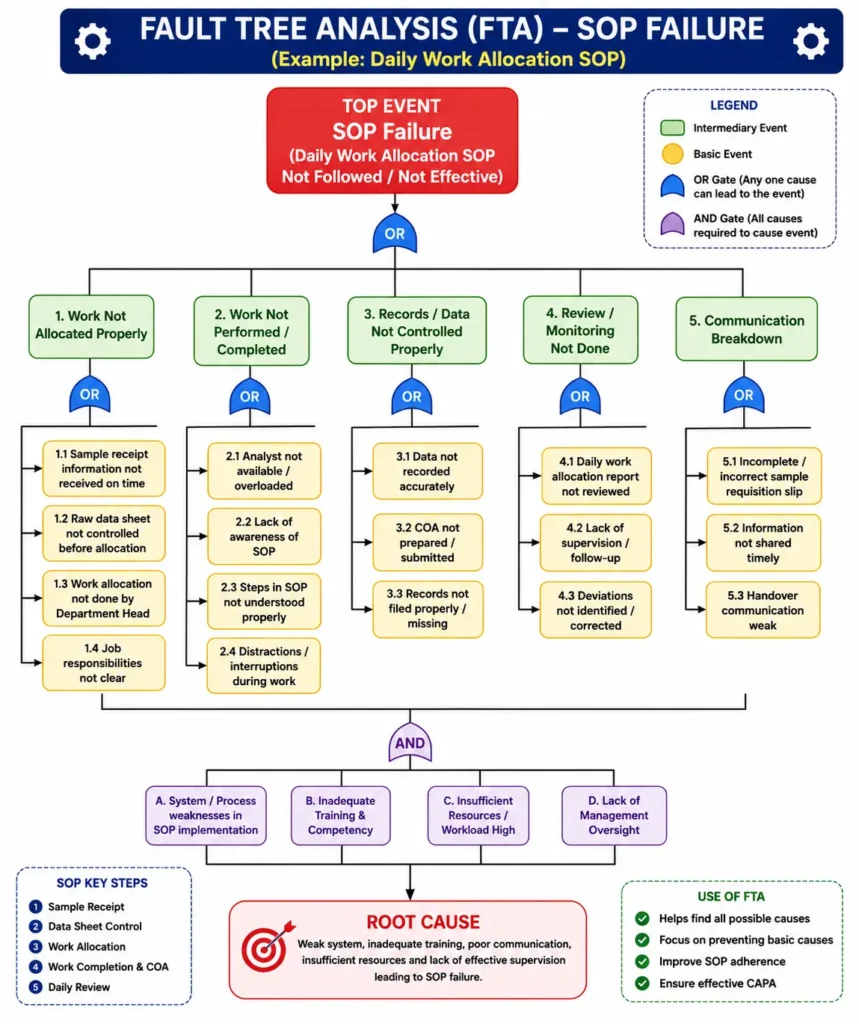
The SOP requires the Department Head to control raw data sheets, allocate work according to job responsibility, review completed work, and check the daily work allocation report at the end of the shift.FTA helps identify the most critical system weaknesses so that suitable CAPA can be implemented through improved training, communication, documentation, monitoring, and management oversight.
Questions & Answers – SOP for Daily Work Allocation
- What is the objective of the Daily Work Allocation SOP?
The objective is to lay down the procedure for daily work allocation in the Quality Control Department. - Which department is covered under this SOP?
This SOP is applicable to the Quality Control Department for daily work allocation. - Who is responsible for execution of this SOP?
The Executive–Quality Control is responsible for execution of the SOP. - Who is responsible for effective implementation of the SOP?
The Department Head is responsible for effective implementation. - Who sends bulk and finished product samples to QC?
The In-Process QA person sends bulk and finished product samples along with the sample requisition slip to QC. - Who sends raw material and packing material samples to QC?
The QC sampling person sends raw material and packing material samples with the sample requisition slip to the QC Department. - Who receives the samples in QC?
The Quality Control person receives the samples. - Who controls the raw data sheet?
The Department Head takes and controls the raw data sheet. - When is daily work allocated to analysts?
Work is allocated by the Department Head at the start of the shift according to job responsibilities. - What does the analyst do after completing the assigned work?
The analyst prepares the Certificate of Analysis (COA) and submits it to the Department Head or Section Head. - What is checked at the end of the shift?
The Department Head checks the Daily Work Allocation Report at the end of the shift. - Who provides training for this SOP?
The Manager–QC is the trainer, and the concerned personnel are the trainees. The training period is half an hour. - What is Annexure-I of this SOP?
Annexure-I is the Daily Work Allocation format. - What information is recorded in the Daily Work Allocation format?
The format records Section, Analyst, Work Allotted, Status, and Remark. - What does COA stand for?
COA stands for Certificate of Analysis.