




1. Introduction:
Equipment management is an important part of pharmaceutical Quality Assurance because manufacturing, measuring, testing, and process-control equipment must remain suitable, reliable, and properly controlled throughout its use. This SOP provides a systematic guideline for managing equipment used in the Warehouse, Manufacturing, Maintenance, and Quality Control departments. The procedure begins with equipment qualification, covering Design Qualification (DQ), receipt checks, Installation Qualification (IQ), Operational Qualification (OQ), Performance Qualification (PQ), personnel training, equipment identification, and formal handover for use. Requalification is required when equipment is modified or relocated. The SOP also establishes requirements for preventive maintenance, including maintaining essential spare parts, carrying out scheduled maintenance, recording activities, reviewing repeated breakdowns, and making justified changes through the change-control system. In addition, equipment must have defined cleaning, operating, and calibration procedures. Cleaning instructions should specify the sequence, cleaning-agent concentration, dismantling requirements, sanitation, and safety precautions. Calibration procedures should define responsibilities, acceptance criteria, traceable reference standards, and actions required when equipment is found out of calibration. Overall, this SOP helps ensure that equipment is qualified, maintained, cleaned, operated, calibrated, documented, and ready for safe pharmaceutical processing.
Skip to PDF content2. Flow Diagram:
The Equipment Management Flow Diagram explains the complete life cycle of pharmaceutical equipment in a simple step-by-step manner. It starts with identifying the need for equipment and then moves through Design Qualification (DQ), receipt inspection, Installation Qualification (IQ), Operational Qualification (OQ), and Performance Qualification (PQ). After successful qualification, the equipment is formally handed over for routine use.
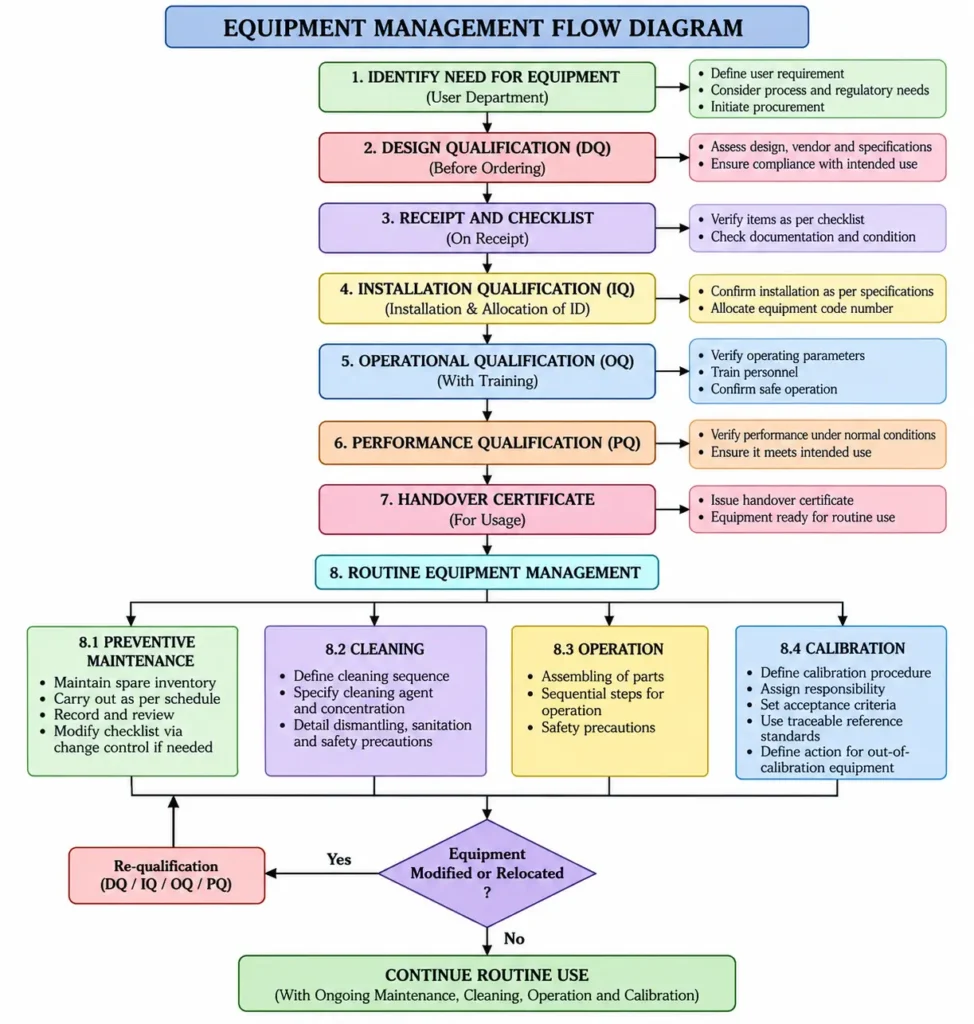
During routine operation, the equipment is controlled through four major activities: preventive maintenance, cleaning, operation, and calibration. Preventive maintenance is performed according to a schedule and recorded properly. Cleaning procedures define the cleaning sequence, cleaning agents, dismantling, sanitation, and safety precautions. Operating procedures describe correct assembly, operating steps, and safety requirements. Calibration ensures that the equipment remains accurate and suitable for use. If equipment is modified or relocated, requalification is required before it is returned to routine use. This system helps maintain equipment reliability, consistency, safety, and proper documentation.
3. Benefits of Following SOP:
The image explains how following the Equipment Management SOP helps keep pharmaceutical equipment safe, reliable, accurate, and suitable for routine use. It highlights the importance of completing equipment qualification activities such as DQ, IQ, OQ, and PQ before the equipment is released for operation. The diagram also shows that scheduled preventive maintenance helps reduce breakdowns and supports reliable equipment performance. Proper cleaning procedures help control contamination by defining the cleaning sequence, cleaning agents, dismantling requirements, sanitation, and safety precautions.
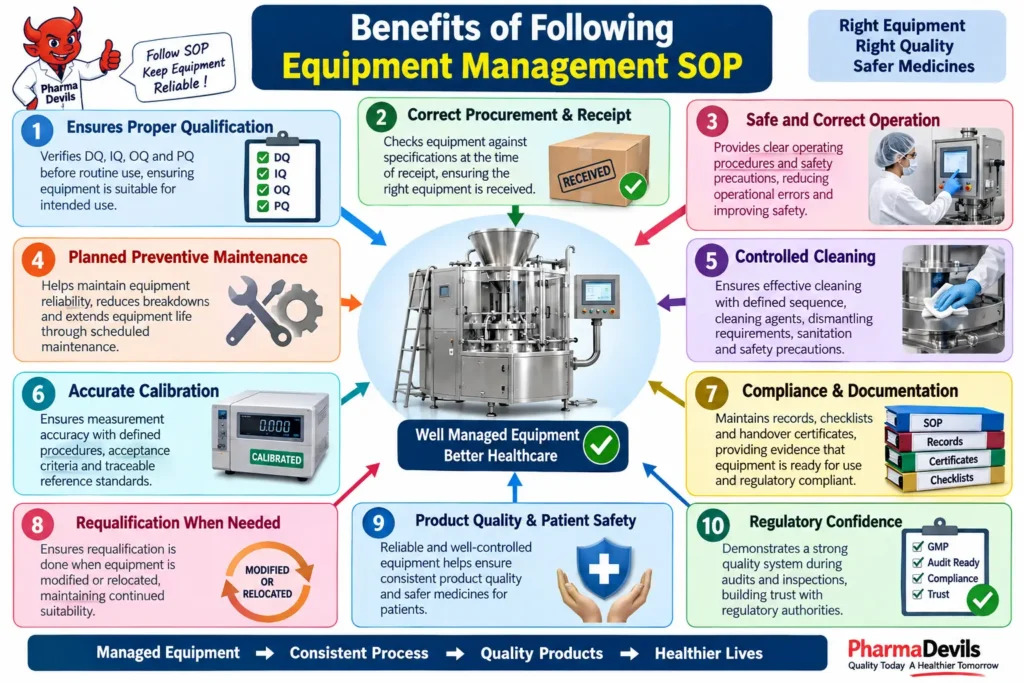
Correct operating procedures improve safe and consistent equipment use, while calibration helps maintain measurement accuracy through defined procedures, acceptance criteria, and traceable reference standards. Overall, the image shows that proper equipment management supports better control, fewer failures, reliable operation, documented compliance, and consistent pharmaceutical processing.
4. Brainstorming for SOP Failure:
The brainstorming image shows a worst-condition pharmaceutical core manufacturing area where the Equipment Management SOP is not being followed properly. It highlights several possible causes of failure such as equipment not qualified, preventive maintenance missed, cleaning not performed, calibration overdue, operators not trained, checklists not followed, incomplete documentation, improper equipment status labeling, breakdowns not reported, change control not followed, unsafe operation, and weak supervision.
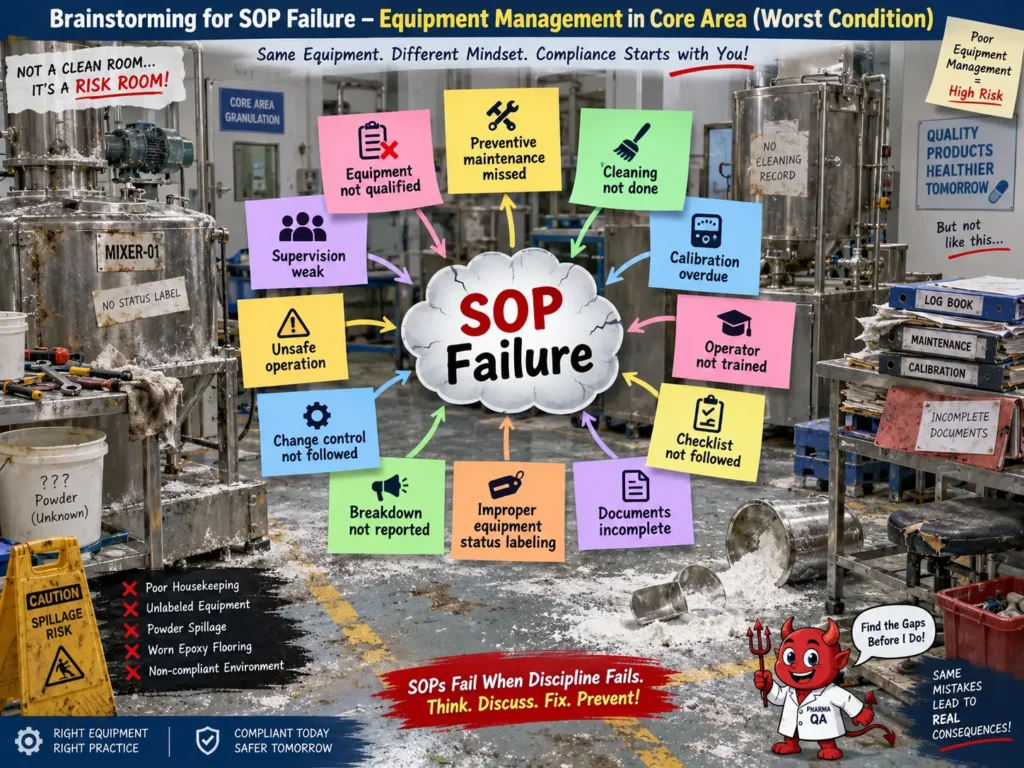
The surrounding area also shows poor housekeeping, powder spillage, worn flooring, unidentified materials, and disorganized records, representing how multiple small failures can combine into a serious GMP problem. These failures directly oppose the SOP requirements for equipment qualification, preventive maintenance, proper cleaning, safe operation, calibration, and requalification when equipment is modified or relocated. Overall, the brainstorming demonstrates that poor equipment control can lead to breakdowns, contamination, inaccurate results, process deviations, product-quality problems, safety risks, and regulatory observations.
5. 5-Why Analysis for SOP Failure:
The 5-Why Analysis explains how failure of the Equipment Management SOP can develop in a pharmaceutical core area. The problem starts when routine equipment controls such as maintenance, cleaning, calibration, and checklist verification are not followed. These controls are required under the SOP for proper equipment management.The second level shows that operators and supervisors may not follow the defined procedure correctly. The third “Why” points to inadequate training and weak daily supervision. The fourth level identifies weak documentation and control systems, such as incomplete records, missed follow-up, and poor change-control practices.
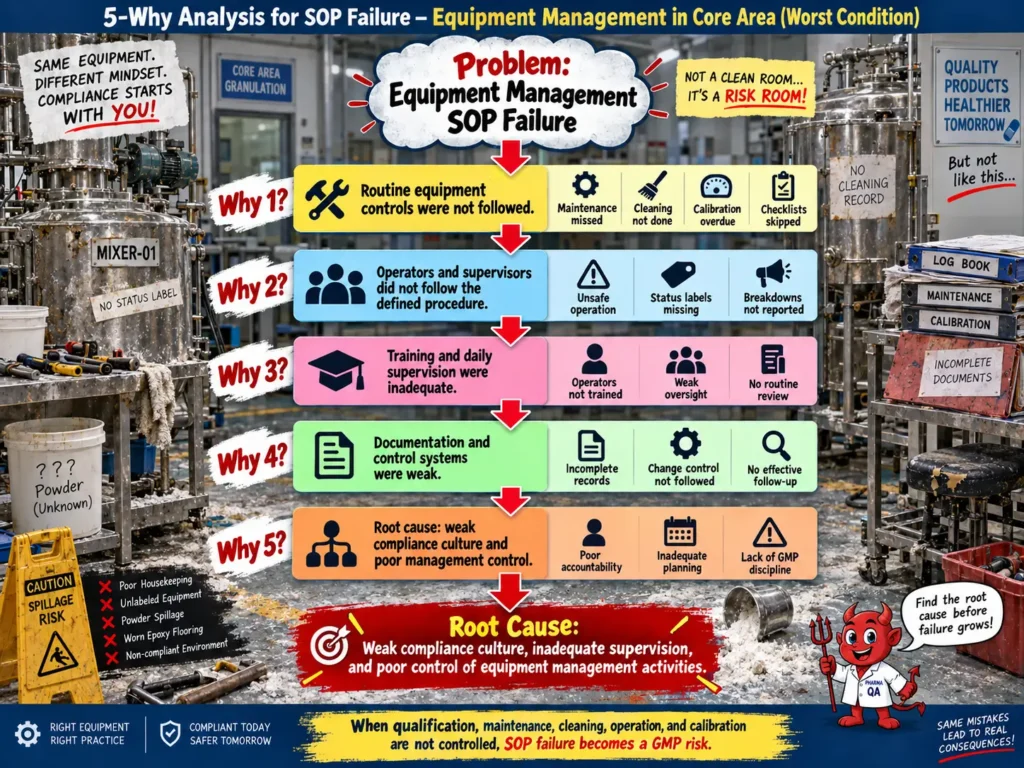
The fifth “Why” reaches the main root cause: weak compliance culture, poor accountability, inadequate planning, and insufficient management control. Overall, the diagram shows that SOP failure is usually not caused by a single mistake. It develops through repeated weaknesses in qualification, maintenance, cleaning, operation, calibration, documentation, training, and supervision.
6. Fishbone Analysis for SOP Failure:
The Fishbone Analysis shows the possible causes that can lead to failure of the Equipment Management SOP in a pharmaceutical core area. The effect identified in the diagram is “Equipment Management SOP Failure.” The causes are grouped into six major categories: Man, Machine, Method, Measurement/Documentation, Environment, and Management. Under Man, key issues include untrained operators, weak supervision, unsafe operation, and failure to report breakdowns. Under Machine, the diagram highlights unqualified equipment, missed preventive maintenance, overdue calibration, and missing status labels. Under Method, common failures include not following the SOP, skipping cleaning, missing checklists, and not following change control.
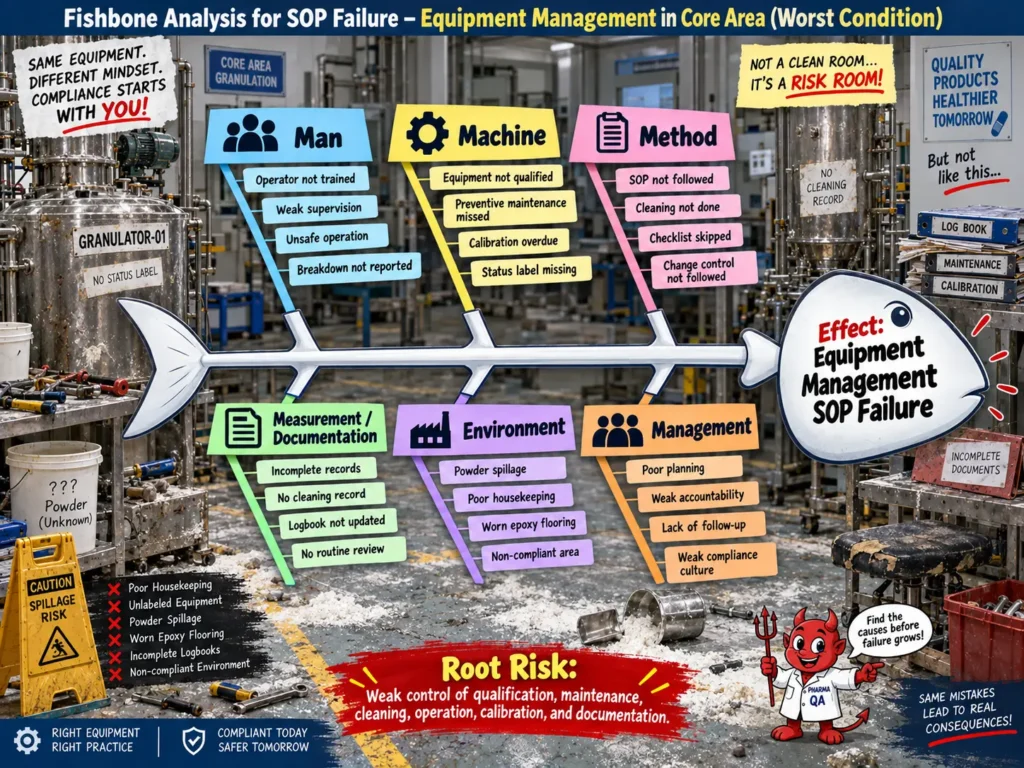
The Measurement/Documentation section shows incomplete records, missing cleaning records, outdated logbooks, and lack of routine review. Environmental causes include powder spillage, poor housekeeping, worn epoxy flooring, and a non-compliant area. Management-related causes include poor planning, weak accountability, lack of follow-up, and weak compliance culture. These causes relate directly to the SOP requirements for qualification, preventive maintenance, cleaning, operation, calibration, and proper control of equipment. Overall, the analysis shows that equipment-management failure usually results from multiple system weaknesses occurring together rather than one single mistake.
7. Fault Tree Analysis for SOP Failure:
The Fault Tree Analysis (FTA) diagram explains how different failures can combine and lead to the top event: Equipment Management SOP Failure. The major contributing branches shown are equipment not suitable for use, SOP not followed properly, inadequate documentation, and an unsuitable operating environment. Equipment-related causes include qualification not performed, preventive maintenance not completed, and calibration becoming overdue or out of limit. This directly relates to the SOP requirement for DQ, IQ, OQ, PQ, preventive maintenance, and calibration control.
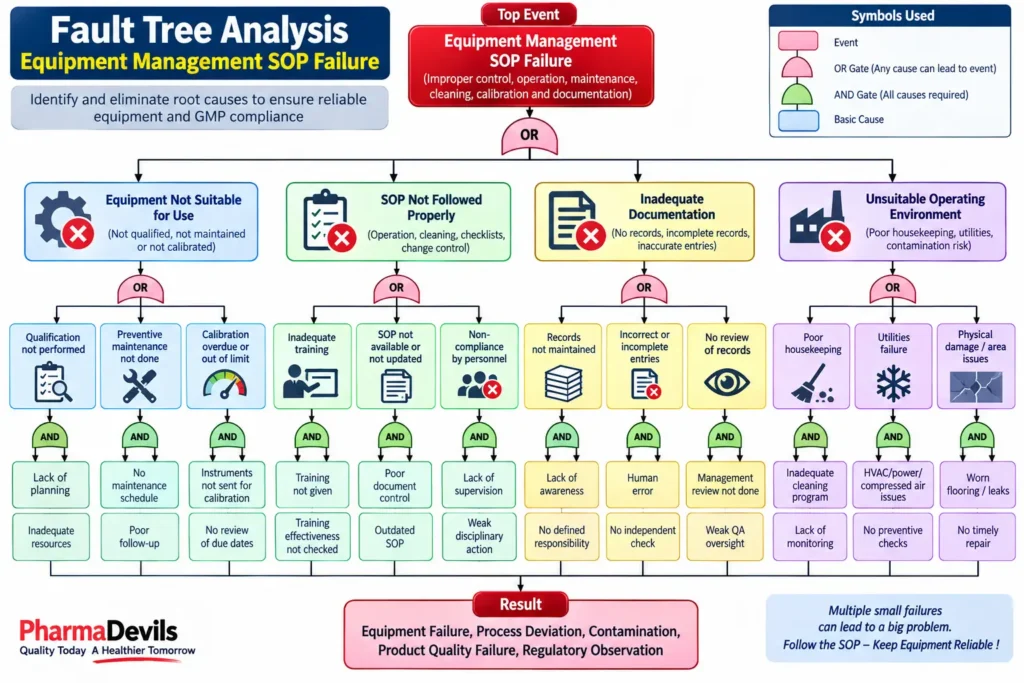
The second branch covers procedural failures such as inadequate training, outdated or unavailable procedures, and non-compliance by personnel. Documentation failures include missing records, incomplete entries, and lack of review. Environmental causes shown include poor housekeeping, utility problems, and physical damage within the area.The diagram uses OR gates to show that any one major failure can contribute to the event, while AND gates show situations where multiple underlying causes may act together. Overall, the FTA demonstrates that weak control of qualification, maintenance, cleaning, operation, calibration, documentation, training, and facility conditions can ultimately result in equipment failure, process deviation, contamination risk, product-quality problems, and regulatory observations.
8. Impact Assessment for SOP Failure:
The Impact Assessment image shows the possible consequences when the Equipment Management SOP is not followed properly. The impact can affect product quality, patient safety, regulatory compliance, operations, finances, personnel, environment, and documentation systems. Failure to maintain, clean, operate, qualify, or calibrate equipment can result in breakdowns, downtime, process deviations, contamination risk, inconsistent product quality, batch rejection, and additional investigation or rework. This is directly related to the SOP requirements for qualification, preventive maintenance, cleaning, operation, and calibration.
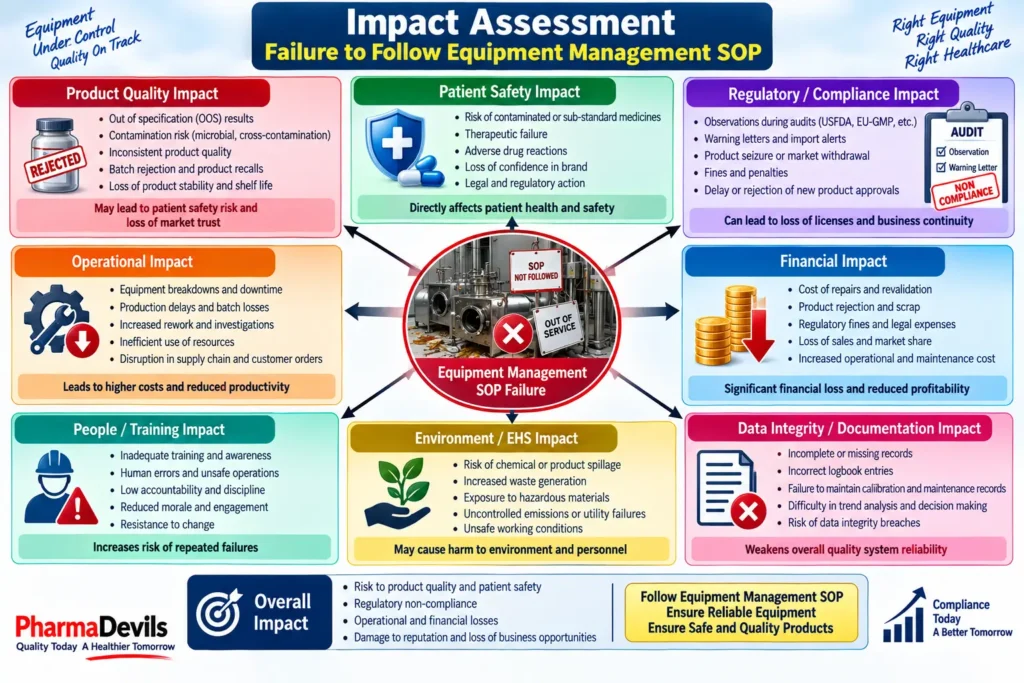
Poor equipment management may also lead to incomplete records, incorrect logbook entries, missing maintenance or calibration documentation, unsafe working conditions, and repeated human errors. These failures can weaken the overall pharmaceutical quality system. Overall, the image emphasizes that failure to follow the Equipment Management SOP can create quality risks, operational losses, compliance problems, financial impact, and potential patient-safety concerns. Proper SOP implementation helps maintain reliable equipment and consistent pharmaceutical processing.
Questions & Answers:
- Q: What is the objective of the Equipment Management SOP?
A: The objective is to provide a guideline for systematic equipment management. - Q: Which equipment is covered under this SOP?
A: It applies to manufacturing, measuring, testing, and process-control equipment used in Warehouse, Manufacturing, Maintenance, and Quality Control areas. - Q: Who is responsible for executing this SOP?
A: Warehouse, Production, Maintenance, Quality Control, and Quality Assurance staff are responsible for execution. - Q: Who is responsible for effective implementation of the SOP?
A: The respective department heads, including Warehouse, Maintenance, Quality Control, Quality Assurance, and Head-QA/QC, are responsible for implementation. - Q: What are the main stages of equipment qualification?
A: The SOP includes Design Qualification, receipt checking, Installation Qualification, Operational Qualification, Performance Qualification, and handover for use. - Q: When should Design Qualification be performed?
A: Design Qualification should be completed before ordering the equipment. - Q: What is required during Installation Qualification?
A: Installation Qualification of new equipment is required along with allocation of an equipment code number. - Q: Does Operational Qualification include personnel training?
A: Yes. The SOP specifies that Operational Qualification should include training of personnel. - Q: When is equipment requalification required?
A: Requalification is required when equipment is modified or relocated. - Q: What is required under the preventive maintenance program?
A: Minimum spare inventory should be established, preventive maintenance should be performed as scheduled, and records should be maintained. - Q: Why should previous preventive-maintenance activities be reviewed?
A: The review helps identify repeated breakdowns and activities that may not require frequent monitoring. Any changes to the maintenance checklist should be controlled through change control. - Q: What should an equipment cleaning procedure include?
A: It should define the cleaning sequence, cleaning-agent name and concentration, extent of dismantling, sanitation requirements, and safety precautions where required. - Q: What should an equipment operating procedure include?
A: It should describe assembling of parts, sequential operating steps, and safety precautions wherever required. - Q: What should an equipment calibration procedure contain?
A: It should include the calibration procedure, responsibility, acceptance criteria, details and traceability of reference standards, and actions for out-of-calibration equipment. - Q: What points are checked before new equipment is considered ready for processing?
A: The checklist includes DQ, IQ, OQ, PQ, preventive maintenance, cleaning and operational SOPs, calibration of relevant components, and equipment calibration status.
Reference Guideline:
As per the uploaded Equipment Management SOP, the official reference stated in Section 5.0 is:
Reference: In House — the SOP does not cite any specific external regulatory guideline.
The SOP also includes Annexure-I: Checklist for New Equipment, covering DQ, IQ, OQ, PQ, preventive maintenance, cleaning/operation SOPs, and calibration status.