







1. Introduction – SOP for Good Documentation Practices:
The SOP for Good Documentation Practices establishes standardized requirements for recording, maintaining, correcting, reviewing, and controlling GMP/GLP documentation within the pharmaceutical quality system. Its objective is to ensure that all manually generated GMP and GLP records are completed in a consistent, clear, legible, accurate, and traceable manner. The SOP applies to relevant GMP/GLP records and provides general documentation requirements unless more specific instructions are defined in another approved SOP or document. The procedure covers requirements such as signing and dating entries, standardized date and time formats, correction of incorrect entries without overwriting, handling of blank spaces, use of indelible ink, chronological recording, authorization of document changes, recording of unusual observations, missed entries, rounding of values, due-date assignment, and specimen signatures. These practices help maintain the reliability, integrity, traceability, and controlled status of pharmaceutical documentation throughout its lifecycle.
Skip to PDF content2. Flow Diagram – SOP for Good Documentation Practices:
The SOP for Good Documentation Practices provides a systematic approach for creating, recording, correcting, reviewing, and maintaining GMP/GLP documentation. The flow begins with ensuring that the approved document or format is available and that entries are made using permanent blue or black indelible ink. All information should be recorded clearly, legibly, chronologically, and immediately after completion of the activity, with appropriate date, time, initials, or signature.
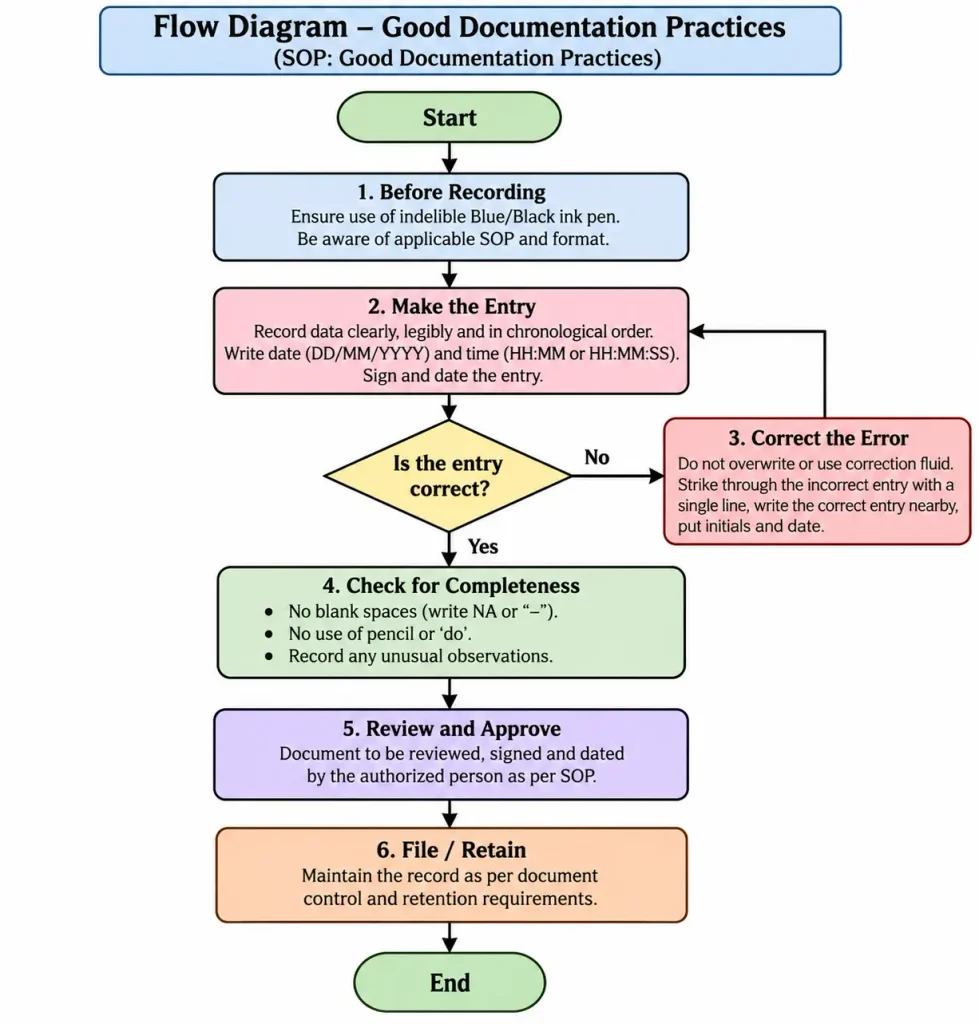
If an incorrect entry is identified, it should not be overwritten or obscured; instead, it should be struck through with a single line, corrected nearby, and appropriately initialled and dated. Blank spaces should not be left in GMP records, and unusual observations should be properly documented. These controls support accurate, traceable, consistent, and reliable pharmaceutical documentation.
3. Benefits of Following SOP for Good Documentation Practices:
Following the SOP for Good Documentation Practices ensures that pharmaceutical records are created and maintained in a clear, accurate, legible, and traceable manner. The SOP requires entries to be signed and dated, recorded in chronological order, written using permanent ink, and corrected without overwriting or obscuring the original information.
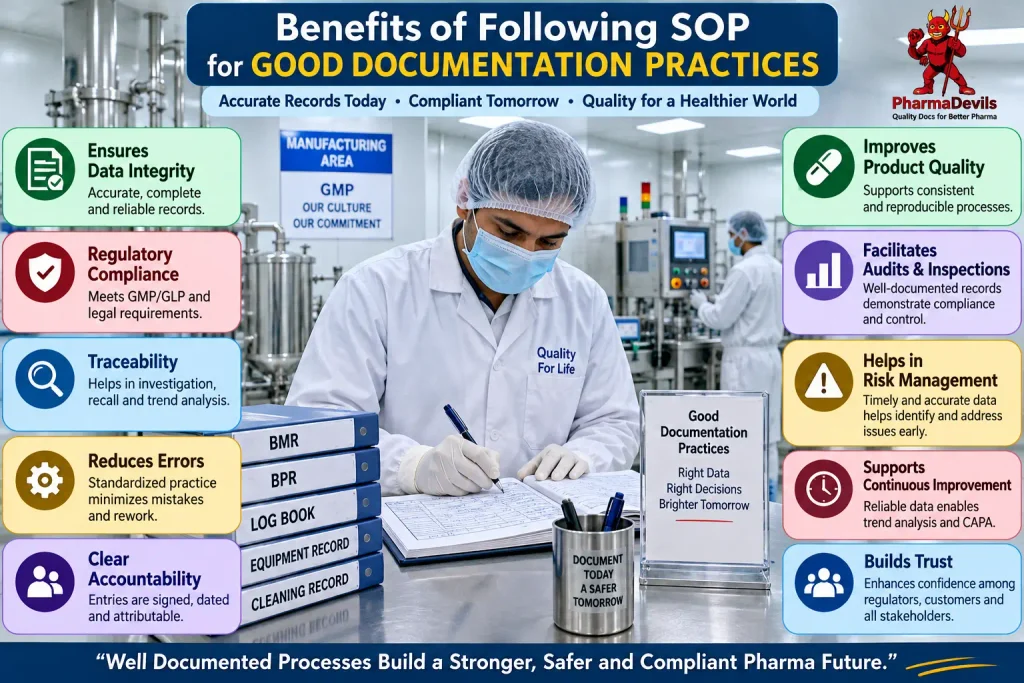
Proper implementation of this SOP supports data integrity, regulatory compliance, accountability, traceability, error reduction, audit readiness, and consistent product quality. It also helps investigators review historical activities, identify deviations, support CAPA, and verify that manufacturing and quality operations were performed as intended. Requirements for recording date and time, correcting errors, handling blank spaces, documenting missed steps, and maintaining authorized records strengthen overall GMP control and improve confidence in the reliability of pharmaceutical documentation.
4. Brainstorming for SOP Failure – Good Documentation Practices:
The Brainstorming for SOP Failure – Good Documentation Practices highlights potential causes that may lead to poor or non-compliant documentation in pharmaceutical manufacturing. The SOP requires entries to be clear, legible, chronological, signed and dated, with no overwriting, blank spaces, pencil use, or correction fluid. It also requires unusual observations to be recorded and document changes to be properly authorized.
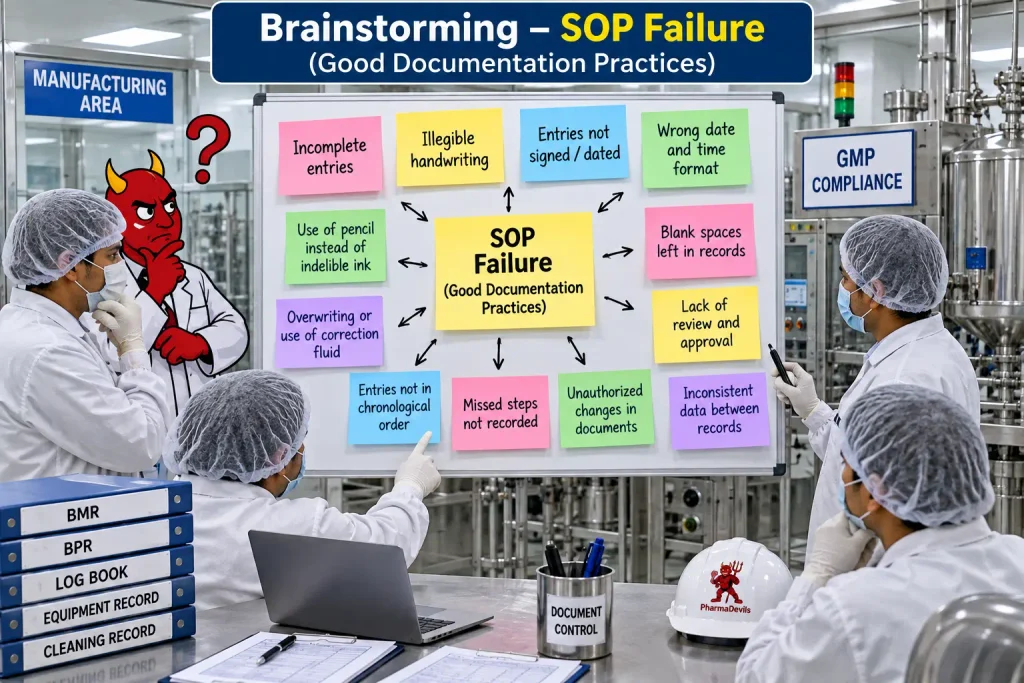
The brainstorming exercise identifies possible failure factors such as inadequate training, lack of awareness, time pressure, confusing formats, weak supervision, use of incorrect writing tools, missed entries, blank spaces, human errors, unauthorized changes, and poor documentation culture. Such weaknesses can result in incomplete or unreliable GMP records. The SOP therefore emphasizes immediate documentation, proper date and time recording, controlled correction of errors, and traceable entries to maintain reliable pharmaceutical documentation.
5. 5-Why Analysis for SOP Failure – Good Documentation Practices:
The 5-Why Analysis for SOP Failure – Good Documentation Practices is used to identify the underlying reasons why GDP requirements may not be followed consistently in a pharmaceutical manufacturing area. The analysis starts with documentation failures such as incomplete, unclear, unsigned, or delayed entries and then traces the problem through successive contributing causes. The attached SOP requires entries to be clear, legible, chronological, signed and dated, with no overwriting, blank spaces, pencil use, or unauthorized changes.
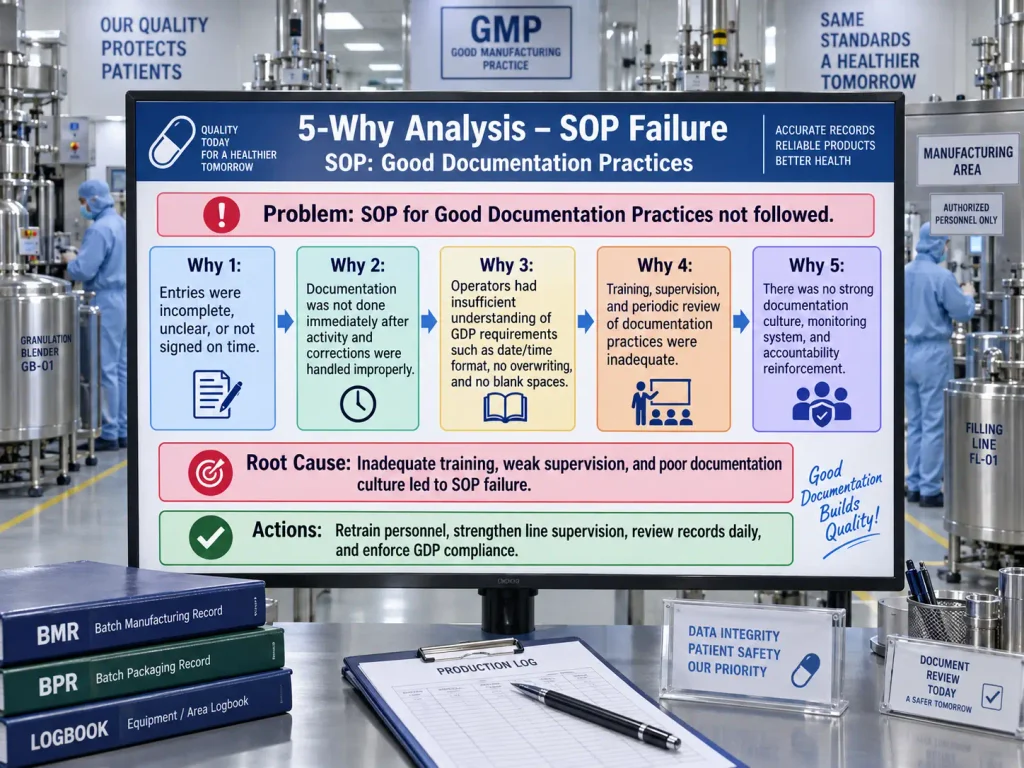
The 5-Why sequence may reveal causes such as delayed documentation, inadequate understanding of date/time and correction requirements, insufficient training, weak supervision, and lack of a strong documentation culture. The likely root cause is therefore a combination of training gaps, inadequate monitoring, and weak reinforcement of GDP requirements. Corrective actions should focus on retraining personnel, strengthening supervisory review, and routinely verifying compliance with documentation practices.
6. Fishbone Analysis for SOP Failure – Good Documentation Practices:
The Fishbone Analysis for SOP Failure – Good Documentation Practices is used to identify and organize the possible causes responsible for non-compliance with documentation requirements in the pharmaceutical manufacturing area. The analysis groups potential causes under key categories such as Man, Method, Machine/Tools, Material/Documents, Environment, and Management.
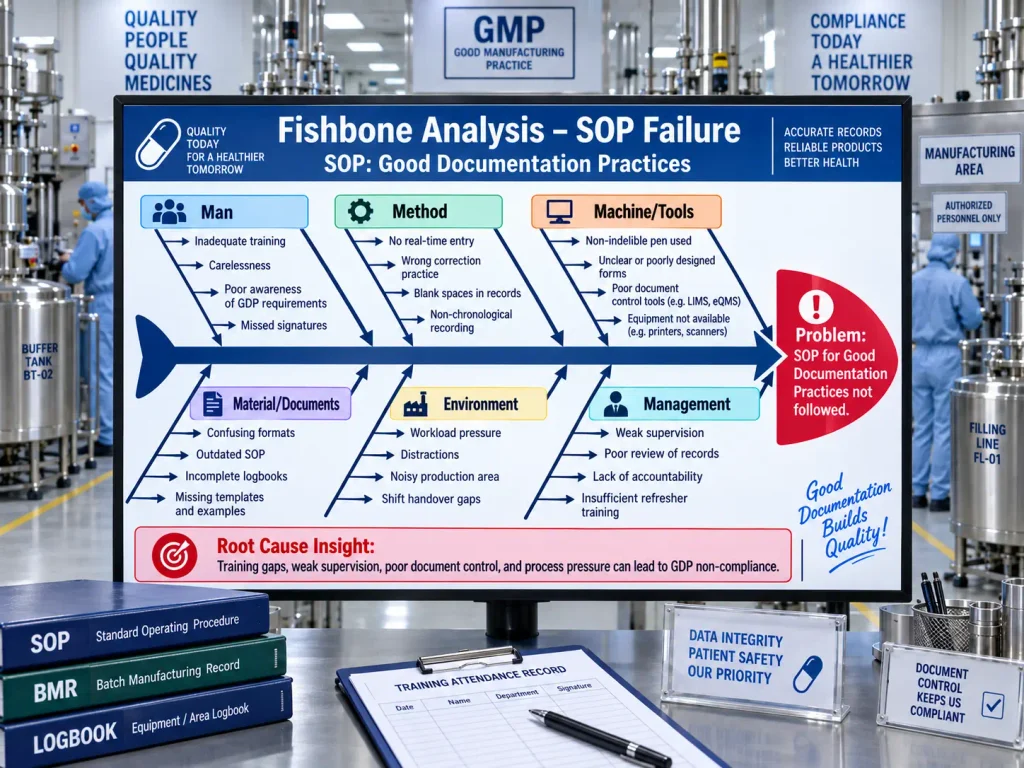
Typical contributing factors include inadequate training, poor awareness of GDP requirements, missed signatures, delayed or non-chronological entries, incorrect correction practices, use of non-indelible pens, confusing formats, incomplete logbooks, workload pressure, weak supervision, and insufficient record review. These factors can result in incomplete, inaccurate, unclear, or poorly controlled GMP documentation. The SOP specifically requires entries to be legible, chronological, signed and dated, free from unauthorized changes, and corrected without overwriting or obscuring the original entry. The Fishbone Analysis therefore helps identify systemic weaknesses and supports targeted actions such as retraining personnel, strengthening supervision, improving document control, and reinforcing compliance with Good Documentation Practices.
7. Fault Tree Analysis for SOP Failure – Good Documentation Practices:
The Fault Tree Analysis for SOP Failure – Good Documentation Practices identifies the possible pathways that can lead to inadequate or non-compliant documentation in a pharmaceutical manufacturing area. The top event is failure to follow the requirements of the Good Documentation Practices SOP. This may arise through incomplete or missing entries, incorrect or unclear entries, or unauthorized changes. The SOP requires data entries to be clear, legible, chronological, signed and dated, while prohibiting overwriting, blank spaces, pencil use, correction fluid, and unauthorized document changes.
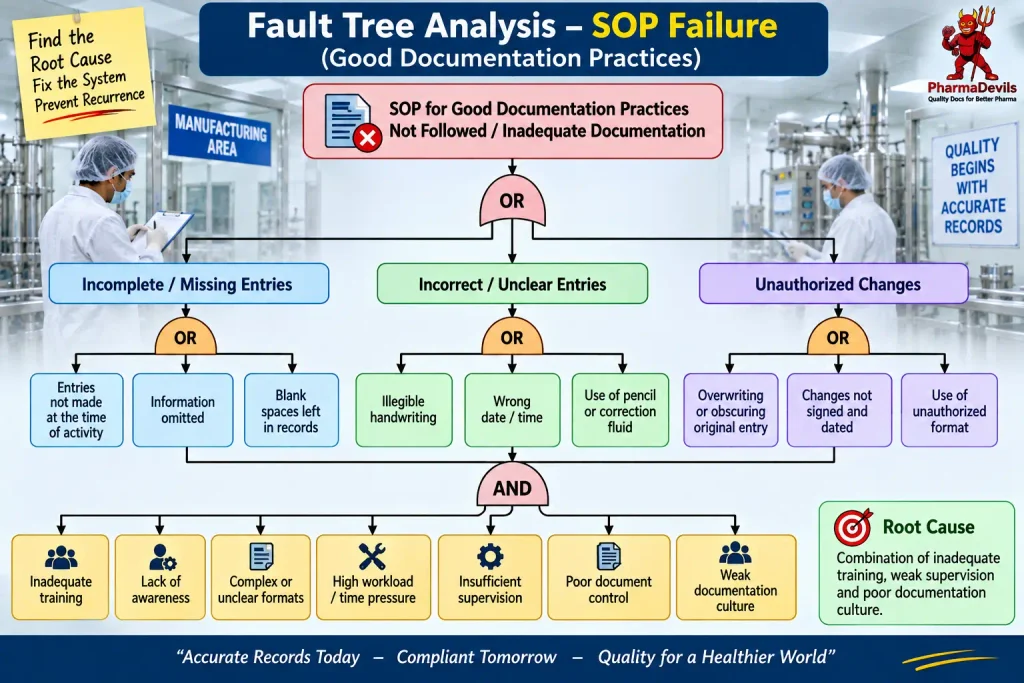
The fault tree further links these failures to underlying causes such as inadequate training, poor awareness, complex formats, workload pressure, insufficient supervision, weak document control, and poor documentation culture. By identifying how individual failures combine, the analysis helps determine appropriate CAPA, including retraining, stronger supervisory checks, improved document formats, and periodic compliance review.
8. Impact Assessment for SOP Failure – Good Documentation Practices:
The Impact Assessment for SOP Failure – Good Documentation Practices evaluates the potential consequences when documentation requirements are not properly followed in a pharmaceutical manufacturing area. The SOP requires records to be clear, legible, chronological, signed and dated, with no overwriting, blank spaces, pencil use, correction fluid, or unauthorized changes. Failure to comply with these requirements can result in incomplete or unreliable records, reduced traceability, difficulty during record review, and inability to reconstruct manufacturing activities accurately. The SOP also requires data to be recorded immediately after completion of an activity and specifies controlled correction of recording errors.
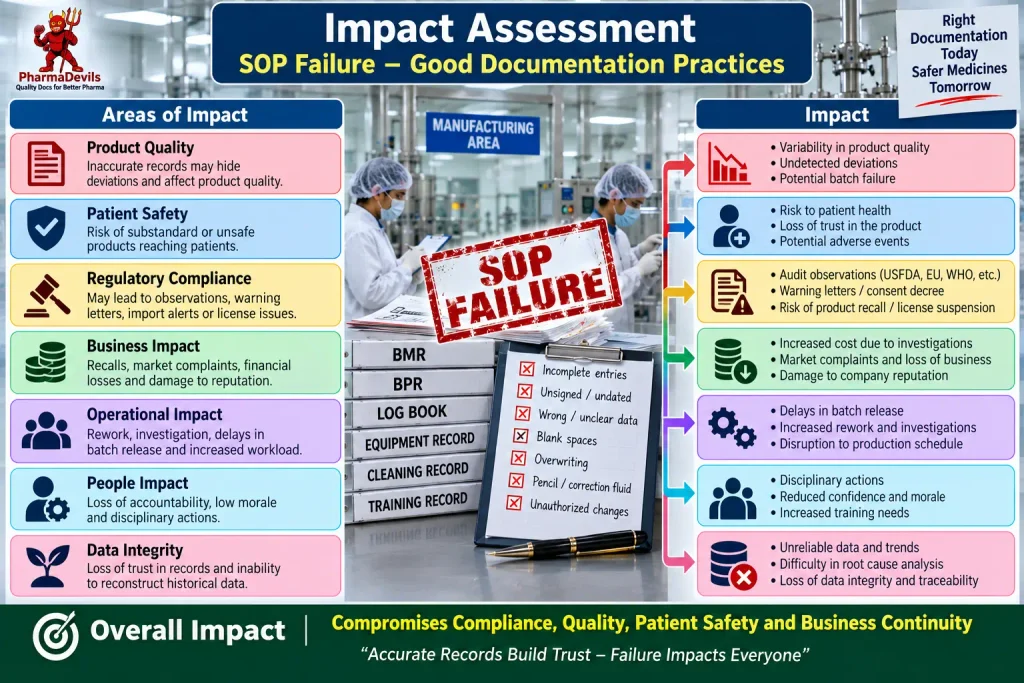
Therefore, non-compliance may adversely affect data integrity, documentation reliability, accountability, investigation effectiveness, and overall GMP control. The impact assessment helps identify vulnerable areas and supports appropriate corrective and preventive actions to strengthen documentation practices.
Question & Answer – SOP for Good Documentation Practices
- Q: What is the objective of the SOP for Good Documentation Practices?
A: To lay down the procedure for Good Documentation Practices for GMP/GLP records. - Q: Who is responsible for execution of this SOP?
A: The Chemist/Executive-QA is responsible for execution, while the Asst. Manager-QA and Head-QA/QC are responsible for effective implementation. - Q: What type of pen should be used for documentation?
A: Permanent blue or black indelible ink pen should be used for signing master documents. - Q: When should data entries be recorded?
A: Data entries should be recorded, signed, and dated immediately after completion of each activity. - Q: What is the required date format?
A: The date should be written as DD/MM/YYYY or DD/MM/YY. - Q: What is the required time format?
A: Time should be written in HH:MM or HH:MM:SS format using the 24-hour clock system. - Q: Is overwriting allowed in GMP records?
A: No. Incorrect entries should not be overwritten, blocked, or made unreadable. They should be struck through with a single line so the original entry remains readable. - Q: How should an incorrect entry be corrected?
A: Strike through the incorrect entry with a single line, make the correct entry nearby, and add initials and the date of correction. For major changes, the reason should also be recorded. - Q: Can correction fluid, white ink, or erasers be used?
A: No. Correction fluid, white ink, and erasers should not be used. - Q: Can blank spaces be left in GMP records?
A: No. Blank spaces should not be left. The SOP requires writing NA or “-”, and blank unused spaces should be appropriately struck through and initialled/dated. - Q: Is the use of pencil permitted?
A: No. Use of pencil is not allowed. - Q: How should unusual observations be handled?
A: Unusual observations should be recorded, signed, and dated. - Q: How should entries in logbooks be made?
A: Entries should be made in chronological order. - Q: Can a missed step be documented later?
A: Yes, but only when it can be demonstrated that the step was actually performed and only the documentation was missed. The person making the late entry should initial and date it. - Q: Can observed values be rounded off?
A: No. Rounding is applicable to calculations, not to observed readings. Fixed specification limits should not be rounded. - Q: How are due dates assigned in GMP records?
A: Due dates are calculated according to the defined frequency of the activity from the date on which the activity is performed. - Q: Who should have a specimen signature recorded?
A: Personnel involved in writing or filling GMP and GLP records should have their signatures recorded in the specimen signature log maintained by Quality Assurance. - Q: What records are specifically referenced by the SOP?
A: The SOP includes documentation controls applicable to records such as BMR, BPR, logbooks, GMP/GLP records, and Site Master File documentation.
Reference Guidelines – SOP for Good Documentation Practices
- Good Manufacturing Practices (GMP) – applicable requirements for proper creation, completion, correction, review, and control of pharmaceutical documentation.
The SOP also refers to compliance-related sources such as the Drugs and Cosmetics Act, 1940, Drugs Rules, 1945, the current edition of the Indian Pharmacopoeia, and other relevant guidance documents officially issued by the Ministry of Health and Family Welfare, Government of India. These are mentioned within the procedure as supporting compliance resources, although the formal “Reference” section itself lists only GMP.
Reference: Good Manufacturing Practices (GMP) and applicable statutory/regulatory requirements related to pharmaceutical documentation.