







1. Brief Description:
The Hold Time Study SOP defines the documented procedure for establishing the acceptable holding period of pharmaceutical products and intermediates before further processing or final packing. Its main purpose is to demonstrate that a product remains stable and meets defined quality requirements while stored in bulk or intermediate containers prior to packaging. The study is generally performed on the initial three batches and includes applicable intermediate manufacturing stages. Quality Assurance prepares and controls the Hold Time Study Protocol and Report, collects in-process samples, maintains documentation, and assigns the study number. Samples are stored in simulated containers under conditions similar to routine manufacturing and are transferred to Quality Control for testing against approved specifications. The study is also required when storage conditions or manufacturing processes change. If an established holding time is exceeded, a deviation is raised and the product is retested before further processing.
Skip to PDF content2. Flow Diagram:
The Hold Time Study Flow Diagram presents the systematic sequence used to establish the acceptable holding period of pharmaceutical products and intermediate stages before further processing or final packing. The process begins with identification of a new product, storage-condition change, or process change. Quality Assurance then prepares the Hold Time Study Protocol and Report, selects the required initial batches, defines applicable intermediate stages, and assigns a unique study number.
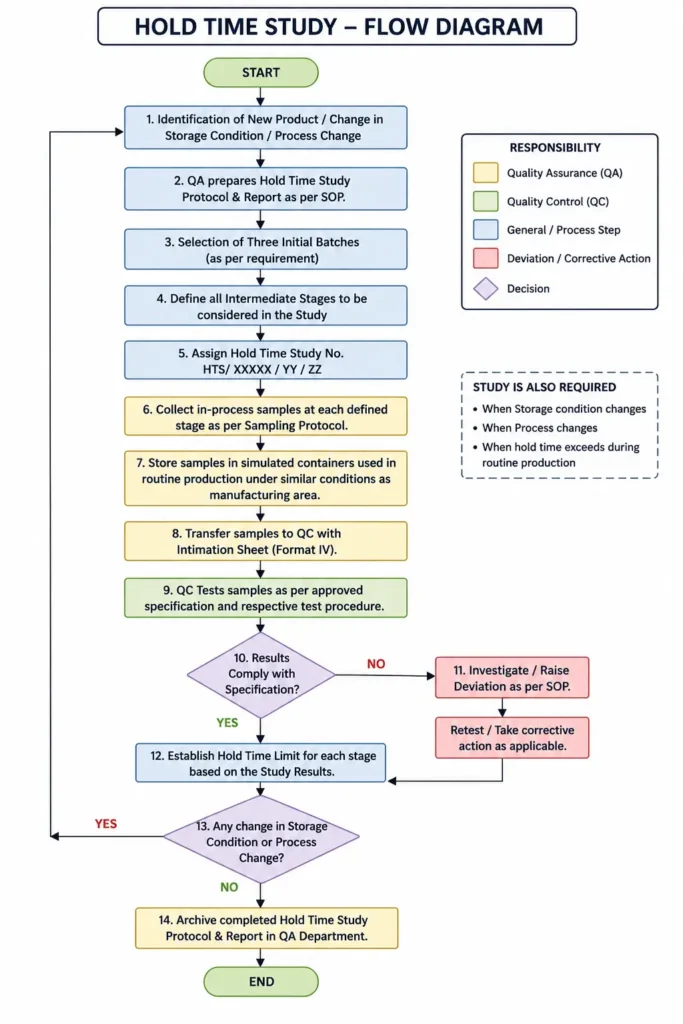
Samples are collected according to the approved sampling protocol and stored in simulated containers under conditions similar to routine manufacturing. The samples are then transferred to Quality Control for testing against approved specifications and respective test procedures. Based on satisfactory results, the acceptable hold-time limit is established. If the hold time is exceeded or storage/process conditions change, deviation, retesting, or a new study may be required. Completed protocols and reports are finally archived in the Quality Assurance department.
3. Brainstorming:
Brainstorming for Hold Time Study SOP failure is used to systematically identify possible causes that can lead to unreliable study results, product-quality risks, or GMP non-compliance. The key areas reviewed include incomplete protocol preparation, incorrect batch selection, improper sampling, unsuitable storage conditions, delayed transfer of samples to Quality Control, testing errors, and incomplete documentation.
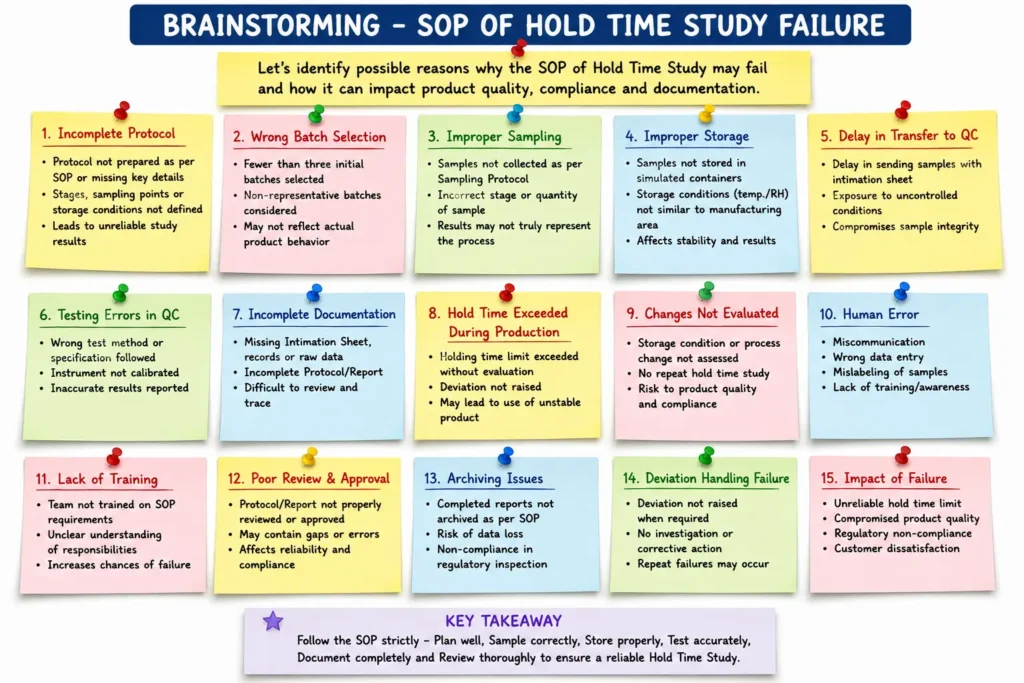
The brainstorming exercise also considers situations such as exceeding the established holding period during routine production, failure to evaluate process or storage-condition changes, human errors, inadequate training, poor review and approval, archiving deficiencies, and ineffective deviation handling. These potential causes are discussed by representatives from Quality Assurance, Quality Control, and Production to understand where the Hold Time Study process may fail. The outcome of brainstorming helps the investigation team identify probable causes, prioritize further investigation, and establish suitable corrective and preventive actions to ensure reliable hold-time limits and consistent product quality.
4. 5 Why Analysis:
The 5 Why Analysis is a structured root-cause investigation tool used to determine why the Hold Time Study SOP failed or was not implemented effectively. The analysis begins with a defined problem, such as unreliable hold-time results, incorrect sampling, inaccurate testing, exceeding the approved holding period, or failure to evaluate process and storage changes.
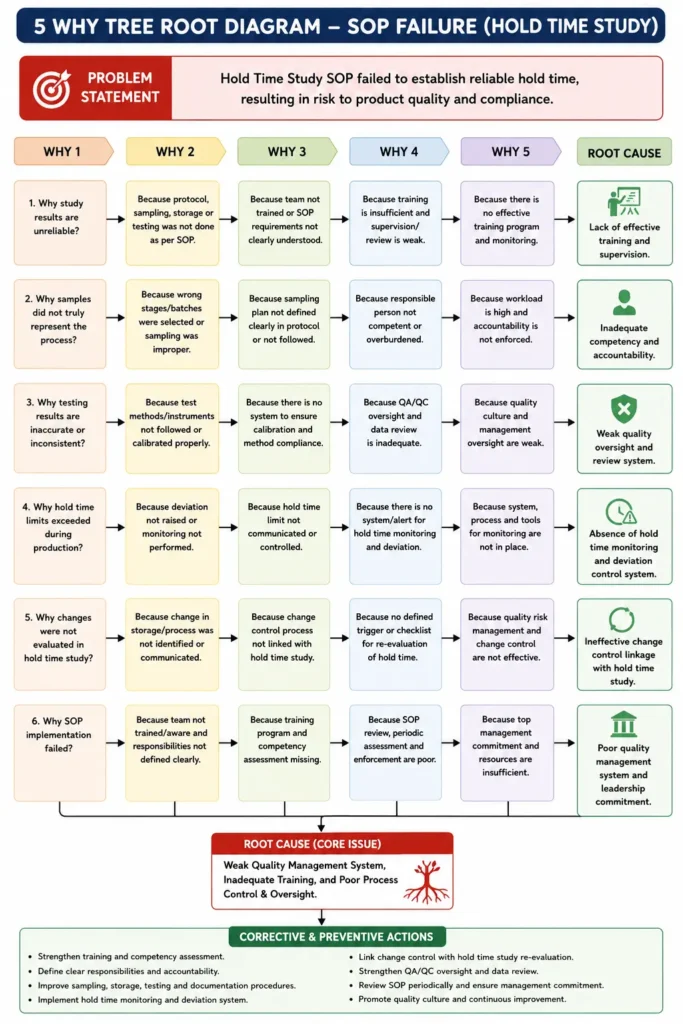
Each “Why” progressively explores the underlying reasons, such as improper protocol preparation, inadequate sampling plans, insufficient training, weak supervision, poor QA/QC review, ineffective deviation handling, and inadequate process controls. The SOP specifically requires controlled sample storage, approved testing, evaluation of storage or process changes, and deviation handling when the holding time is exceeded. The 5 Why approach helps identify the true root cause rather than only the immediate error, enabling appropriate CAPA such as improved training, monitoring, accountability, SOP compliance, and stronger quality-system oversight.
5. Heat Map (FMEA):
The Heat Map for Hold Time Study SOP Failure is a visual risk-assessment tool used to identify, classify, and prioritize possible failures associated with execution of the Hold Time Study. It evaluates failure modes such as incomplete protocol preparation, incorrect sampling, improper sample storage, delay in transfer to Quality Control, testing errors, exceeding established hold time, inadequate documentation, and failure to evaluate process or storage-condition changes. These areas reflect key controls required by the SOP, including controlled sample storage, testing against approved specifications, deviation handling, and reassessment following process or storage changes.
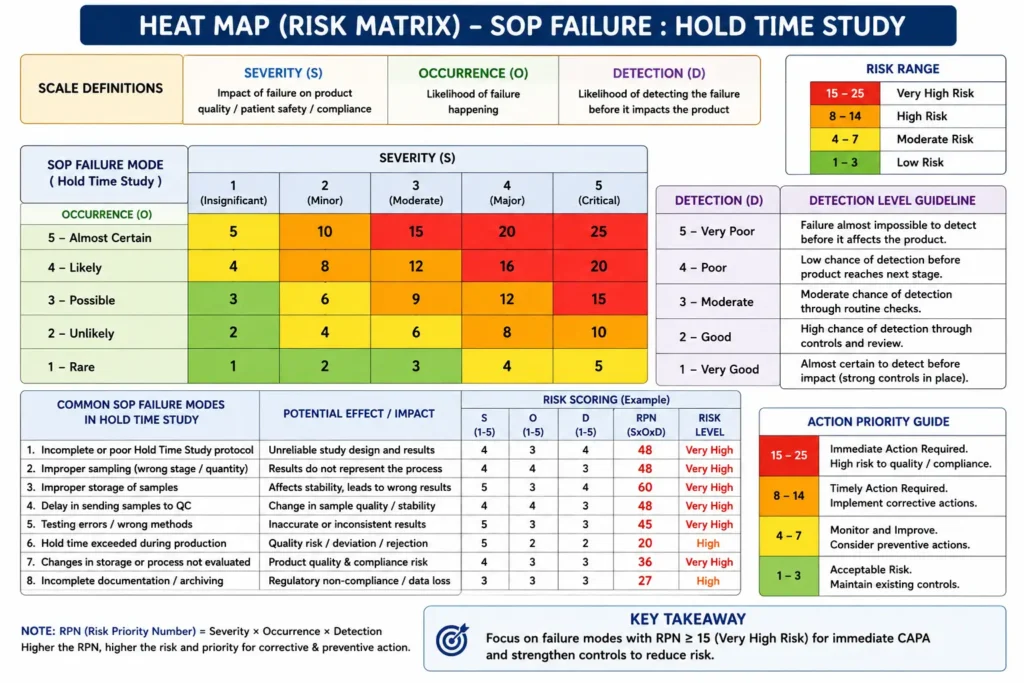
Risks are evaluated using Severity, Occurrence, and Detection, and an RPN can be calculated to support prioritization. Higher-risk failures require immediate investigation and CAPA, while moderate or low risks may be managed through monitoring and preventive controls. The heat map helps QA, QC, and Production focus resources on the most critical weaknesses affecting product quality, data reliability, and GMP compliance.
Questions & Answers
Q1. What is a Hold Time Study?
A Hold Time Study evaluates the period during which a pharmaceutical product or intermediate can be stored in a bulk container before final packing while maintaining acceptable quality.
Q2. What is the purpose of the Hold Time Study SOP?
The purpose is to define a documented procedure for hold time studies and establish the stability of products stored in bulk containers before packing.
Q3. What is the scope of the SOP?
The SOP is applicable for establishing time limits for completion of each phase of the product.
Q4. Who prepares the Hold Time Study Protocol?
Quality Assurance is responsible for preparing the Hold Time Study Protocol and maintaining the related documentation.
Q5. How many batches are considered for a Hold Time Study?
The SOP states that the three initial batches are to be considered, as required.
Q6. Which manufacturing stages are included in the study?
Applicable intermediate stages are considered according to the product and the relevant manufacturing procedure.
Q7. How should Hold Time Study samples be stored?
Samples should be stored in simulated containers used for routine production under conditions similar to the manufacturing area.
Q8. Who is responsible for testing the samples?
Quality Control is responsible for sample entry, analysis according to the defined procedure, and reporting results to Quality Assurance.
Q9. How are samples transferred to Quality Control?
Hold Time Study samples are transferred to QC with the prescribed intimation sheet for testing according to the approved specification.
Q10. When is a Hold Time Study required again?
The SOP requires a Hold Time Study when there is a change in the product’s storage condition or process.
Q11. What happens if the established holding time is exceeded during routine production?
A deviation should be raised according to the SOP, and the product should be tested again before final processing.
Q12. Where are completed Hold Time Study records maintained?
The completed Hold Time Study Protocol and Report are archived in the Quality Assurance department.
Q13. What reference is mentioned in the SOP?
The SOP references WHO TRS No. 992, Annexure 4 – General Guidelines for Hold Time Study.
Q14. What formats are included in the SOP?
Separate Hold Time Study Protocol and Report formats are provided for Tablets & Capsules, Liquid Injection, Dry Syrup & Dry Powder Injection, along with an intimation format for sample analysis.
Q15. Why is a Hold Time Study important?
It provides documented evidence that a product or intermediate can remain under specified holding conditions for a defined period before further processing or packing without compromising the intended study requirements.