







1. Introduction – SOP for HVAC Validation:
The SOP for HVAC Validation describes the systematic procedure for establishing documented evidence that the Heating, Ventilation and Air-Conditioning (HVAC) system installed in a pharmaceutical facility operates effectively and in accordance with current Good Manufacturing Practices (cGMP). The HVAC system plays a critical role in maintaining controlled environmental conditions by regulating temperature, relative humidity, airflow, pressure differentials, viable contamination, and non-viable particulate levels, thereby helping protect product quality from environmental contamination. The SOP covers important validation parameters including room air-change rates, HEPA filter integrity testing, airflow velocity, differential pressure, non-viable particle counting, viable environmental monitoring, and airflow visualization. It also defines monitoring frequencies and revalidation requirements to ensure the system continues to perform as intended throughout its operating range. Effective implementation of this SOP provides documented assurance that the HVAC system consistently maintains environmental conditions suitable for pharmaceutical manufacturing and quality-controlled areas.
Skip to PDF content2. Flow Diagram for HVAC Validation:
The Flow Diagram for HVAC Validation illustrates the sequential activities required to demonstrate that the pharmaceutical HVAC system performs consistently according to the approved SOP and defined acceptance criteria. The process begins with review of the SOP and validation requirements, followed by confirmation that the HVAC equipment and measuring instruments are ready and calibrated. Validation testing includes temperature and relative humidity monitoring, room air-change rate, airflow velocity, HEPA filter integrity, differential pressure, non-viable particle count, viable monitoring, and airflow visualization.
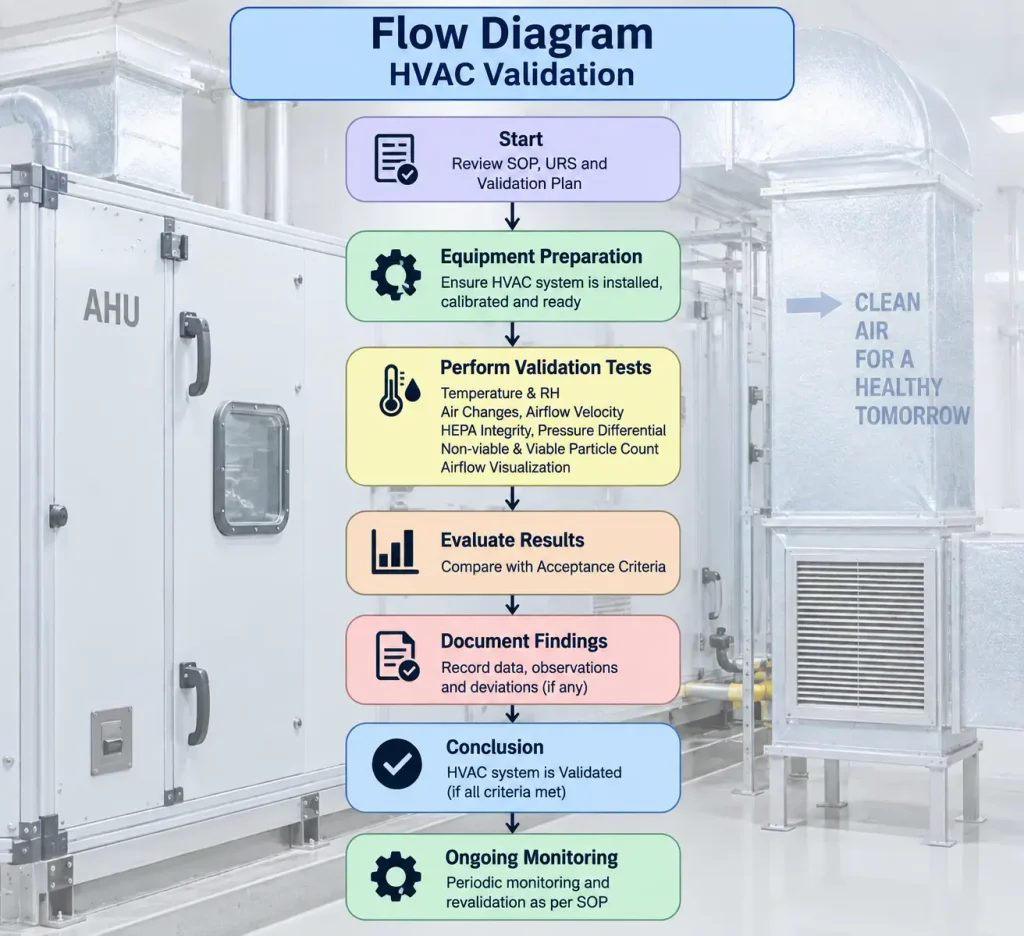
The obtained results are evaluated against specified acceptance criteria, and all observations, test data, and deviations are documented. When the required criteria are satisfactorily met, the HVAC system is considered validated. Periodic monitoring and revalidation are then performed to ensure continued system performance and maintenance of the required environmental conditions.
3. Benefits of Following SOP for HVAC Validation:
Following the SOP for HVAC Validation ensures that the pharmaceutical HVAC system is evaluated in a controlled, consistent, and documented manner. The procedure helps demonstrate that the system can maintain required environmental conditions such as temperature, relative humidity, air-change rate, airflow velocity, pressure differentials, viable contamination, non-viable particle levels, HEPA filter integrity, and airflow patterns.
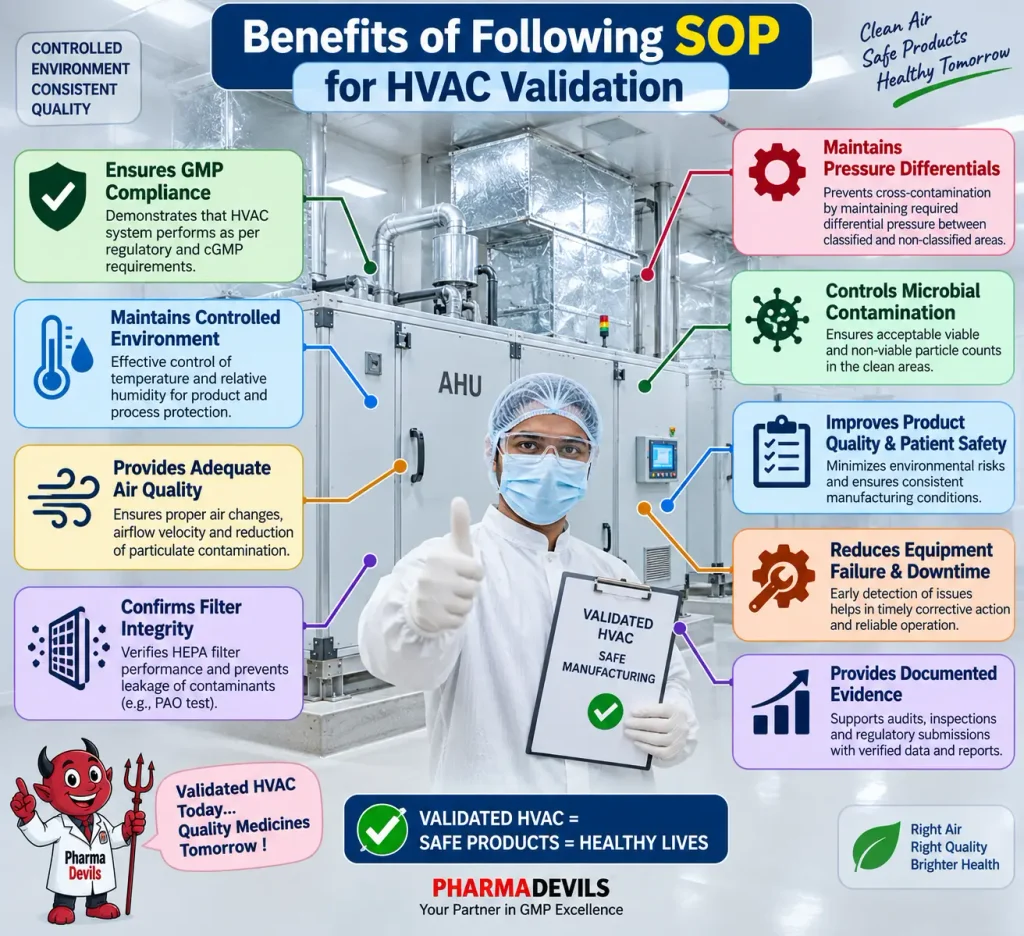
Proper implementation of the SOP supports maintenance of suitable cleanroom conditions, reduces the risk of contamination and cross-contamination, and provides documented evidence of HVAC performance. It also ensures that validation tests are performed at defined frequencies and that requalification is carried out periodically or whenever changes may affect system performance. Overall, adherence to the SOP strengthens GMP compliance, supports product quality, and helps maintain reliable environmental control throughout pharmaceutical manufacturing operations.
4. Brainstorming for SOP Failure in HVAC Validation:
The Brainstorming for SOP Failure in HVAC Validation diagram identifies possible causes that may lead to ineffective implementation of the SOP in the pharmaceutical manufacturing area. Key causes include inadequate training, poor understanding of the procedure, incomplete documentation, lack of supervision, uncalibrated instruments, failure to perform required HVAC monitoring, manpower shortage, communication gaps, delayed deviation reporting, and absence of periodic SOP review.
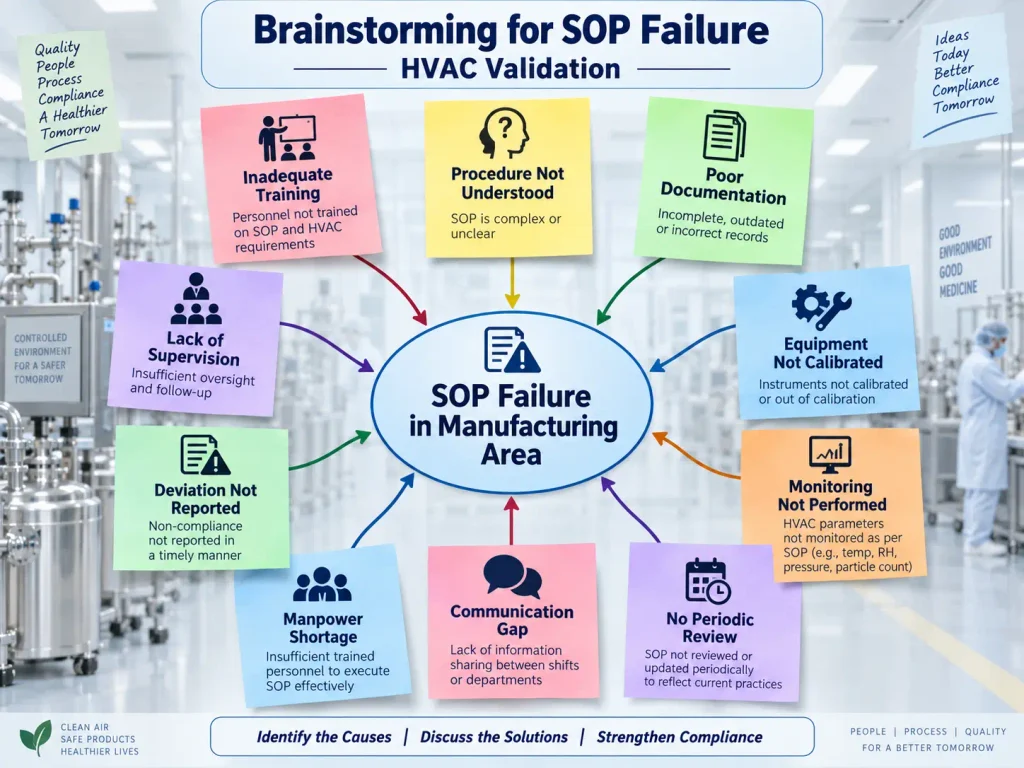
These failures can directly affect critical HVAC validation activities such as temperature and relative humidity monitoring, air-change rate verification, HEPA filter integrity testing, airflow velocity, differential pressure, viable monitoring, non-viable particle counting, and airflow visualization. The brainstorming exercise helps the Quality Assurance and Maintenance teams identify potential weaknesses, discuss corrective measures, strengthen personnel training and documentation practices, and ensure that HVAC validation and revalidation activities are performed at the defined frequencies.
5. 5-Why Analysis for SOP Failure in HVAC Validation:
The 5-Why Analysis for SOP Failure in HVAC Validation is used to systematically identify the underlying cause of non-compliance with the approved HVAC validation procedure in the pharmaceutical manufacturing area. The analysis begins with the observed problem that HVAC validation activities were not performed as required and progressively investigates why the failure occurred. The analysis may identify contributing causes such as inadequate understanding of the SOP, ineffective training, insufficient supervision, weak follow-up, poor document control, and inadequate quality-system oversight. These weaknesses can affect critical HVAC validation activities including temperature and relative humidity monitoring, room air-change verification, HEPA filter integrity testing, pressure differential monitoring, viable and non-viable particle monitoring, and airflow visualization.
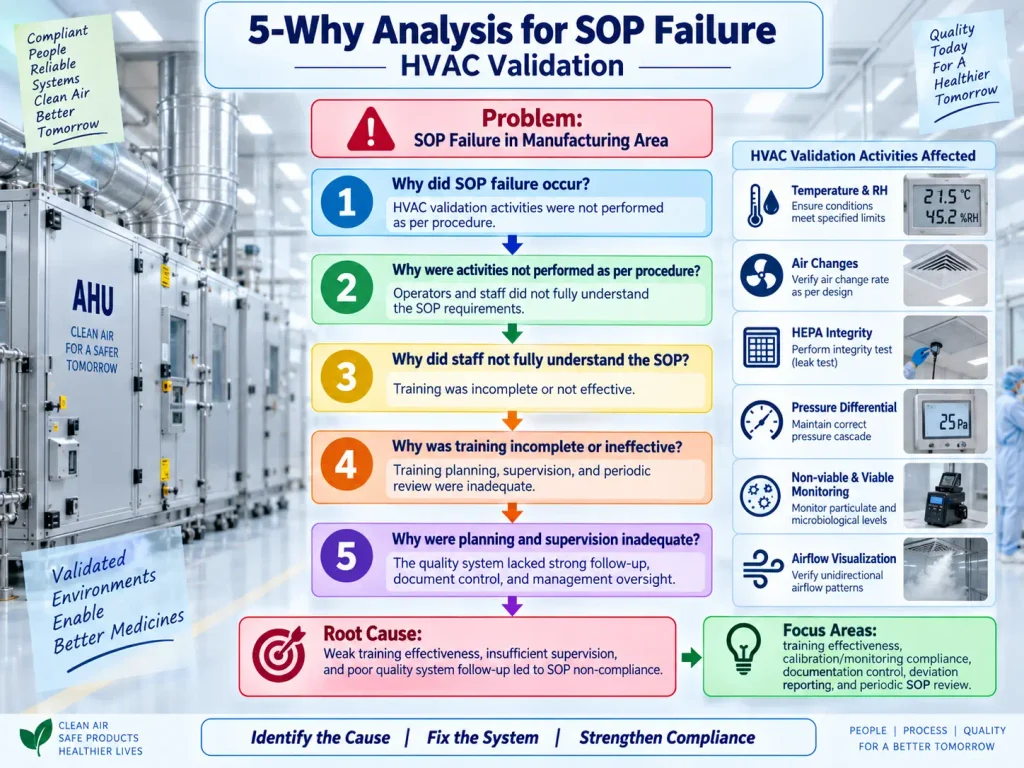
The purpose of the 5-Why approach is to move beyond the immediate failure and identify the true systemic root cause so that appropriate corrective and preventive actions can be implemented. Strengthening training, supervision, documentation, periodic review, and revalidation controls helps improve SOP compliance and sustain reliable HVAC performance.
6. Fishbone Analysis for SOP Failure in HVAC Validation:
The Fishbone Analysis for SOP Failure in HVAC Validation systematically identifies potential causes that can lead to failure in implementing the HVAC validation SOP within the pharmaceutical manufacturing area. The diagram groups possible causes under major categories such as Man/Personnel, Method/Procedure, Machine/Equipment, Measurement/Monitoring, Materials/Documentation, and Environment/Management. Typical causes include inadequate training, lack of awareness, manpower shortage, poor supervision, unclear instructions, uncalibrated instruments, equipment issues, incomplete monitoring, outdated SOPs, poor documentation practices, communication gaps, weak quality oversight, and failure to report deviations.
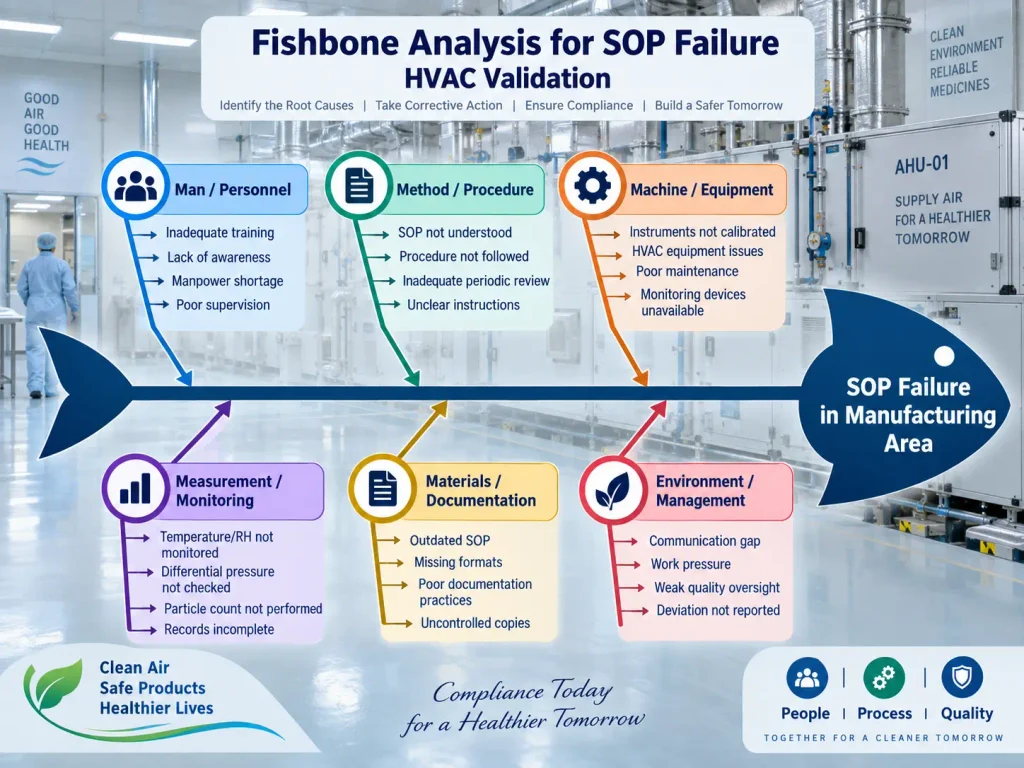
Such failures can affect critical HVAC validation activities including temperature and relative humidity monitoring, air-change rate verification, HEPA filter integrity testing, airflow velocity, differential pressure, viable and non-viable particle monitoring, and airflow visualization. The Fishbone Analysis helps the investigation team evaluate all possible contributing factors, identify the most probable root causes, and establish appropriate corrective and preventive actions to strengthen SOP compliance and maintain reliable HVAC performance.
7. Fault Tree Analysis for SOP Failure in HVAC Validation:
The Fault Tree Analysis for SOP Failure in HVAC Validation provides a structured method for identifying the possible events and basic causes that can lead to failure of the HVAC validation SOP in the pharmaceutical manufacturing area. The top event is SOP failure in HVAC validation, which may result from validation tests not being performed, test results falling outside acceptance criteria, or inadequate documentation and review. Potential causes include lack of training, manpower shortage, unavailable or overdue calibrated instruments, HVAC system malfunction, improper test methodology, environmental disturbances, incomplete records, failure to follow the procedure, unreported deviations, and inadequate QA review.
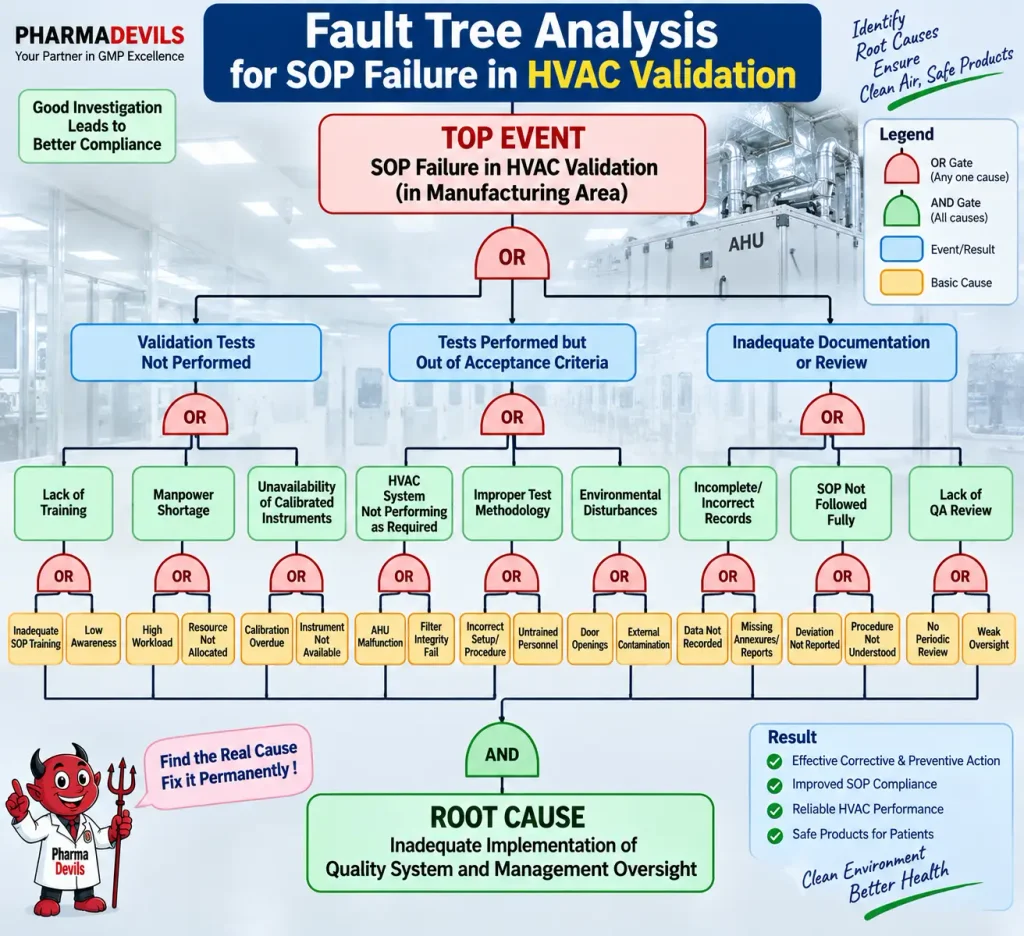
These causes can affect critical HVAC validation activities such as temperature and relative humidity monitoring, room air-change rate, HEPA filter integrity, airflow velocity, pressure differential, viable monitoring, non-viable particle counting, and airflow visualization. The analysis helps trace failures from the top event to their underlying causes so that effective CAPA, stronger quality-system controls, improved training, better documentation, and appropriate management oversight can be established.
8. Impact Assessment for SOP Failure in HVAC Validation:
The Impact Assessment for SOP Failure in HVAC Validation evaluates the potential consequences of not performing or controlling HVAC validation activities according to the approved procedure. The SOP establishes HVAC validation to provide documented evidence that the system controls viable and non-viable particulate exposure, temperature, and relative humidity within the pharmaceutical facility. Failure to follow the SOP may therefore compromise environmental control, including air-change rates, HEPA filter integrity, airflow velocity, pressure differentials, viable monitoring, non-viable particle counts, and airflow visualization. Such failures can reasonably lead to increased contamination risk, potential product-quality concerns, investigation and repeat-testing requirements, production delays, additional CAPA and revalidation activities, and adverse regulatory observations.
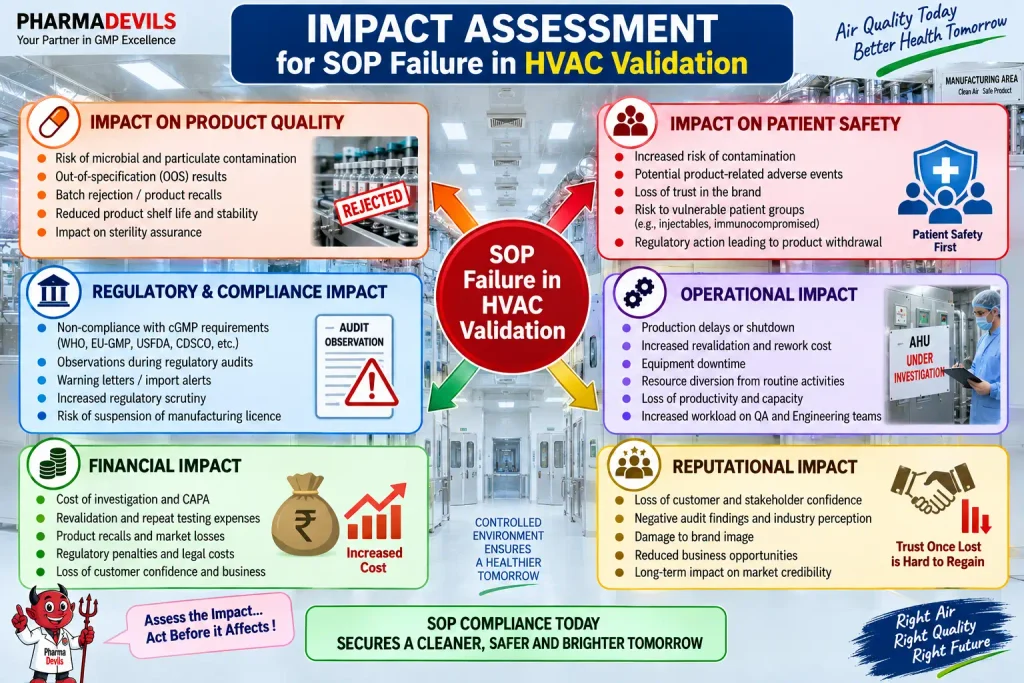
The assessment highlights the importance of timely monitoring, proper documentation, periodic qualification, and requalification whenever changes could affect HVAC performance. Effective SOP implementation supports consistent environmental control, reliable HVAC performance, and sustained GMP compliance.
Questions & Answers – SOP for HVAC Validation:
- What is the objective of the HVAC Validation SOP?
The objective is to establish documented evidence that the installed HVAC system functions according to cGMP requirements and controls viable and non-viable particulate exposure, temperature, and relative humidity. - What is the scope of the SOP?
The SOP is applicable to HVAC systems in the facility that may directly or indirectly affect product quality. - Who is responsible for execution of the HVAC Validation SOP?
The Maintenance Department is responsible for execution, while QA and the Head-QA/QC are responsible for effective implementation. - Which major parameters are evaluated during HVAC validation?
The SOP covers temperature and RH, room air-change rate, HEPA filter integrity, airflow velocity, pressure differential, non-viable particle count, viable monitoring, and airflow visualization. - What is the acceptance criterion for temperature?
The specified temperature acceptance criterion is 25 ± 2°C. - What is the acceptance criterion for relative humidity?
The specified relative humidity acceptance criterion is 55 ± 5% RH. - How is the room air-change rate determined?
Air velocity is measured using a calibrated anemometer, total airflow is determined, and air changes per hour are calculated based on room airflow and room volume. - What is the minimum acceptable air-change rate specified in the SOP?
The SOP specifies a minimum acceptable air-change rate of 20 air changes per hour. - Why is HEPA filter integrity testing performed?
It is performed to confirm that there is no damage to the HEPA filter or its seals and that particle leakage is controlled. - What is the acceptable HEPA filter leakage mentioned in the SOP?
The acceptable leakage is 0.01%. - Which instrument is used for airflow velocity measurement?
An anemometer is used for airflow velocity measurement. - Why is differential pressure monitored?
Differential pressure is monitored to maintain the required overpressure between adjacent areas and ensure airflow moves from cleaner areas toward less-clean areas. - Which instrument is used to measure differential pressure?
A calibrated digital manometer is used for differential pressure measurement. - Which equipment is used for non-viable particle counting?
An optical particle counter or discrete particle counter is used. - Which media is specified for viable monitoring?
The SOP specifies Soybean Casein Digest Agar for monitoring bacteria and fungi. - What is the recommended settle-plate size?
The recommended settle-plate size is 90 mm diameter. - How is airflow visualization performed?
Airflow visualization is performed using a water fogger and video recording to demonstrate the actual airflow pattern. - How frequently should HEPA filter integrity testing be performed according to the SOP?
HEPA filter integrity testing is specified once in 12 months. - How frequently should non-viable particle counting be performed?
The SOP specifies non-viable particle counting once in 6 months. - When should HVAC requalification be performed?
Requalification should be performed periodically, such as annually, and whenever a change occurs that could affect HVAC system performance. - What is Performance Qualification (PQ) according to the SOP?
PQ is documented verification that the process or system performs as intended throughout the anticipated operating range. - What annexures are included in the SOP?
The SOP includes annexures for viable count by settle plate, temperature and RH monitoring, non-viable particle count, and differential pressure monitoring.
Reference Guideline – SOP for HVAC Validation:
1. In-House Procedure / Internal Quality System Requirements
The SOP specifically lists “In House” as its reference.
The attached SOP does not cite external regulatory or international guidelines such as WHO, EU-GMP, ISO 14644, or FDA in its formal reference section. Although the SOP uses ISO cleanroom classification terminology within the procedure, those external standards are not listed as formal references in the document.