






1. Introduction for SOP for Verification of Interlocking in HVAC System:
This SOP describes the procedure for verification of interlocking functions within the HVAC system, including interlocks between AHUs, wet scrubbers, and dust collectors. It applies to HVAC systems serving tablet, injectable, microbiology, and other designated areas. The procedure requires prior intimation to the concerned department, placement of an “Under Preventive Maintenance” board, and systematic challenge of each interlock. Verification confirms that dependent AHUs start or stop according to the defined sequence and acceptance criteria. After successful verification, equipment is restored to normal operation. The interlocking verification is performed once annually, with an allowable variation of one month.
Skip to PDF content2. Flow Diagram for Verification of Interlocking in HVAC System:
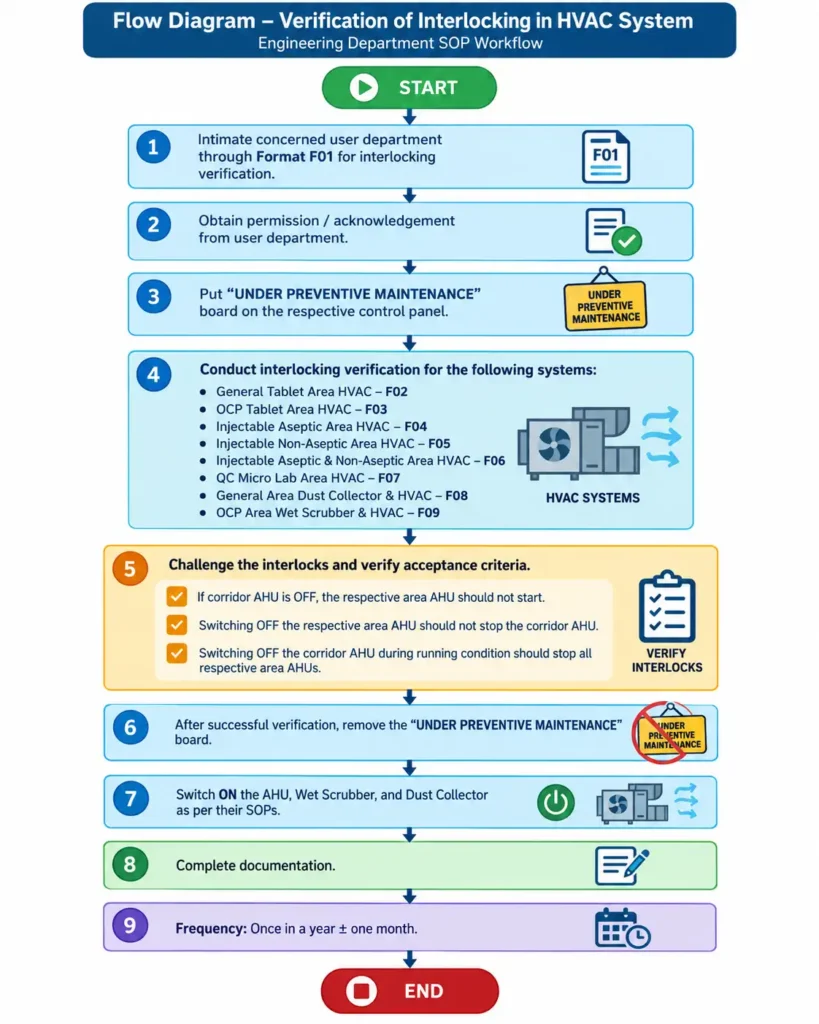
The flow diagram presents the step-by-step process for verification of HVAC system interlocking. It begins with informing the concerned department through Format F01 and obtaining permission before testing. An “Under Preventive Maintenance” board is placed on the control panel, followed by verification of interlocks for AHUs, dust collectors, and wet scrubbers across designated areas. Each interlock is challenged against defined acceptance criteria to confirm correct start-stop dependency. After successful verification, the maintenance board is removed, equipment is switched on as per applicable SOPs, and documentation is completed. Verification is performed once every year with an allowable variation of one month.
3. Brainstorming Analysis for HVAC Interlocking SOP Not Implemented:
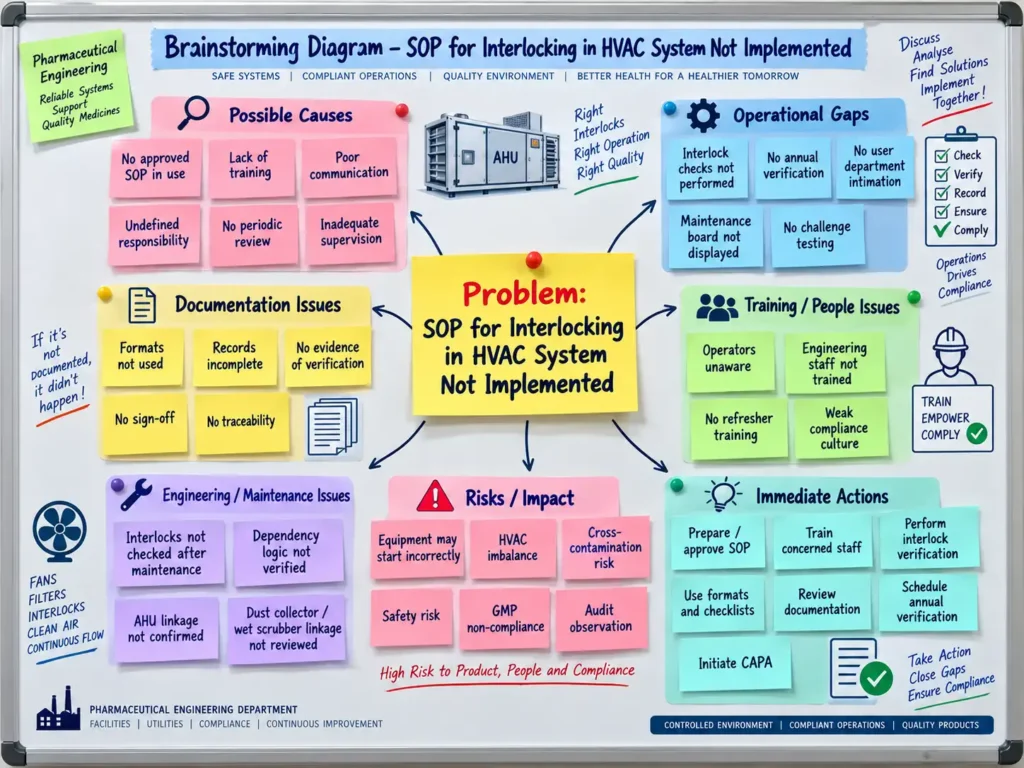
The brainstorming diagram identifies possible reasons and consequences when the SOP for HVAC interlocking is not implemented. Major causes include absence of an approved SOP, inadequate training, poor communication, undefined responsibilities, weak supervision, and lack of periodic review. Operational gaps may include missed interlock checks, no annual verification, incomplete documentation, and failure to challenge the interlocking logic. Engineering-related issues may involve unverified AHU, dust collector, and wet scrubber linkages. These gaps can result in HVAC imbalance, incorrect equipment operation, cross-contamination risk, safety concerns, GMP non-compliance, and audit observations. Immediate actions include SOP approval, training, verification, documentation review, and CAPA initiation.
4. 5 Why Analysis for HVAC Interlocking SOP Not Implemented:
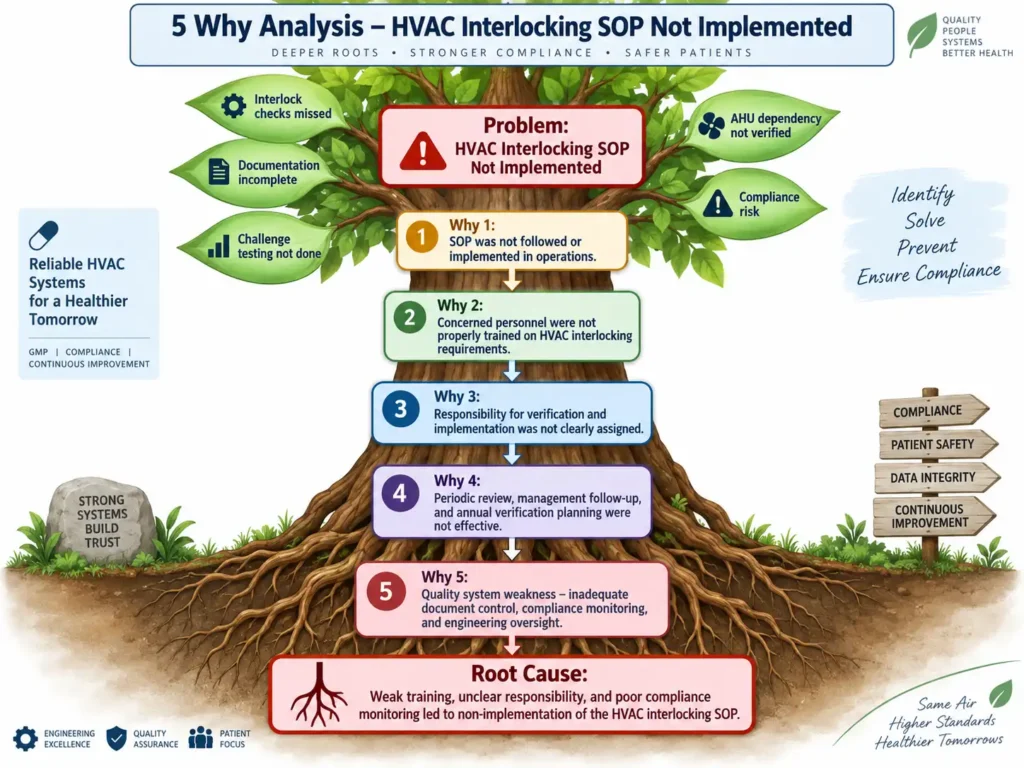
The 5 Why analysis identifies the underlying causes for non-implementation of the HVAC interlocking SOP. The first cause is failure to follow or implement the SOP in routine operations. This is linked to inadequate training of concerned personnel, unclear responsibility for verification and implementation, and weak periodic review and management follow-up. Further analysis indicates gaps in document control, compliance monitoring, and engineering oversight. These weaknesses can lead to missed interlock checks, incomplete records, unverified AHU dependency, and compliance risks. The root cause is inadequate training, unclear accountability, and insufficient compliance monitoring within the engineering and quality systems.
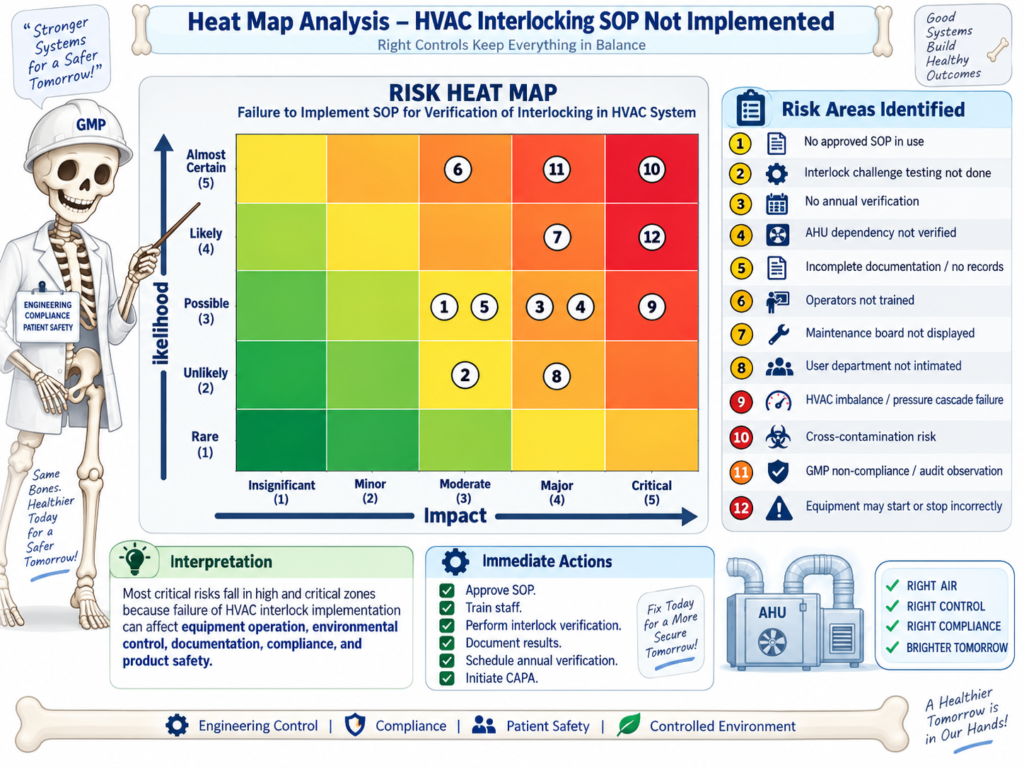
5. Heat Map Analysis for HVAC Interlocking SOP Not Implemented:
The heat map evaluates risks associated with non-implementation of the HVAC interlocking SOP by comparing likelihood against impact. Key concerns include missing SOP approval, lack of challenge testing, unverified AHU dependency, incomplete documentation, inadequate training, HVAC imbalance, cross-contamination, and GMP non-compliance. Risks positioned in orange and red zones require priority attention because they can affect equipment operation, environmental control, product safety, and regulatory compliance. The analysis supports immediate actions such as SOP approval, staff training, interlock verification, proper documentation, annual verification scheduling, and CAPA initiation to reduce risk and maintain reliable HVAC system performance.
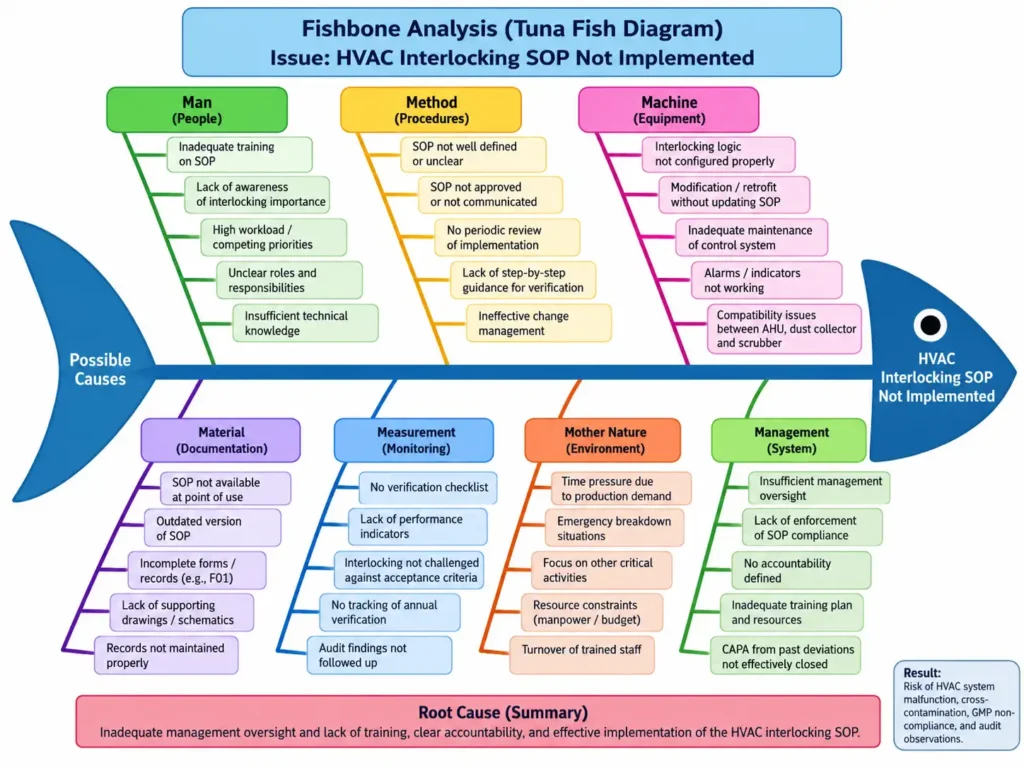
6. Fishbone Analysis for HVAC Interlocking SOP not Implemented:
The fishbone analysis identifies major causes responsible for non-implementation of the HVAC interlocking SOP. The causes are grouped under People, Procedures, Equipment, Documentation, Monitoring, Environment, and Management. Key issues include inadequate training, unclear responsibilities, missing or outdated SOPs, poor interlock configuration, incomplete records, absence of verification checklists, resource constraints, and weak management oversight. These factors can prevent proper challenge testing and annual verification of AHU, dust collector, and wet scrubber interlocks. The analysis indicates that inadequate oversight, insufficient training, unclear accountability, and ineffective SOP implementation are the principal root causes requiring CAPA and stronger compliance monitoring.
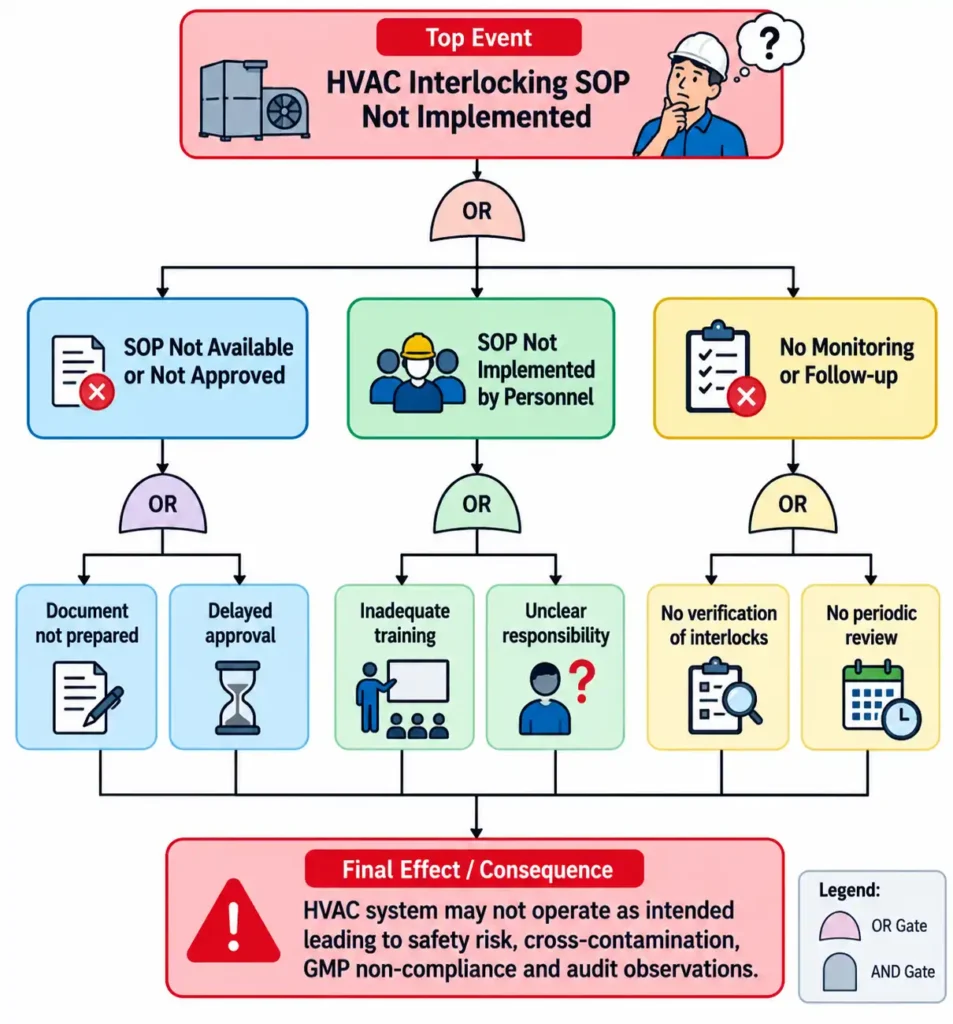
7. Fault Tree Analysis for HVAC Interlocking SOP Not Implemented:
The fault tree analysis identifies the main causes leading to non-implementation of the HVAC interlocking SOP. The top event is linked to three major failure areas: SOP not available or approved, SOP not implemented by personnel, and lack of monitoring or follow-up. Contributing causes include delayed document approval, inadequate training, unclear responsibilities, absence of interlock verification, and lack of periodic review. These failures can prevent proper control and verification of HVAC interlocking functions. The final consequence may include improper HVAC operation, safety risks, cross-contamination, GMP non-compliance, and audit observations, requiring corrective and preventive actions.
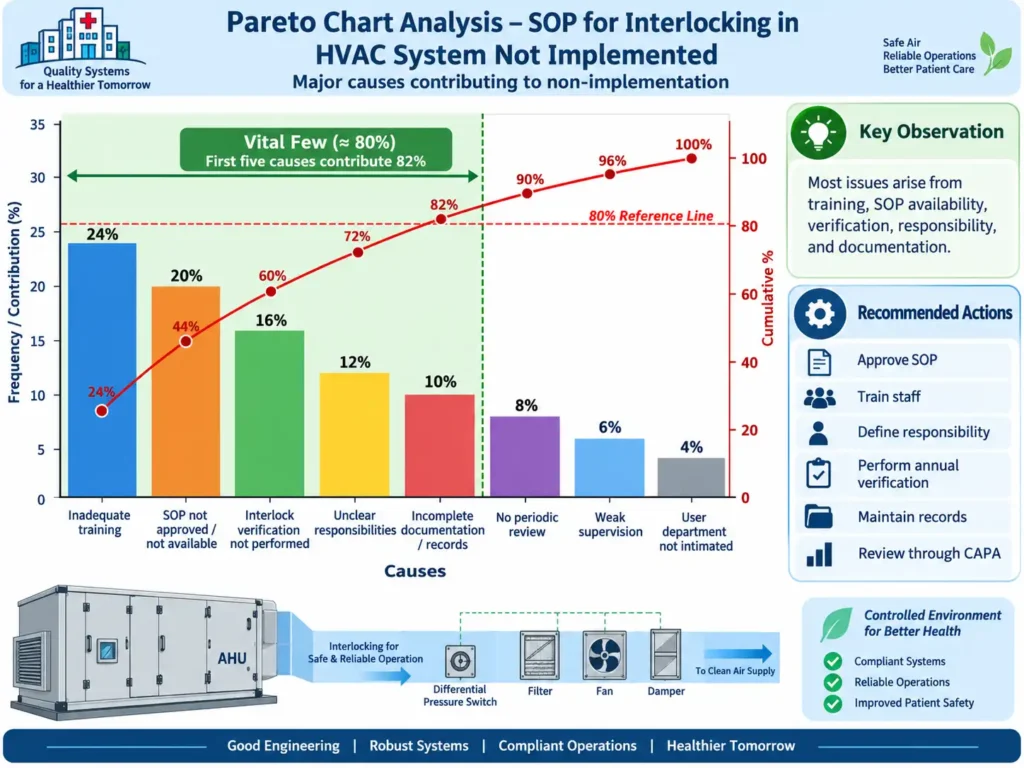
8. Pareto Chart Analysis for HVAC Interlocking SOP not Implemented:
The Pareto chart highlights the major causes contributing to non-implementation of the HVAC interlocking SOP. The highest contributors are inadequate training, SOP not approved or available, interlock verification not performed, unclear responsibilities, and incomplete documentation. Together, these first five causes account for approximately 82% of the identified issues, indicating priority areas for corrective action. Other contributing factors include lack of periodic review, weak supervision, and failure to intimate the user department. The analysis supports prioritizing SOP approval, personnel training, defined responsibilities, annual interlock verification, proper documentation, and CAPA monitoring to improve HVAC reliability, GMP compliance, and environmental control.
9. Corrective Action and Preventive Action with Effectiveness Review:
HVAC Interlocking SOP Not Implemented
The attached SOP requires Engineering to verify HVAC interlocks, complete associated documentation, obtain user-department permission before verification, and perform the activity once yearly ± one month.
| No. | Type | Action | Responsibility | Target |
|---|---|---|---|---|
| 1 | Correction | Immediately assess all affected HVAC systems to identify whether interlock verification is overdue or missing. | Engineering | Immediate |
| 2 | Corrective Action | Approve, issue, and implement the HVAC Interlocking SOP at applicable points of use. | Engineering / QA | 7 days |
| 3 | Corrective Action | Perform documented interlock verification for AHU-to-AHU, AHU-to-wet scrubber, and AHU-to-dust collector systems as applicable. | Engineering | 15 days |
| 4 | Corrective Action | Complete all applicable formats and record challenge results against defined acceptance criteria. | Engineering | During verification |
| 5 | Corrective Action | Train Engineering operators, officers, executives, and concerned user departments on the approved SOP. | Engineering / QA | 15 days |
| 6 | Corrective Action | Define responsible persons for planning, execution, review, and approval of HVAC interlock verification. | Engineering Head | 10 days |
| 7 | Preventive Action | Include annual HVAC interlock verification in the preventive-maintenance/calibration/qualification planner with due-date tracking. | Engineering | Ongoing |
| 8 | Preventive Action | Establish advance reminders before the annual due date and escalate overdue activities to Engineering Head and QA. | Engineering / QA | Ongoing |
| 9 | Preventive Action | Review interlock functionality after major maintenance, modification, control-logic change, or relevant equipment replacement. | Engineering | As applicable |
| 10 | Preventive Action | Conduct periodic QA review of completed interlock records, deviations, and overdue verification status. | QA | Quarterly |
| 11 | Preventive Action | Include HVAC interlock SOP compliance in internal audits and engineering self-inspection checklists. | QA / Engineering | Periodic |
| 12 | Preventive Action | Initiate deviation and CAPA whenever interlock challenge results fail acceptance criteria. | Engineering / QA | As required |
Effectiveness Review
Effectiveness should be reviewed after 3 months and again after the next scheduled annual verification cycle. The CAPA may be considered effective when 100% of applicable HVAC systems have documented interlock verification, trained personnel records are available, no overdue annual verification exists, all applicable formats are complete and traceable, and no repeat deviation or audit observation related to HVAC interlocking is identified. Challenge testing should demonstrate that the corridor and respective area AHUs respond according to the defined start/stop acceptance criteria.
Effectiveness conclusion:
Effective — when all above criteria are satisfactorily met.
Not Effective — if any recurring failure, overdue verification, documentation gap, or interlock malfunction is identified; CAPA should then be reopened and reassessed.
10. Questions & Answers – SOP for Interlocking in HVAC System
- What is the purpose of the HVAC interlocking SOP?
The purpose is to define the procedure for verification of HVAC interlocking between AHU-to-AHU, AHU-to-wet scrubber, and AHU-to-dust collector systems. - What is the scope of this SOP?
The SOP applies to AHUs, dust collectors, and wet scrubbers. - Who is responsible for performing HVAC interlock verification?
Engineering operators are responsible for verification, while Engineering Officers/Executives are responsible for verification and completion of documentation. - Who is responsible for overall compliance with the SOP?
The Manager or designee is responsible for overall SOP compliance. - What should be done before starting interlock verification?
The concerned user department should be informed through Format F01 and permission should be obtained before verification. - What board should be displayed during verification?
An “UNDER PREVENTIVE MAINTENANCE” board should be placed on the respective control panel. - Which areas are covered by HVAC interlocking verification?
The SOP covers General Tablet, OCP Tablet, Injectable Aseptic, Injectable Non-Aseptic, combined Injectable areas, QC Micro Lab, General Area Dust Collector, and OCP Wet Scrubber HVAC systems. - What happens if the corridor AHU is OFF?
The respective area AHU should not start when the corridor AHU is not operational. - What happens when a respective area AHU is switched OFF?
The corridor AHU should continue running and should not stop. - What happens if the corridor AHU is switched OFF during operation?
All respective area AHUs linked to it should also stop. - How is the HVAC interlock challenged?
The required AHUs are deliberately started or stopped under defined conditions and their response is checked against the specified acceptance criteria. - What should be done after successful verification?
The “UNDER PREVENTIVE MAINTENANCE” board should be removed after successful verification. - What should be done with the equipment after verification?
The AHU, wet scrubber, and dust collector should be switched ON as per their respective SOPs. - What is the frequency of HVAC interlocking verification?
Verification should be performed once in a year ± one month. - What is the purpose of the interlocking verification format?
The format records the interlock description, challenge procedure, acceptance criteria, and observations. - Why is HVAC interlocking verification important?
According to the SOP’s acceptance criteria, verification confirms that linked AHUs start and stop in the intended sequence and that dependencies between systems function correctly.
11. Expanded Reference Guidelines – HVAC Interlocking System:
The attached SOP itself lists Section 6.0 – Reference Guidelines as “N.A.” . For a stronger GMP reference section, the following external guidelines can be cited where applicable:
- WHO Technical Report Series (TRS) No. 1019, Annex 2 (2019) – WHO Good Manufacturing Practices for Heating, Ventilation and Air-Conditioning Systems for Non-Sterile Pharmaceutical Products. It covers HVAC design, airflow direction, pressure differentials, filtration, commissioning, qualification, and maintenance.
- WHO TRS No. 1044, Annex 2 (2022) – WHO Good Manufacturing Practices for Sterile Pharmaceutical Products. This is relevant where HVAC interlocking supports sterile or aseptic manufacturing areas. WHO lists this as its current sterile-products GMP guidance.
- EU GMP, EudraLex Volume 4 – Chapter 3: Premises and Equipment – provides GMP expectations for suitable premises, utilities, equipment, and environmental control.
- EU GMP, EudraLex Volume 4 – Annex 1: Manufacture of Sterile Medicinal Products – applicable to sterile manufacturing HVAC, pressure cascades, cleanroom control, alarms, monitoring, and contamination-control systems. The revised Annex 1 has been fully applicable since 25 August 2024.
- ISO 14644-1:2015 – Cleanrooms and Associated Controlled Environments – Part 1: Classification of Air Cleanliness by Particle Concentration. It provides the basis for cleanroom particle classification.
- ISO 14644-2:2015 – Monitoring to Provide Evidence of Cleanroom Performance Related to Air Cleanliness by Particle Concentration. It is useful for continued monitoring and verification of cleanroom performance.
- Revised Schedule M of the Drugs Rules, 1945 – G.S.R. 922(E), dated 28 December 2023, India – establishes current GMP and requirements for premises, plant, equipment, qualification, validation, approved procedures, trained personnel, and pharmaceutical quality systems.
- CDSCO Circular dated 07 August 2024 – Implementation of Schedule M and WHO TRS – directs manufacturers to conduct gap assessment and take necessary steps for compliance with revised Schedule M and applicable WHO TRS requirements.