







1. Introduction – SOP for Operation, Cleaning & Maintenance of Shipper Label Printer & Control of Shipper Label:
The SOP for Operation, Cleaning & Maintenance of Shipper Label Printer & Control of Shipper Label establishes a standardized system for the proper handling, operation, cleaning, maintenance, and control of the shipper label printer used in the pharmaceutical overprinting area. This SOP is intended to ensure that shipper labels are printed accurately, legibly, and under controlled conditions so that the correct product, batch, manufacturing, expiry, quantity, storage, and other required information is provided on shipping containers. It defines appropriate cleaning of printer components, loading of ribbon and label media, printer operation and settings, and control of printed labels. The procedure also establishes QA oversight for label verification, approval, issuance, reconciliation, and controlled handling. Following this SOP helps minimize the risk of label mix-ups, printing errors, incorrect product identification, and traceability failures, thereby supporting GMP compliance, packaging accuracy, data integrity, and reliable product distribution.
Skip to PDF content2. Flow Diagram – SOP for Operation, Cleaning & Maintenance of Shipper Label Printer & Control of Shipper Label:
The flow diagram illustrates the controlled sequence for operating, cleaning, maintaining, and managing the shipper label printer. The process begins with checking the printer, power supply, label media, ribbon, and surrounding area, followed by scheduled cleaning of the exterior, sensors, print head, platen roller, peel assembly, and cutter components.
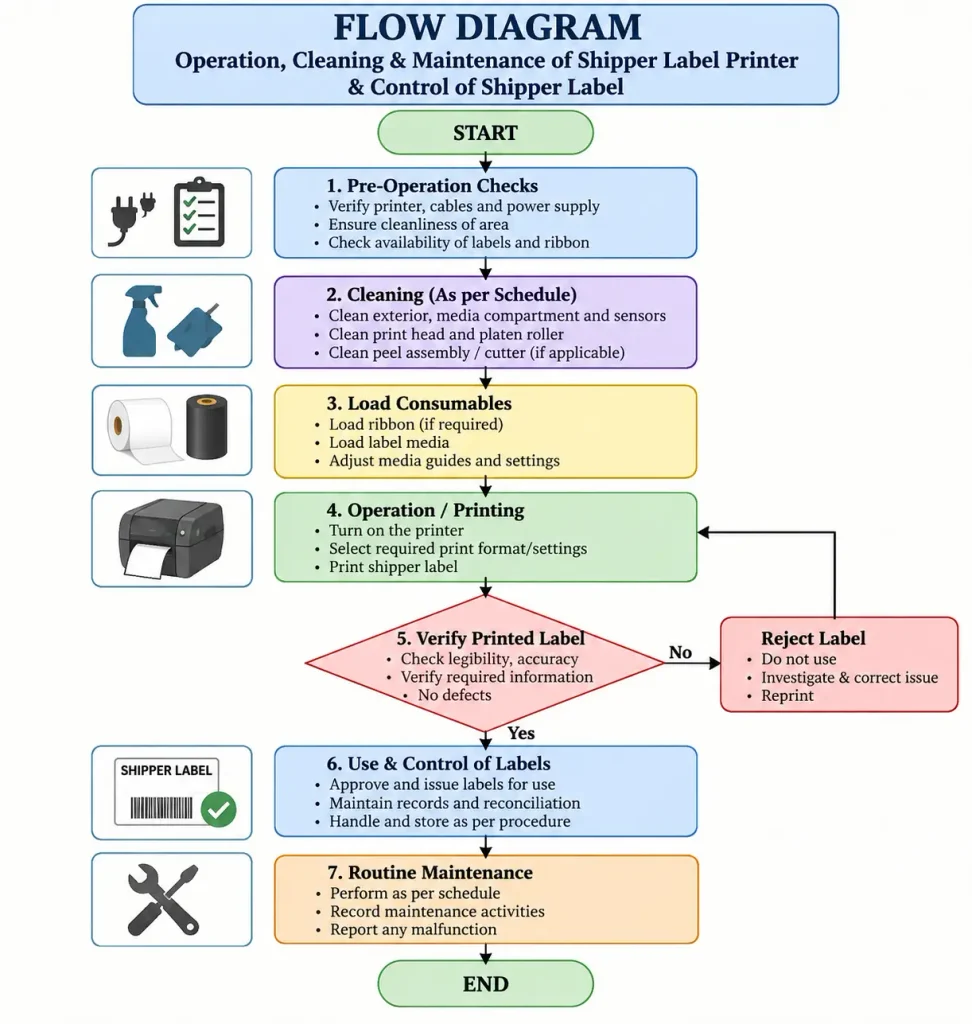
The printer is then started, the ribbon and media are loaded, and the required labels are printed according to approved settings. Printed shipper labels are verified and approved before issuance to Production. Label quantities are controlled, recorded, and checked to maintain traceability and prevent mix-ups or unauthorized use.
3. Benefits of Following SOP – Operation, Cleaning & Maintenance of Shipper Label Printer & Control of Shipper Label:
Following the SOP for Operation, Cleaning & Maintenance of Shipper Label Printer & Control of Shipper Label ensures consistent, accurate, and controlled printing of shipper labels in the manufacturing and packaging area. The SOP defines responsibilities for QA personnel and specifies standardized requirements for printer cleaning, operation, media and ribbon loading, label printing, verification, issuance, and control. Proper adherence helps prevent label mix-ups, printing defects, incorrect batch information, and unauthorized use of labels. Routine cleaning of the print head, platen roller, sensors, peel assembly, and cutter supports reliable printer performance and reduces equipment-related interruptions.
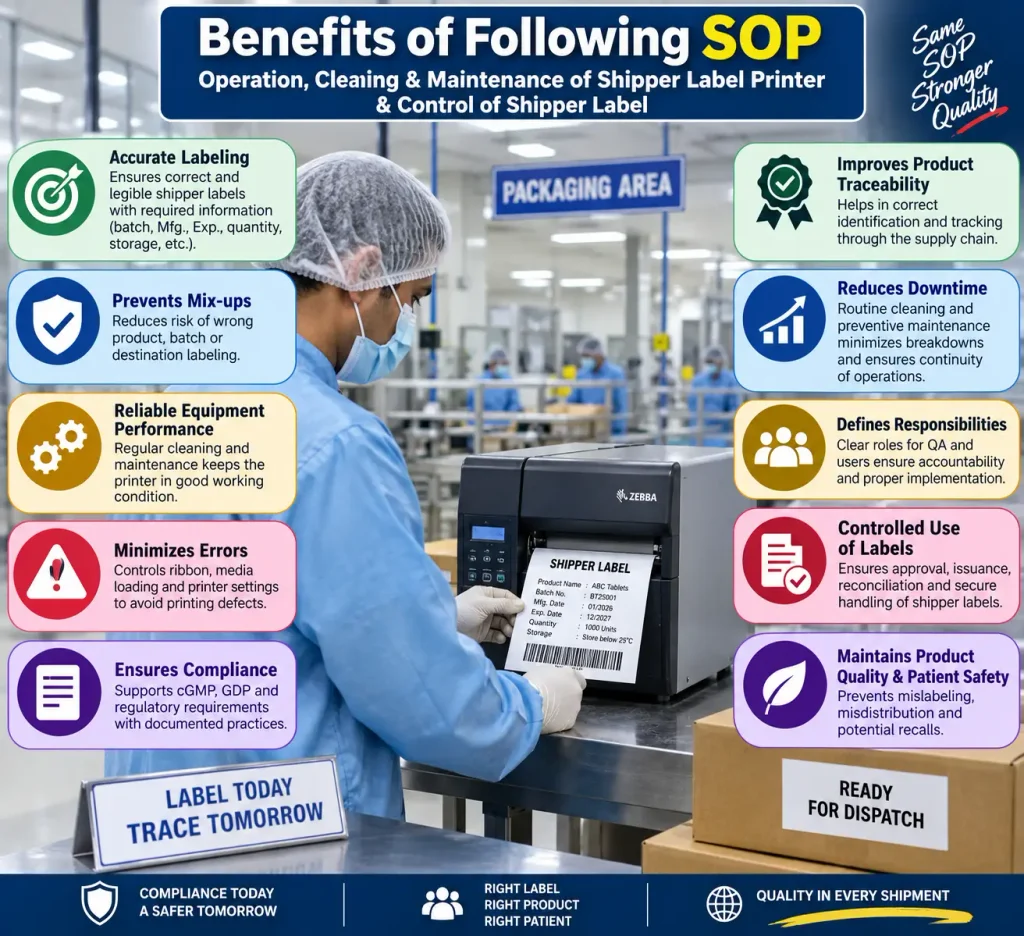
Controlled verification and issuance of printed labels improves traceability, reconciliation, and accountability between QA and Production. Overall, following the SOP strengthens GMP compliance, documentation control, product identification, packaging accuracy, operational efficiency, and assurance that the correct shipper label is applied to the intended product.
4. Brainstorming for SOP Failure – Operation, Cleaning & Maintenance of Shipper Label Printer & Control of Shipper Label:
The brainstorming analysis for the SOP for Operation, Cleaning & Maintenance of Shipper Label Printer & Control of Shipper Label identifies potential factors that may lead to failure of the defined procedure. Major causes include inadequate operator training, lack of awareness, unclear instructions, incorrect printer settings, poor cleaning practices, equipment malfunction, unsuitable ribbon or label material, and improper verification of printed labels. The SOP requires controlled cleaning, correct printer operation, label handling, verification, issuance, and defined QA responsibilities.
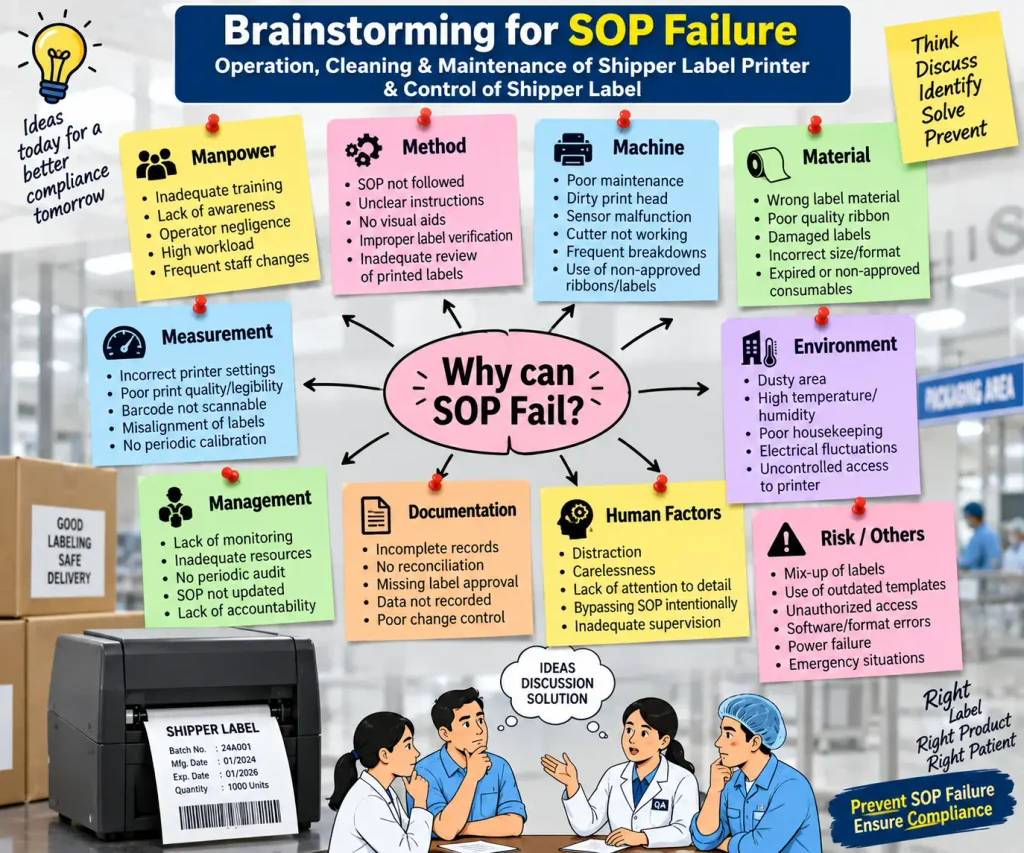
Additional risks include incomplete documentation, poor reconciliation, unauthorized access, outdated formats, insufficient supervision, and failure to maintain the printer properly. Brainstorming these possible causes helps the organization identify weaknesses before they result in label mix-ups, printing defects, traceability problems, or GMP non-compliance. The exercise supports effective investigation, corrective actions, preventive controls, training improvements, and stronger overall management of shipper labeling activities.
5. 5-Why Analysis for SOP Failure – Operation, Cleaning & Maintenance of Shipper Label Printer & Control of Shipper Label:
The 5-Why Analysis for SOP Failure – Operation, Cleaning & Maintenance of Shipper Label Printer & Control of Shipper Label systematically identifies the underlying causes of failure in printer operation, cleaning, maintenance, and label control activities. The analysis begins with incorrect printer operation, inadequate cleaning, maintenance deficiencies, or printing errors and progressively examines why the defined procedure was not followed. Potential causes include operator non-compliance, insufficient training, lack of awareness, weak supervision, and ineffective monitoring of SOP implementation.
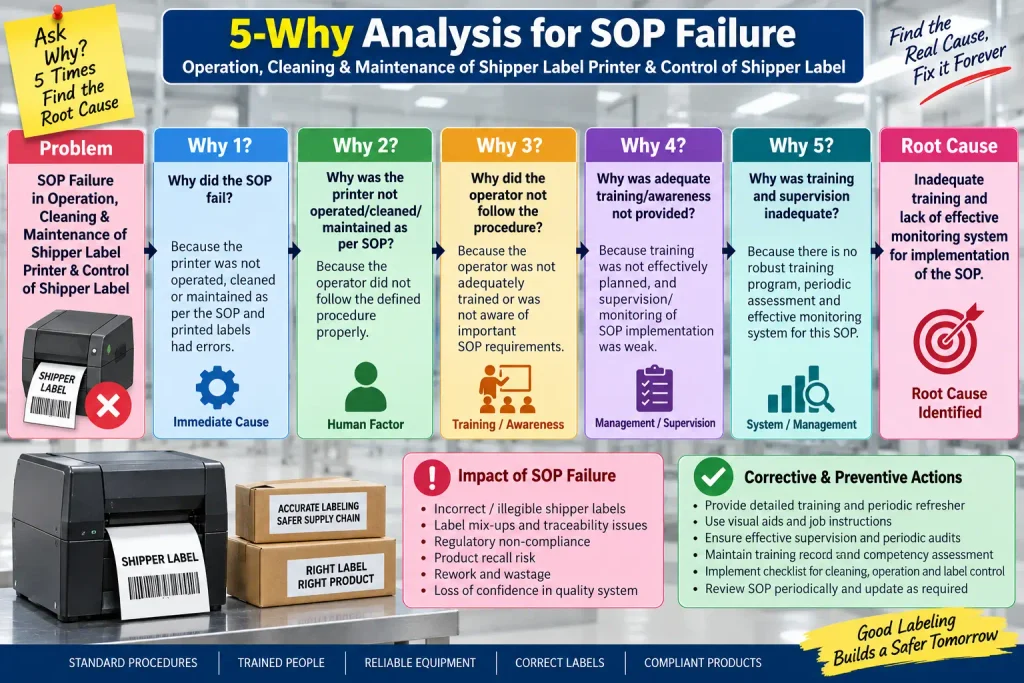
The SOP assigns responsibility to QA personnel for execution and effective implementation and defines requirements for cleaning, operation, label verification, issuance, and control. The analysis ultimately helps identify root causes requiring corrective and preventive actions such as refresher training, competency assessment, improved supervision, routine checklist verification, periodic SOP review, and stronger documentation controls. This approach supports reliable labeling, traceability, GMP compliance, and prevention of recurring SOP failures.
6. Fishbone Analysis for SOP Failure – Operation, Cleaning & Maintenance of Shipper Label Printer & Control of Shipper Label:
The Fishbone Analysis for SOP Failure – Operation, Cleaning & Maintenance of Shipper Label Printer & Control of Shipper Label identifies possible causes of non-compliance under major categories such as Manpower, Machine, Method, Material, Measurement, Environment, and Management. Potential causes include inadequate training, poor supervision, failure to follow approved procedures, incorrect printer settings, dirty print heads, sensor or cutter malfunction, unsuitable ribbons or labels, incomplete verification, and weak documentation control. The SOP specifically defines requirements for cleaning printer components, operating the equipment, and controlling printed shipper labels.
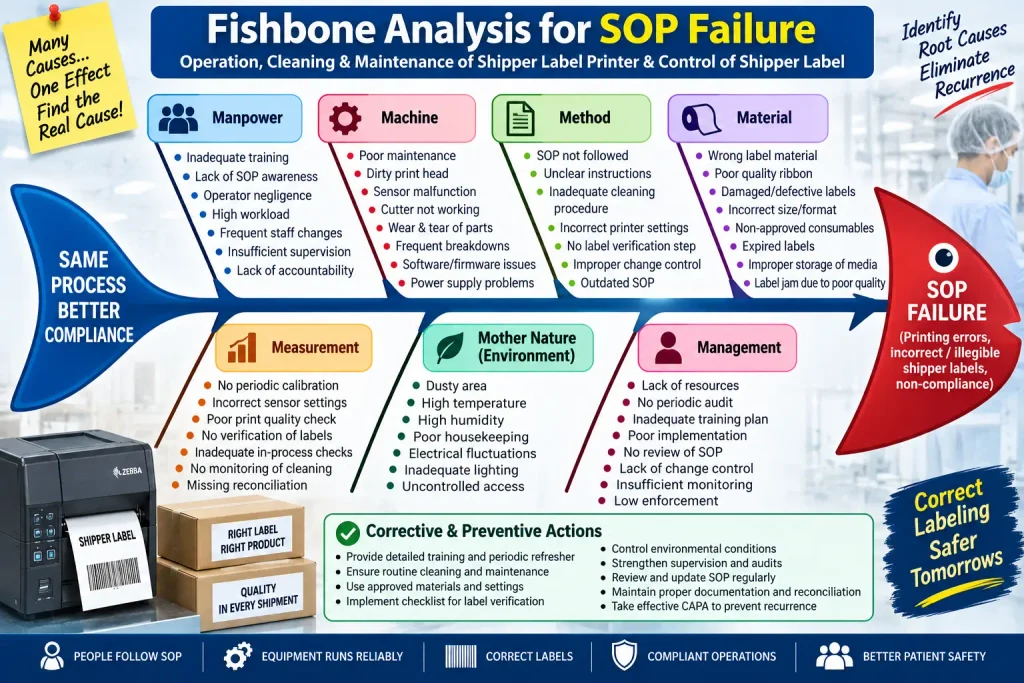
It also requires QA verification and controlled issuance of labels before use by Production. Fishbone analysis helps organize these contributing factors systematically, enabling effective root-cause identification, targeted CAPA, improved training, preventive maintenance, stronger monitoring, and better label reconciliation, thereby reducing printing errors, mix-ups, traceability failures, and GMP compliance risks.
7. Fault Tree Analysis for SOP Failure – Operation, Cleaning & Maintenance of Shipper Label Printer & Control of Shipper Label:
The Fault Tree Analysis for SOP Failure – Operation, Cleaning & Maintenance of Shipper Label Printer & Control of Shipper Label evaluates how multiple failures can combine to produce incorrect, illegible, or uncontrolled shipper labels. The analysis begins with the top event of SOP failure and traces possible contributing causes through human error, equipment malfunction, procedural deficiencies, and label or ribbon-related problems. The SOP requires defined QA responsibility, scheduled cleaning, proper printer operation, and controlled handling of printed labels.
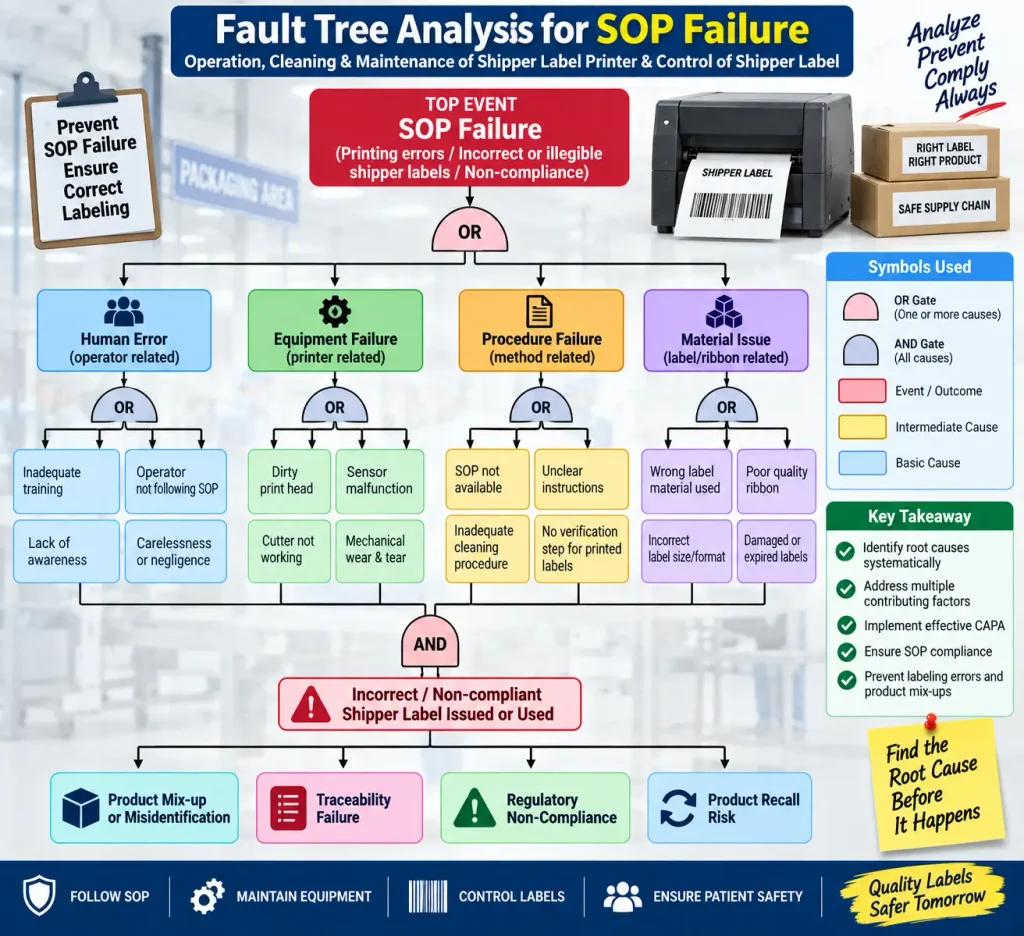
Printer-related failures may involve the print head, platen roller, sensors, peel assembly, or cutter, all of which have specified cleaning requirements. Procedural failures may also occur during label verification, approval, issuance, or handover to Production. Fault Tree Analysis helps identify root causes systematically and supports effective CAPA to prevent label mix-ups, traceability failures, rework, and GMP non-compliance.
8. Impact Assessment – SOP for Operation, Cleaning & Maintenance of Shipper Label Printer & Control of Shipper Label:
The Impact Assessment for SOP for Operation, Cleaning & Maintenance of Shipper Label Printer & Control of Shipper Label evaluates the consequences of both compliance and failure in shipper-label printing activities. If the SOP is not followed, possible impacts include incorrect or illegible labels, product or batch mix-ups, poor traceability, reprinting, operational delays, and loss of control over label issuance. The SOP specifically requires QA verification of new and existing shipper labels before use and defines controlled issuance to Production.
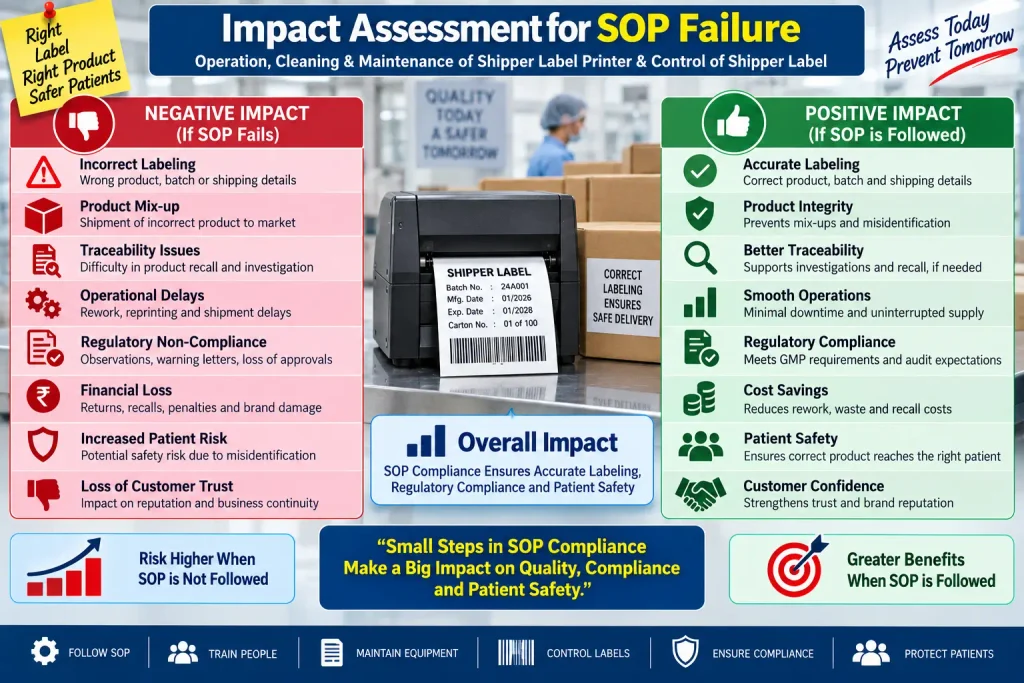
It also requires Production to verify and count issued labels and IPQA to control loose shipper labels. Proper adherence supports accurate labeling, reliable printer performance, controlled documentation, improved traceability, and reduced risk of labeling errors. Overall, effective implementation strengthens GMP compliance, operational efficiency, product identification, accountability, and consistent control of shipper labeling activities.
Questions & Answers – SOP for Operation, Cleaning & Maintenance of Shipper Label Printer & Control of Shipper Label:
- What is the objective of this SOP?
The objective is to define the procedure for handling, operation, cleaning, maintenance, and control of the shipper label printer used for shipper labels. - Where is this SOP applicable?
It is applicable to handling, operation, cleaning, maintenance, and control of the shipper label printer in the overprinting area. - Who is responsible for execution of the SOP?
The QA Chemist is responsible for execution of the SOP. - Who is responsible for effective implementation of the SOP?
The Assistant Manager-QA and Head-QA/QC are responsible for effective implementation. - Which printer parts require routine cleaning?
The printer exterior, media compartment, sensors, print head, platen roller, peel assembly, and cutter module require cleaning as per the defined schedule. - How should the printer exterior be cleaned?
The exterior should be cleaned with a lint-free cloth and, if necessary, a small amount of mild detergent. Harsh or abrasive cleaning agents or solvents should not be used. - How are the print head and platen roller cleaned?
They are cleaned using the recommended swab or a clean swab with isopropyl alcohol solution, and the solvent is allowed to evaporate before use. - What should be done before cleaning the cutter module?
The printer should be switched off and unplugged from its power source, and loaded media should be removed from the cutter module. - How is the printer started for operation?
The power cord is connected to the printer and an appropriate power outlet, after which the printer is switched on. - What should be done after completion of printing work?
After printing is completed, the printer should be switched off. - How is a new product shipper label controlled?
The administrator/designer prepares the design, QA verifies it, and the approved product folder is stored and password-protected. - How are labels for an existing product issued?
When Production raises a requisition, the QA Chemist takes one print for approval by IPQA and Production personnel. After approval, the required quantity of labels is printed and handed over to Production. - Who verifies and counts the issued shipper labels?
The Production Chemist verifies and counts the labels before they are pasted on the shipper. - How are loose shipper labels controlled?
For loose shipper labels, the IPQA Chemist personally checks and pastes the label on the shipper. - Which records and formats are attached to the SOP?
The SOP includes the Shipper Label Issuance Log, Label Indent Format, and Shipper Label Format as Annexure-I, Annexure-II, and Annexure-III respectively.
Reference Guidelines – SOP for Operation, Cleaning & Maintenance of Shipper Label Printer & Control of Shipper Label:
- Schedule M, Drugs Rules, India – GMP requirements for pharmaceutical manufacturing, packaging, labeling, equipment cleaning, documentation, and controls.
- WHO Good Manufacturing Practices for Pharmaceutical Products – requirements for packaging operations, prevention of mix-ups, line clearance, labeling control, documentation, and equipment maintenance.
- PIC/S Guide to GMP, PE 009 – particularly Chapter 4: Documentation and Chapter 5: Production, including packaging and labeling controls.
- EU Guidelines for Good Manufacturing Practice, EudraLex Volume 4 – especially Chapter 4: Documentation and Chapter 5: Production.
- US FDA 21 CFR Part 211.122 – Materials examination and usage criteria for labeling and packaging materials.
- US FDA 21 CFR Part 211.125 – Issuance, control, reconciliation, and accountability of labeling.
- US FDA 21 CFR Part 211.130 – Packaging and labeling operations, including controls to prevent mix-ups and mislabeling.
- Manufacturer’s Operating and Maintenance Manual for the Shipper Label Printer – for printer-specific operation, cleaning, preventive maintenance, troubleshooting, and recommended consumables.