







1. Introduction – SOP for Person Authorisation:
The SOP for Person Authorisation establishes a documented and controlled system for identifying personnel who are authorized to perform approvals, authorizations, and other designated responsibilities within various departments of a pharmaceutical organization. The procedure applies to Production, Warehouse, Maintenance, Administration, Quality Control, and Quality Assurance functions and defines the responsible personnel for maintaining effective authorization arrangements.This SOP also provides a mechanism for continuity of operations when an authorized person is absent. In such cases, an appropriately appointed nominee of the respective authorized person may perform the required approval or authorization activities according to the defined authorization structure. Implementation of this SOP helps ensure that responsibilities are clearly assigned, only designated personnel perform authorized activities, and accountability is maintained. The accompanying Person Authorization List records the authorized person and the nominated individual responsible during their absence.
Skip to PDF content2. Flow Diagram SOP for Person Authorisation:
The SOP for Person Authorisation describes the systematic process for identifying and documenting personnel who are permitted to perform approval and authorization activities within different departments of the organization. It covers departments such as Production, Warehouse, Maintenance, Administration, Quality Control, and Quality Assurance.
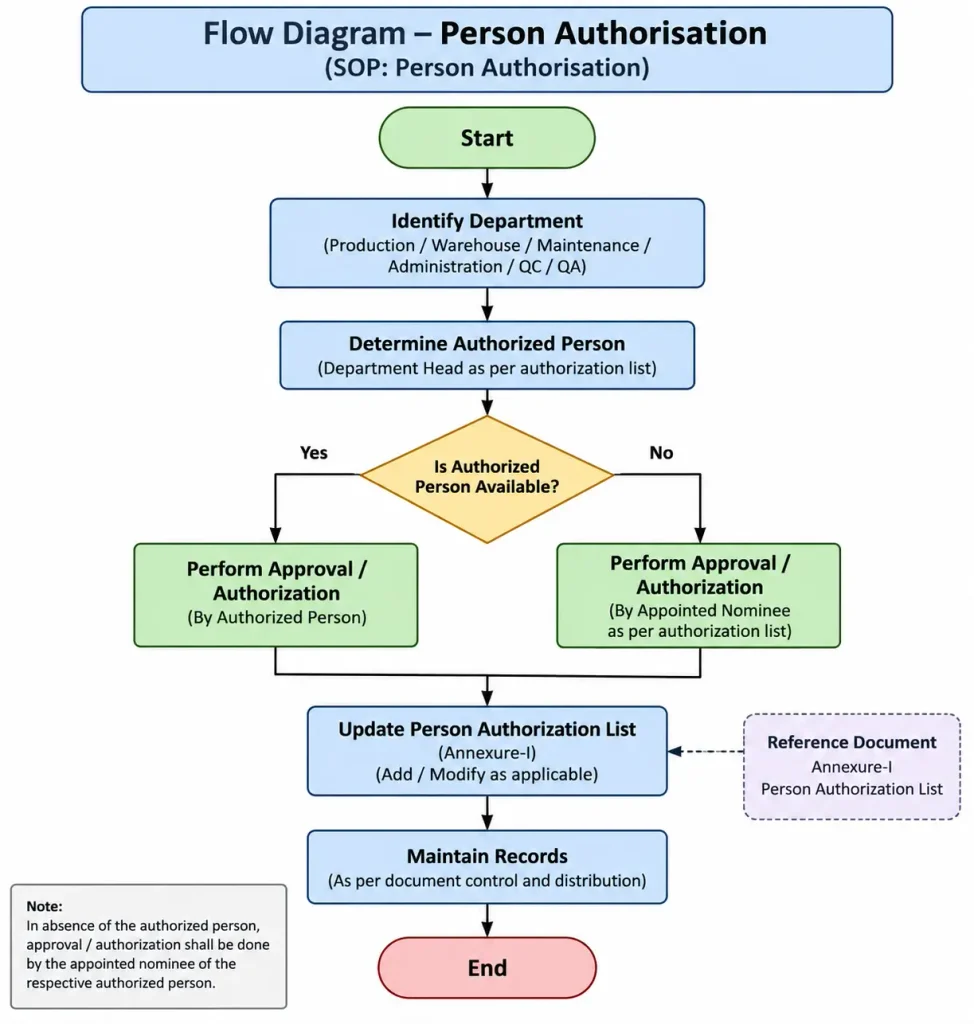
As shown in the flow diagram, the process begins with identification of the concerned department and determination of the authorized person. If the designated authorized person is available, the required approval or authorization is performed by that individual. If the person is absent, the activity is carried out by the appointed nominee of the respective authorized person, as specified in the SOP. The authorization details are maintained through Annexure-I – Person Authorization List, which records the authorized person and the person responsible during their absence. This arrangement supports continuity of operations, clear accountability, proper delegation of authority, and controlled documentation of authorization responsibilities.
3. Benefits of Following SOP for Person Authorisation:
The SOP for Person Authorisation helps establish a controlled system in which only designated and authorized personnel perform approval and authorization activities. It clearly defines departmental responsibilities and ensures that an appointed nominee is available to carry out required authorization activities when the primary authorized person is absent.
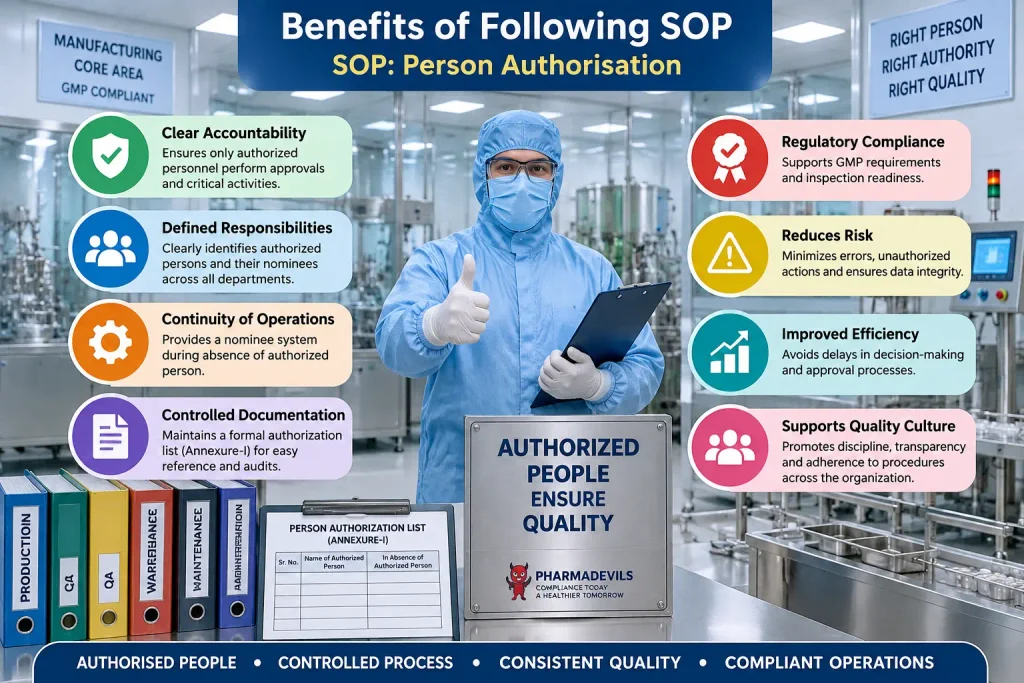
Following this SOP supports clear accountability, continuity of operations, controlled documentation, defined responsibilities, and consistent decision-making across departments such as Production, Warehouse, Maintenance, Administration, Quality Control, and Quality Assurance. The Person Authorization List in Annexure-I provides documented evidence of authorized personnel and their nominated substitutes. This helps maintain proper records, reduces the possibility of unauthorized approvals, and supports an organized authorization system within the pharmaceutical quality framework.
4. Brainstorming for SOP Failure – SOP for Person Authorisation:
The Brainstorming Analysis for SOP for Person Authorisation Failure identifies potential reasons why the defined authorization system may not be followed effectively in the pharmaceutical manufacturing area. The SOP requires approval or authorization activities to be performed by the designated authorized person or, in their absence, by the appointed nominee. Possible contributing factors include inadequate training, lack of awareness, SOP unavailability at the workplace, poor communication of revisions, insufficient supervision, weak accountability, high workload, inadequate resources, poor documentation, and failure to periodically review or update authorization details.
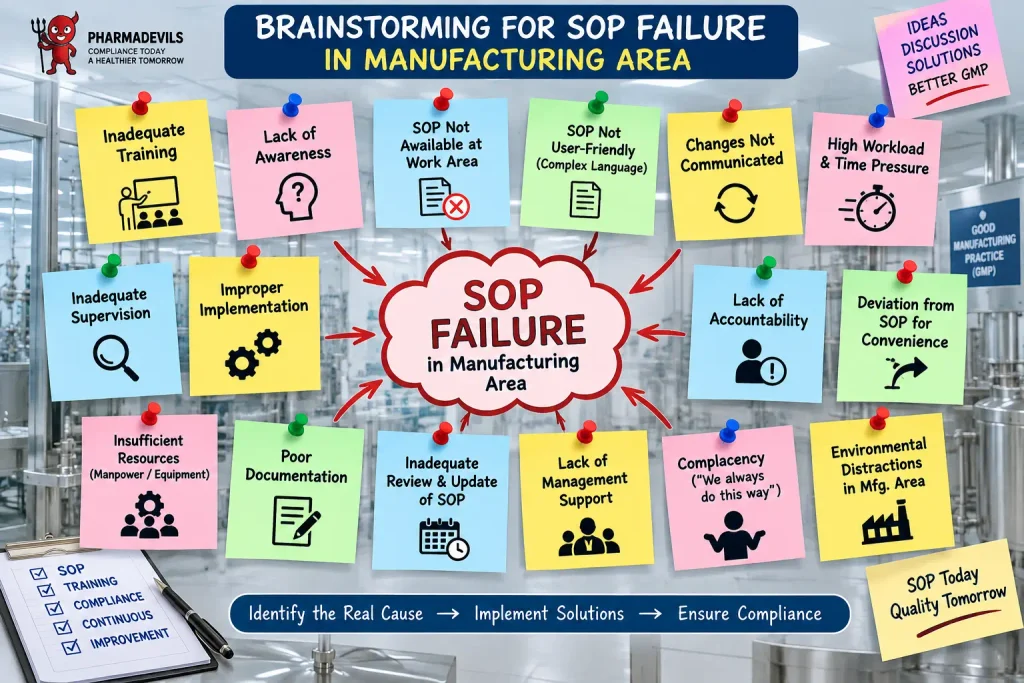
The brainstorming exercise helps the investigation team consider personnel, procedural, documentation, communication, supervision, and management-related causes before conducting detailed root-cause analysis. Particular attention should be given to maintaining the Person Authorization List (Annexure-I), which identifies the authorized person and the responsible substitute during absence. This approach supports identification of practical corrective and preventive actions to strengthen authorization control and improve consistent SOP implementation.
5. 5-Why Analysis for SOP Failure – SOP for Person Authorisation:
The 5-Why Analysis for SOP for Person Authorisation Failure is used to systematically identify the underlying reasons why authorization requirements may not be followed in the pharmaceutical manufacturing area. The SOP requires approval or authorization activities to be performed by the designated authorized person or by an appointed nominee when the primary person is absent. The analysis may begin with an observed failure such as an unauthorized person performing an approval activity. Repeated questioning can identify contributing causes such as non-availability of the authorization list, inadequate communication, insufficient training, weak supervision, poor SOP implementation, and lack of periodic review of authorized personnel and nominees.
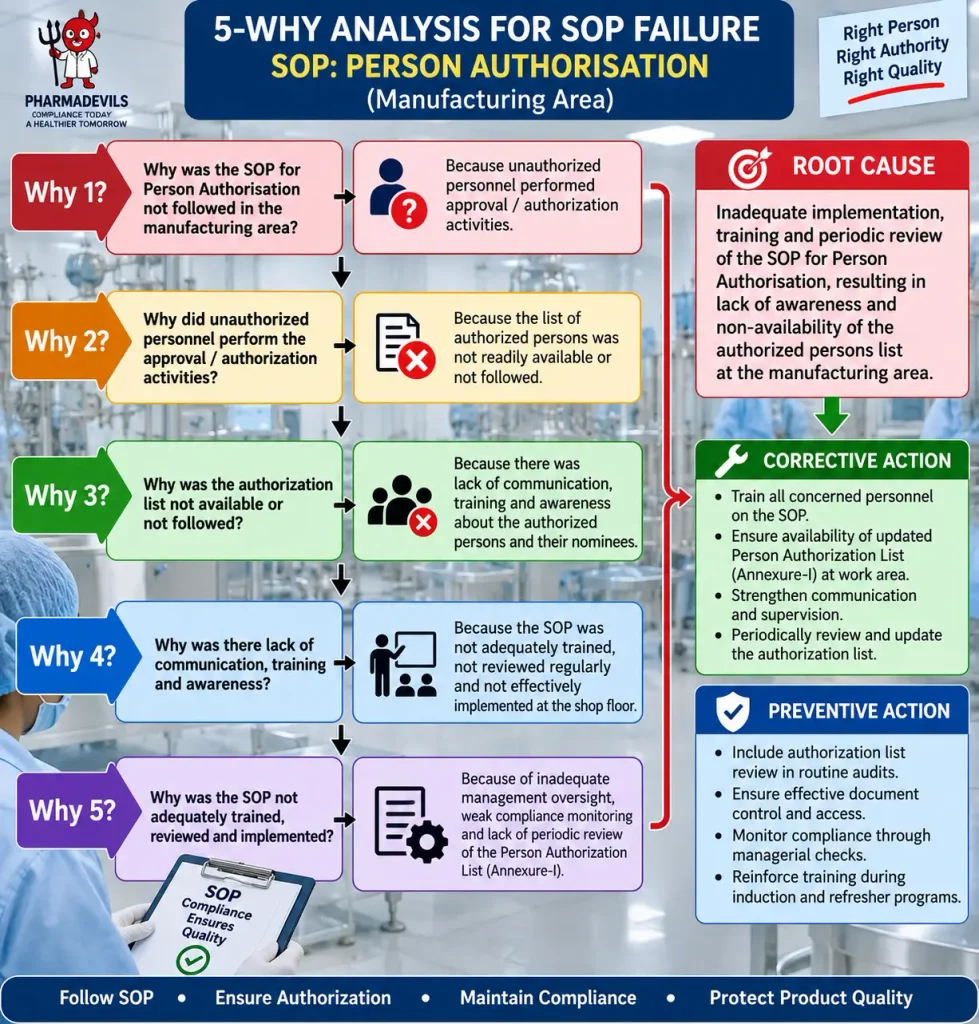
The analysis should ultimately lead to a clearly defined root cause and appropriate corrective and preventive actions. Particular emphasis should be placed on maintaining and periodically reviewing the Person Authorization List (Annexure-I) so that the authorized person and substitute are clearly identified. This approach supports stronger accountability, improved SOP compliance, and better control of authorization-related activities in the manufacturing area.
6. Fishbone Analysis for SOP Failure: SOP for Person Authorisation:
The Fishbone Analysis for SOP for Person Authorisation Failure is used to identify and organize the potential causes that may lead to failure of the authorization system in the pharmaceutical manufacturing area. The SOP requires approval or authorization activities to be performed by the designated authorized person or by an appointed nominee when the authorized person is absent. The analysis groups possible causes under major categories such as Man (People), Method (Procedure), Machine/System, Material/Documents, Measurement/Monitoring, Environment, and Management. Typical causes may include inadequate training, lack of awareness of authorized personnel, outdated or unavailable authorization lists, poor SOP implementation, weak supervision, insufficient compliance monitoring, document-control gaps, workload pressure, and inadequate management oversight.
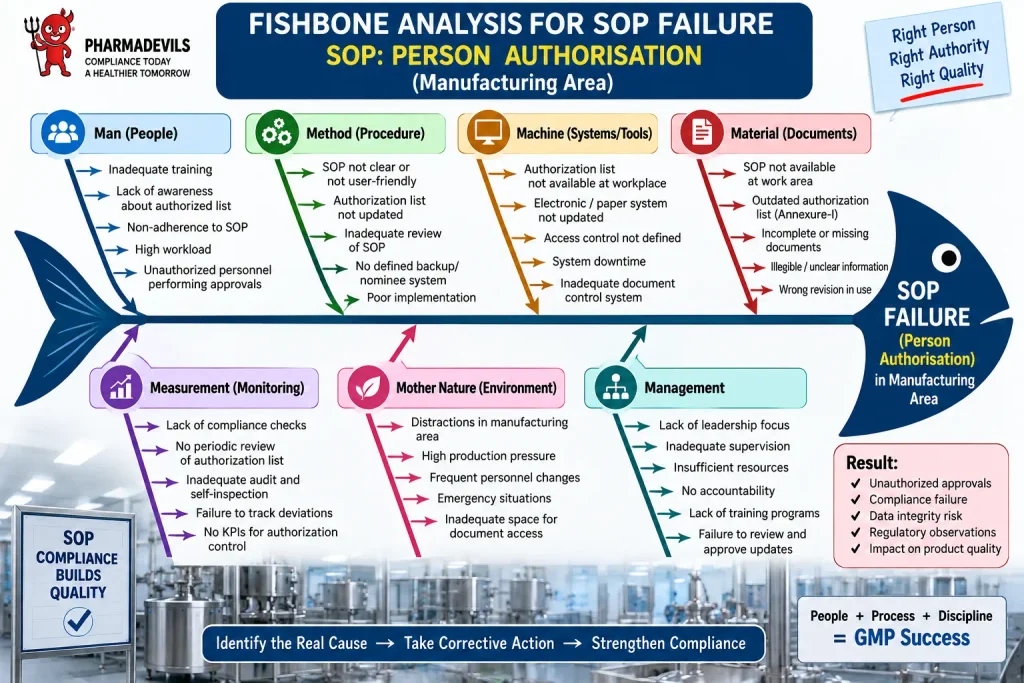
The fishbone approach helps the investigation team evaluate multiple contributing factors in a structured manner rather than focusing on only one apparent cause. Special attention should be given to the Person Authorization List (Annexure-I), which identifies the authorized person and the person responsible during their absence. This analysis supports identification of the most probable root cause and development of appropriate corrective and preventive actions to strengthen authorization control, accountability, and SOP compliance.
7. Fault Tree Analysis for SOP Failure -SOP for Person Authorisation:
The Fault Tree Analysis for SOP for Person Authorisation Failure evaluates how breakdowns in the authorization system can result in SOP non-compliance within the pharmaceutical manufacturing area. The SOP requires approval or authorization to be performed by the designated authorized person and, during their absence, by the appointed nominee. The fault tree considers potential failure pathways such as unauthorized personnel performing approvals, non-availability or non-updating of the Person Authorization List, inadequate training, poor communication, weak supervision, insufficient document control, unclear responsibilities, and lack of periodic review. These contributing factors can combine to increase the risk of unauthorized approvals, documentation deficiencies, compliance failures, and audit observations.
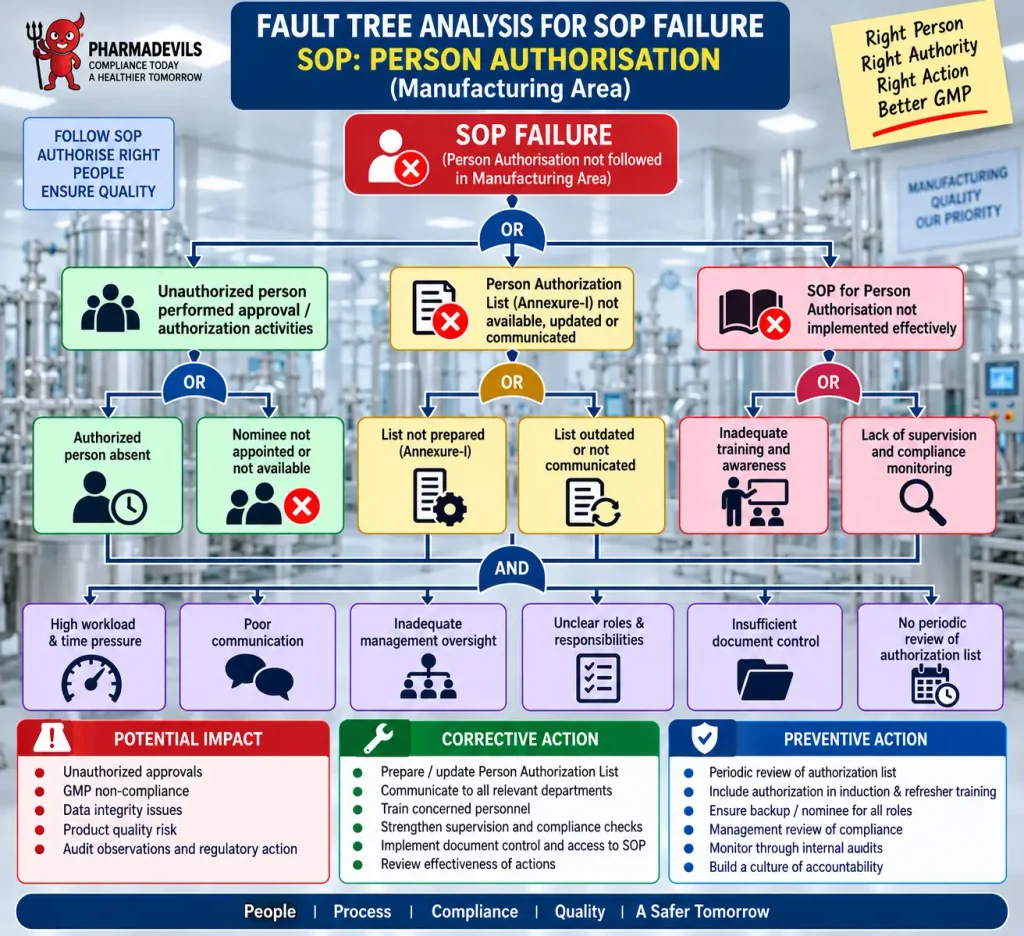
The analysis emphasizes maintaining Annexure-I – Person Authorization List, which identifies the authorized person and the responsible person during their absence. Corrective and preventive measures should therefore focus on timely authorization-list updates, effective communication, personnel training, supervisory checks, document control, and periodic compliance review.
8. Impact Assessment for SOP Failure – SOP for Person Authorisation:
The Impact Assessment for SOP for Person Authorisation Failure evaluates the potential consequences when defined authorization requirements are not followed within the pharmaceutical manufacturing area. The SOP requires approval and authorization activities to be performed by designated authorized personnel or, during their absence, by the appointed nominee.
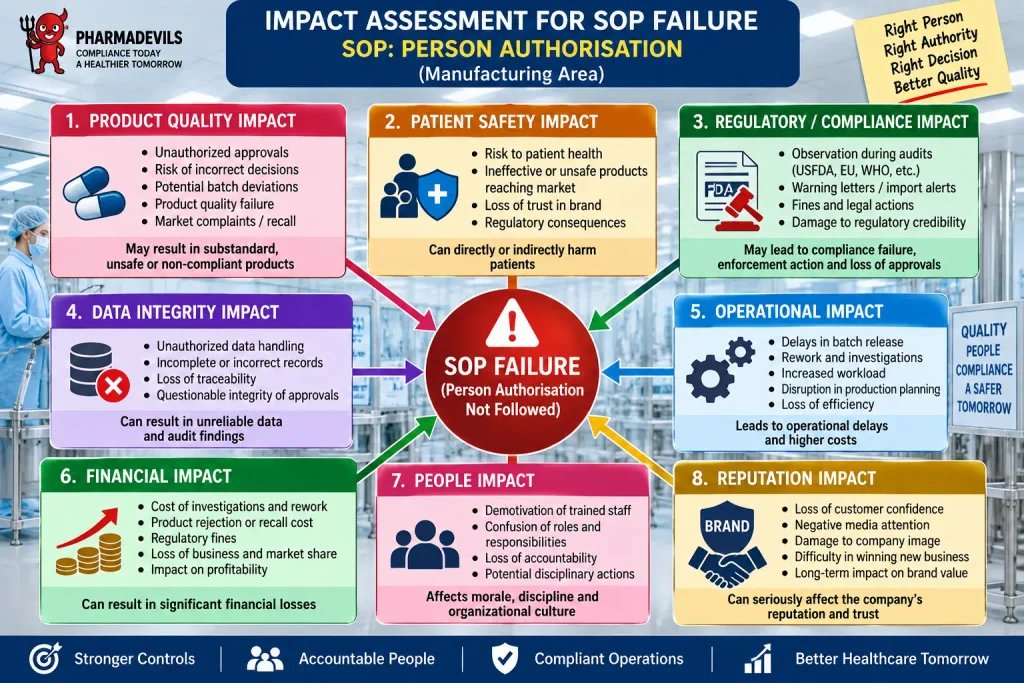
Failure of this control may potentially affect product quality, compliance, documentation integrity, operational efficiency, personnel accountability, financial performance, and organizational reputation. Unauthorized approvals or unclear delegation can result in incorrect decisions, incomplete records, delayed activities, additional investigations, rework, and audit observations. The assessment therefore emphasizes maintaining an accurate Person Authorization List (Annexure-I) identifying authorized personnel and their substitutes. Effective training, proper communication, periodic review, supervision, and document control help minimize authorization-related risks and strengthen accountability and consistent SOP compliance.
Questions & Answers – SOP for Person Authorisation:
- What is the objective of the SOP for Person Authorisation?
The objective is to provide an authorized list of personnel to be followed for authorization activities in different departments. - Which departments are covered under this SOP?
The SOP applies to Production, Warehouse, Maintenance, Administration, Quality Control, and Quality Assurance departments. - Who is responsible for implementation of the SOP?
Responsibility is assigned to personnel from Production, Warehouse, Maintenance, Administration, Quality Control, Quality Assurance, and GM-Production. - What happens when an authorized person is absent?
In the absence of an authorized person, the required approval or authorization is performed by the appointed nominee of that authorized person. - Who may be included in the authorization structure?
The SOP identifies the individual Department Head, department nominee, G.M., Head-QA/QC, Asst. Manager-QA, Manager-QC, and where applicable an auditor or external party person/guest. - What annexure is provided with this SOP?
Annexure-I – Person Authorization List is provided. - What information is recorded in the Person Authorization List?
The annexure contains the area, serial number, name of authorized person, and person responsible in the absence of the authorized person. - What is the reference mentioned in the SOP?
The reference specified in the SOP is In House. - Who receives the controlled copy of the SOP?
The controlled copy is distributed to the Head of Department – All Sections. - Who maintains the master copy of the SOP?
The master copy is maintained by the Head of Department – Quality Assurance. - Why is nomination of an alternate authorized person important?
According to the SOP, the nominee performs approval or authorization activities when the primary authorized person is absent, thereby maintaining continuity of the authorization process. - What abbreviations are defined in the SOP?
The SOP defines SOP – Standard Operating Procedure, QA – Quality Assurance, and QC – Quality Control.
Reference Guidelines – SOP for Person Authorisation:
- WHO Good Manufacturing Practices (GMP) – requirements concerning personnel responsibilities, defined authority, training, and documentation.
- EU Guidelines for GMP – EudraLex Volume 4, Chapter 2: Personnel – organization, responsibilities, delegation, qualifications, and training.
- EU GMP, Chapter 4: Documentation – controlled documents, approval, authorization, signatures, and document management.
- PIC/S Guide to GMP (PE 009), Chapter 2 – Personnel – defined responsibilities, organizational arrangements, delegation, and training.
- 21 CFR Part 211.22 – Responsibilities of Quality Control Unit – responsibilities and authority for approving or rejecting GMP-related activities and materials.
- 21 CFR Part 211.25 – Personnel Qualifications – requirements for education, training, experience, and continuing GMP training.
- ICH Q10 – Pharmaceutical Quality System – management responsibility, defined roles, authority, communication, and pharmaceutical quality-system governance.
- Company Quality Manual / Organization Chart / Delegation of Authority Procedure – internal documents defining departmental authority and approved substitutes.