







1. INTRODUCTION – SOP FOR PHARMACOVIGILANCE SYSTEM MASTER FILE:
The SOP for Pharmacovigilance System Master File (PvMF) establishes a standardized approach for the preparation, review, maintenance, updating, filing, archiving, and control of the organization’s Pharmacovigilance System Master File. The PvMF provides a structured overview of the pharmacovigilance system applicable to marketed medicinal products and supports compliance with relevant regulatory requirements. The master file describes key elements of the pharmacovigilance system, including the Pharmacovigilance Officer In-charge (PvOI), organizational structure, sources of safety data, pharmacovigilance processes, system performance, quality-system information, computerized systems, procedural documents, audit information, and product-related records. The PvMF is maintained as a living document reflecting the current status of the pharmacovigilance system. It requires periodic and, where necessary, ad-hoc updates following significant changes, with all revisions appropriately documented and controlled. This ensures that current pharmacovigilance information remains available for internal review, regulatory inspection, and verification of compliance.
Skip to PDF content2. Flow Diagram – SOP for Pharmacovigilance System Master File (PvMF):
The flow diagram for the SOP for Pharmacovigilance System Master File (PvMF) illustrates the systematic sequence followed for preparation, review, approval, maintenance, and updating of the PvMF. The process begins with an internal meeting to plan activities, define responsibilities, and establish timelines for collecting required pharmacovigilance information from concerned departments.
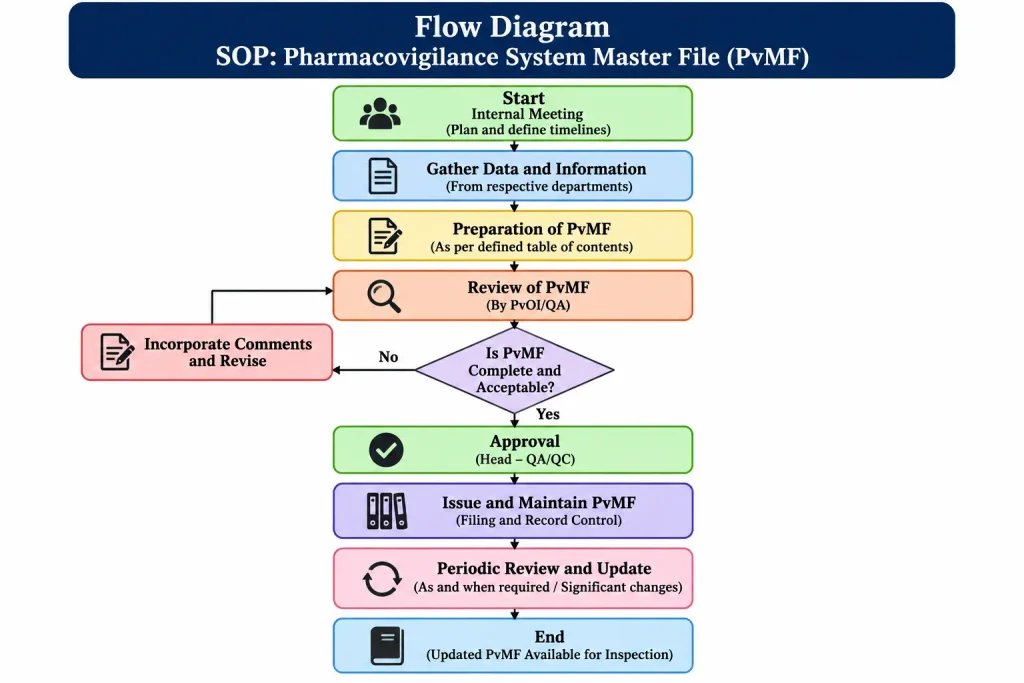
The collected information is compiled into the PvMF according to the defined structure and contents. The completed draft is then reviewed by the Pharmacovigilance Officer In-charge and relevant stakeholders. Review comments are incorporated until the document is considered complete and acceptable. After approval, the PvMF is issued and maintained under controlled filing and record-management practices. As a living document, it is periodically reviewed and updated whenever significant changes occur. All revisions are documented to maintain an accurate history, and the latest approved version remains available for regulatory inspection and compliance verification.
3. Benefits of Following SOP for Pharmacovigilance System Master File (PvMF):
Following the SOP for Pharmacovigilance System Master File (PvMF) ensures that the organization maintains a structured, controlled, and current description of its pharmacovigilance system. The SOP supports systematic documentation of the PvOI, organizational structure, safety-data sources, pharmacovigilance processes, system performance, quality-system elements, computerized systems, procedural documents, audits, and products covered by the PV system. Effective implementation helps maintain regulatory compliance and improves readiness for audits and inspections because the PvMF is required to remain available for review by regulatory authorities when requested.
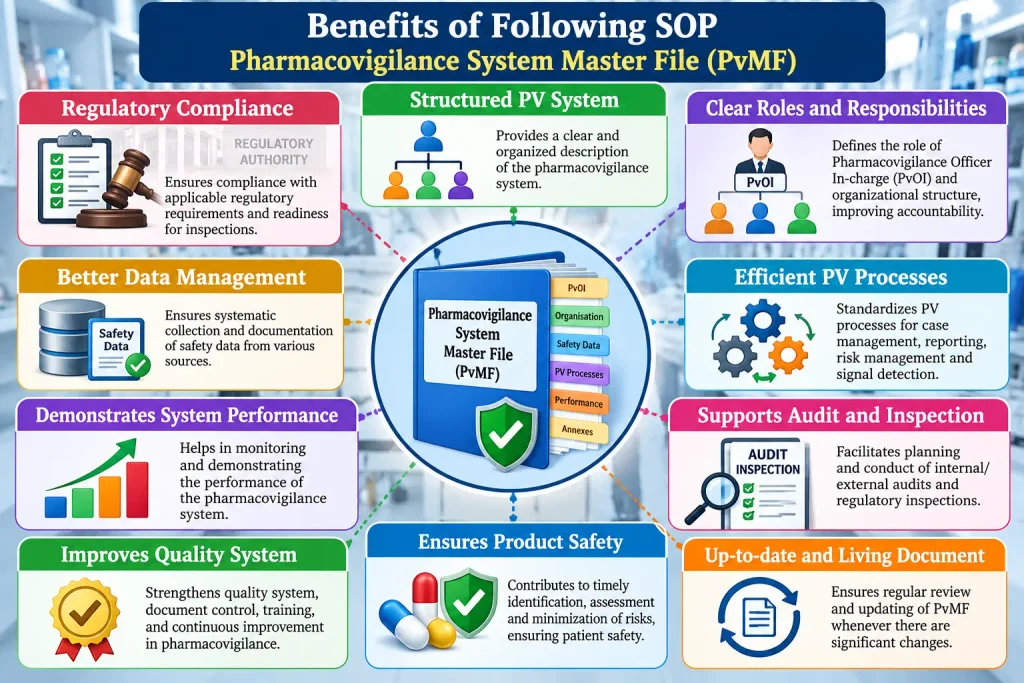
The SOP also supports clear responsibilities, controlled review, documentation of changes, proper filing and archiving, and regular updating of the PvMF. Since the master file is treated as a living document, periodic and ad-hoc updates help ensure that it accurately reflects the current pharmacovigilance system and that historical changes remain traceable.
4. Brainstorming for SOP Failure SOP for Pharmacovigilance System Master File (PvMF):
The Brainstorming Analysis for SOP Failure – Pharmacovigilance System Master File (PvMF) identifies potential causes that may lead to ineffective preparation, maintenance, review, or control of the PvMF. Key concerns include incomplete or incorrect information from departments, delays in data collection, unclear responsibilities, inadequate organizational details, missing safety-data sources, poorly described pharmacovigilance processes, insufficient supporting documents or annexes, outdated information, weak review and quality checks, poor document control, and inadequate tracking of changes. These failure points are directly relevant because the SOP requires the PvMF to contain defined elements such as the PvOI, organizational structure, safety-data sources, PV processes, system performance, annexes, quality-system information, and document-change history.
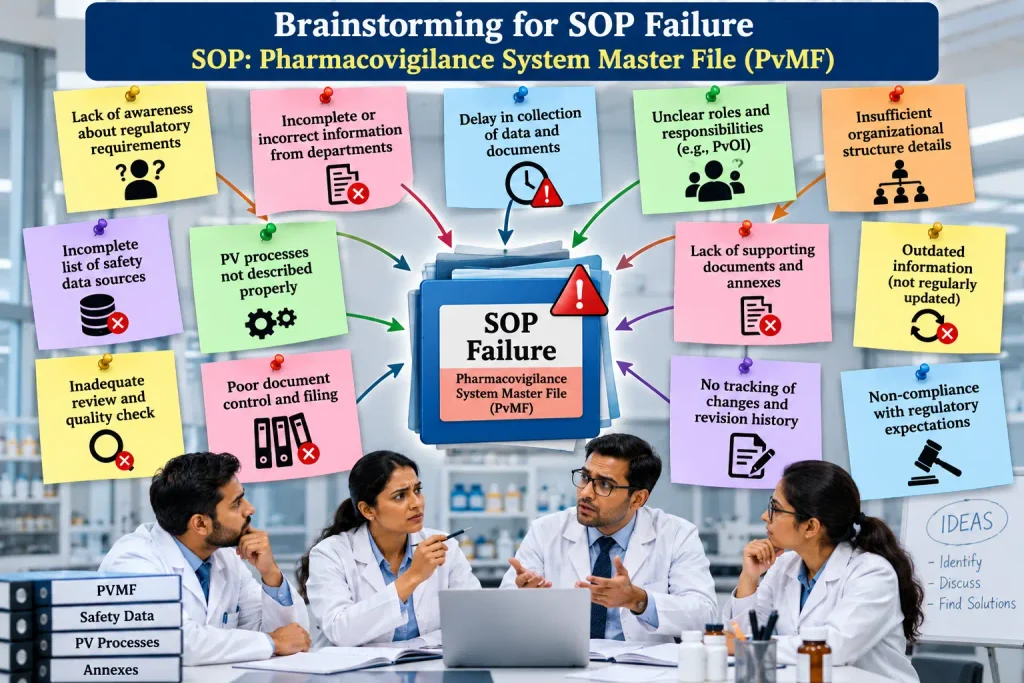
The brainstorming exercise helps the organization recognize these weaknesses early so that responsibilities, document completeness, review controls, filing practices, and periodic updates can be strengthened. Since the SOP treats the PvMF as a living document, timely updates and documented changes are essential to maintain an accurate and inspection-ready pharmacovigilance system.
5. 5-Why Analysis for SOP Failure SOP for Pharmacovigilance System Master File (PvMF):
The 5-Why Analysis for SOP Failure – Pharmacovigilance System Master File (PvMF) evaluates the underlying reasons why the PvMF may not be properly prepared, maintained, reviewed, or updated. The analysis begins with the problem of an inadequately maintained PvMF and progressively examines contributing causes such as incomplete or delayed collection of pharmacovigilance information, unclear departmental responsibilities, weak coordination, inadequate review planning, insufficient training, and ineffective document-control practices. This analysis is aligned with the SOP requirement to collect necessary information from concerned departments, assign responsibility for preparation, perform stakeholder review, and maintain the PvMF as a controlled and current document.
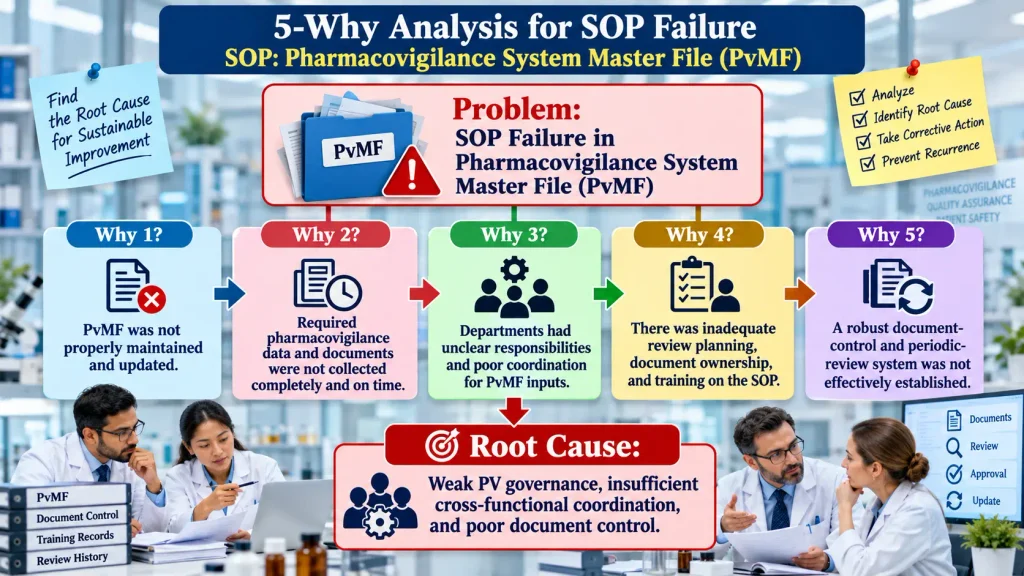
The analysis ultimately highlights potential root causes such as weak PV governance, insufficient cross-functional coordination, and inadequate document control. Addressing these causes supports timely review, documented changes, periodic updating, proper filing, and continued availability of an accurate PvMF for regulatory inspection.
6. Fishbone Analysis for SOP Failure – SOP for Pharmacovigilance System Master File (PvMF):
The Fishbone Analysis for SOP Failure – Pharmacovigilance System Master File (PvMF) systematically identifies potential causes that may lead to ineffective preparation, review, maintenance, or control of the PvMF. The causes are grouped under six major categories: Man (People), Method (Process), Machine (Systems), Material (Information), Measurement (Monitoring), and Environment. Possible contributing factors include inadequate training, unclear responsibilities, incomplete data collection, weak review practices, poor document-management systems, missing safety information, insufficient supporting annexes, inadequate performance monitoring, failure to track revisions, and changing regulatory requirements. The SOP itself requires coordinated collection of information from relevant departments and defined responsibility for preparation and review of the PvMF.
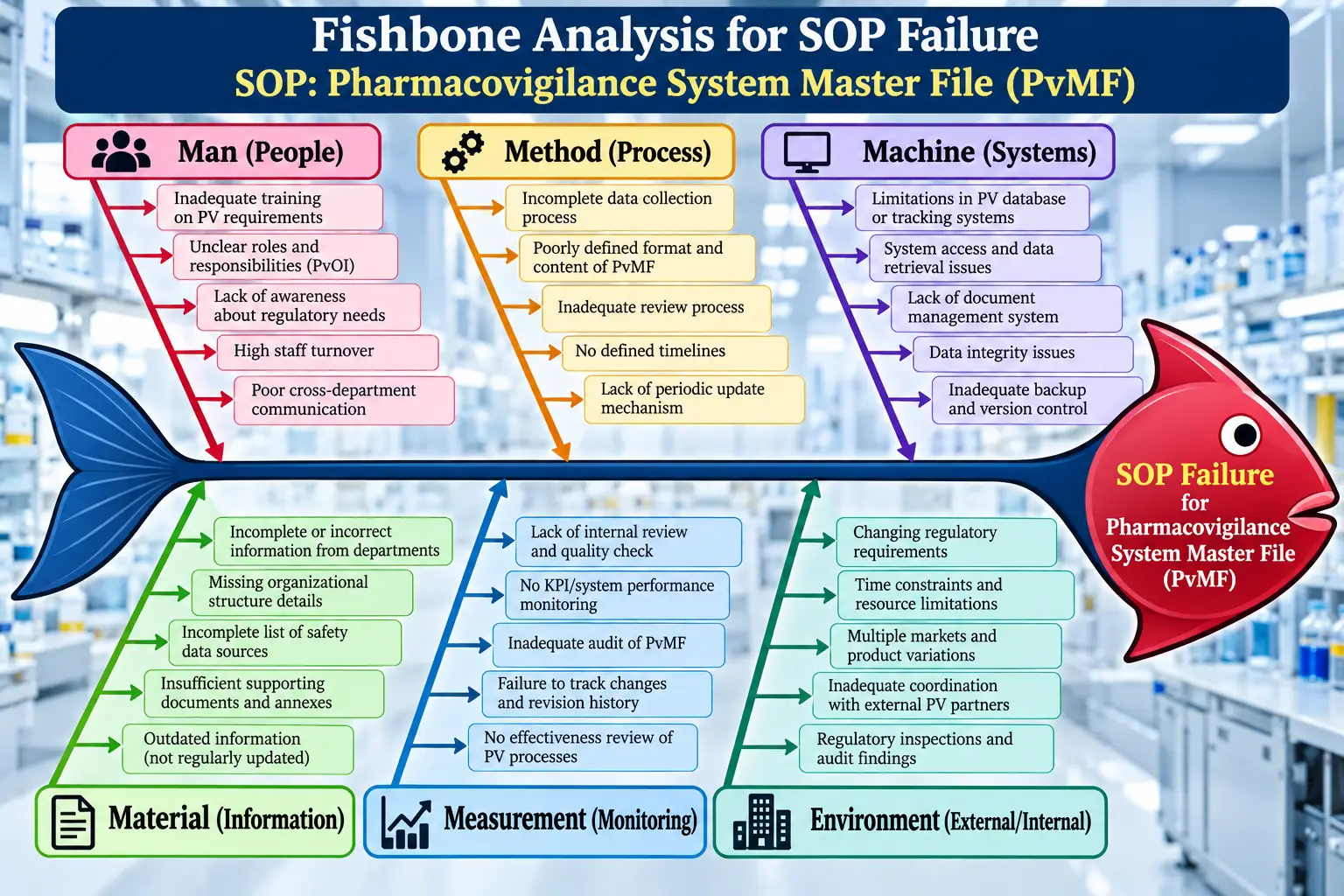
The analysis also emphasizes the importance of maintaining organizational information, safety-data sources, PV processes, system-performance information, quality records, and document-change history. By addressing these causes, the organization can strengthen document control, periodic updating, traceability, and regulatory inspection readiness.
7. Fault Tree Analysis for SOP Failure SOP for Pharmacovigilance System Master File (PvMF):
The Fault Tree Analysis for SOP Failure – Pharmacovigilance System Master File (PvMF) illustrates the logical causes that may result in an incomplete, inadequate, or outdated PvMF. The top event, PvMF SOP Failure, is divided into three major failure branches: incomplete collection of required information, inadequate preparation/review/approval, and ineffective maintenance and control.
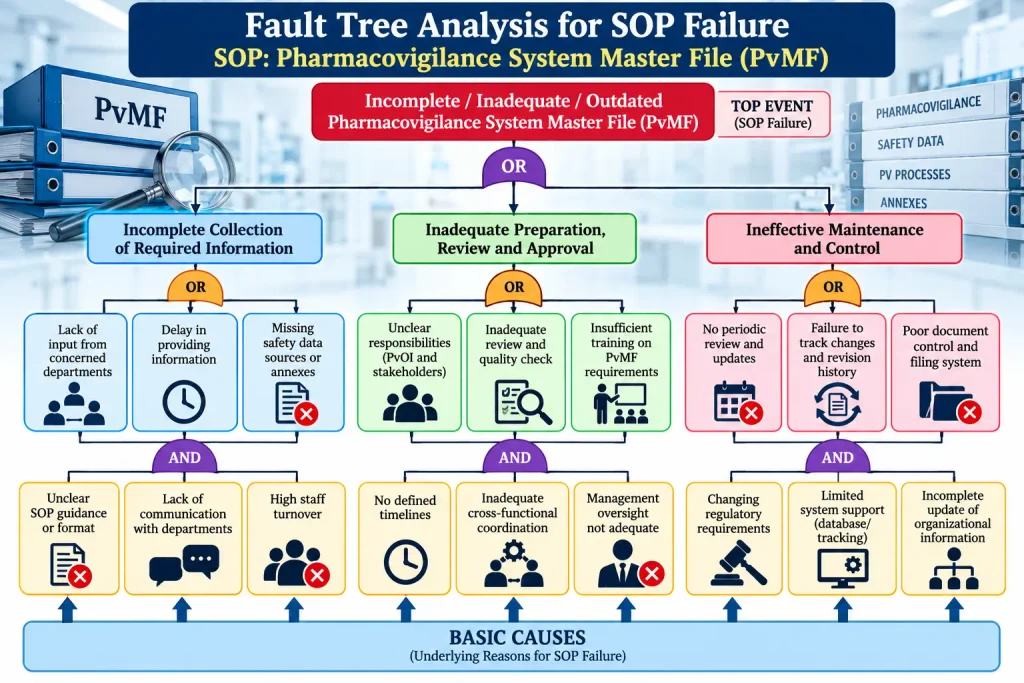
Potential causes include delayed or missing departmental inputs, incomplete safety-data sources and annexes, unclear responsibilities, inadequate review and quality checks, insufficient training, lack of periodic updates, poor document control, and failure to maintain revision history. These factors are relevant because the SOP requires coordinated collection of information, defined document ownership, structured preparation, and formal review of the PvMF. The analysis further highlights underlying causes such as weak communication, undefined timelines, inadequate cross-functional coordination, limited system support, and incomplete organizational updates. Effective control of these causes supports proper maintenance, documented changes, archiving, and continued availability of an up-to-date PvMF for regulatory inspection.
8. Impact Assessment for SOP Failure SOP for Pharmacovigilance System Master File (PvMF):
The Impact Assessment for SOP Failure – Pharmacovigilance System Master File (PvMF) evaluates the possible consequences of ineffective implementation, maintenance, review, or control of the PvMF. Failure of the SOP may result in incomplete or outdated pharmacovigilance information, weak document control, missing annexes, inadequate review, and poor availability of current system information. Such failures can affect regulatory compliance, quality-system effectiveness, pharmacovigilance operations, inspection readiness, and organizational credibility. The SOP requires the PvMF to remain current, properly reviewed, updated, filed, archived, and available for regulatory assessment when required.
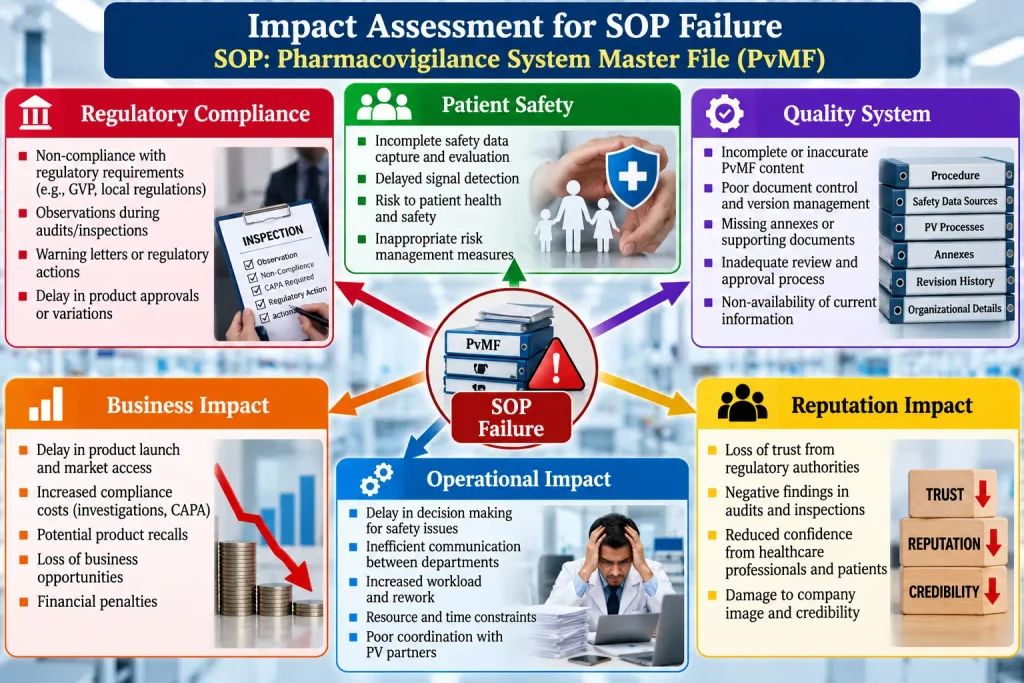
The impact assessment also highlights that ineffective control of the PvMF can contribute to delays in safety-related decision-making, increased rework, poor coordination between departments, and negative findings during audits or inspections. Maintaining an accurate and updated PvMF therefore supports regulatory compliance, traceability, effective pharmacovigilance oversight, and continued readiness for inspection.
Questions & Answers – SOP for Pharmacovigilance System Master File (PvMF):
Q1. What is the objective of the SOP for Pharmacovigilance System Master File?
Answer: The objective is to provide guidance for the preparation and maintenance of the Pharmacovigilance System Master File and the processes associated with it.
Q2. What is the scope of this SOP?
Answer: The SOP applies to the preparation, maintenance, and regular updating of the PvMF for all marketed products within the organization to support compliance with applicable regulatory requirements.
Q3. What is the purpose of a PvMF?
Answer: The PvMF describes the pharmacovigilance system for one or more medicinal products of the Marketing Authorization Holder and documents compliance with regulatory requirements.
Q4. Why should the PvMF remain available for inspection?
Answer: The PvMF may be requested and assessed by regulatory authorities during marketing authorization activities or after authorization, and therefore it should remain available for inspection.
Q5. What is done before preparation of the PvMF?
Answer: An internal meeting is conducted to collect the required data and information from relevant departments and to define timelines for submission of those inputs.
Q6. Who is responsible for authoring the PvMF?
Answer: The nominated Pharmacovigilance Officer In-charge (PvOI) staff is responsible for authoring the PvMF and functions as the document owner.
Q7. What are the main contents of the PvMF?
Answer: The core document includes the PvOI, pharmacovigilance organizational structure, sources of safety data, PV processes, PV system performance, and annexes.
Q8. What types of information are included in the annexes?
Answer: Annexes may include the PvOI CV and job description, organizational structure, PV contracts, safety-data sources, computerized systems, procedural documents, PV performance information, audit information, product lists, and document-control records.
Q9. How is the PvMF reviewed?
Answer: The final draft is sent to the PvOI, manager, and other relevant stakeholders for review. Review comments are incorporated before the final PvMF is forwarded back to the PvOI.
Q10. Why is the PvMF described as a “living document”?
Answer: The PvMF must reflect the current status of the pharmacovigilance system and therefore requires regular updating using timely information from relevant functions.
Q11. When should the PvMF be updated?
Answer: Relevant sections may be updated regularly, such as annually or semi-annually, and ad-hoc updates may be required when significant changes occur or when requested by a regulatory authority.
Q12. How should changes to the PvMF be controlled?
Answer: Approved changes must be implemented and documented, and all changes to the main body and annexes should be recorded so that the history of changes remains available.
Q13. Where should the PvMF be maintained?
Answer: The PvMF should be located at the site where the main pharmacovigilance activities are performed, either in paper-based or electronic form.
Q14. Who has access to the current PvMF?
Answer: The PvOI and Deputy PvOI have unlimited access to the current PvMF and its annexes, while read access is limited to project team members.
Q15. What pharmacovigilance records are specifically monitored in the PvMF?
Answer: The document includes monitoring of ICSR reporting timeliness and quality, PSUR submission timeliness, safety variations, risk-management-plan activities, audits, and other PV obligations.
Reference Guidelines – SOP for Pharmacovigilance System Master File (PvMF):
- Pharmacovigilance Guidance Document for Marketing Authorization Holders (MAHs) – the SOP specifically refers to this guidance when describing the applicant’s pharmacovigilance responsibilities and capability to fulfil required PV tasks.
- Applicable Pharmacovigilance Regulatory Requirements – the PvMF is intended to document compliance with applicable regulatory requirements and remain available for assessment by regulatory authorities.
- Current Applicable Pharmacovigilance Guidance – the SOP requires timely reference to applicable guidance when maintaining and periodically updating the PvMF.
- Internal Reference: “IH” – Section 5.0 of the uploaded SOP lists the reference only as “IH”; the document does not provide its full form or identify a specific publication.