







1. Introduction – SOP for Preparation of Master Formula Record:
The SOP for Preparation of Master Formula Record (MFR) establishes a controlled and standardized procedure for preparing, reviewing, approving, numbering, issuing, and maintaining Master Formula Records for pharmaceutical products. The MFR serves as an authorized master document containing essential product and manufacturing information, including product name, dosage form, label claim, batch size, storage conditions, raw and packing material details, equipment requirements, manufacturing instructions, process flow, reconciliation, and other applicable controls. The SOP assigns responsibility to Quality Assurance personnel for preparation and implementation of the MFR and requires its preparation, review, and approval by authorized personnel. It also defines a unique numbering system, control-copy issuance to Production, and maintenance of distribution and retrieval records. Following this SOP helps ensure consistency, traceability, document control, and standardized execution of pharmaceutical manufacturing processes.
Skip to PDF content2. Flow Diagram – SOP for Preparation of Master Formula Record:
The flow diagram for SOP for Preparation of Master Formula Record (MFR) illustrates the systematic sequence followed for preparation, review, approval, numbering, issuance, and control of the Master Formula Record. The process begins with identification of the requirement for a new or revised MFR, followed by preparation by the Quality Assurance department as per the prescribed format and product requirements. The MFR is reviewed for completeness and compliance by authorized QA personnel and, if acceptable, approved by the Head-QA/QC.
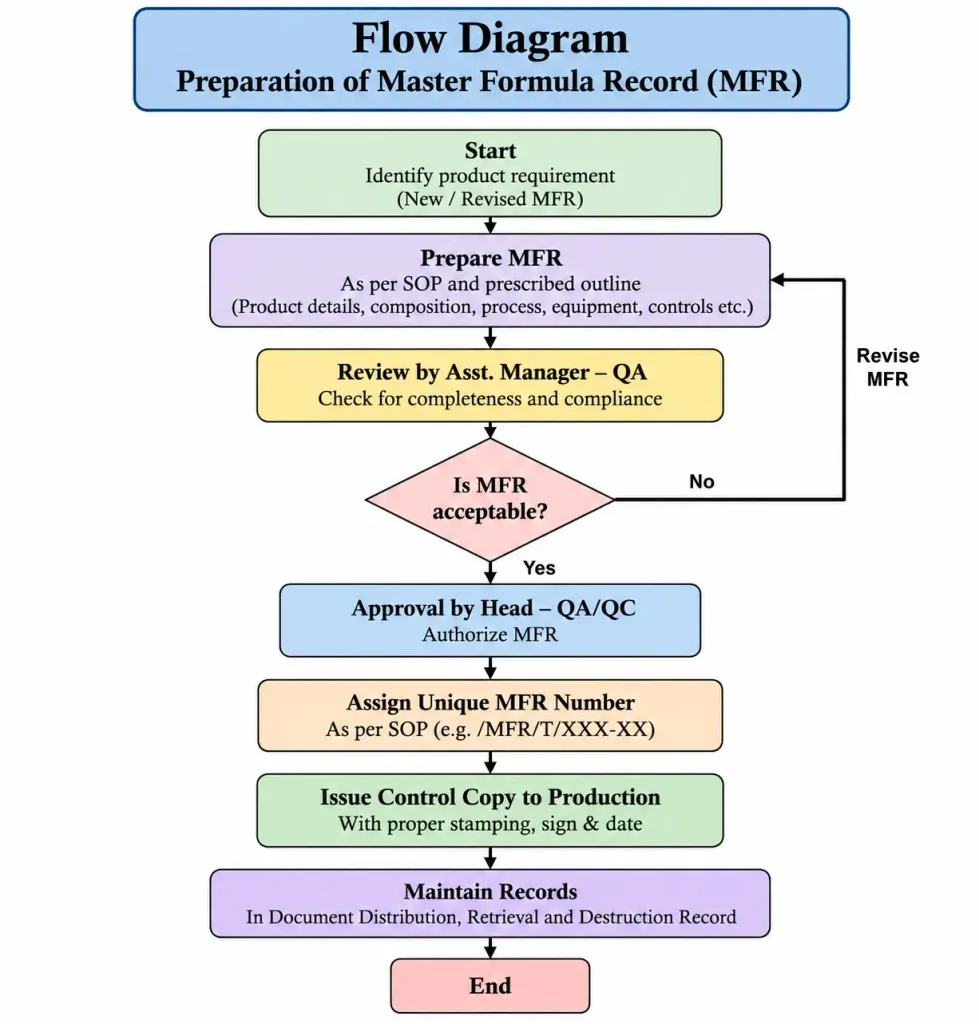
After approval, a unique MFR number is assigned according to the defined numbering system. The approved document is issued to Production as a properly stamped controlled copy, while issuance and retrieval details are maintained in the Document Distribution, Retrieval and Destruction Record.
3. Benefits of Following SOP – Preparation of Master Formula Record:
Following the SOP for Preparation of Master Formula Record (MFR) provides a controlled and standardized approach for preparing, reviewing, approving, numbering, issuing, and maintaining Master Formula Records. The SOP requires authorized personnel to prepare and approve the MFR and includes essential information such as product details, dosage form, label claim, batch size, storage conditions, equipment details, dispensing information, process flow, manufacturing instructions, and yield requirements.
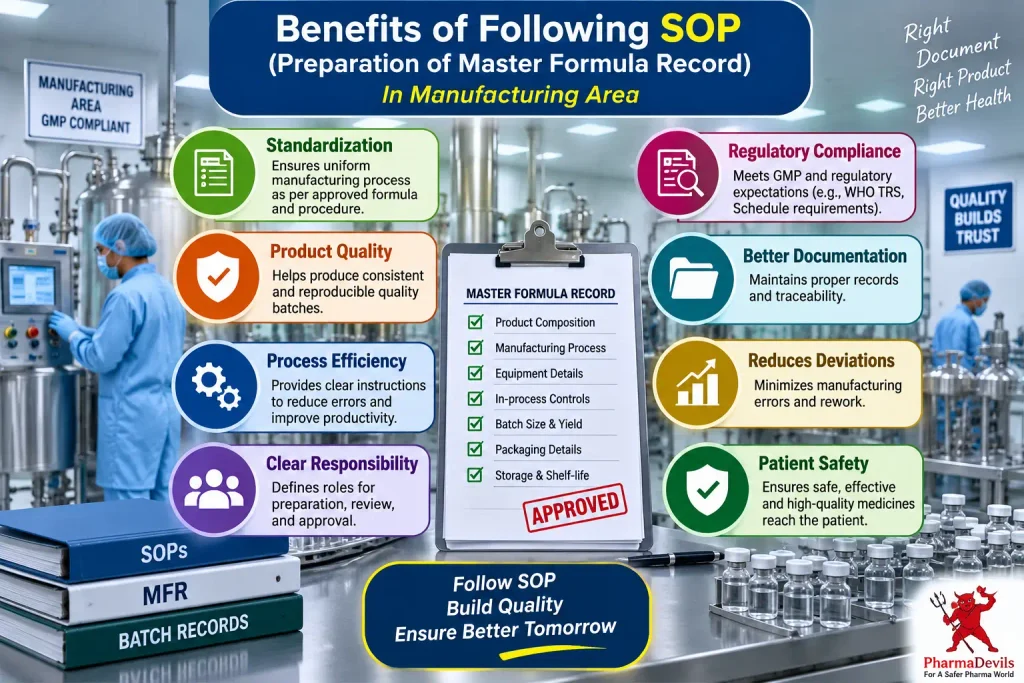
Proper implementation of this SOP supports consistent manufacturing practices, clear responsibilities, improved documentation, traceability, and controlled issuance of approved records. It also helps reduce documentation errors, unauthorized changes, process variability, and manufacturing deviations. The defined numbering and controlled-copy system ensures that Production uses the correct and current MFR, while distribution, retrieval, and destruction records maintain effective document control throughout the product lifecycle.
4. Brainstorming for SOP Failure – SOP for Preparation of Master Formula Record:
The brainstorming diagram highlights potential causes that may lead to failure in implementation of the SOP for Preparation of Master Formula Record (MFR). The SOP requires the Quality Assurance department to prepare or revise the MFR according to product requirements and ensures that preparation, checking, and approval are performed by authorized personnel.
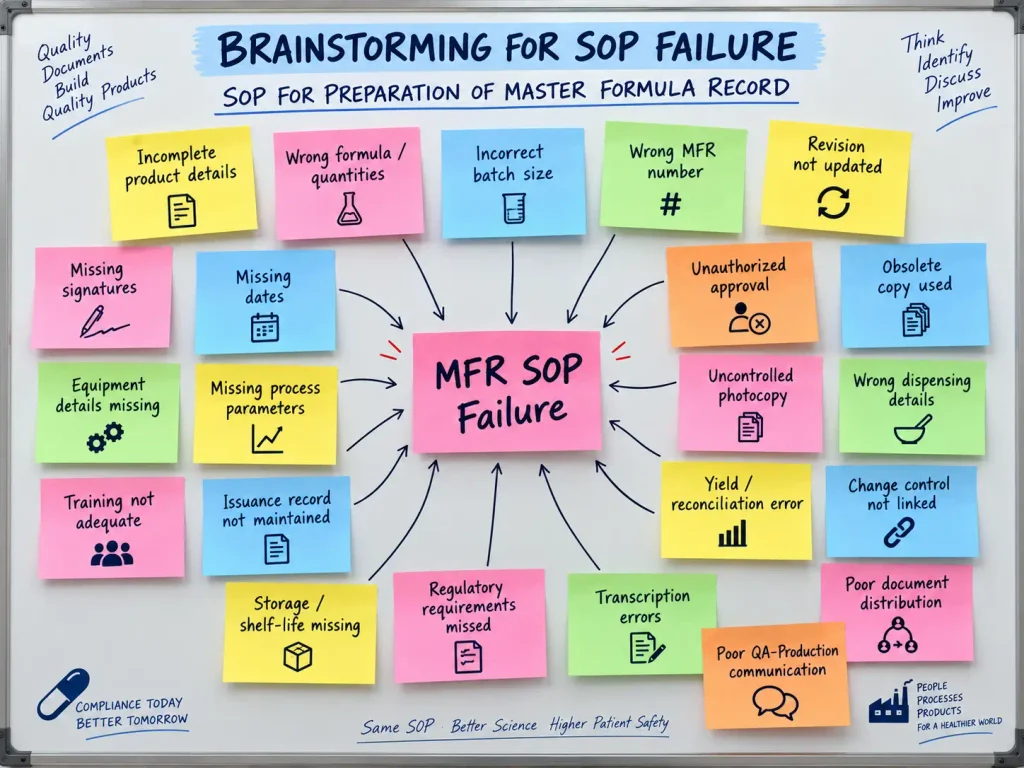
The brainstorming exercise identifies possible weaknesses such as incomplete product details, incorrect formulation quantities, wrong batch size, missing signatures or dates, incorrect MFR numbering, use of obsolete or uncontrolled copies, inadequate training, missing process parameters, transcription errors, and poor QA–Production communication. It also considers failures in document issuance, revision control, dispensing information, reconciliation, storage conditions, and regulatory requirements. The purpose of this analysis is to proactively identify documentation and operational risks so appropriate controls, training, review mechanisms, and CAPA can be established to maintain accurate and controlled Master Formula Records.
5. 5-Why Analysis for SOP Failure – Preparation of Master Formula Record (MFR):
The 5-Why Analysis for SOP Failure – Preparation of Master Formula Record (MFR) examines possible underlying causes of an incomplete, incorrect, or inadequately controlled MFR. The SOP requires the QA department to prepare or revise the MFR according to product requirements and specifies that preparation, review, and approval must be performed by authorized personnel. Using these requirements as the basis, the 5-Why diagram illustrates a possible failure chain: incomplete or incorrect MFR → inadequate collection of product/process information → poor coordination among concerned departments → unclear responsibility or preparation timelines → ineffective SOP implementation and monitoring. This causal chain is an analytical interpretation rather than wording stated directly in the SOP.
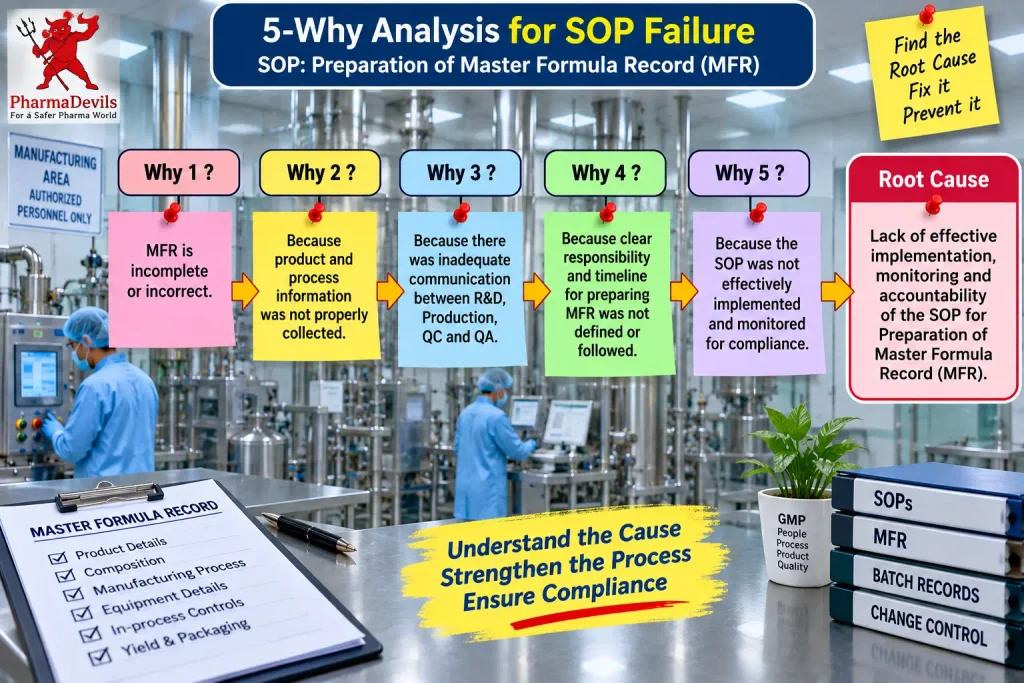
The analysis helps identify the potential root cause as weak implementation, monitoring, and accountability for MFR preparation and control. Addressing these areas can strengthen document accuracy, review effectiveness, traceability, compliance, and consistent manufacturing execution.
6. Fishbone Analysis for SOP Failure – Preparation of Master Formula Record (MFR):
The Fishbone Analysis for SOP Failure – Preparation of Master Formula Record (MFR) is used to identify and organize potential causes that may result in an incomplete, incorrect, outdated, or poorly controlled Master Formula Record. The SOP requires QA to prepare or revise the MFR according to product requirements and states that preparation, review, and approval must be carried out by authorized personnel. The fishbone diagram groups possible causes under major categories such as Man, Method, Material/Information, Machine/Equipment, Measurement/Review, and Environment/Management. These include inadequate training, unclear responsibilities, outdated formats, incomplete product or RM/PM details, missing equipment information, insufficient review, numbering errors, weak document control, poor communication, inadequate supervision, and overlooked regulatory requirements.
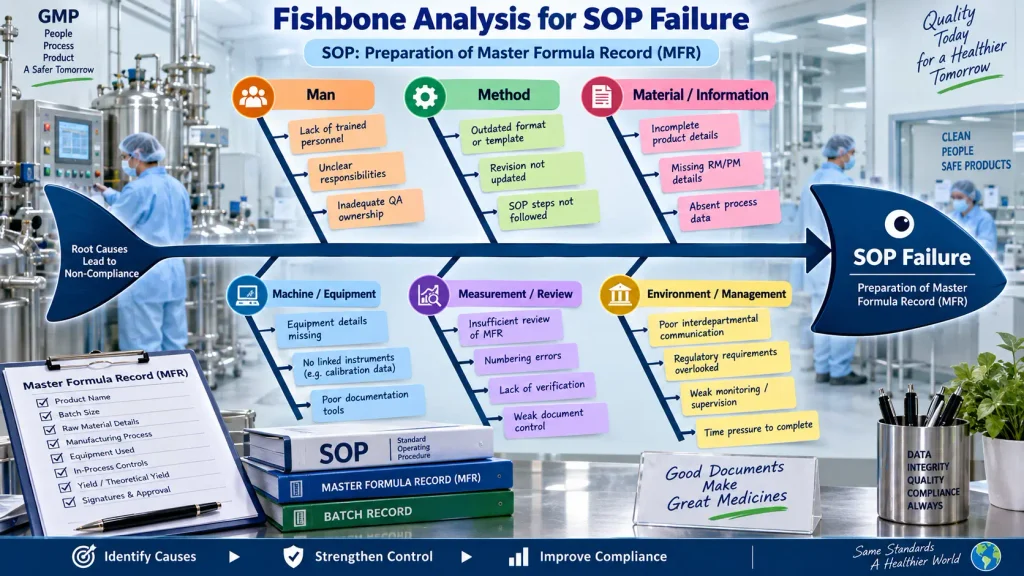
The analysis helps Quality Assurance systematically identify contributing factors behind SOP failure and focus corrective actions on strengthening training, document preparation, review, approval, numbering, issuance, and record control. The SOP also specifically requires unique MFR numbering and controlled issuance through documented distribution and retrieval records.
7. Fault Tree Analysis for SOP Failure – Preparation of Master Formula Record (MFR):
The Fault Tree Analysis for SOP Failure – Preparation of Master Formula Record (MFR) illustrates how different failures can combine to result in an incorrect, incomplete, outdated, unapproved, or improperly issued Master Formula Record. The SOP states that QA is responsible for preparing or revising the MFR according to product requirements and that preparation, review, and approval must be performed by authorized personnel. The fault tree groups potential causes under Man, Method, Material/Information, Machine/Systems, Measurement/Review, and Environment/Management. Possible contributors include inadequate training, unclear responsibilities, failure to follow the SOP, outdated formats, incomplete product or RM/PM information, missing equipment or process details, inadequate review, numbering or version-control errors, poor interdepartmental communication, and insufficient management oversight.
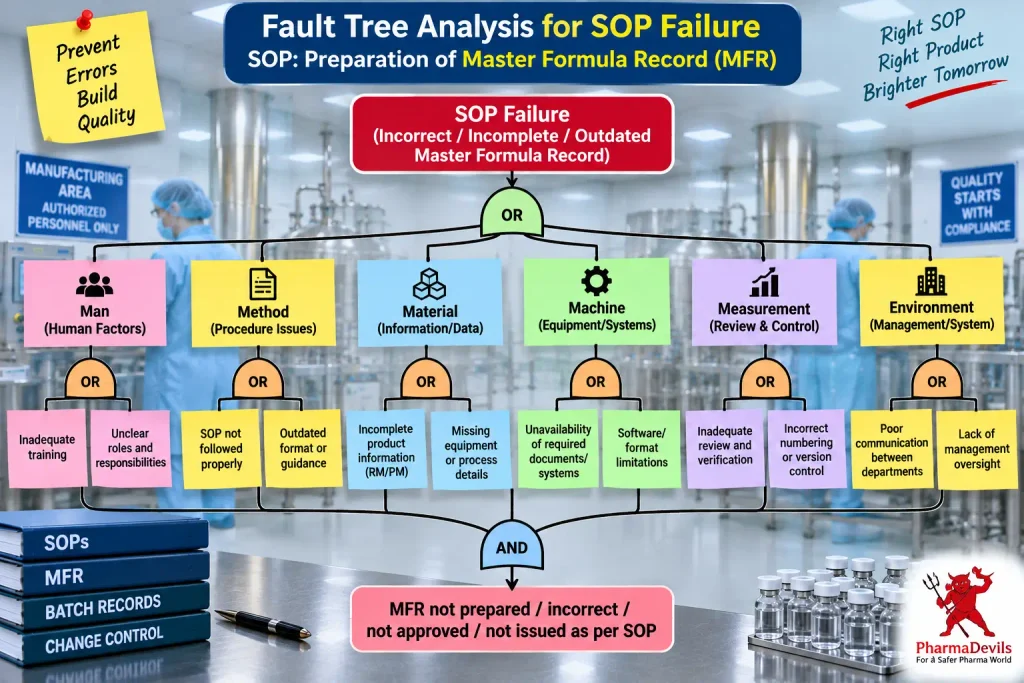
These failures can ultimately lead to an MFR being not prepared correctly, not approved, or not issued as required. The SOP specifically defines unique MFR numbering, controlled-copy issuance, authorization by QA, and maintenance of issuance records through the Document Distribution, Retrieval and Destruction Record.
8. Impact Assessment for SOP Failure – Preparation of Master Formula Record (MFR):
The Impact Assessment for SOP Failure – Preparation of Master Formula Record (MFR) evaluates the potential consequences of preparing, reviewing, approving, numbering, or issuing an MFR incorrectly. The SOP requires QA to prepare or revise the MFR according to product requirements and specifies that preparation, review, and approval must be performed by authorized personnel.
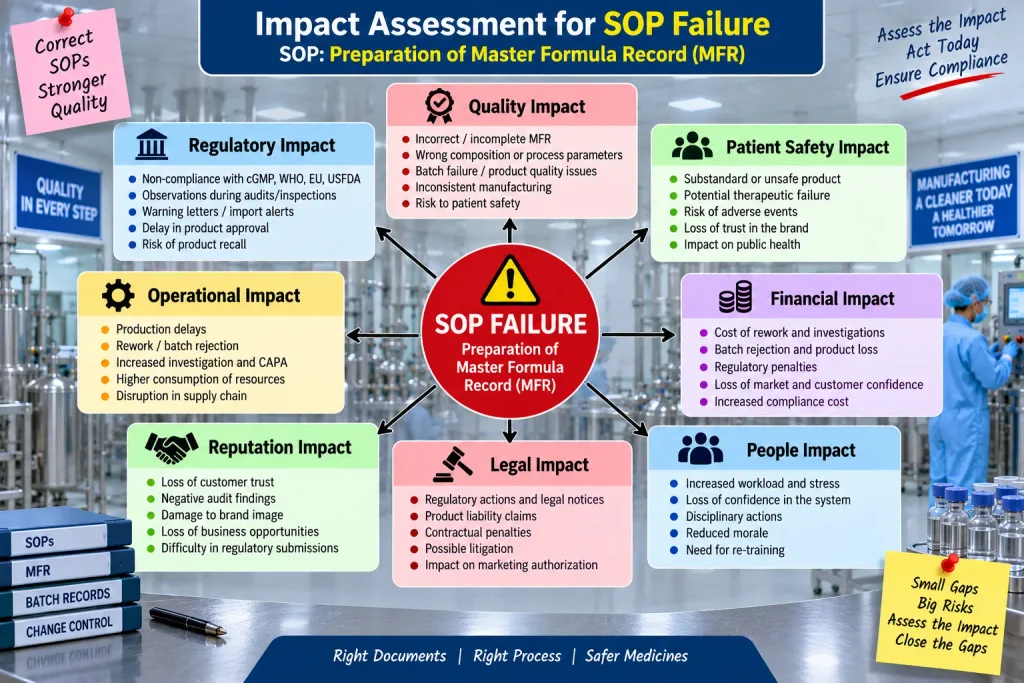
Failure of these controls may lead to incomplete product information, incorrect manufacturing instructions, missing equipment or material details, wrong document versions, and inadequate traceability. The resulting impact may extend to product quality, manufacturing consistency, batch documentation, regulatory compliance, production efficiency, and document control. Broader consequences such as rework, investigation, batch rejection, audit observations, additional compliance costs, and potential patient-safety concerns are risk-based outcomes inferred from such failures rather than explicitly listed in the SOP. The SOP reduces these risks through unique MFR numbering, controlled-copy issuance, QA authorization, and documented distribution, retrieval, and destruction controls.
Questions & Answers – SOP for Preparation of Master Formula Record (MFR):
Q1. What is the objective of this SOP?
Answer: The objective is to lay down a procedure for preparation of the Master Formula Record.
Q2. Who is responsible for execution of this SOP?
Answer: The Officer/Chemist-QA is responsible for execution of the SOP.
Q3. Who is responsible for effective implementation of the SOP?
Answer: The Asst. Manager-QA and Head-QA/QC are responsible for effective implementation.
Q4. Who prepares or revises the Master Formula Record?
Answer: The QA department prepares or revises the MFR as per product requirements.
Q5. Who shall prepare, review, and approve the MFR?
Answer: Preparation, review, and approval of the MFR shall be performed by authorized personnel.
Q6. What product information should be included in the MFR?
Answer: The MFR includes information such as product name, dosage form, label claim, product description, batch size, pack size/packing style, shelf life, storage condition, drug schedule, master number, effective date, manufacturing and expiry dates, flow chart, equipment details, dispensing details, and final yield limits.
Q7. What processing information should be included in the MFR?
Answer: It should include stepwise processing instructions, material checks, pretreatments, sequence of material addition, mixing times, and temperature requirements.
Q8. How is the MFR uniquely numbered?
Answer: The numbering system consists of site code, MFR identification, section code, serial number, and version number, for example /MFR/T/XXX-XX.
Q9. What do T, L, and O represent in the MFR numbering system?
Answer: T, L, and O denote Tablet, Liquid, and Ointment sections respectively.
Q10. How is the Master Copy of an MFR maintained?
Answer: The Master Copy is printed on A4-size white paper and stamped as “Master Copy” according to the applicable SOP procedure.
Q11. How is an MFR issued to the Production department?
Answer: QA prepares a photocopy of the Master MFR and stamps it as “CONTROL COPY.” The Officer/Executive-QA authorizes it by signing and dating the copy.
Q12. Where is issuance of the MFR recorded?
Answer: Issuance is recorded in the Document Distribution, Retrieval and Destruction Record.
Q13. What happens if Production requires an additional MFR copy?
Answer: Production shall request an additional copy, and the reason for the requirement shall be recorded in the distribution record.
Q14. What is the reference mentioned in the SOP?
Answer: The SOP lists WHO TRS as the reference.
Q15. What major sections are included in the MFR format?
Answer: The format includes general information, index, raw-material dispensing details, active-material calculation sheet, storage conditions, equipment/instrument list, manufacturing instructions, pre-manufacturing controls, process flow sheet, manufacturing process, reconciliation, shelf-life/sample details, destruction instructions, cleaning guidelines, stability testing guidelines, abbreviations, and change history.
Reference Guidelines – SOP for Preparation of Master Formula Record (MFR):
- WHO Technical Report Series (WHO TRS) – used as the regulatory/GMP reference for preparation and control of the Master Formula Record.
The SOP does not specify a particular WHO TRS number, annex, or edition, so no more specific guideline reference can be confirmed from the document itself.