






1. Introduction for SOP for Qualification of Water System:
The SOP for Qualification of Water System defines the systematic approach for ensuring pharmaceutical water generation, storage, and distribution systems are suitable for intended use and comply with cGMP requirements. It covers Design Qualification, Installation Qualification, Operational Qualification, and Performance Qualification. Performance qualification is conducted in three phases: Phase I for two weeks, Phase II for two weeks, and Phase III for one year. The procedure includes system start-up, sampling, chemical and microbiological testing, trend evaluation, sanitization, maintenance, alert/action limits, and continuous monitoring. Responsibilities are assigned to Engineering, QC, and QA, with requalification required after major modifications or breakdown events.
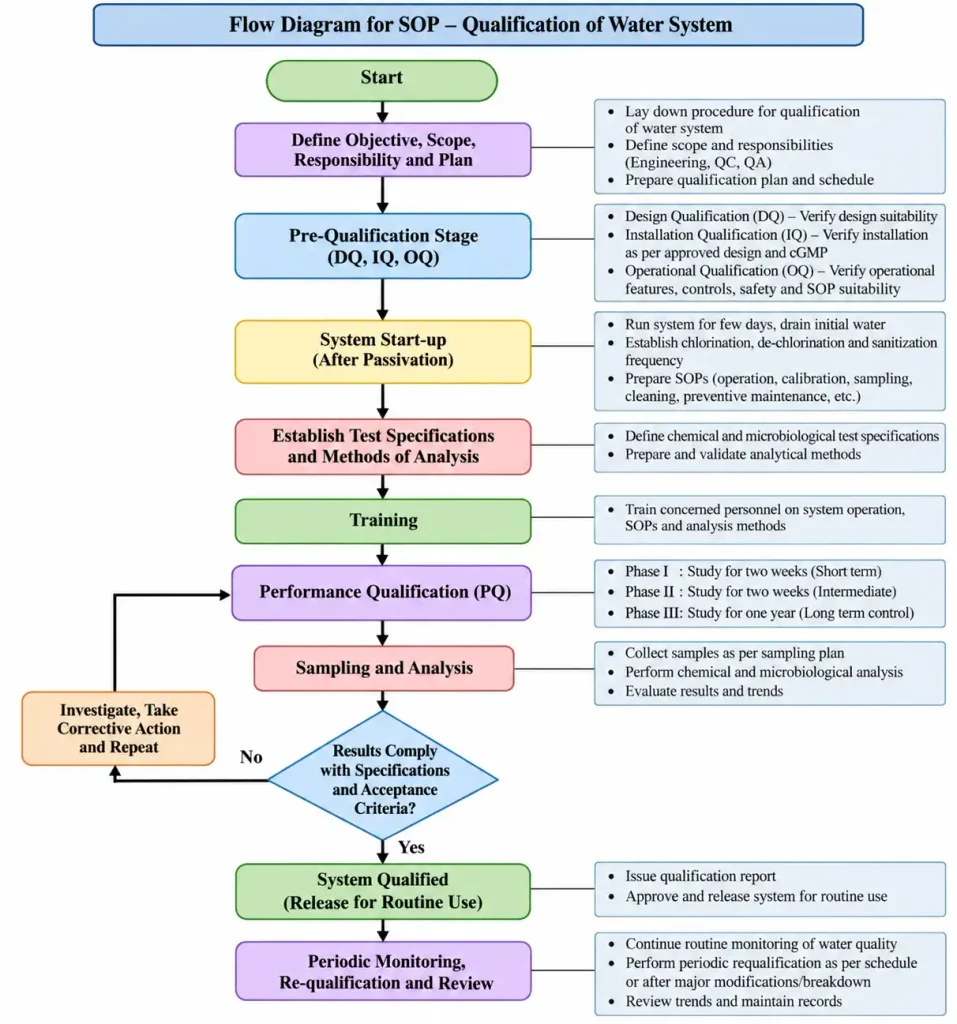
2. Flow Diagram for SOP for Qualification of Water System:
The flow diagram illustrates the systematic qualification of a pharmaceutical water system from initial planning through routine monitoring. The process begins with defining responsibilities and completing Design, Installation, and Operational Qualification. After passivation, the system is started, test specifications and analytical methods are established, and concerned personnel are trained. Performance Qualification is then conducted in three phases: Phase I for two weeks, Phase II for two weeks, and Phase III for one year. Water samples are chemically and microbiologically tested and trended. Compliant results lead to system qualification and routine use, while failures require investigation, corrective action, and repeat evaluation.
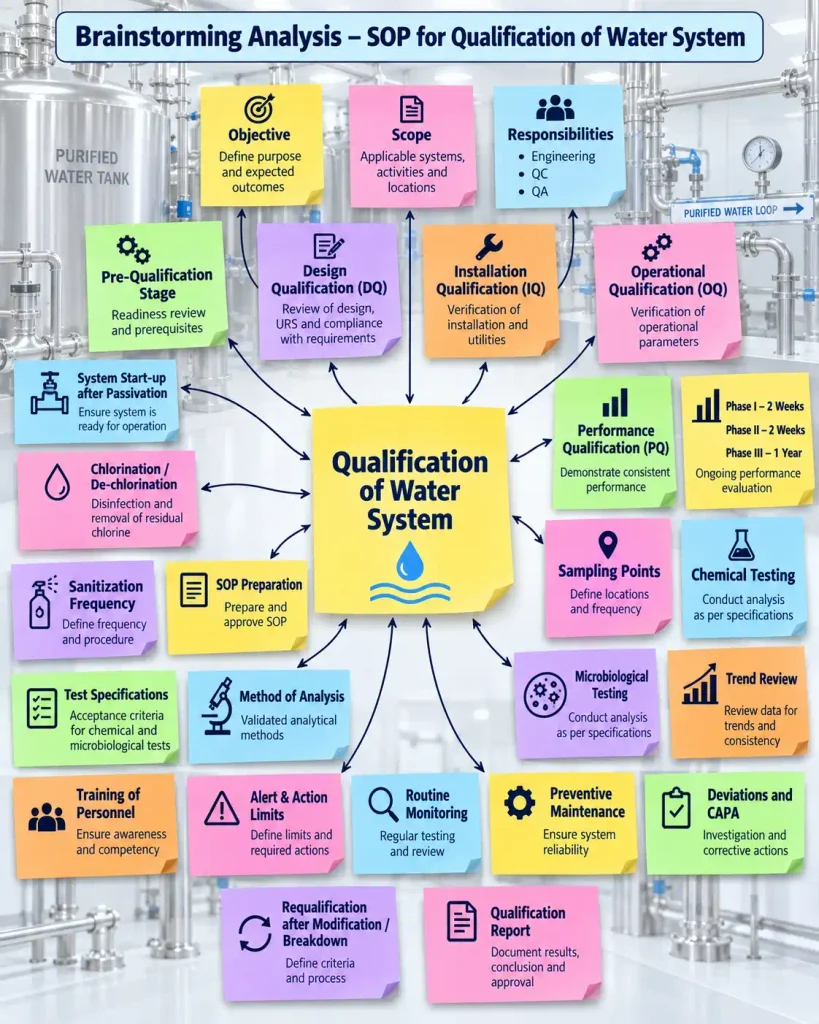
3. Brainstorming Analysis for Qualification of Water System:
The brainstorming analysis identifies the key elements required for effective qualification of a pharmaceutical water system. It covers the objective, scope, responsibilities, pre-qualification activities, Design Qualification, Installation Qualification, Operational Qualification, and Performance Qualification. Major considerations include system start-up after passivation, chlorination and de-chlorination, sanitization frequency, SOP preparation, sampling locations, chemical and microbiological testing, and analytical methods. The analysis also highlights personnel training, establishment of test specifications, alert and action limits, trend review, preventive maintenance, deviation handling, CAPA, routine monitoring, qualification reporting, and requalification after major modification or breakdown to maintain consistent water quality and system reliability.
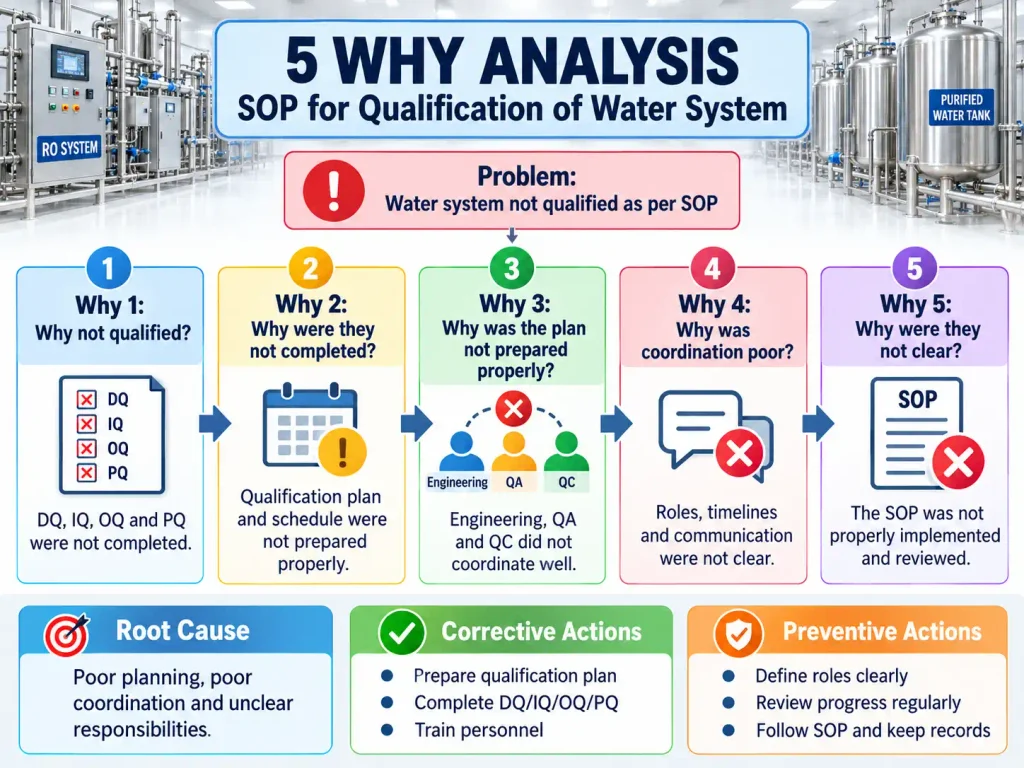
4. 5 Why Analysis for Qualification of Water System:
The 5 Why Analysis identifies the underlying causes of failure to qualify the pharmaceutical water system as per the approved SOP. The analysis begins with incomplete DQ, IQ, OQ, or PQ activities and traces the problem to inadequate qualification planning, missing protocols, poor scheduling, and insufficient coordination among Engineering, QA, and QC. Further investigation highlights unclear roles, responsibilities, timelines, and weak SOP implementation. The root cause is inadequate planning and ineffective cross-functional control. Corrective actions include completing qualification activities, approving protocols, and training personnel, while preventive actions focus on defined responsibilities, periodic reviews, document readiness, audits, and sustained compliance.
5. Fishbone Analysis for SOP for Qualification of Water System:
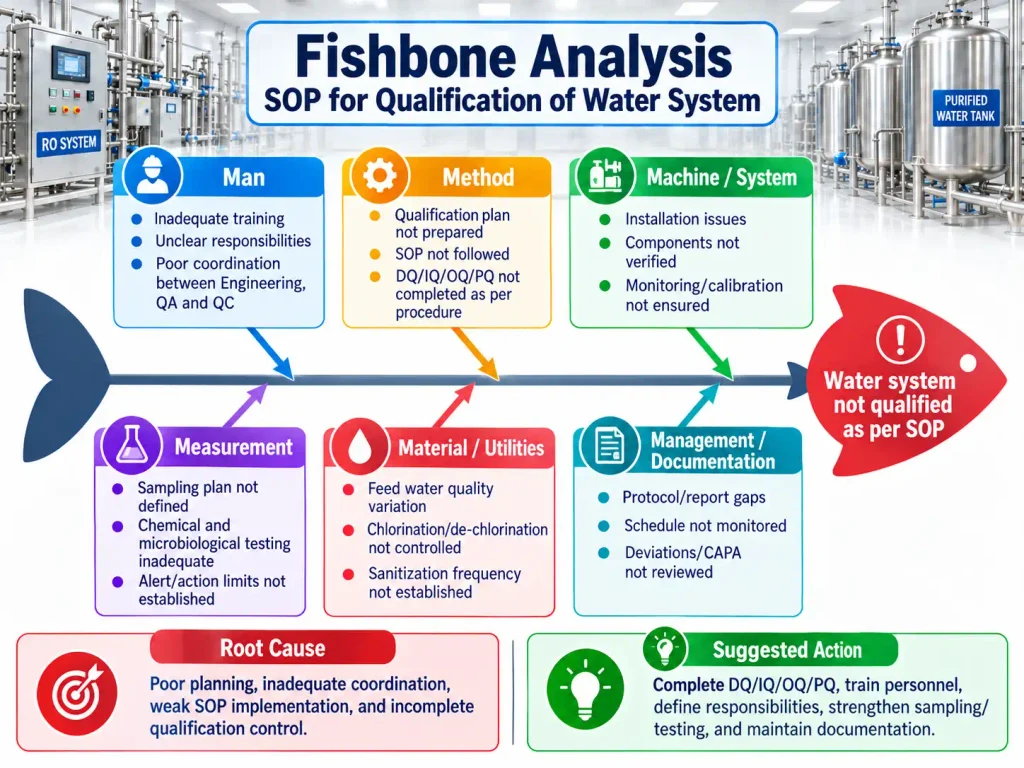
The Fishbone Analysis identifies possible causes that may lead to failure of water system qualification as per the SOP. The causes are grouped under Man, Method, Machine/System, Measurement, Material/Utilities, and Management/Documentation. Key issues include inadequate training, unclear responsibilities, incomplete DQ/IQ/OQ/PQ activities, installation problems, poor calibration, undefined sampling plans, inadequate chemical and microbiological testing, uncontrolled chlorination or sanitization, and gaps in protocols or reports. The analysis helps identify the root causes of qualification failure and supports appropriate corrective actions such as improved planning, better coordination, complete documentation, personnel training, and effective monitoring of qualification activities.
6. Heat Map Analysis for SOP for Qualification of Water System:
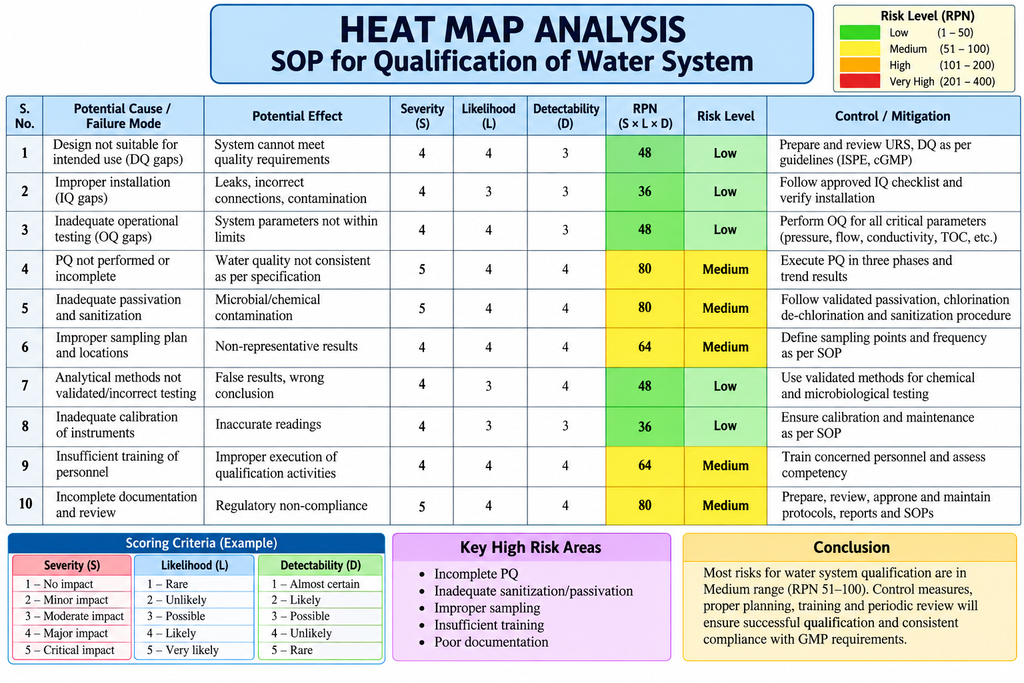
The Heat Map Analysis evaluates potential risks associated with qualification of the pharmaceutical water system. Major risk areas include incomplete Performance Qualification, inadequate passivation and sanitization, improper sampling plans, insufficient personnel training, and incomplete documentation. Each risk is assessed using severity, likelihood, and detectability to determine the Risk Priority Number (RPN). The analysis helps prioritize controls for preventing system failure and maintaining water quality. Recommended controls include completing DQ, IQ, OQ, and PQ activities, using validated analytical methods, ensuring calibration, defining sampling locations, training personnel, reviewing qualification records, and maintaining effective routine monitoring and documentation.
7. Fault Tree Analysis for SOP for Qualification of Water System:
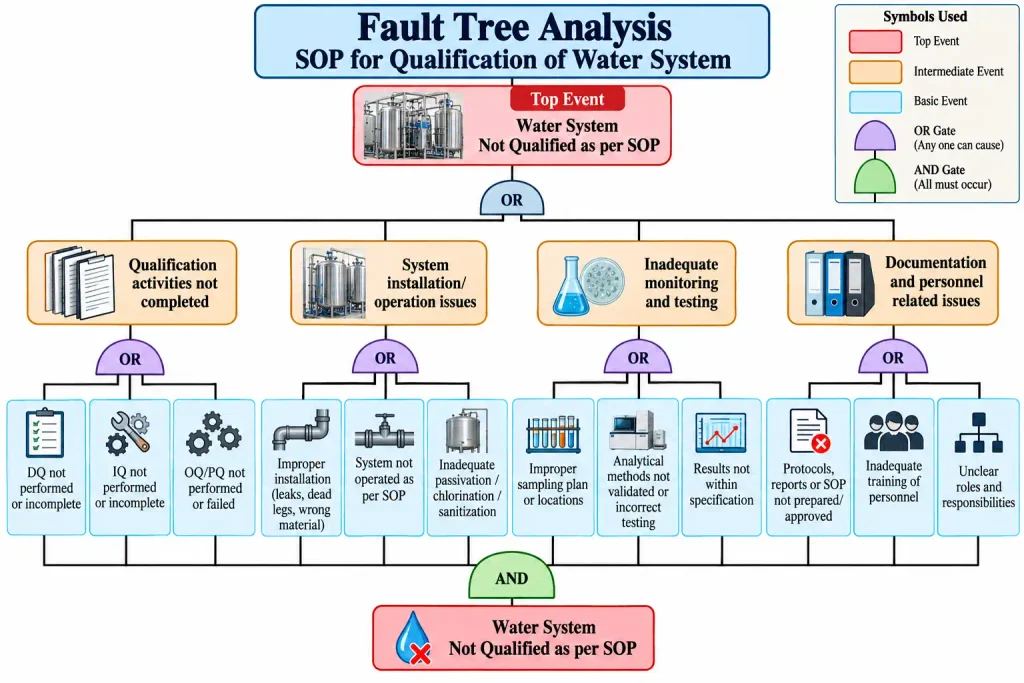
The Fault Tree Analysis identifies the major causes that may result in a water system not being qualified as per SOP. The main contributing areas include incomplete qualification activities, system installation or operational problems, inadequate monitoring and testing, and documentation or personnel-related issues. Basic causes include incomplete DQ, IQ, OQ or PQ, improper installation, inadequate passivation or sanitization, incorrect sampling, unsuitable analytical methods, out-of-specification results, incomplete protocols, insufficient training, and unclear responsibilities. The analysis helps systematically identify failure pathways so that appropriate corrective and preventive actions can be implemented to ensure successful qualification and continued system compliance.
8. Pareto Chart Analysis for SOP for Qualification of Water System:
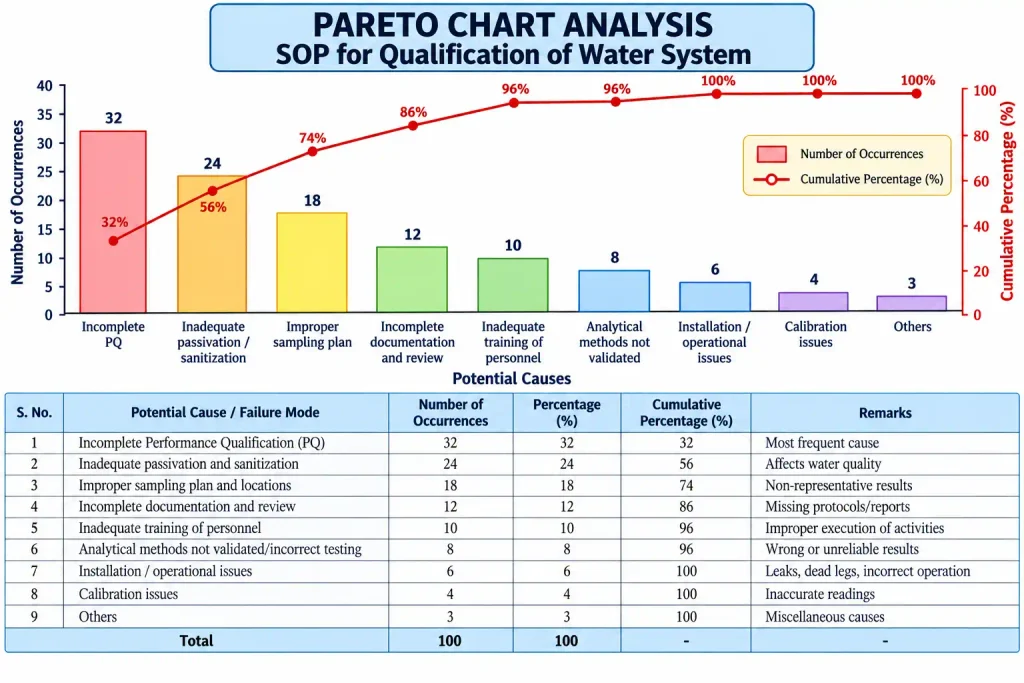
The Pareto Chart Analysis identifies and prioritizes major causes that may affect effective qualification of the pharmaceutical water system. The most significant issues include incomplete Performance Qualification, inadequate passivation and sanitization, improper sampling plans, incomplete documentation, insufficient training, unsuitable analytical methods, installation or operational problems, and calibration issues. The chart arranges these causes according to their frequency and shows their cumulative contribution. This helps the organization focus corrective and preventive actions on the most important problems first. Addressing the major causes through proper planning, qualification, training, sampling, documentation, maintenance, and monitoring supports reliable water-system performance and continued GMP compliance.
9. Corrective Action and Preventive Action – SOP for Qualification of Water System:
The CAPA program for water-system qualification should address deficiencies identified during DQ, IQ, OQ, PQ, sampling, testing, documentation, operation, sanitization, and routine monitoring. The SOP requires qualification before pharmaceutical use and defines DQ, IQ and OQ as prequalification stages.
| Identified Issue | Corrective Action | Preventive Action |
|---|---|---|
| DQ not completed or inadequate | Review approved design and complete documented DQ against intended use and requirements. | Establish a mandatory DQ checklist and QA review before installation. |
| IQ incomplete | Verify installation, components, utilities and system configuration against approved specifications. | Use an approved IQ protocol and installation checklist for every new or modified system. |
| OQ not performed adequately | Execute OQ for operating functions, controls, safety features, cleaning, start-up and shutdown. | Define critical operating parameters and periodically verify their control. |
| PQ incomplete | Complete the required Performance Qualification phases and document results. | Maintain an approved PQ schedule covering Phase I, Phase II and Phase III. |
| Improper passivation/start-up | Perform appropriate system start-up and verify readiness before qualification testing. | Establish documented start-up and passivation requirements before PQ. |
| Sanitization not properly controlled | Perform sanitization and review chlorination/de-chlorination practices and frequency. | Establish and periodically review validated sanitization frequencies and procedures. |
| Sampling deficiencies | Resample affected points as per the approved sampling plan and evaluate results. | Clearly define sampling locations, frequencies and responsible personnel in the protocol. |
| Chemical/microbiological failure | Investigate the failure, identify the cause, implement correction and repeat testing where justified. | Trend chemical and microbiological results to detect deterioration before specification failure. |
| Alert/action limits not established | Evaluate available qualification data and establish appropriate limits. | Periodically review limits using Phase III and routine monitoring data. |
| Personnel training inadequate | Retrain Engineering, QC and QA personnel on qualification activities and relevant SOPs. | Maintain an approved training program and verify personnel competency before assigning qualification work. |
| Documentation incomplete | Complete missing protocols, reports, raw data, deviations and approvals. | Implement QA-controlled document review before closure of each qualification phase. |
| Deviations observed during qualification | Investigate deviations, determine root cause and implement documented corrective actions. | Perform effectiveness checks and trend recurring deviations to prevent recurrence. |
| Major modification or breakdown | Assess the impact and perform appropriate requalification before routine use. | Include requalification assessment in change control and breakdown-management procedures. |
CAPA Effectiveness: Effectiveness should be demonstrated through satisfactory qualification results, compliance with established specifications, successful trend review, absence of recurring deviations, completion of required documentation, and continued reliable performance of the water generation, storage and distribution system.
10. Questions & Answers – SOP for Qualification of Water System:
- Q: What is the objective of the SOP for Qualification of Water System?
A: The objective is to define the procedure for qualification of the pharmaceutical water system before its use in the plant. - Q: Who is responsible for operating and sanitizing the water system?
A: Engineering personnel are responsible for efficient operation of the system and for regeneration and sanitization at defined frequencies. - Q: What is the responsibility of QC during water-system qualification?
A: QC is responsible for analyzing water samples according to the sampling plan and established specifications. - Q: What is the responsibility of QA during qualification?
A: QA monitors protocol completeness, accuracy, applicability, scheduling, validation runs, data review, and preparation of revalidation reports. - Q: What are the main prequalification stages?
A: The main prequalification stages are Design Qualification (DQ), Installation Qualification (IQ), and Operational Qualification (OQ). - Q: What is Design Qualification?
A: DQ is documented verification that the proposed design of the equipment or system is suitable for its intended purpose. - Q: What is the purpose of Installation Qualification?
A: IQ verifies that the purified water or WFI generation, storage, and distribution system has been installed according to predefined acceptance criteria and cGMP requirements. - Q: What is the purpose of Operational Qualification?
A: OQ demonstrates that the water system operates according to the URS, design specifications, and relevant cGMP requirements. - Q: What are the Performance Qualification phases?
A: Performance Qualification consists of Phase I for two weeks, Phase II for two weeks, and Phase III for one year. - Q: When does water-system start-up begin?
A: System start-up begins after passivation. During this stage, the system is operated for a few days and initially generated water is drained. - Q: What activities should be established during system start-up?
A: Chlorination, de-chlorination, sanitization frequency, operation and calibration procedures, sampling procedures, preventive maintenance, and storage-tank cleaning frequency should be established. - Q: What is the objective of Performance Qualification?
A: PQ verifies that the water generation, storage, and distribution system functions according to predefined acceptance criteria and can provide the required water quality and quantity. - Q: Can water be used for manufacturing during Phase I?
A: No. The SOP states that water shall not be used in finished pharmaceutical products during Phase I qualification. - Q: Can water be used for manufacturing during Phase II?
A: Yes. Water can be used for manufacturing during Phase II, while daily sampling and testing continue. - Q: What is the purpose of Phase III?
A: Phase III demonstrates extended reliable performance and evaluates seasonal variations over approximately one year. - Q: How are alert and action limits established?
A: Alert and action limits for routine monitoring are established by statistical evaluation of data generated during Phase III qualification. - Q: When is requalification of the water system required?
A: Requalification is required after a major modification of the water system or after a major breakdown. - Q: Why is trending important during qualification?
A: Trending helps evaluate each test parameter at sampling or user points and supports QA review of system performance during qualification phases. - Q: What testing is performed during Phase I?
A: Chemical and microbiological testing is performed according to the qualification protocol, including sampling of feed water, purification stages, user points, and defined sampling locations. - Q: What should be done after successful completion of Phase III?
A: A continuous monitoring schedule should be prepared, alert and action limits established, and QA should prepare a yearly sampling schedule covering all user points.
11. Reference Guidelines – SOP for Qualification of Water System:
The SOP identifies the following references for qualification, operation, monitoring, and control of the pharmaceutical water system:
- In-House Procedures and Specifications – Approved internal procedures, specifications, qualification protocols, sampling plans, and monitoring requirements.
- WHO Technical Report Series (TRS) 970 – WHO guidance applicable to pharmaceutical water systems and GMP requirements.
- WHO Technical Report Series (TRS) 937 – WHO GMP guidance covering pharmaceutical water-system design, qualification, operation, and monitoring.
- WHO Technical Report Series (TRS) 929 – WHO GMP guidance relevant to water used for pharmaceutical purposes.
- Bureau of Indian Standards – IS 10500:1991 – Drinking-water quality requirements referenced by the SOP.
- Indian Pharmacopoeia (IP) – Pharmacopoeial requirements and test specifications for pharmaceutical-grade water.
- United States Pharmacopeia (USP) – Pharmacopoeial requirements for pharmaceutical water quality, testing, and control.