






1. Introduction – SOP for Redressing of Finished Products:
The SOP for Redressing of Finished Products establishes a controlled procedure for handling, evaluating, and redressing finished pharmaceutical products that have been returned or recalled. Returned goods are kept in a designated area under “Hold” status until the Quality Assurance Department completes the required investigation and determines whether the material is suitable for redressing. The evaluation includes verification of quantity, condition of the consignment, source location, batch details, manufacturing and expiry dates, and other relevant information. Where redressing is approved, the activity is performed under controlled conditions with appropriate segregation, issuance and coding of packaging materials, proper identification, and documentation. Quality Assurance supervises the activity to prevent product or batch mix-ups, and the process requires appropriate change control or deviation approval before commencement. All redressing data are recorded by QA to maintain traceability and control of the activity.
Skip to PDF content2. Flow Diagram – Redressing of Finished Products:
The flow diagram illustrates the controlled sequence for redressing of finished pharmaceutical products. The process begins when information is received regarding returned or recalled goods. The material is received, stored separately in the designated “Recalled Goods” area under Hold status, and verified for quantity, condition, source, value, batch details, manufacturing date, expiry date, and other relevant information. Quality Assurance then investigates the reason for return and determines whether the product is suitable for redressing.
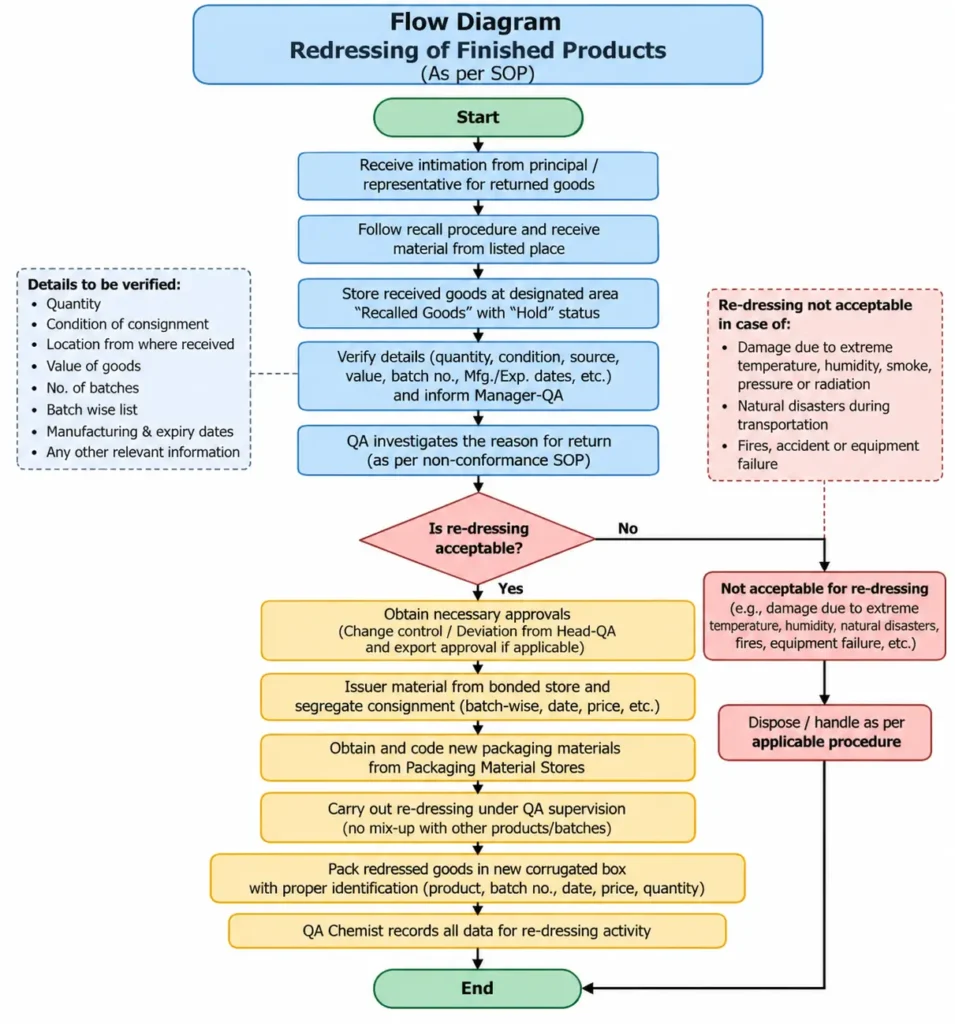
If redressing is approved, the required change control or deviation approval is obtained. The material is issued from the bonded store, segregated batch-wise, and required packaging materials are issued and coded. Redressing is performed under QA supervision to prevent product or batch mix-ups. The finished goods are then packed in properly identified corrugated boxes, and all details of the activity are recorded by the QA Chemist. Products unsuitable for redressing are handled through the applicable disposition procedure.
3. Benefits of Following SOP for Redressing of Finished Products:
Following the SOP for Redressing of Finished Products ensures that returned or recalled finished goods are handled in a controlled, documented, and traceable manner. The procedure supports proper segregation of returned goods, verification of batch and consignment details, QA investigation, and formal approval before any redressing activity is started.
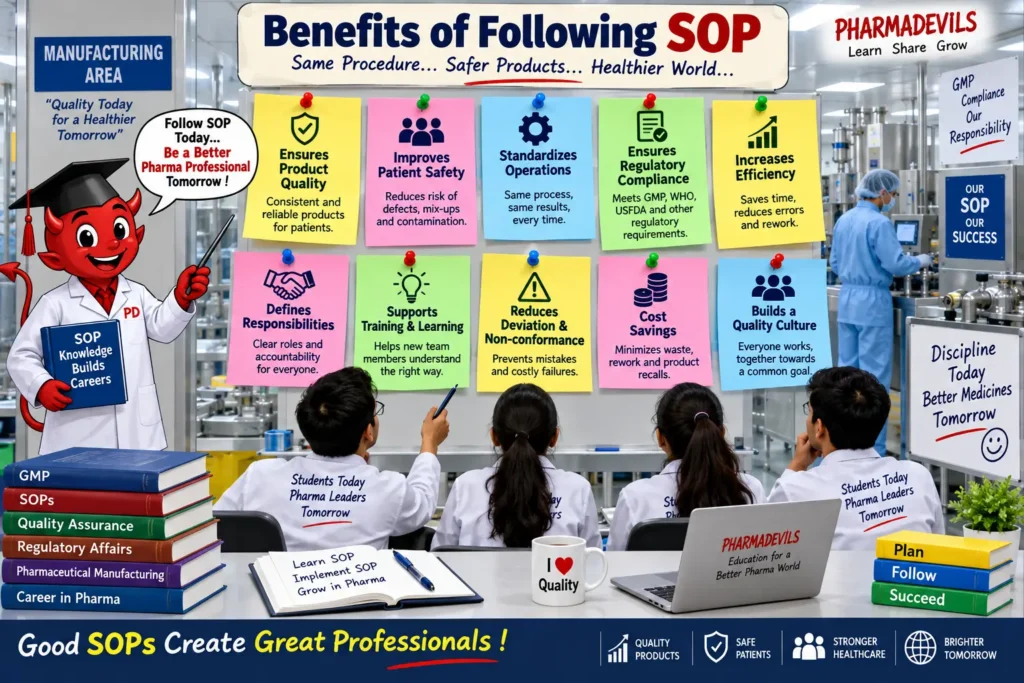
The sticky-note diagram highlights major benefits such as consistent product quality, patient safety, standardized operations, regulatory compliance, improved efficiency, defined responsibilities, effective training, reduced deviations, cost control, and development of a strong quality culture. In the context of this SOP, QA supervision during redressing helps prevent product or batch mix-ups, while controlled issuance and coding of packaging materials support correct identification and traceability. Proper recording of the redressing activity also provides documented evidence for review and accountability.
4. Brainstorming for SOP Failure – Redressing of Finished Products:
Brainstorming for failure of the SOP for Redressing of Finished Products is performed to identify possible reasons why returned or recalled finished goods may not be handled according to the approved procedure. The discussion should focus on common gaps such as lack of SOP training, poor understanding of responsibilities, incomplete records, improper segregation of returned goods, incorrect coding of packaging materials, inadequate QA supervision, product or batch mix-ups, and failure to obtain required change control or deviation approval before starting the activity.
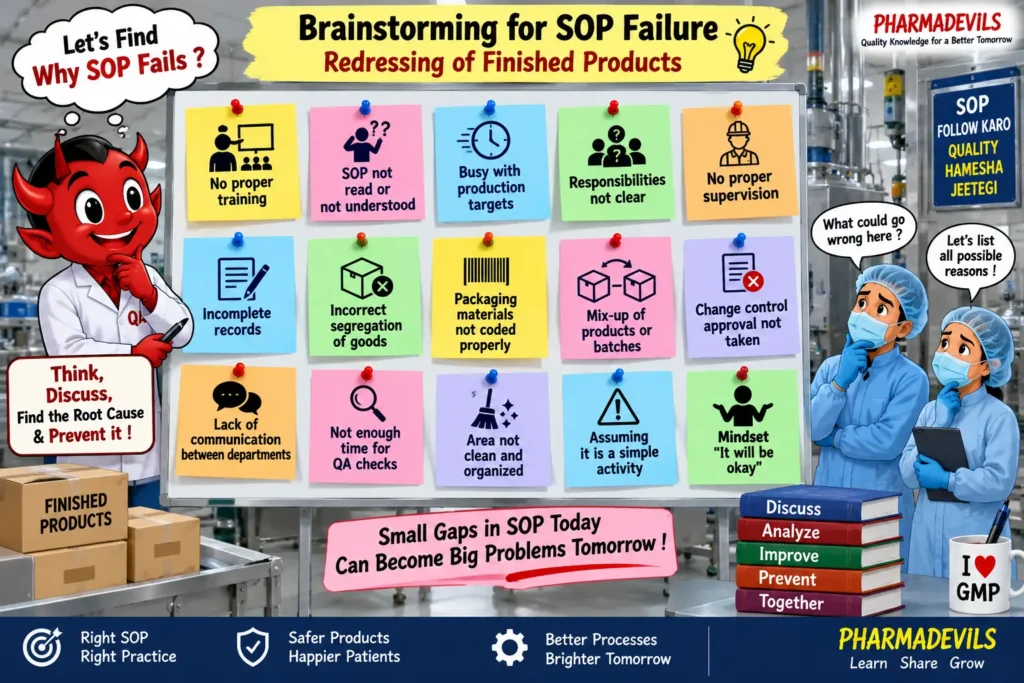
The SOP requires returned goods to remain under Hold status, followed by verification and QA investigation before a decision on redressing is made. During approved redressing, materials must be properly segregated, packaging components controlled, activities supervised by QA, and all relevant data recorded. Brainstorming helps the team recognize these weaknesses early, determine likely causes, strengthen training and supervision, and prevent recurrence of SOP failures.
5. 5-Why Analysis for SOP Failure – Redressing of Finished Products:
The 5-Why Analysis for failure of the SOP for Redressing of Finished Products is used to identify the underlying cause when redressing activities are not performed according to the approved procedure. A typical analysis may begin with the problem that redressing was not carried out as per SOP. The first reason may be that personnel were not fully aware of the correct procedure. This may occur because proper SOP training was not provided or was not effective. Further questioning may identify that training was not adequately planned, documented, or followed up. The next level may reveal that responsibilities for training, supervision, and implementation were not clearly defined. Ultimately, the root cause may be weak SOP implementation, inadequate training control, and insufficient monitoring of compliance.
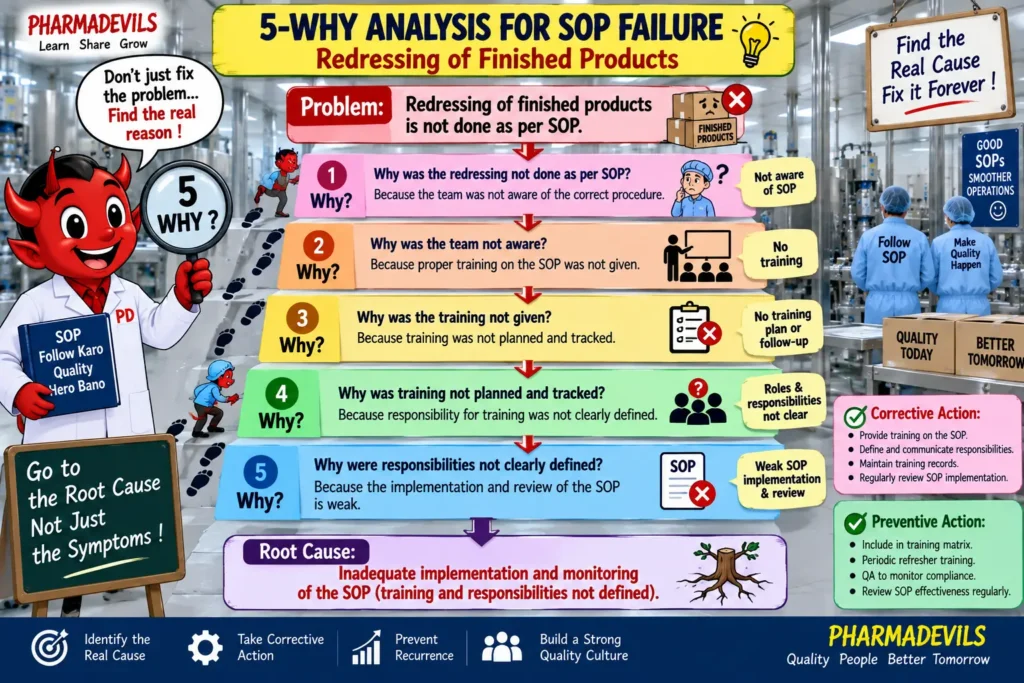
The SOP requires QA investigation, segregation, approval before redressing, QA supervision, prevention of mix-ups, and proper documentation of the activity. The 5-Why approach helps identify the real cause rather than only correcting the visible problem, enabling effective corrective and preventive actions to avoid recurrence.
6. Fishbone Analysis for SOP Failure – Redressing of Finished Products:
The Fishbone Analysis for failure of the SOP for Redressing of Finished Products is used to identify possible causes that can lead to improper handling or redressing of returned finished goods. The analysis can group potential causes under Man, Machine, Method, Material, Measurement, and Environment. Possible causes may include inadequate SOP training, unclear responsibilities, poor supervision, incorrect segregation of returned goods, wrong or uncontrolled packaging materials, incomplete documentation, improper coding or identification, inadequate work-area control, and failure to obtain required approval before starting redressing. These are analytical causes used to investigate why the procedure may fail; they are not all explicitly stated as failures in the SOP.
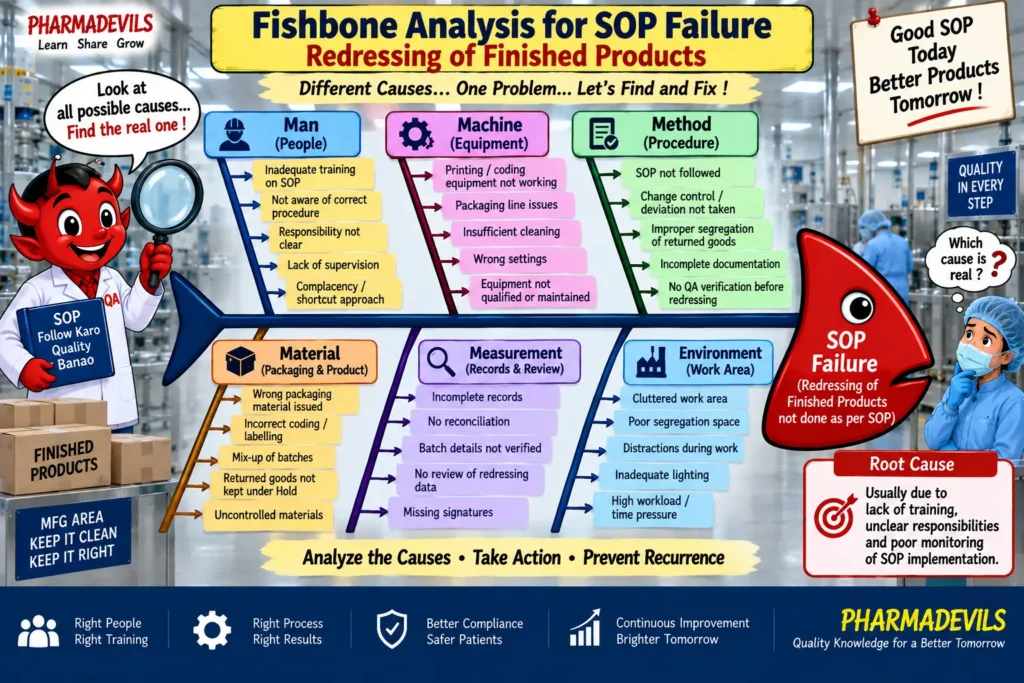
The SOP requires returned goods to be kept under Hold status, investigated by QA, and assessed before redressing. It also requires segregation, controlled packaging materials, QA supervision, prevention of mix-ups, approval through change control/deviation, and recording of redressing data. Fishbone analysis therefore helps organize potential causes systematically, identify the most likely root causes, and support effective corrective and preventive actions.
7. Fault Tree Analysis for SOP Failure – Redressing of Finished Products:
The Fault Tree Analysis for failure of the SOP for Redressing of Finished Products helps trace how different errors can combine and lead to failure of the redressing process. The top event is that redressing of finished products is not performed according to the approved SOP. The analysis can identify major contributing branches such as SOP not followed, inadequate supervision or approval, incorrect handling of materials, and incomplete documentation. Possible underlying causes include lack of training, poor understanding of the procedure, failure to obtain change control or deviation approval, improper segregation of returned goods, incorrect packaging material or coding, and incomplete recording of batch or redressing details.
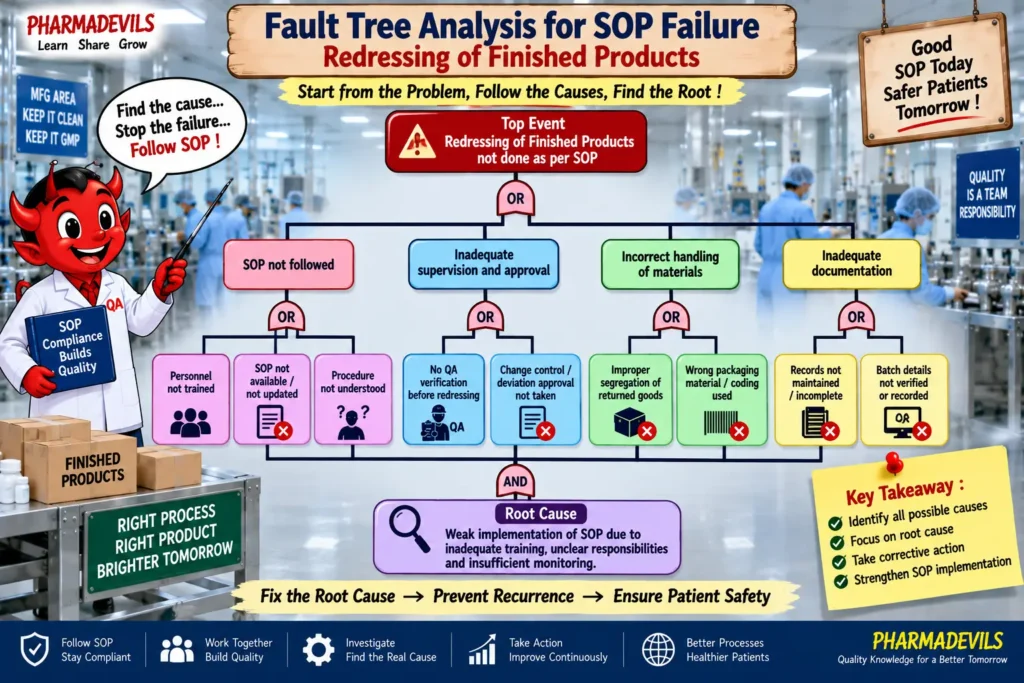
The SOP requires QA investigation before deciding on redressing and requires returned goods to remain under controlled status until the investigation is completed. It also requires batch-wise segregation, controlled packaging materials, QA supervision, approval before starting the activity, and recording of all redressing data. Fault Tree Analysis therefore helps identify the combination of failures leading to the event, supports identification of the root cause, and guides suitable corrective and preventive actions to prevent recurrence.
8. Impact Assessment for SOP Failure – Redressing of Finished Products:
The Impact Assessment for failure of the SOP for Redressing of Finished Products evaluates the possible consequences when returned or recalled finished goods are not handled according to the approved procedure. Such failure may affect product quality, patient safety, packaging and labelling accuracy, batch segregation, traceability, QA control, and regulatory compliance. If returned goods are not properly segregated, investigated, and maintained under controlled status, there is a risk that unsuitable material could be redressed or processed further. Improper redressing may also lead to product or batch mix-ups, incorrect coding, wrong packaging material, incomplete records, or activities performed without required approval or QA supervision. The SOP specifically requires controlled material issuance, proper identification, QA supervision, approval through change control/deviation, and recording of all redressing data.
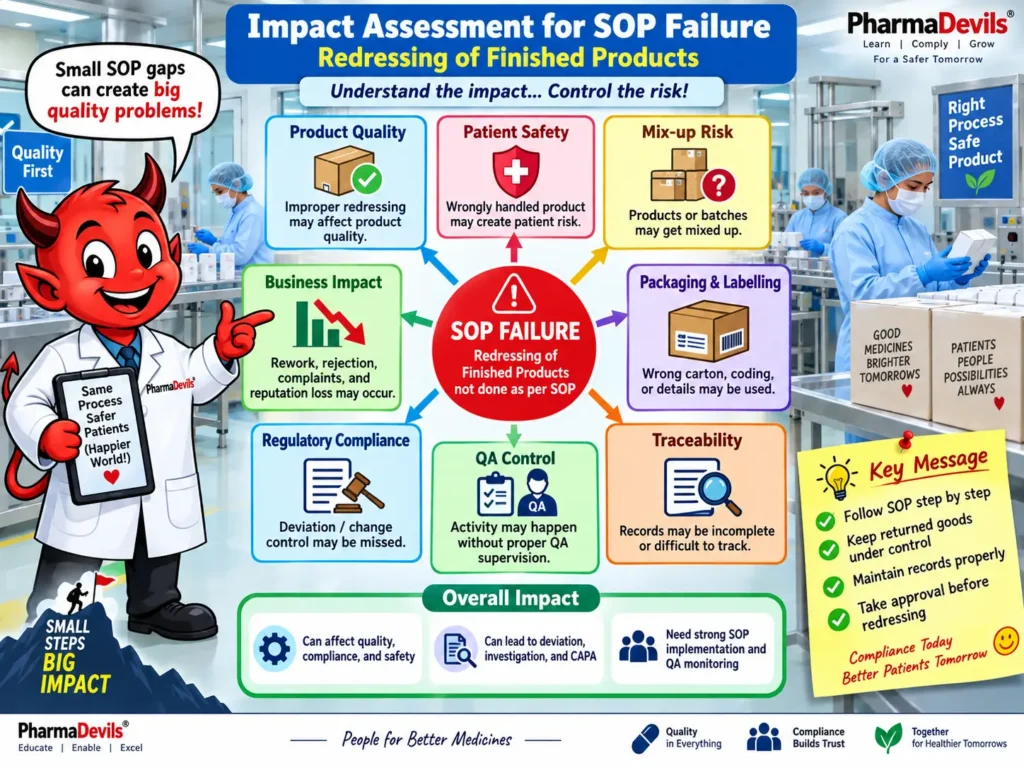
Therefore, SOP failure can result in deviations, rework, investigation, rejection, and potential product-quality or compliance concerns, making effective SOP implementation and QA monitoring essential.
Questions & Answers – SOP for Redressing of Finished Products:
- What is the objective of the SOP?
The objective is to establish a procedure for the redressing of finished products. - Who is responsible for executing the SOP?
The concerned person and Finished Goods In-charge are responsible for execution of the SOP. - Who is responsible for effective implementation of the SOP?
The Assistant Manager-QA and Head-QA/QC are responsible for effective implementation. - Where should returned or recalled goods be stored?
They should be stored in a separate designated area for “Recalled Goods” and kept under Hold status until investigation is completed. - What details should be checked for returned goods?
Quantity, condition of consignment, source location, value, number of batches, batch-wise list, manufacturing date, expiry date, and other relevant information should be verified. - Who investigates the reason for returned goods?
The Quality Assurance Department investigates the reason for return and decides whether redressing is required. - When is redressing not acceptable?
Redressing is not acceptable where goods are damaged due to extreme temperature, humidity, smoke, pressure, radiation, natural disasters, fire, accidents, or equipment failure. - Can returned goods be tested before deciding on redressing?
Yes. If required, Quality Control may analyze the goods to provide evidence that the product meets required identity, strength, and purity standards. - Can redressing be performed at the market place?
No. The SOP states that redressing shall not be conducted at the market place. - How should material be segregated before redressing?
The consignment should be segregated based on details such as batch number, date, year, price, and other applicable information. - How are packaging materials obtained for redressing?
Required packaging materials are issued from the Packaging Material Store against a request for redressing and are coded as required. - How are redressed goods packed?
They are packed in a new corrugated box with proper identification of product, batch number, date, price, and quantity. - What is the role of QA during redressing?
QA supervises the redressing activity and ensures that no mix-up occurs with another product or another batch of the same product. - What approval is required before starting redressing?
Change control or deviation approval from Head-QA is required before starting the activity. Export products also require approval from the export department as applicable. - Who records the redressing activity data?
The QA Chemist is responsible for recording all data related to the redressing activity.
Reference Guideline – Redressing of Finished Products:
1. In-House Procedure / Approved Internal SOP – The document identifies “In House” as its reference for controlling the redressing of finished products.