






1. SOP for Root Cause Analysis – Introduction
Root Cause Analysis (RCA) is a systematic investigation process used to identify the fundamental cause or causes responsible for a problem, deviation, failure, incident, or undesirable event. The purpose of this SOP is to establish a structured procedure for identifying root causes rather than only correcting the immediate symptoms of a problem. Effective RCA requires factual problem definition, collection of relevant evidence, evaluation of causal factors, and documented conclusions supported by evidence. The process may involve different investigation techniques depending on the nature and complexity of the event. Tools such as Brainstorming, 5-Why Analysis, Ishikawa/Fishbone Analysis, Change Analysis, and FMEA may be applied to identify contributing and root causes.The ultimate objective is to establish appropriate corrective and preventive actions, prevent recurrence, improve processes, and strengthen the pharmaceutical quality management system.
Skip to PDF content2. SOP FOR ROOT CAUSE ANALYSIS – Flow Diagram:
The flow diagram for the SOP for Root Cause Analysis presents a systematic approach for investigating deviations, incidents, failures, or quality-related problems. The process begins with identification and factual definition of the problem, followed by collection of relevant data, documented evidence, and establishment of the sequence or timeline of events.
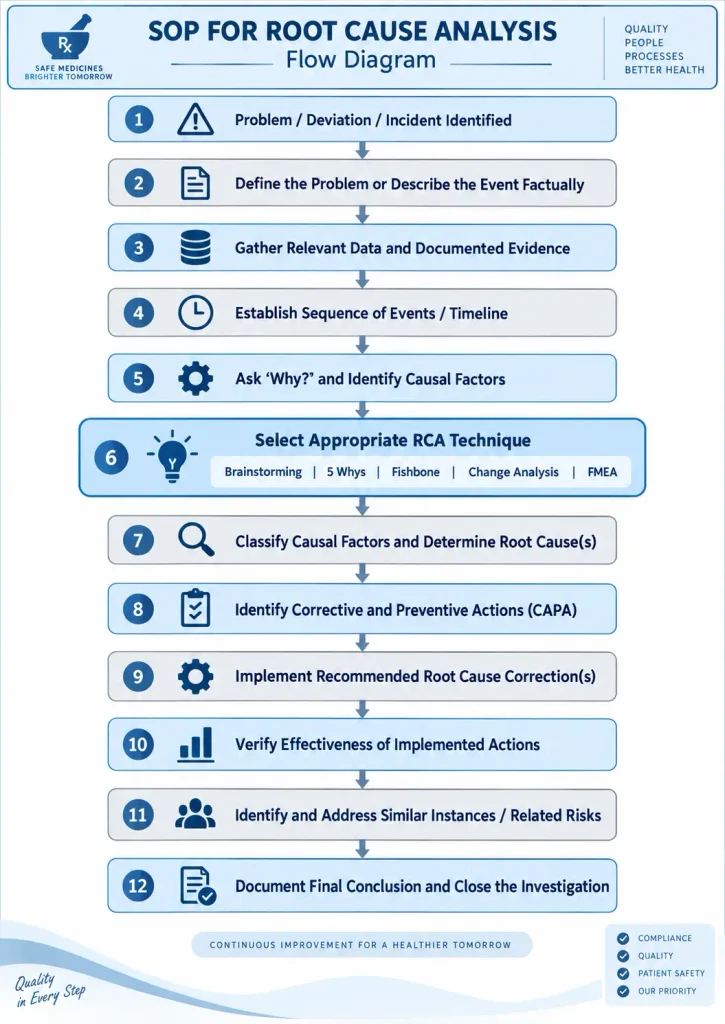
The investigation then evaluates causal factors by repeatedly asking “Why?” and applying suitable RCA tools such as Brainstorming, 5-Why Analysis, Fishbone Analysis, Change Analysis, and FMEA. The identified causes are classified to determine the actual root cause(s). Appropriate corrective and preventive actions (CAPA) are then established and implemented. Effectiveness of the actions is verified, similar risks are addressed, and the investigation is formally concluded with documented findings and final closure.
3. SOP for Root Cause Analysis – Benefits of Following SOP:
Following the SOP for Root Cause Analysis provides a structured and systematic approach for investigating deviations, failures, incidents, and other quality-related problems. The procedure helps investigators focus on identifying the actual root cause instead of only correcting visible symptoms. It supports proper collection of evidence, evaluation of causal factors, and selection of suitable investigation tools such as Brainstorming, 5-Why Analysis, Fishbone Analysis, Change Analysis, and FMEA.
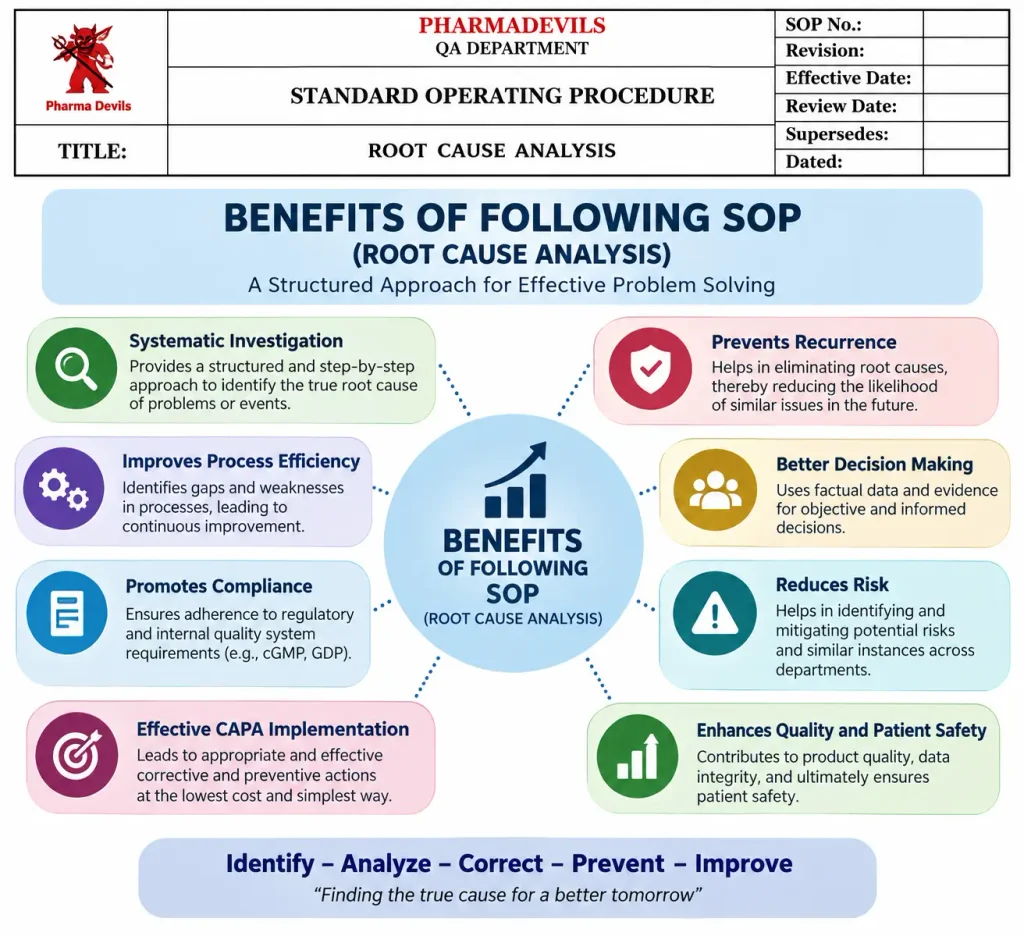
A well-performed RCA helps prevent recurrence by ensuring that corrective actions are directed toward the identified root causes. It also supports effective CAPA implementation, improved process control, better decision-making, and continuous improvement. The SOP requires corrective actions to be implemented and their effectiveness to be verified after implementation. Overall, following this SOP strengthens investigation quality, reduces repeated failures, improves operational reliability, and promotes a more consistent and controlled pharmaceutical quality system.
4. SOP for Root Cause Analysis – Benefits of Following SOP:
Following the SOP for Root Cause Analysis provides a structured and systematic approach for investigating deviations, failures, incidents, and other quality-related problems. The procedure helps investigators focus on identifying the actual root cause instead of only correcting visible symptoms. It supports proper collection of evidence, evaluation of causal factors, and selection of suitable investigation tools such as Brainstorming, 5-Why Analysis, Fishbone Analysis, Change Analysis, and FMEA.
A well-performed RCA helps prevent recurrence by ensuring that corrective actions are directed toward the identified root causes. It also supports effective CAPA implementation, improved process control, better decision-making, and continuous improvement. The SOP requires corrective actions to be implemented and their effectiveness to be verified after implementation. Overall, following this SOP strengthens investigation quality, reduces repeated failures, improves operational reliability, and promotes a more consistent and controlled pharmaceutical quality system.
5. 5-Why Analysis for SOP Failure – Root Cause Analysis:
The 5-Why Analysis for SOP Failure is a systematic root cause investigation technique used to determine why an approved SOP was not followed correctly during manufacturing activities. The method starts with the identified problem and repeatedly asks “Why?” to move from the immediate failure toward the underlying cause. The attached SOP describes the 5-Why technique as progressive questioning used to “drill down” to the cause or causes of an incident.
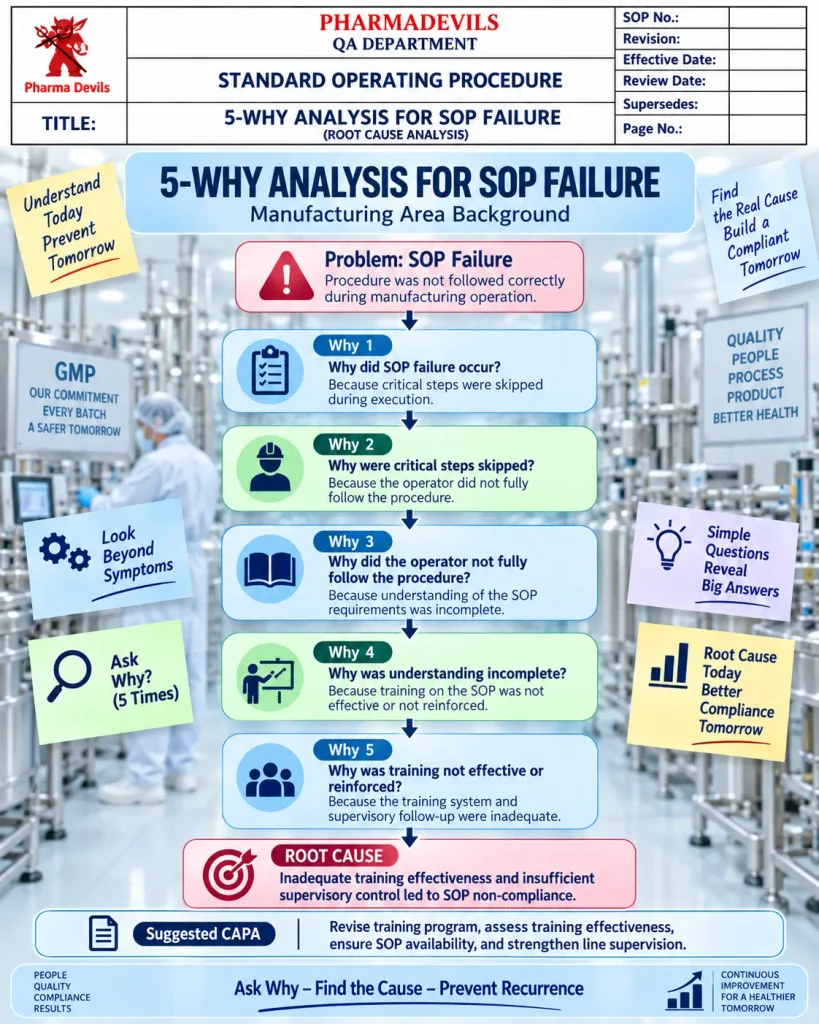
For SOP failure, the investigation may begin with skipped critical steps, followed by questions addressing operator understanding, training effectiveness, supervision, communication, or procedural weaknesses. Each answer becomes the basis for the next “Why?” until a reasonable root cause is established. The number of questions may be more or less than five depending on the complexity of the event. This approach helps distinguish symptoms from actual causes and supports development of appropriate corrective and preventive actions to reduce recurrence.
6. Fishbone Analysis for SOP Failure – SOP FOR Root Cause Analysis:
Fishbone Analysis is a structured root cause analysis technique used to identify and organize the possible causes responsible for an SOP failure. It is particularly useful when an incident may involve several contributing factors that require systematic evaluation. The attached SOP recommends considering potential causes through categories such as Materials, Method, Equipment, and Personnel, with each factor reviewed in relation to the identified problem.
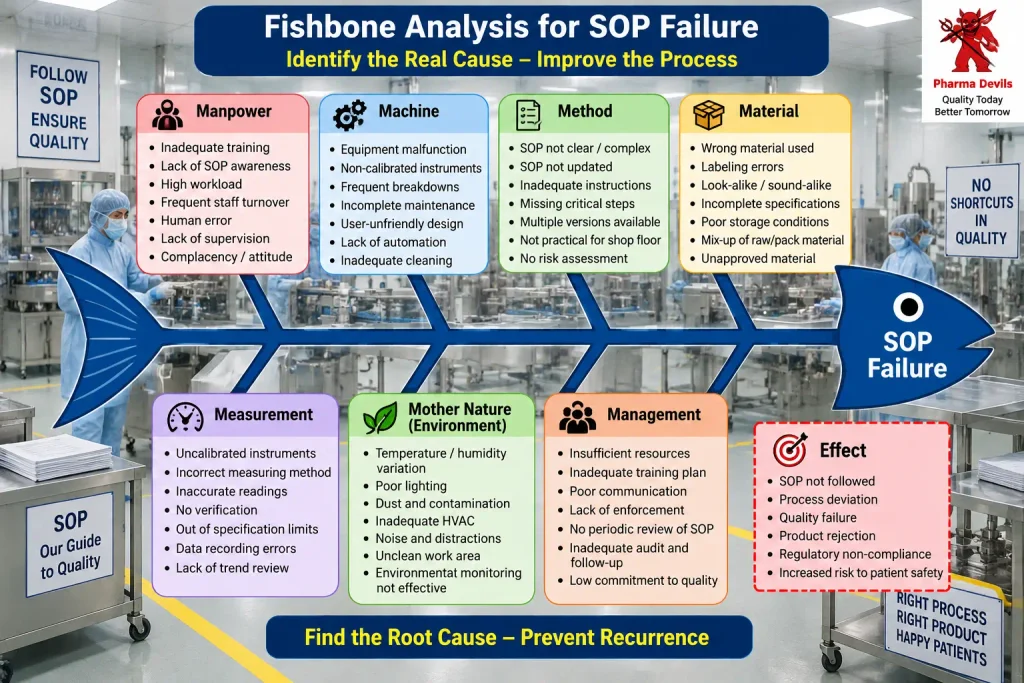
During the investigation, the team may first conduct brainstorming to capture all possible influencing factors and then arrange them on the fishbone diagram for detailed assessment. Individual factors can subsequently be evaluated using the 5-Why technique to determine their actual influence on the incident. Once all relevant causal factors are identified, the investigation team should determine which factors represent the true root cause or causes. This systematic approach supports appropriate CAPA development, prevention of recurrence, and stronger SOP compliance.
7. SOP for Root Cause Analysis – Fishbone Analysis for SOP Failure:
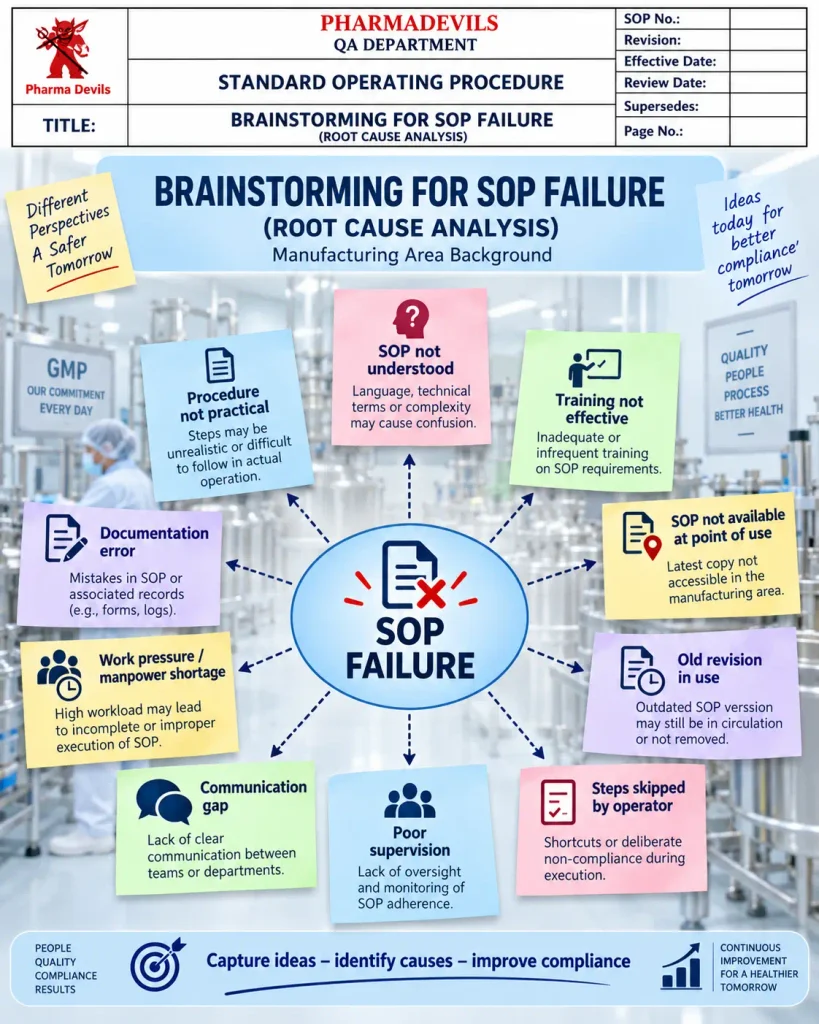
The Fishbone Analysis for SOP Failure provides a structured method for identifying and organizing potential causes responsible for failure to follow or effectively implement an approved SOP. Under the SOP for Root Cause Analysis, this technique is particularly useful when an incident has several possible influencing factors requiring detailed evaluation. The SOP explains that brainstorming may first be conducted with representatives from affected departments so that all relevant causes are captured.
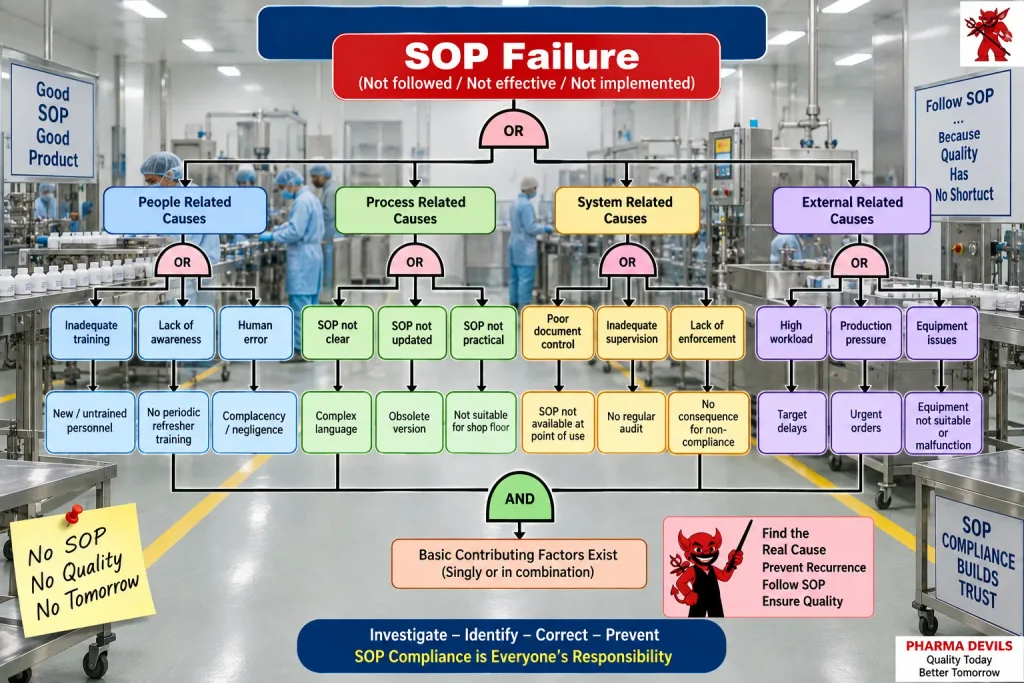
Potential causes may be grouped under categories such as Personnel, Equipment, Method, and Materials, as illustrated in the SOP fishbone example. For SOP failure, contributing factors may include inadequate training, unclear procedures, obsolete SOP versions, equipment problems, documentation weaknesses, poor supervision, and communication gaps. Each identified factor should be evaluated in relation to the problem, and the most significant causes should be investigated further. This approach helps determine the actual root cause and supports appropriate corrective and preventive actions.
8. Impact Assessment for SOP Failure – Root Cause Analysis:
The Impact Assessment for SOP Failure evaluates the possible consequences when an approved procedure is not followed, is ineffective, or is not properly implemented. In the context of Root Cause Analysis, the impact should be assessed systematically to understand the seriousness of the event and to determine appropriate corrective and preventive actions.
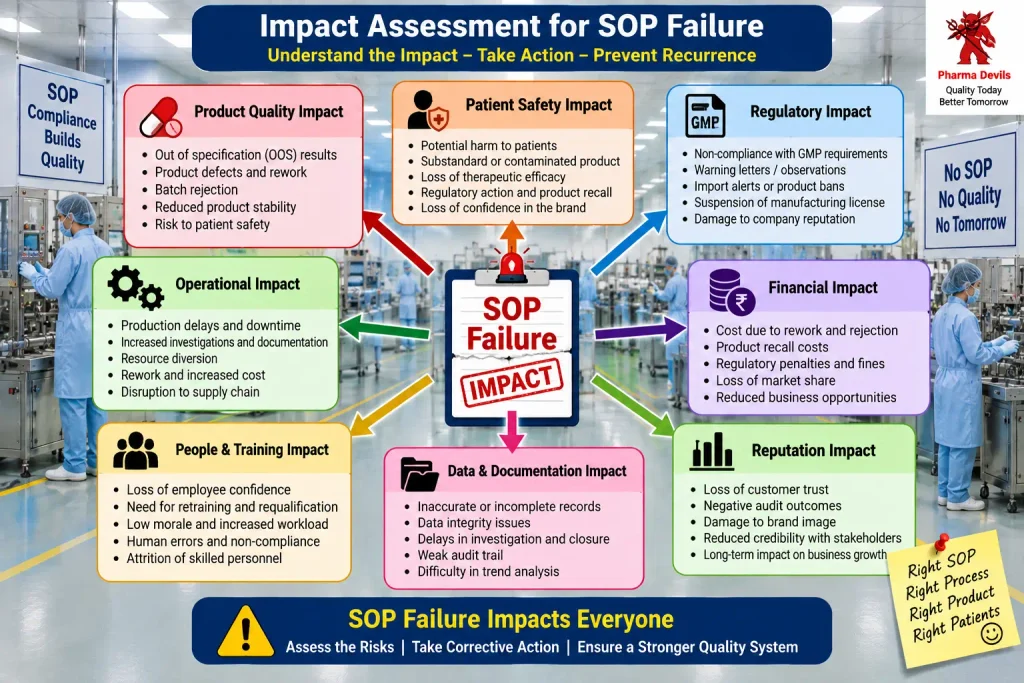
SOP failure may affect product quality, patient safety, regulatory compliance, operations, documentation, personnel performance, cost, and organizational reputation. Possible consequences include deviations, rework, batch rejection, inaccurate records, delayed investigations, production downtime, repeated errors, and increased regulatory concern. The Root Cause Analysis SOP requires the investigation to identify harmful outcomes, contributing factors, and potential risks associated with the problem. The assessment should therefore consider the magnitude and significance of the impact, determine whether similar situations exist elsewhere, and support development of suitable CAPA to prevent recurrence and strengthen the overall quality system.
SOP for Root Cause Analysis – Questions & Answers:
Q1. What is the purpose of Root Cause Analysis (RCA)?
Answer: RCA is used to identify the actual root cause of a problem or event so that appropriate actions can be taken to prevent recurrence.
Q2. Who is responsible for identifying the RCA method?
Answer: The Head of Department or designee is responsible for identifying the appropriate root cause analysis method.
Q3. Why should RCA focus on root causes instead of symptoms?
Answer: Correcting root causes is more likely to prevent recurrence than only addressing the immediately visible symptoms of a problem.
Q4. What should be done first during an RCA investigation?
Answer: The problem or event should be defined factually, including its nature, magnitude, location, timing, and harmful outcomes.
Q5. Why is evidence important in RCA?
Answer: RCA conclusions and identified root causes should be supported by documented evidence collected during the investigation.
Q6. What is the purpose of establishing an event timeline?
Answer: A timeline helps establish relationships between causal factors, root causes, and the identified problem or event.
Q7. What is the 5-Why technique?
Answer: The 5-Why technique uses progressive “Why?” questions to drill down from the observed problem to its underlying cause or causes.
Q8. When is Fishbone Analysis useful?
Answer: Fishbone Analysis is useful when an incident has several potential influencing factors that require systematic evaluation.
Q9. What is the purpose of brainstorming in RCA?
Answer: Brainstorming allows representatives from different departments to identify possible influencing factors that might otherwise be missed.
Q10. What is FMEA used for in RCA?
Answer: FMEA is used to analyze a multistep process step-by-step, identify potential sources of failure, review existing controls, and determine where additional controls may be required.
Q11. What should be done after identifying the root cause?
Answer: Appropriate corrective actions should be identified and implemented, followed by verification of their effectiveness.
Q12. What if Human Error is identified as the root cause?
Answer: The investigation report should explain why Human Error was concluded as the root cause and demonstrate that other potential causes were evaluated and eliminated.
Reference Guidelines – SOP for Root Cause Analysis:
- ICH Q9(R1) – Quality Risk Management – principles and tools for systematic identification, assessment, control, communication, and review of quality risks.
- ICH Q10 – Pharmaceutical Quality System – supports investigation, CAPA, continual improvement, and management of product/process knowledge.
- EU GMP, Chapter 1 – Pharmaceutical Quality System – requires investigation of deviations, determination of root causes, CAPA, and effectiveness evaluation.
- 21 CFR Part 211.192 – Production Record Review – requires thorough investigation of unexplained discrepancies and failures of batches or components to meet specifications.
- 21 CFR Part 211.100 – Written Procedures; Deviations – requires approved written procedures and documentation/justification of deviations.
- WHO GMP Guidelines – provide expectations for deviation investigation, quality risk management, CAPA, and continuous improvement.
- PIC/S GMP Guide, Part I, Chapter 1 – Pharmaceutical Quality System – emphasizes investigation of deviations, root-cause determination, CAPA, and evaluation of CAPA effectiveness.