







1. Brief Description:
This SOP describes the systematic search and review of global medical literature and digital media to identify adverse events, Individual Case Safety Reports (ICSRs), new safety signals, and emerging safety concerns related to medicinal products. It applies to pharmacovigilance personnel involved in literature monitoring, case assessment, documentation, and record retention. Search alerts are established in PubMed or other relevant databases and reviewed weekly or monthly. Each article is classified as an ICSR, an article of interest for aggregate reporting and signal management, or not selected. A valid literature case must include an identifiable reporter, identifiable patient, suspected adverse reaction, and suspected medicinal product. Selected cases undergo medical review, regulatory reporting assessment, follow-up, and documentation. Company-managed digital media is screened at least weekly. Quality control includes reviewing 10% of rejected articles. Search strategies, results, selection decisions, and relevant source documents are archived according to defined retention periods to ensure regulatory compliance, traceability, and effective pharmacovigilance activities.
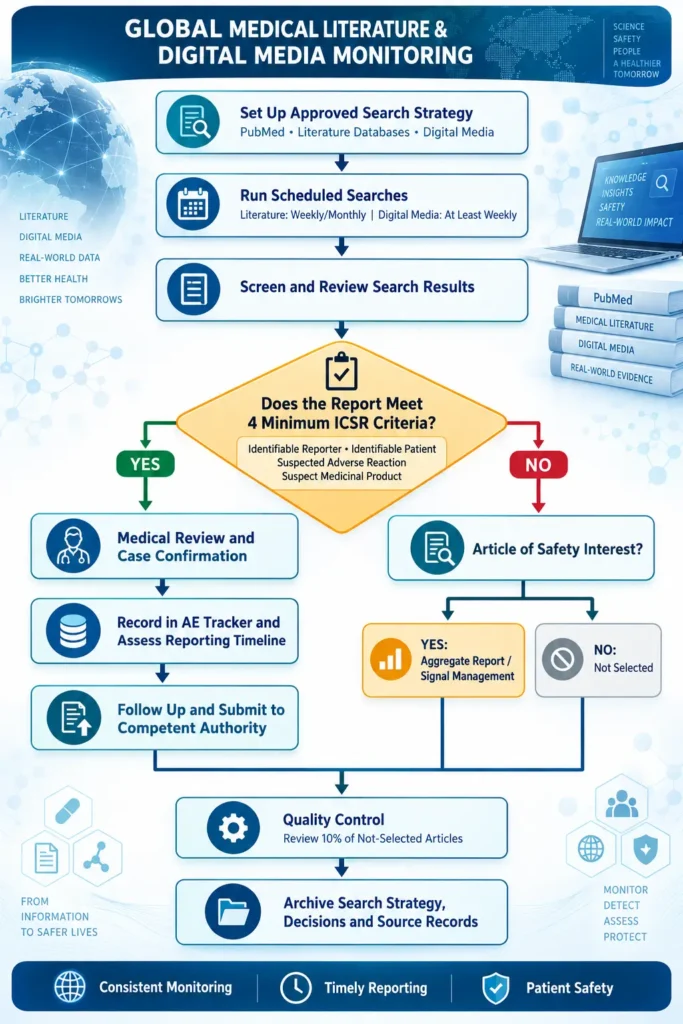
Skip to PDF content2. Flow Diagram:
The flow diagram explains how literature and digital media are monitored for medicine safety information. First, an approved search strategy is prepared using PubMed, literature databases, and digital media sources. Searches are then performed weekly or monthly according to the defined schedule. All search results are screened to identify adverse events and safety information. The reviewer checks whether a report contains four basic ICSR elements: an identifiable reporter, identifiable patient, suspected adverse reaction, and suspected medicinal product. If all four elements are available, the case is reviewed, confirmed, entered into the adverse event tracker, assessed for reporting timelines, followed up, and submitted to the competent authority when required. If the report is not a valid ICSR, it is assessed for use in aggregate reports or signal management. Unimportant articles are marked as not selected. Finally, quality checks are performed, and all search strategies, decisions, articles, and supporting records are archived.
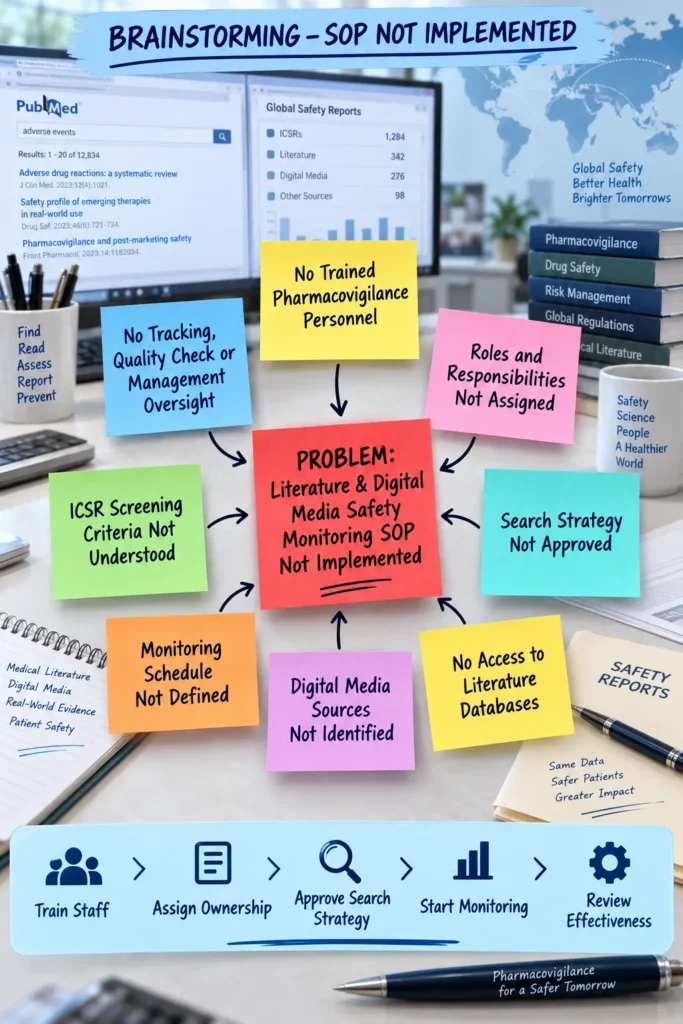
3. Brainstorming:
The brainstorming diagram identifies reasons why the SOP for searching and reviewing global medical literature and digital media was not implemented. The main problem is shown at the centre, while the surrounding sticky notes display eight causes. These include a lack of trained pharmacovigilance personnel, unclear roles and responsibilities, an unapproved search strategy, and no access to literature databases. Other possible causes are unidentified digital media sources, an undefined monitoring schedule, poor understanding of ICSR screening criteria, and missing tracking, quality checks, or management oversight. The diagram helps the investigation team collect ideas without immediately rejecting any possibility. Each suggested cause should be supported by records, interviews, training documents, access logs, and monitoring evidence before it is accepted as a root cause. The action pathway recommends training staff, assigning ownership, approving the search strategy, starting monitoring, and reviewing effectiveness. This approach supports compliance, timely safety reporting, and protection of patients.
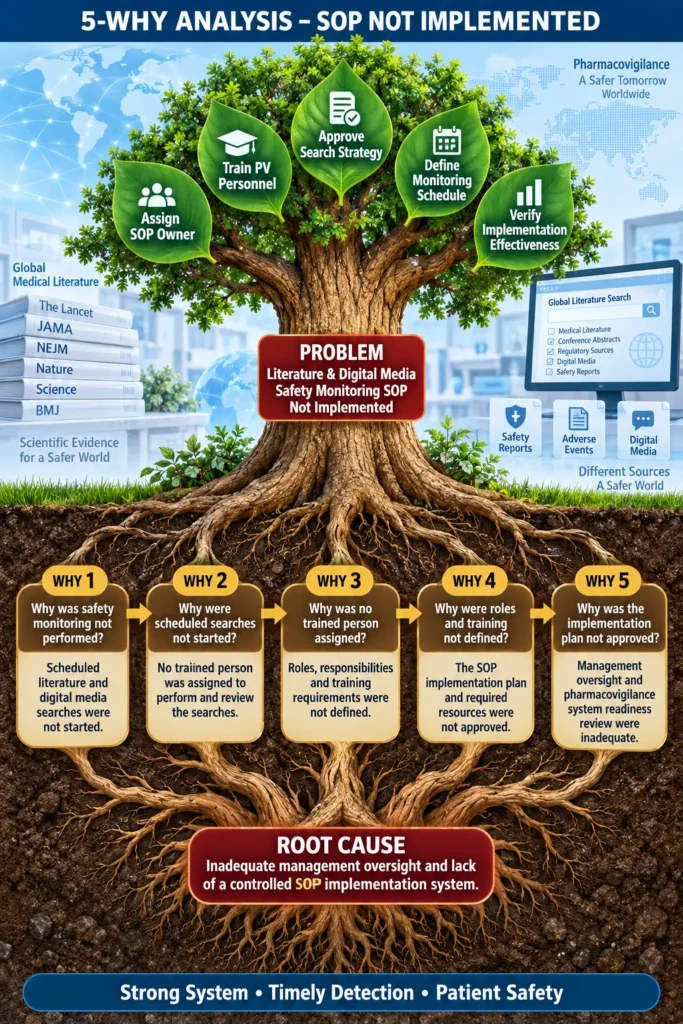
4. 5-Why Analysis:
The 5-Why analysis explains why the SOP for monitoring global medical literature and digital media was not implemented. The first reason was that scheduled searches were not started. This happened because no trained person was assigned to perform and review the searches. A person was not assigned because roles, responsibilities, and training requirements were not clearly defined. These requirements were not defined because an SOP implementation plan and the required resources were not approved. Finally, the implementation plan was not approved because management oversight and pharmacovigilance system-readiness review were inadequate. Therefore, the identified root cause is inadequate management oversight and the absence of a controlled system for implementing the SOP. The recommended corrective actions include assigning an SOP owner, training pharmacovigilance personnel, approving the literature-search strategy, defining the monitoring schedule, and checking implementation effectiveness. These actions will support timely safety-signal detection, regulatory reporting, SOP compliance, and protection of patient safety.
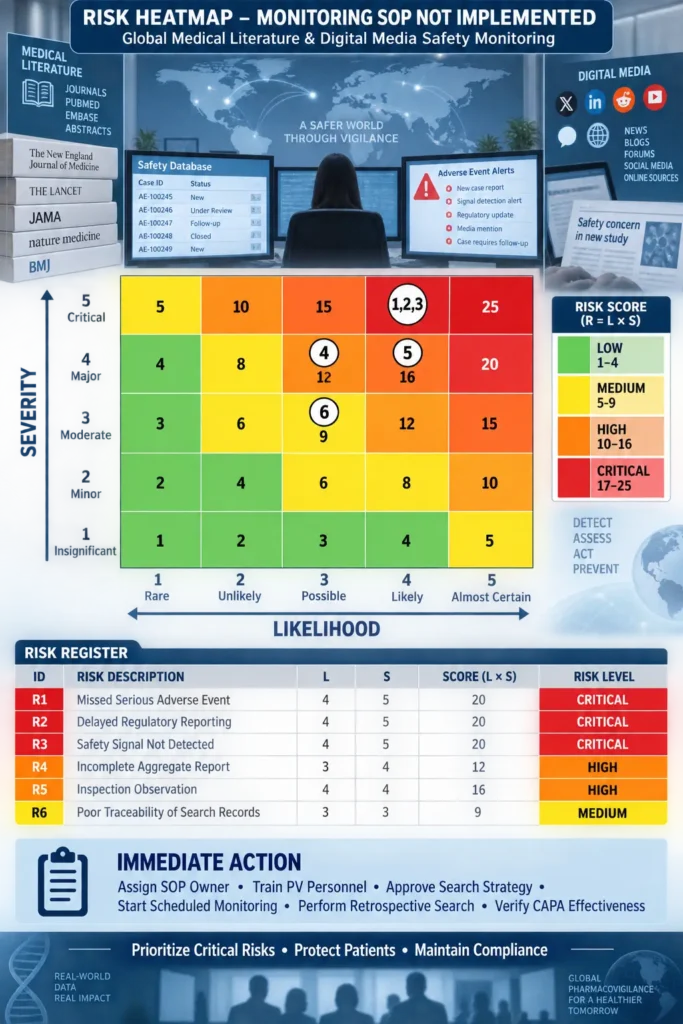
5. Heatmap Analysis:
The heatmap evaluates the risks created when the SOP for monitoring medical literature and digital media is not implemented. Each risk is rated using likelihood and severity, and values are multiplied to calculate the risk score. Green represents low risk, yellow represents medium risk, orange represents high risk, and red represents critical risk. Missing a serious adverse event, delaying regulatory reporting, and failing to detect a safety signal receive scores of 20 and are classified as critical. An incomplete aggregate report scores 12, while an inspection observation scores 16; both are high risks. Poor traceability of literature-search records scores 9 and is considered a medium risk. The heatmap helps management identify which problems require immediate attention and resources. Required actions include assigning an SOP owner, training pharmacovigilance personnel, approving the search strategy, starting scheduled monitoring, performing a retrospective search, and verifying CAPA effectiveness to protect patients and maintain regulatory compliance.
6. Fault Tree Analysis:
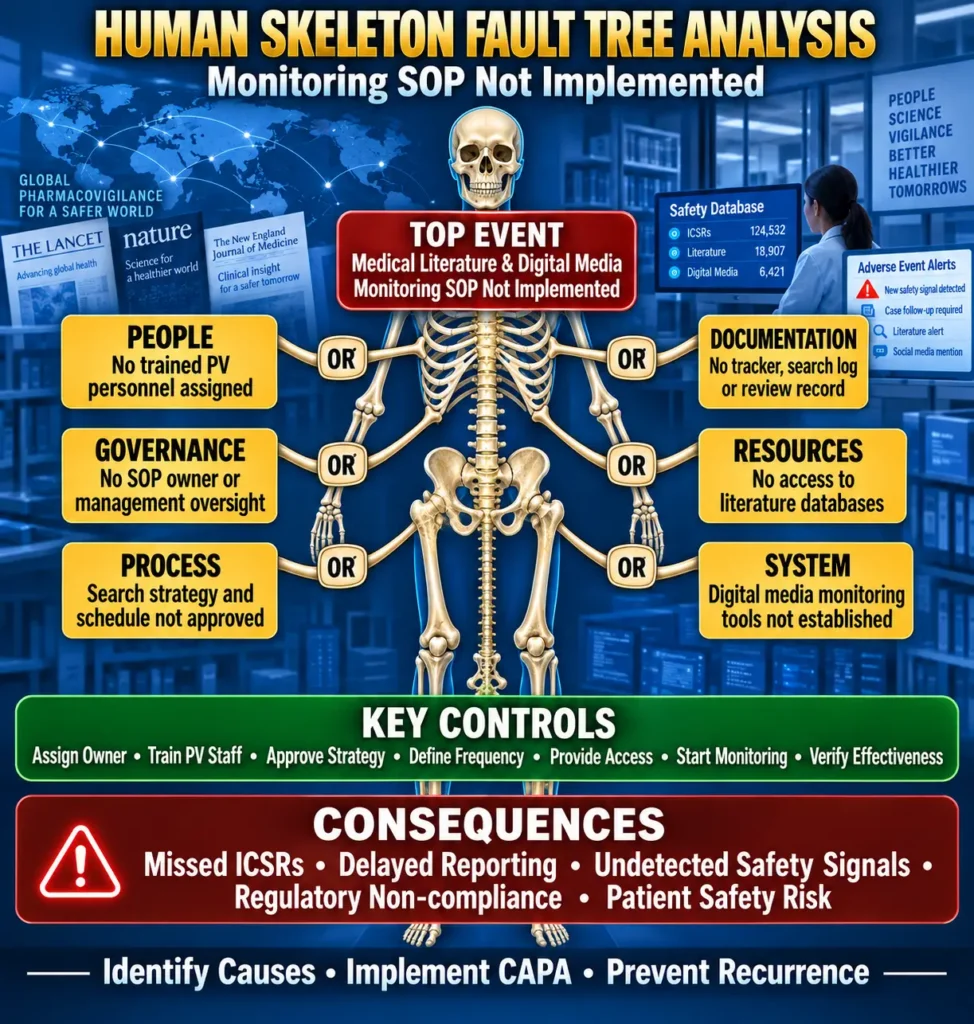
The fault tree analysis explains why the SOP for monitoring medical literature and digital media was not implemented. The main failure is shown as the top event. It is connected through OR gates to six possible basic causes. These causes include no trained pharmacovigilance personnel, no assigned SOP owner, weak management oversight, an unapproved search strategy, and an undefined monitoring schedule. Other causes include missing search trackers, review records, literature database access, and digital media monitoring tools. Any one of these failures may contribute to the main problem. The diagram also shows the consequences, such as missed Individual Case Safety Reports, delayed regulatory reporting, undetected safety signals, incomplete safety information, regulatory non-compliance, and risks to patients. Important controls include assigning ownership, training staff, approving the search strategy, defining search frequency, providing database access, starting routine monitoring, and checking effectiveness. The analysis supports root-cause confirmation, effective CAPA, and prevention of recurrence.
7. Pareto Chart:
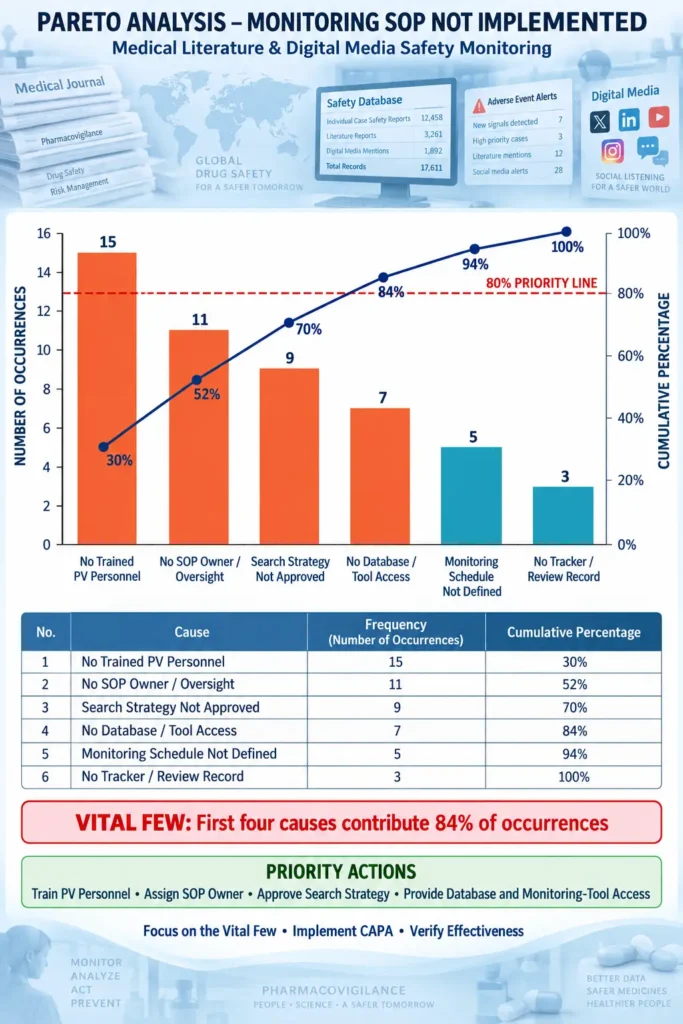
The Pareto chart shows the main reasons why the SOP for monitoring medical literature and digital media was not implemented. The causes are arranged from the highest to the lowest number of occurrences. Lack of trained pharmacovigilance personnel is the largest cause, followed by missing SOP ownership and management oversight. Other important causes include an unapproved search strategy and lack of access to databases or monitoring tools. Together, these first four causes contribute 84% of all occurrences and are identified as the vital few. The remaining causes are an undefined monitoring schedule and missing trackers or review records. The blue cumulative line shows the increasing percentage, while the red 80% line indicates where priority action should be focused. Management should first train personnel, assign an SOP owner, approve the search strategy, and provide database access. Addressing these causes through CAPA can improve compliance, safety monitoring, reporting timelines, and patient protection.
Corrective Action and Preventive Action (CAPA)
Problem: The SOP for monitoring global medical literature and digital media was not implemented.
| S.No. | Identified Cause | Corrective Action | Preventive Action | Responsibility | Target |
|---|---|---|---|---|---|
| 1 | No trained PV personnel | Train concerned personnel on literature searching, ICSR criteria, Day 0, digital-media screening and reporting timelines. | Include SOP training in induction and annual refresher programmes. | PV Head/Training Coordinator | 15 days |
| 2 | SOP owner not assigned | Appoint a qualified SOP owner and backup person. | Maintain an approved responsibility matrix with periodic review. | PV Head/QA | 7 days |
| 3 | Search strategy not approved | Prepare and approve product-specific search strings for PubMed and other applicable sources. | Review search strategies annually and after product or safety-information changes. | PV Officer/Medical Reviewer | 15 days |
| 4 | Database access unavailable | Provide authorised access to required literature databases and digital-monitoring tools. | Review licences, access rights and system availability periodically. | Management/IT/PV | 30 days |
| 5 | Monitoring schedule undefined | Establish weekly or monthly searches and weekly digital-media screening. | Use automatic alerts, reminders and an approved monitoring calendar. | SOP Owner | 7 days |
| 6 | Tracker and records missing | Introduce controlled search logs, article-review forms, AE tracker and archival records. | QA shall review completeness, traceability and retention of records monthly. | PV/QA | 15 days |
| 7 | Previous monitoring missed | Perform a documented retrospective literature and digital-media search from the last confirmed monitoring date. Assess all potential ICSRs and reporting obligations. | Establish escalation procedures for delayed, missed or incomplete searches. | PV Officer/Medical Reviewer | 30 days |
| 8 | Weak management oversight | Review implementation status, overdue searches, identified cases and safety signals during management meetings. | Conduct quarterly compliance reviews and annual internal audits. | PV Head/QA Head | Ongoing |
Effectiveness Verification
- Achieve 100% completion of scheduled searches for three consecutive months.
- Confirm no overdue literature or digital-media reviews.
- Check that all potential ICSRs are evaluated within defined timelines.
- Review 10% of rejected articles without finding a missed valid ICSR.
- Verify complete search logs, review records, approvals and archived evidence.
- Perform an internal audit after 90 days.
- Close the CAPA only when implementation is effective and no repeat failure is observed.
Questions and Answers
1. What is the purpose of this SOP?
The SOP ensures regular searching and reviewing of medical literature and digital media to identify adverse events, valid ICSRs, safety signals and emerging safety information.
2. Why was the SOP not implemented?
Major causes included inadequate management oversight, unclear responsibility, insufficient training, an unapproved search strategy, undefined search frequency and missing monitoring tools.
3. What is an ICSR?
ICSR means Individual Case Safety Report. It contains information about a suspected adverse reaction associated with a medicinal product.
4. What are the four minimum criteria for a valid ICSR?
- Identifiable patient
- Identifiable reporter
- Suspected adverse reaction
- Suspected medicinal product
5. What is Day 0 for a literature case?
Day 0 is the date when company personnel or an authorised service provider first becomes aware of a publication containing the four minimum ICSR criteria.
6. How frequently should medical literature be searched?
Worldwide literature should be reviewed at least monthly or according to applicable local regulatory requirements and approved procedures.
7. How frequently should company-managed digital media be monitored?
Company-managed websites and digital-media sources should be screened at least once every week.
8. Which sources may be included in the search?
Sources may include PubMed, relevant literature databases, local scientific journals, safety-data partners, company websites and managed digital-media platforms.
9. How should reviewed articles be classified?
Articles should be classified as valid ICSRs, articles of safety interest for aggregate reporting or signal management, or not selected.
10. Who should review a selected literature ICSR?
A qualified medical reviewer should confirm whether the selected article meets the requirements for ICSR processing.
11. What quality check is required for rejected articles?
At least 10% of not-selected articles should be randomly reviewed. If a valid ICSR is found, all remaining rejected articles should be reassessed.
12. What should be done when an abstract contains insufficient information?
The complete publication should be obtained, and follow-up may be conducted with the corresponding author.
13. What are the risks of not implementing the SOP?
Risks include missed adverse events, delayed regulatory reporting, unidentified safety signals, incomplete aggregate reports, inspection observations and patient-safety concerns.
14. What immediate corrective action is required?
An SOP owner should be assigned, personnel trained, search strategies approved, database access provided and retrospective searches completed.
15. Why is a retrospective search necessary?
It identifies adverse-event reports or safety information that may have been missed during the period when routine monitoring was not performed.
16. How should literature-monitoring activities be documented?
Search terms, search dates, results, article-selection decisions, ICSR assessments, reviewer approvals and follow-up records should be documented in controlled records.
17. How long should relevant literature records be retained?
Relevant articles used for ICSR processing or signal management should be retained for ten years, subject to company and regulatory requirements.
18. How can CAPA effectiveness be verified?
Effectiveness can be confirmed through three months of completed searches, timely ICSR assessment, complete records, satisfactory quality checks and no repeat failure.
19. Who is accountable for SOP implementation?
The Pharmacovigilance Officer In-charge or designated Pharmacovigilance Department Head is accountable for effective implementation and oversight.
20. What is the expected outcome of effective implementation?
Effective implementation supports timely case identification, regulatory compliance, early safety-signal detection, reliable documentation and improved patient protection.
Reference Guidelines:
- EMA Guideline on Good Pharmacovigilance Practices (GVP), Module VI – Collection, Management and Submission of Reports of Suspected Adverse Reactions
Covers literature monitoring, internet and digital-media reports, valid ICSR criteria, Day 0, follow-up and regulatory reporting.
EMA GVP Module VI - EMA GVP Module IX – Signal Management
Provides requirements for detecting, validating, confirming, analysing and managing safety signals from literature and other sources.
EMA GVP Module IX - EMA GVP Module VII – Periodic Safety Update Report
Covers the use of published literature and safety information in aggregate reports and benefit-risk evaluation.
EMA GVP Module VII - ICH E2D – Post-Approval Safety Data Management
Defines spontaneous reports, literature cases, minimum ICSR criteria, reporting requirements and standards for expedited reporting.
ICH E2D Guideline - ICH E2C(R2) – Periodic Benefit-Risk Evaluation Report
Provides guidance for including worldwide literature findings, safety signals and cumulative safety information in PBRERs.
ICH E2C(R2) Guideline - ICH E2B(R3) – Electronic Transmission of Individual Case Safety Reports
Defines the data elements and electronic standards required for recording and submitting ICSRs.
ICH E2B(R3) - FDA – Good Pharmacovigilance Practices and Pharmacoepidemiologic Assessment
Provides guidance on safety-signal identification, evaluation, documentation, risk assessment and pharmacovigilance planning.
FDA Pharmacovigilance Guidance - CIOMS Working Group VIII – Practical Aspects of Signal Detection in Pharmacovigilance
Describes signal detection using spontaneous reports, scientific literature, databases and other safety-information sources.
CIOMS Pharmacovigilance Publications - Pharmacovigilance Programme of India – Guidance Documents
Provides Indian requirements and supporting guidance for adverse-event reporting and pharmacovigilance activities.
PvPI Guidance Documents - Drugs and Cosmetics Rules, 1945 – Schedule Y, India
Specifies Indian requirements related to clinical safety reporting, serious adverse events and pharmacovigilance responsibilities.
CDSCO Official Website
Note: Always verify the current revision, regional requirements, marketing-authorisation conditions and applicable Safety Data Exchange Agreements before approving the SOP.