






1. INTRODUCTION-SOP FOR SELF INSPECTION:
Self-inspection is an important element of the pharmaceutical Quality Management System used to evaluate whether manufacturing and support activities are being performed in accordance with current Good Manufacturing Practices (cGMP), approved procedures, and established quality requirements. The purpose of the Self-Inspection SOP is to provide a systematic process for planning, conducting, documenting, and following up internal inspections so that deficiencies can be identified and appropriate corrective and preventive actions can be initiated. The self-inspection program covers key functions such as Production, Warehousing, Dispensing, Packaging, Quality Control, Quality Assurance, Maintenance, Personnel and Administration, Safety, and Documentation. Department heads participate in the process, while the Head of QA/QC is responsible for effective implementation of the SOP.Inspections are performed by competent and impartial personnel who are familiar with cGMP requirements and, where possible, are independent of the area being audited. Observations are classified according to their potential impact on product quality, enabling appropriate prioritization of corrective actions. An effective self-inspection system helps identify compliance gaps, strengthen pharmaceutical quality systems, prevent recurrence of deficiencies, improve operational controls, and maintain continuous readiness for regulatory inspections.
Skip to PDF content2. Flow Diagram:
The Self-Inspection Process Flow Diagram explains the systematic sequence used to evaluate cGMP compliance and the effectiveness of the pharmaceutical Quality Management System. The process begins with preparation and approval of the self-inspection schedule, followed by selection of competent and impartial auditors familiar with cGMP requirements. Relevant SOPs, regulatory requirements, and audit checklists are reviewed before the inspection is conducted.
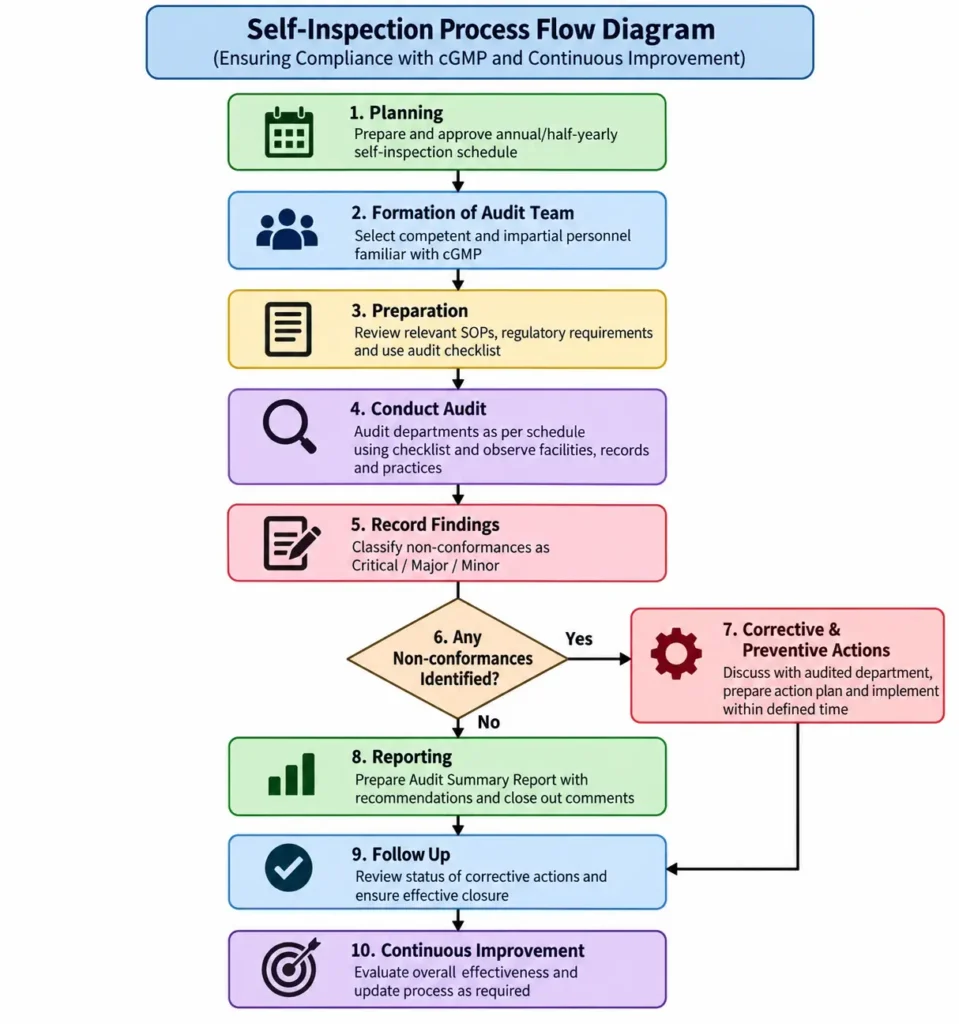
During the audit, observations are recorded and non-conformances are classified as Critical, Major, or Minor according to their potential impact on product quality. When deficiencies are identified, corrective and preventive actions are discussed, planned, and submitted to Quality Assurance within the defined period. Finally, an audit summary is prepared, CAPA implementation is followed up, closure is documented, and management evaluates the effectiveness of the quality system, supporting continual improvement and sustained regulatory compliance.
Description of Brainstorming Diagram
The Brainstorming for SOP Failure in the Manufacturing Area diagram presents possible reasons why an approved SOP may not be followed consistently during manufacturing activities. The central problem, “SOP Failure – Why does it happen?”, is surrounded by sticky notes showing potential contributing factors. The ideas include inadequate training, lack of awareness, SOP not available at the workplace, unclear or complex instructions, outdated SOPs, poor supervision, undefined responsibilities, failure to communicate changes, manpower turnover, equipment problems, incorrect or mixed materials, production pressure, time constraints, inadequate workspace, poor HVAC or environmental conditions, lack of visual aids, insufficient in-process checks, distractions, and weak auditing or follow-up.
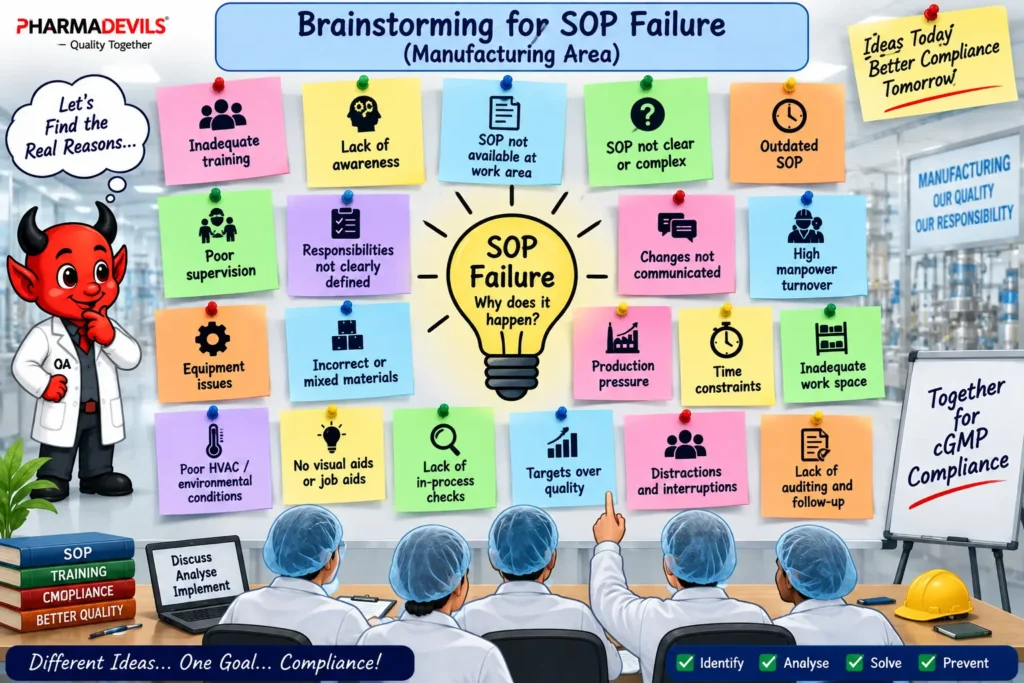
The diagram is intended as a brainstorming aid for investigation teams to collect possible causes before performing detailed root-cause analysis. It supports a structured approach of identifying, analysing, solving, and preventing SOP-related failures and helps direct suitable CAPA toward training, supervision, documentation, monitoring, and manufacturing controls.
4. Benefits of Following the SOP:
The Benefits of Following the Self-Inspection SOP diagram highlights how a structured internal audit system strengthens the pharmaceutical Quality Management System. Regular self-inspections help verify compliance with cGMP requirements, approved procedures, and departmental practices across Production, Quality Assurance, Quality Control, Warehouse, Maintenance, and other support functions. Following the SOP supports early identification of deficiencies and non-conformances, which are classified as Critical, Major, or Minor according to their potential impact on product quality. This allows appropriate attention to higher-risk issues and promotes timely corrective and preventive actions.
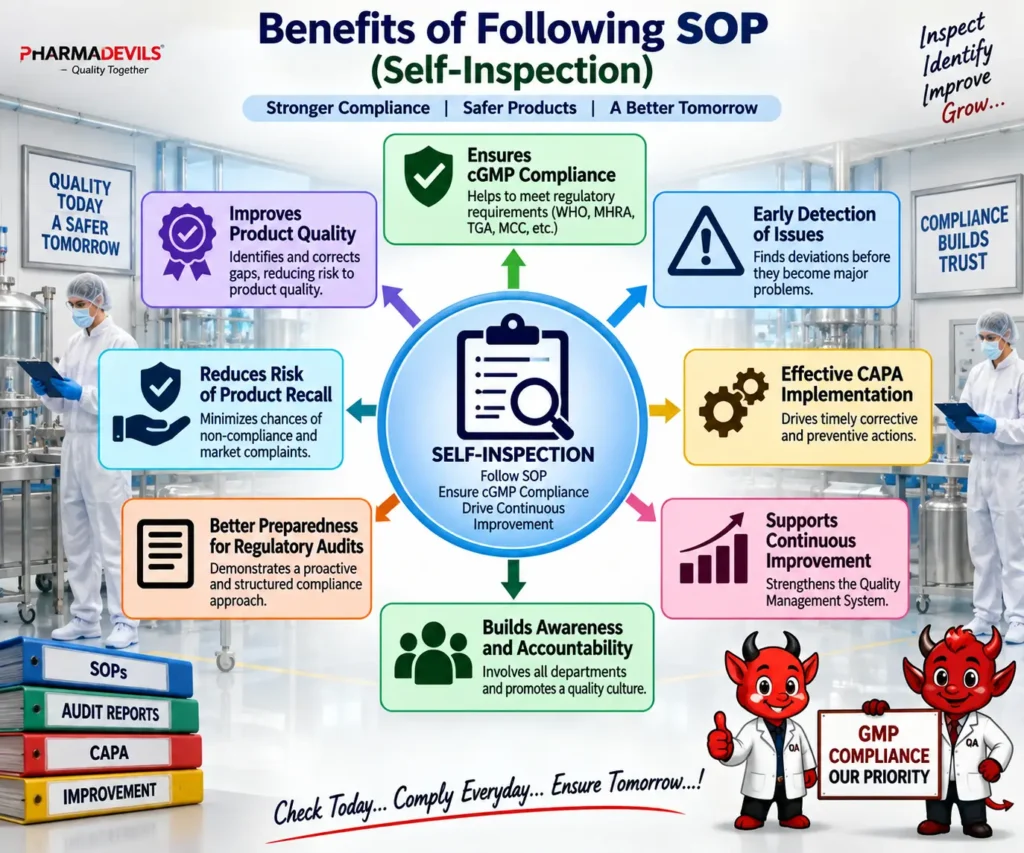
The process also improves audit readiness, accountability, documentation control, CAPA implementation, and continuous improvement. Audit findings are formally reported, recommendations are documented, and follow-up actions are reviewed to confirm that the quality system remains effective in meeting company quality objectives. Overall, effective self-inspection helps maintain consistent GMP practices, reduce compliance gaps, and support reliable pharmaceutical product quality.
5. 5-Why Analysis for SOP Failure:
The 5-Why Analysis for SOP Failure in the Manufacturing Area identifies the underlying reasons why an approved procedure may not be followed consistently during manufacturing activities. The analysis begins with the problem of SOP non-compliance and progressively examines its causes. The first level indicates that required manufacturing steps were not followed consistently. Further questioning shows that operators may not have fully understood or adhered to the procedure. This can be linked to inadequate training, retraining, or insufficient supervision. The next level highlights unclear responsibilities, weak accountability, and inadequate monitoring. Finally, insufficient quality oversight and periodic review are identified as deeper systemic causes.
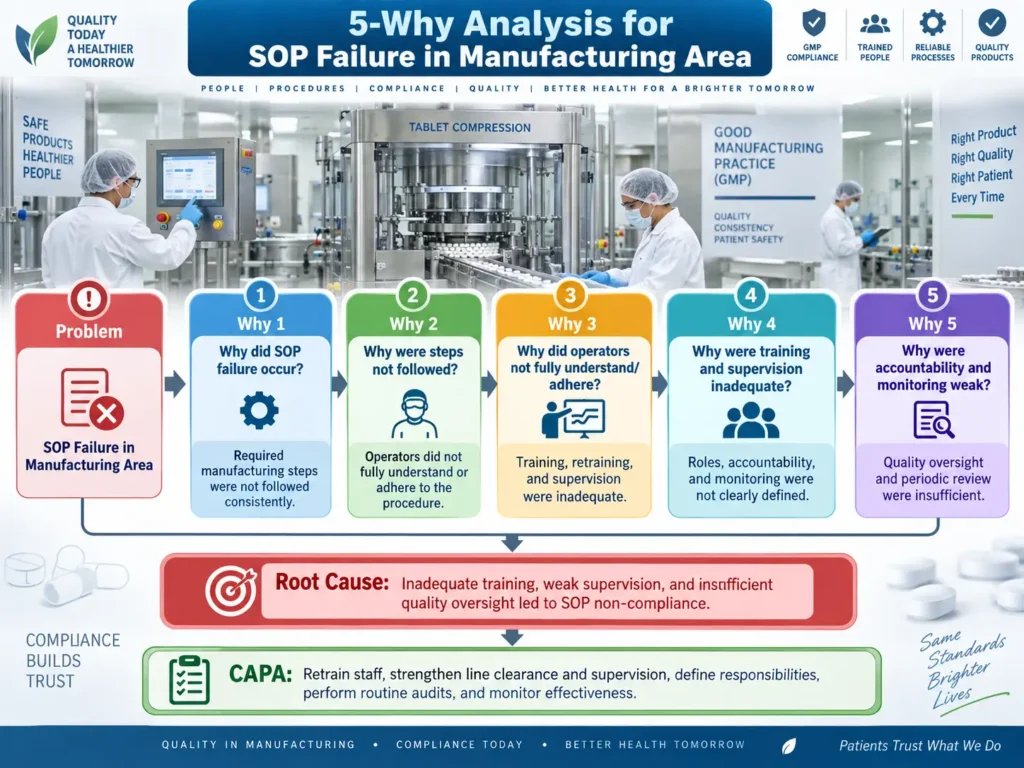
The analysis indicates that the probable root causes are inadequate training, weak supervision, unclear accountability, and insufficient quality monitoring. Appropriate CAPA should therefore include retraining personnel, strengthening supervision, clearly defining responsibilities, performing routine compliance audits, and monitoring the effectiveness of implemented actions.
6. Fishbone Analysis for SOP Failure:
The Fishbone Analysis for SOP Failure in the Manufacturing Area identifies possible causes of non-compliance by grouping them into six major categories: Man, Machine, Material, Method, Measurement, and Environment. The Man category includes inadequate training, lack of awareness, unclear responsibilities, and poor supervision. Machine-related causes may include equipment malfunction, inadequate cleaning, breakdowns, or insufficient preventive maintenance. Material factors can involve incorrect material issue, poor identification, mix-ups, or use of unsuitable materials. Method causes include unavailable, unclear, outdated, or poorly communicated SOPs. Measurement and monitoring issues include inadequate in-process checks, lack of supervisory verification, weak record review, and insufficient self-inspection.
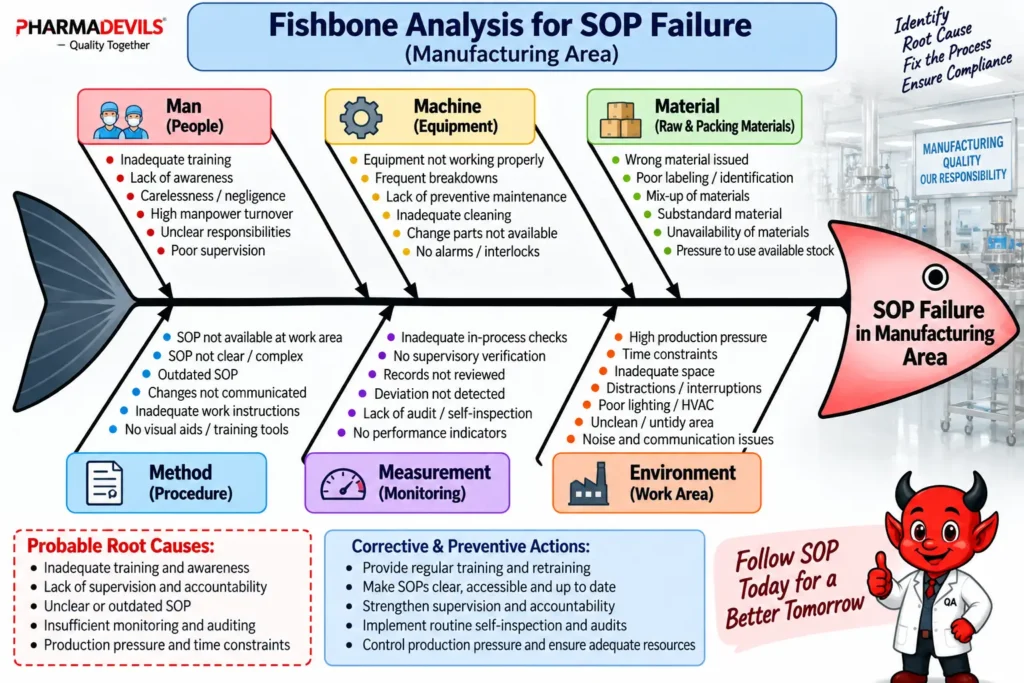
Environmental factors may include production pressure, time constraints, inadequate space, distractions, poor HVAC conditions, or communication problems. The diagram helps teams systematically identify probable root causes and select suitable CAPA such as retraining, strengthening supervision, improving SOP accessibility, enhancing monitoring, and conducting routine self-inspections.
7. Fault Tree Analysis for SOP Failure:
The Fault Tree Analysis for SOP Failure in the Manufacturing Area shows how different underlying failures can lead to non-compliance during manufacturing activities. The top event is “SOP Failure in Manufacturing Area,” meaning that an approved procedure is not followed correctly or consistently. The diagram groups potential causes into four main branches: SOP/document-related issues, personnel-related issues, process or operational deviations, and environmental/system factors. Examples include unavailable or outdated SOPs, inadequate training, lack of awareness, poor supervision, intentional bypass of procedures, production pressure, inadequate in-process checks, unsuitable work-area conditions, excessive workload, and weak monitoring.
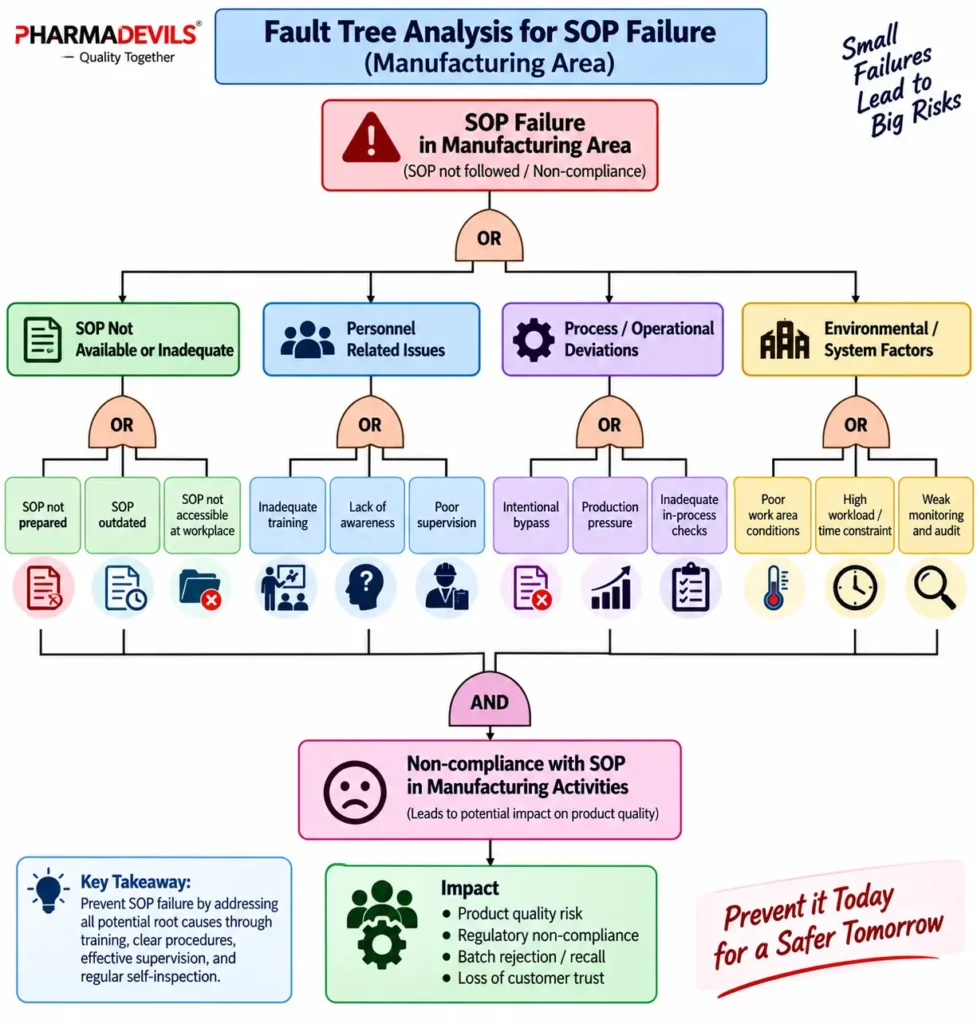
Using OR and AND logic gates, the diagram demonstrates how individual or combined weaknesses may contribute to SOP failure. Such failures can create risks to product quality, regulatory compliance, batch acceptance, and overall quality-system effectiveness. The analysis supports preventive measures such as effective training, clear and accessible procedures, stronger supervision, routine monitoring, and regular self-inspection to detect deficiencies before they become significant compliance issues.
8. Impact Assessment:
The Impact Assessment for SOP Failure in the Manufacturing Area shows the potential consequences when approved manufacturing procedures are not followed correctly. SOP failure can directly affect product quality by increasing the risk of process deviations, contamination, inconsistent results, batch r ejection, and possible product recall.The diagram also highlights regulatory and compliance impacts, including cGMP non-compliance, audit observations, CAPA requirements, and increased regulatory scrutiny. The original Self-Inspection SOP emphasizes identifying deviations from authorized procedures and shortcomings in cGMP implementation so that necessary corrective actions can be recommended.
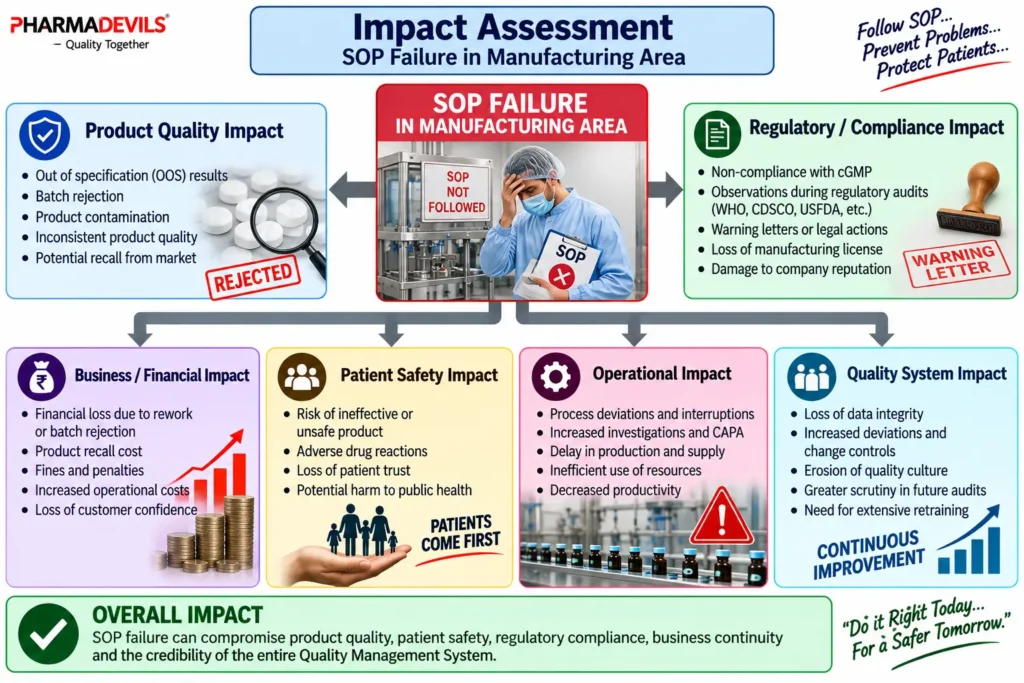
Additional effects may include production delays, investigations, increased operational costs, inefficient use of resources, and weakening of the Quality Management System. Where product quality is affected, patient safety may also be at risk. Overall, SOP failure can have a significant impact on quality, compliance, operational performance, patient safety, and business continuity, making timely investigation, CAPA, training, supervision, and effectiveness monitoring essential.
Questions & Answers – SOP for Self-Inspection
- Q: What is the objective of the Self-Inspection SOP?
A: The objective is to determine whether the Quality Management System is effective in ensuring adherence to cGMP requirements and to identify the need for corrective and preventive actions. - Q: What areas are covered under the scope of self-inspection?
A: The SOP covers operations connected with Manufacturing, Warehousing, Dispensing, Production, Packaging, Quality Control, Maintenance, Personnel, Administration, Safety, and Documentation. - Q: Who is responsible for the self-inspection process?
A: Department Heads of Production, Quality Assurance, Quality Control, Warehouse, Maintenance, Personnel and Administration are responsible for the self-inspection process. - Q: Who is responsible for effective implementation of the SOP?
A: The Head-QA/QC is responsible for effective implementation of the Self-Inspection SOP. - Q: How are non-conformances classified during self-inspection?
A: Non-conformances are classified as Critical, Major, and Minor based on their potential impact on product quality. - Q: What is a Critical non-conformance?
A: A Critical non-conformance is one that may have a direct impact on product quality. - Q: What is a Major non-conformance?
A: A Major non-conformance is one that may have an indirect impact on product quality. - Q: What is a Minor non-conformance?
A: A Minor non-conformance is one that may not have an impact on product quality. - Q: What are the criteria for selecting self-inspection team members?
A: The team should consist of competent and impartial personnel having appropriate qualifications and experience. The SOP specifies minimum experience of 10 years in relevant areas and also considers qualification, experience, training evaluation, and working proficiency. - Q: Should the auditor be independent of the department being audited?
A: Yes. Audit team members should be independent of personnel having direct responsibility for the area being audited. - Q: How frequently should self-inspection be conducted?
A: All departments covered under the program should undergo self-inspection at least twice a year, i.e., half-yearly, according to the self-inspection planner. - Q: Who prepares and approves the audit schedule?
A: The predetermined audit schedule is prepared and approved by Quality Assurance. - Q: Which guidelines are considered while updating the audit checklist?
A: The SOP states that the checklist should be aligned with current cGMP requirements, including guidelines of WHO, TGA, MCC, and MHRA, along with current applicable SOPs. - Q: What is the main focus of a self-inspection audit?
A: The audit focuses on identifying deviations from authorized procedures, checking whether procedures require revision or updating, detecting shortcomings in cGMP implementation, recommending corrective actions, and checking compliance with marketing authorizations. - Q: How is the Self-Inspection Audit Report numbered?
A: Each report receives a unique number beginning with the last two digits of the current year, followed by “/” and a two-digit serial number starting from 01. For example, 21/01 represents the first report of 2021. - Q: Within what period should self-inspection CAPA compliance be submitted to QA?
A: The audited department should submit the planned or completed corrective and preventive actions to Quality Assurance within 30 days from the date of audit. - Q: What should be included in the Self-Inspection Audit Summary?
A: The Audit Summary should include audit findings, recommendations where applicable, and close-out comments related to the self-inspection. - Q: What is done after completion of the audit and CAPA process?
A: The Unit Quality Assurance Head sends the completed audit compliance report and audit summary to company management, which evaluates whether the quality systems are effective in meeting the organization’s quality objectives. - Q: What records or annexures are maintained under this SOP?
A: The SOP includes annexures for audit summaries, departmental checklists, certified auditor lists, non-compliance and CAPA records, self-inspector certificates, compliance reports, and the self-inspection planner. - Q: Why is self-inspection important in a pharmaceutical Quality Management System?
A: According to the SOP, self-inspection is used to evaluate adherence to cGMP, identify deficiencies in implementation, recommend corrective actions, and assess whether the quality system is effectively meeting company quality objectives.
Reference Guidelines:
- WHO Good Manufacturing Practices for Pharmaceutical Products – Main Principles
WHO guidance includes Self-Inspection, Quality Audits and Supplier Audits, covering the self-inspection programme, team, frequency, report and follow-up actions. WHO states that self-inspection should evaluate GMP compliance, identify shortcomings and recommend corrective actions. (World Health Organization)
WHO GMP – Main Principles - EU Guidelines for Good Manufacturing Practice – EudraLex Volume 4, Chapter 9: Self Inspection
Chapter 9 specifically addresses self-inspection and requires systematic examination of personnel, premises, equipment, documentation, production, QC, distribution, complaints, recalls and other GMP systems. (Public Health)
EU GMP Volume 4 - PIC/S GMP Guide PE 009-17, Part I – Chapter 9: Self Inspection
PIC/S requires self-inspections to monitor GMP implementation and compliance. Inspections should be independent and detailed, performed by competent personnel, documented in reports, and followed by recorded corrective measures. (PicScheme)
PIC/S GMP Publications - Revised Schedule M – Drugs Rules, 1945, India, G.S.R. 922(E), dated 28 December 2023
Revised Schedule M is the key Indian GMP reference and includes Self-Inspection, Quality Audits and Suppliers’ Audits and Approval within the pharmaceutical quality system framework. CDSCO lists the official G.S.R. 922(E) Schedule M notification dated 28 December 2023. (CDSCO)
CDSCO Gazette Notifications - WHO Quality Assurance of Pharmaceuticals – Volume 2, 10th Edition, 2024
This WHO compendium provides consolidated GMP and inspection guidance for pharmaceutical manufacturing and quality-control systems and can be used as a broader supporting reference for the self-inspection programme. (World Health Organization)
WHO Quality Assurance of Pharmaceuticals – Volume 2