






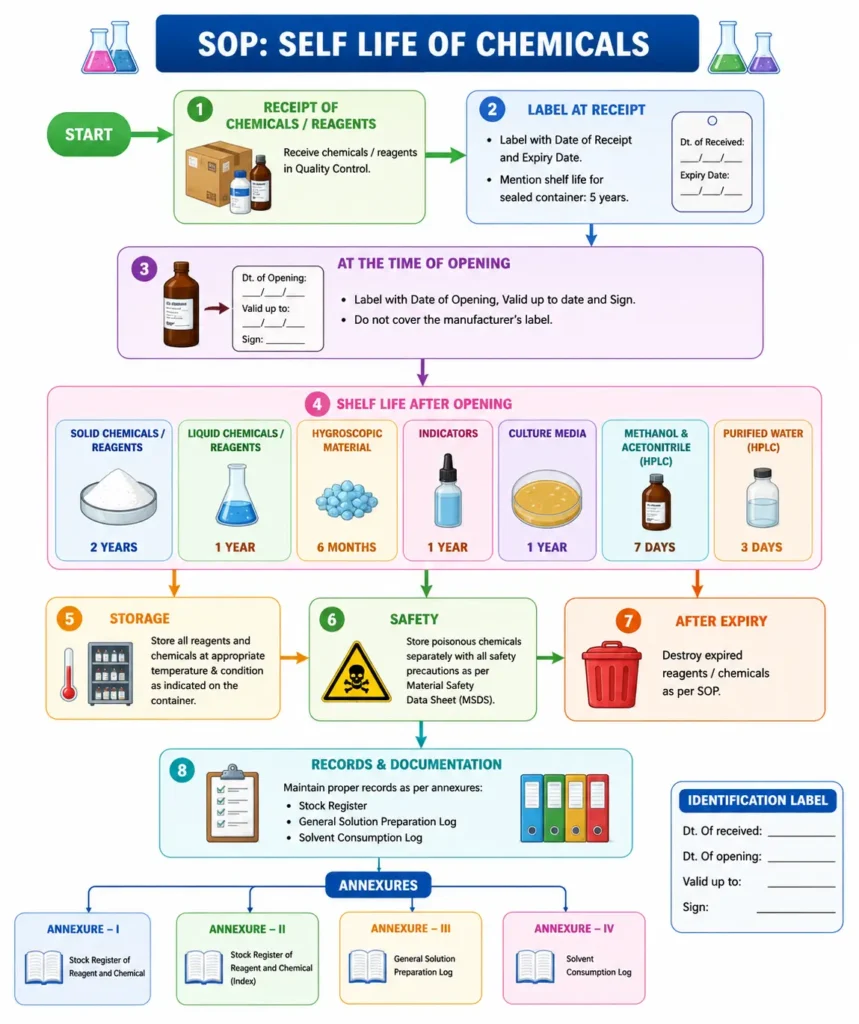
This SOP describes the procedure for monitoring the storage, use, and shelf life of reagents and chemicals used in the Quality Control department. It explains how to label chemicals with the date of receipt, opening date, and validity date. The SOP specifies different shelf lives after opening, such as 2 years for solid chemicals, 1 year for liquid chemicals, 6 months for hygroscopic materials, and 1 year for indicators and culture media. Methanol and acetonitrile used in HPLC are valid for 7 days, while purified water is valid for 3 days. Chemicals must be stored under the required conditions mentioned on the container. Expired chemicals must be destroyed according to the applicable SOP. Poisonous chemicals should be stored separately with proper safety precautions as per their MSDS. Proper records are maintained through stock registers, solution preparation logs, and solvent consumption logs.
Impact Assessment
This SOP will have a positive impact on the Quality Control department by ensuring proper control, storage, monitoring, and use of reagents and chemicals. It provides clear instructions for labeling each chemical with the date of receipt, opening date, expiry or validity date, and user signature. Defined shelf-life requirements for solid chemicals, liquid chemicals, hygroscopic materials, indicators, culture media, methanol, acetonitrile, and purified water will help prevent the use of expired or unsuitable materials. Proper storage under specified temperature and environmental conditions will help maintain chemical quality and stability. Poisonous chemicals will be stored separately with proper safety precautions according to the MSDS. Expired chemicals will be identified and destroyed as per the applicable SOP. Maintenance of stock registers, solution preparation records, and solvent consumption logs will improve traceability and documentation.
Questions & Answers
Q1. Why is proper labeling of chemicals important?
Answer: Proper labeling helps identify the chemical, date of receipt, opening date, expiry or validity date, and responsible person. It prevents the use of expired or unsuitable chemicals.
Q2. Why should chemicals be stored under specified conditions?
Answer: Proper storage conditions help maintain the quality, stability, and effectiveness of chemicals during their shelf life.
Q3. How should poisonous chemicals be stored?
Answer: Poisonous chemicals should be stored separately in a safe and controlled area with necessary precautions as mentioned in the MSDS.
Q4. What should be done with expired chemicals?
Answer: Expired chemicals should not be used for testing. They should be identified, segregated, and destroyed according to the applicable SOP.
Q5. Why is a chemical stock register maintained?
Answer: A chemical stock register helps track the receipt, quantity, issue, usage, and remaining stock of chemicals.
Q6. Why are solution preparation records important?
Answer: These records provide complete information about the preparation and use of laboratory solutions and improve traceability.
Q7. Why should solvent consumption be recorded?
Answer: Recording solvent consumption helps monitor usage, maintain stock control, and identify any unusual or excessive consumption.
Q8. What is the main benefit of this SOP?
Answer: This SOP helps ensure safe handling of chemicals, prevents the use of expired materials, improves documentation, and supports reliable Quality Control testing.