



1. Introduction-SOP For Start-Up Facility in Activity:
This SOP describes the procedure for starting activities in a new pharmaceutical facility, after major renovation, or when a facility has remained non-operational for more than four weeks. It applies to production, packing, stores, and Quality Control areas. Before operations begin, all civil, electrical, and mechanical work must be completed, and the operational status of equipment and accessories must be verified. The area should be thoroughly cleaned, including walls, ceilings, HVAC grills, risers, stainless-steel plates, light and window fixtures, floors, blowers, and drain points. Fumigation, HVAC filter cleaning, and servicing of utilities such as water, compressed air, steam, and vacuum are also required. HVAC systems should be started before personnel enter the area. Equipment and accessories must be cleaned and approved by Quality Assurance. Where required, the area should be qualified, cleanliness verified, and all equipment calibration confirmed before use. This ensures readiness, compliance, cleanliness, and control.
Skip to PDF content2. Flow Diagram:
The flow diagram explains the systematic process for starting activities in a pharmaceutical facility after new construction, major renovation, or an extended shutdown. The process begins by ensuring that all civil, electrical, and mechanical work has been completed. Equipment and accessories are then checked for operational readiness, followed by thorough cleaning of the entire area, including walls, ceilings, HVAC grills, floors, fixtures, blowers, and drain points.
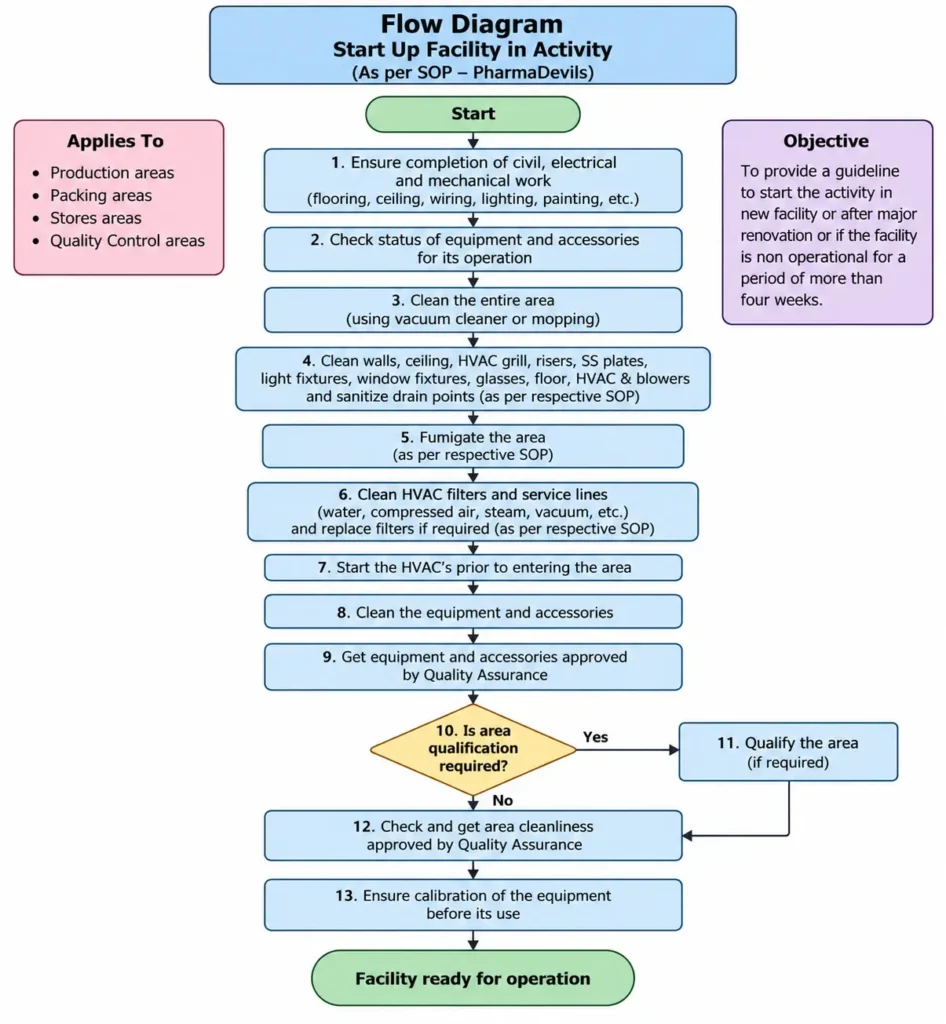
The area is subsequently fumigated, HVAC filters and utility service lines are cleaned, and filters are replaced where required. HVAC systems are started before personnel enter the area. Equipment and accessories are cleaned and approved by Quality Assurance. Where applicable, area qualification is performed. Finally, QA verifies area cleanliness and confirms that equipment calibration is valid before use. Completion of these activities ensures that the facility is clean, qualified, controlled, and ready for safe pharmaceutical operations.
3. Benefits of Following SOP:
The image highlights the major benefits of following the SOP for Start Up Facility in Activity before beginning pharmaceutical operations. Proper implementation ensures that all civil, electrical, and mechanical work is completed and that equipment and accessories are ready for use. It also promotes thorough cleaning of the facility, including walls, ceilings, floors, HVAC components, fixtures, blowers, and drain points.
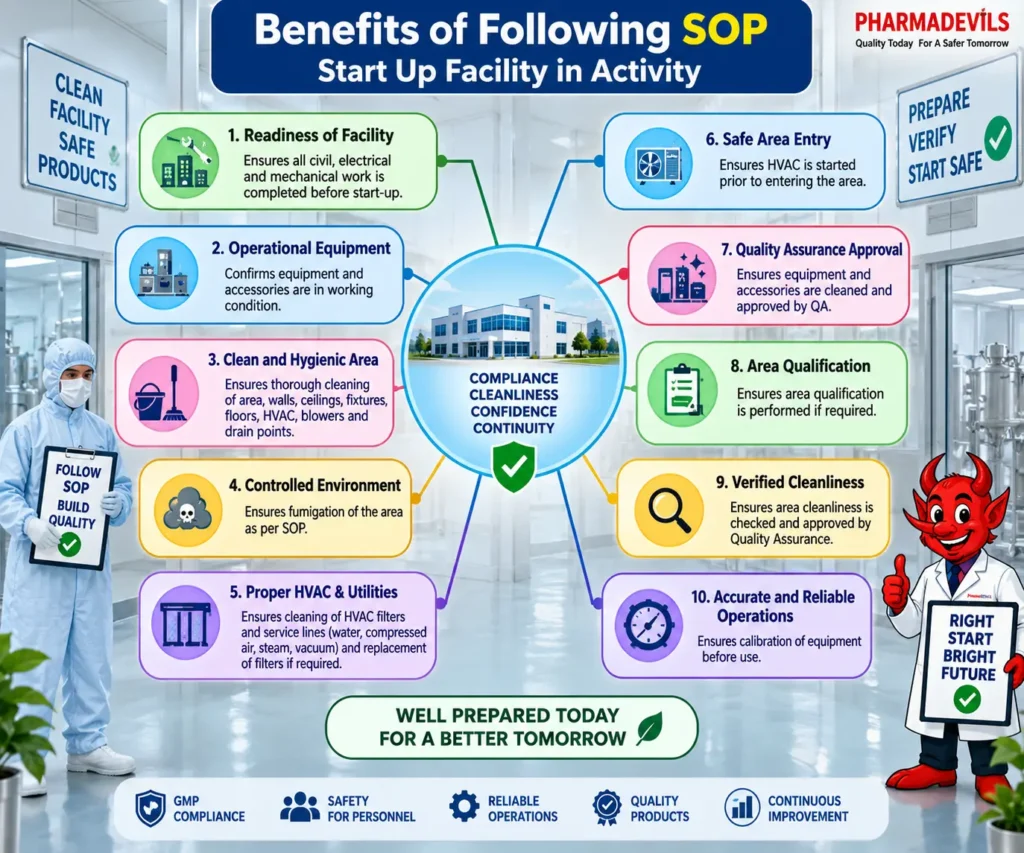
Following the SOP supports controlled environmental conditions through fumigation, cleaning of HVAC filters, and servicing of utilities such as water, compressed air, steam, and vacuum. It ensures HVAC is started before area entry and that equipment is cleaned and approved by Quality Assurance. Where required, the area is qualified and cleanliness is formally verified. Calibration of equipment before use further improves reliability and operational control. Overall, the SOP supports GMP compliance, personnel safety, reliable operations, product quality, cleanliness, and continuous improvement, helping ensure the facility is properly prepared for safe and controlled manufacturing activities.
4. Brainstorming for SOP Failure:
The brainstorming diagram identifies possible causes for failure of the Start Up Facility in Activity SOP. The discussion focuses on gaps that may prevent a pharmaceutical facility from becoming ready for operation. Major causes include incomplete civil, electrical, or mechanical work; equipment not being operational; inadequate cleaning of the area; improper cleaning of walls, ceilings, HVAC components, fixtures, floors, and drain points; incomplete fumigation; and failure to clean or replace HVAC filters and utility service lines. These items directly relate to the startup requirements defined in the SOP.
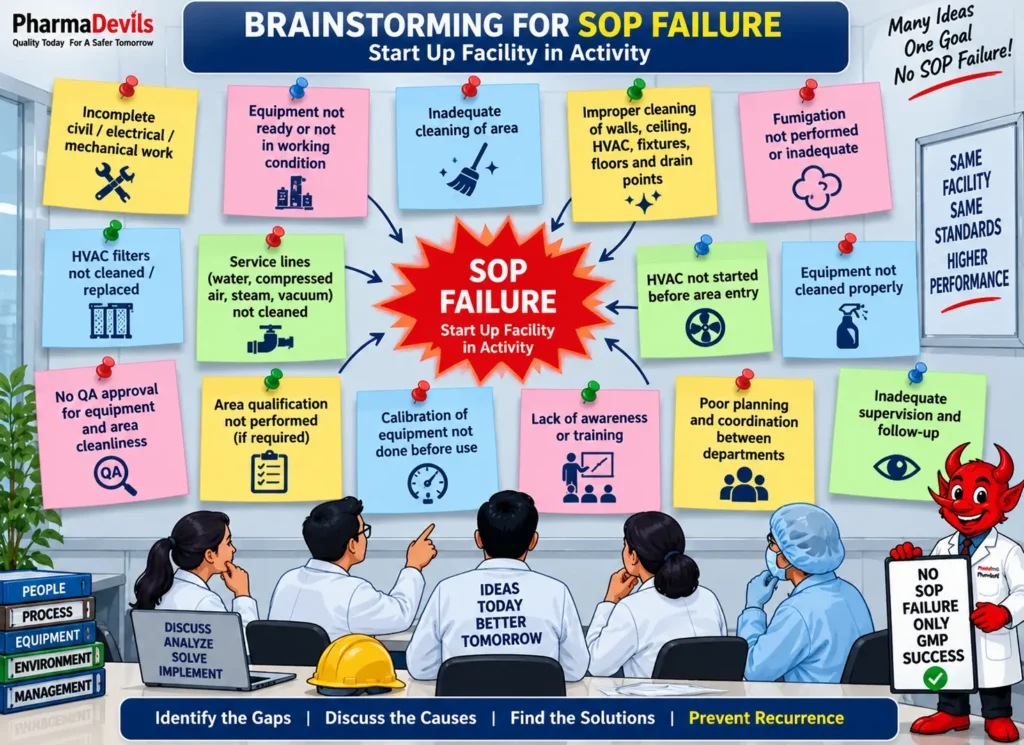
Other important failure points include HVAC not being started before area entry, equipment not being cleaned properly, absence of QA approval, area qualification not being performed when required, and equipment calibration not being completed before use. The diagram also highlights contributing management factors such as inadequate training, poor coordination, and insufficient supervision. The brainstorming approach helps identify gaps, discuss potential causes, develop corrective actions, and prevent recurrence.
5. 5-Why Analysis for SOP Failure:
The 5-Why Analysis for SOP Failure – Start Up Facility in Activity traces the problem from incomplete start-up activities to the underlying management and implementation weaknesses. The first “Why” identifies that required start-up activities were not completed according to the SOP. The second level highlights missed or delayed activities such as area cleaning, HVAC preparation, equipment cleaning, QA approval, qualification, and calibration, all of which are required before facility operation.
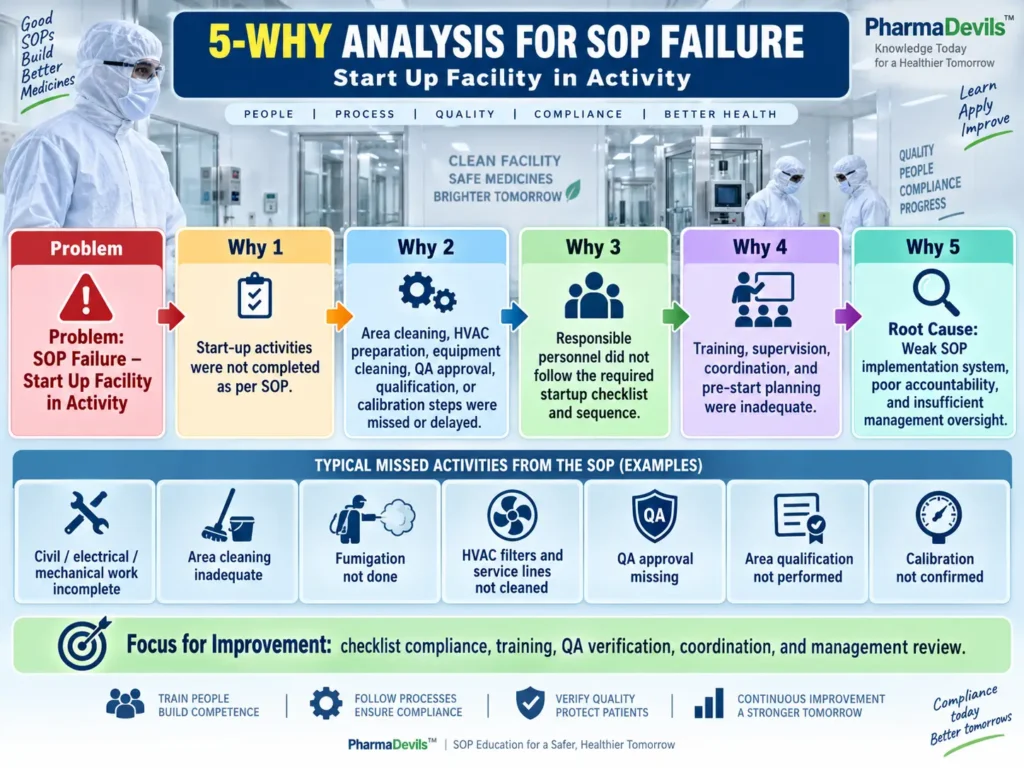
The third “Why” indicates that responsible personnel did not consistently follow the required start-up sequence or checklist. The fourth level identifies inadequate training, supervision, coordination, and pre-start planning as contributing factors. The fifth “Why” identifies the potential root cause as a weak SOP implementation system, insufficient accountability, and inadequate management oversight. The analysis emphasizes stronger checklist compliance, personnel training, QA verification, interdepartmental coordination, supervision, and management review to prevent recurrence and ensure controlled facility start-up.
6. Fishbone Analysis for SOP Failure:
The Fishbone Analysis for SOP Failure – Start Up Facility in Activity identifies the main causes that can lead to failure during facility start-up. The causes are grouped into six categories: Man, Machine, Method, Material, Measurement, and Environment. Under Man, possible causes include inadequate SOP training, lack of awareness, poor supervision, and weak communication. Machine factors include equipment not being ready, improper cleaning, HVAC not being started, filters not being cleaned, utilities not being available, and calibration not being completed. These points reflect the SOP requirements for equipment readiness, cleaning, HVAC operation, utilities, QA approval, qualification, and calibration.
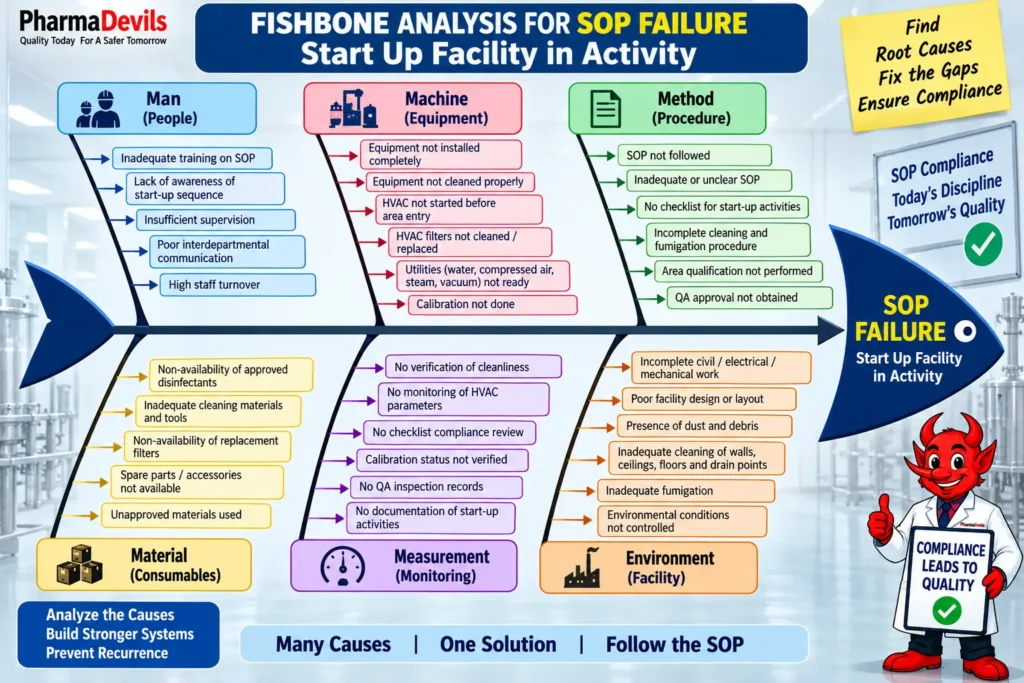
Method causes include failure to follow the SOP, absence of checklists, incomplete cleaning or fumigation, and missing QA approval. Material causes relate to unavailable disinfectants, filters, tools, or accessories. Measurement factors include lack of verification, monitoring, documentation, or calibration review. Environment causes include incomplete civil work, poor facility conditions, dust, inadequate cleaning, and uncontrolled environmental conditions. The analysis helps identify root causes and supports corrective and preventive actions.
7. Fault Tree Analysis for SOP Failure:
The Fault Tree Analysis for SOP Failure – Start Up Facility in Activity explains how different failures can combine to make a pharmaceutical facility unfit for safe operation. The top event is SOP Failure, which can arise from four major branches: inadequate facility readiness, inadequate cleaning and environmental control, equipment not being ready for use, and improper SOP implementation. Facility-related causes include incomplete civil, electrical, or mechanical work and unavailable utilities. Cleaning-related causes include inadequate area cleaning, HVAC not being started, filters not being cleaned or replaced, and fumigation not being performed properly. Equipment-related failures include poor cleaning, incomplete calibration, lack of operational readiness, and missing QA approval. These directly reflect the startup controls specified in the SOP.
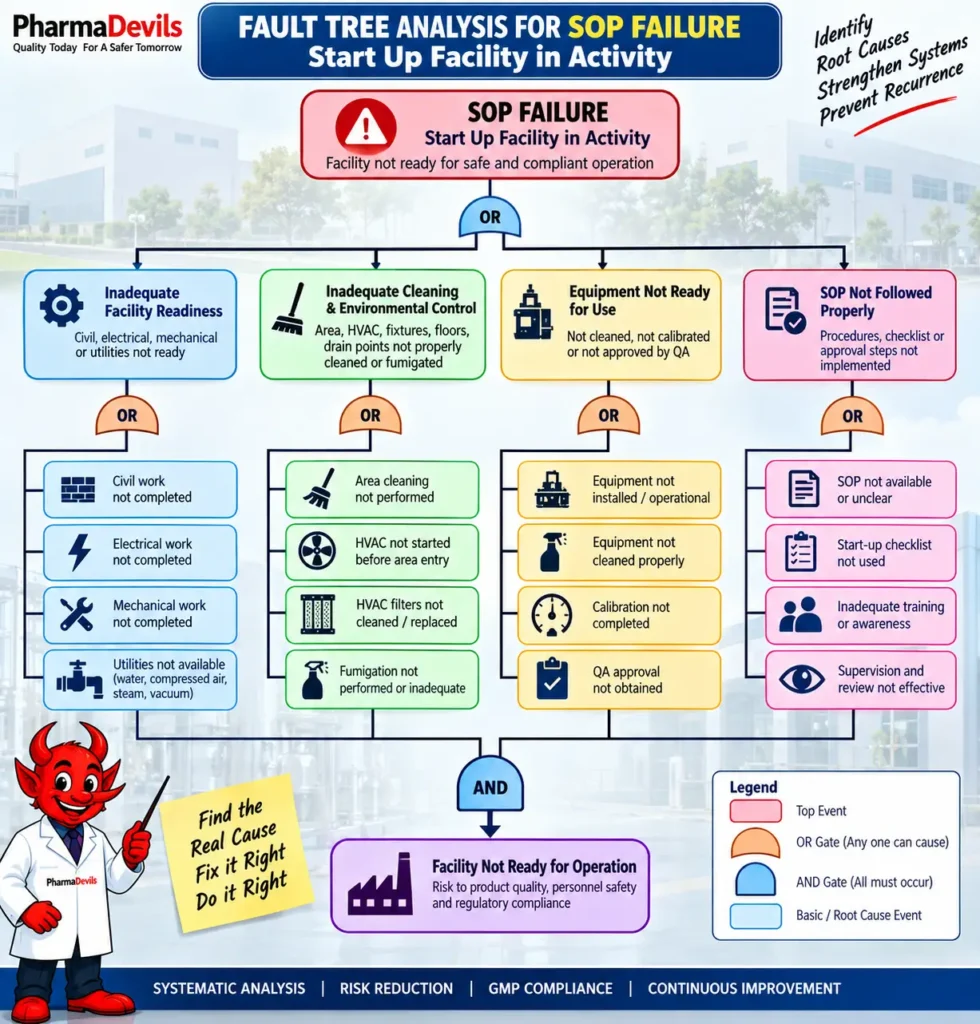
The analysis also highlights procedural weaknesses such as unclear instructions, inadequate training, lack of checklist use, and ineffective supervision. Identifying these basic events supports root-cause investigation, risk reduction, GMP compliance, and prevention of recurrence.
8. Impact Assessment:
The Impact Assessment for SOP Failure – Start Up Facility in Activity illustrates the possible consequences of beginning operations without completing the required facility start-up controls. Failure to verify cleaning, HVAC readiness, equipment condition, qualification, QA approval, and calibration may negatively affect several critical areas.
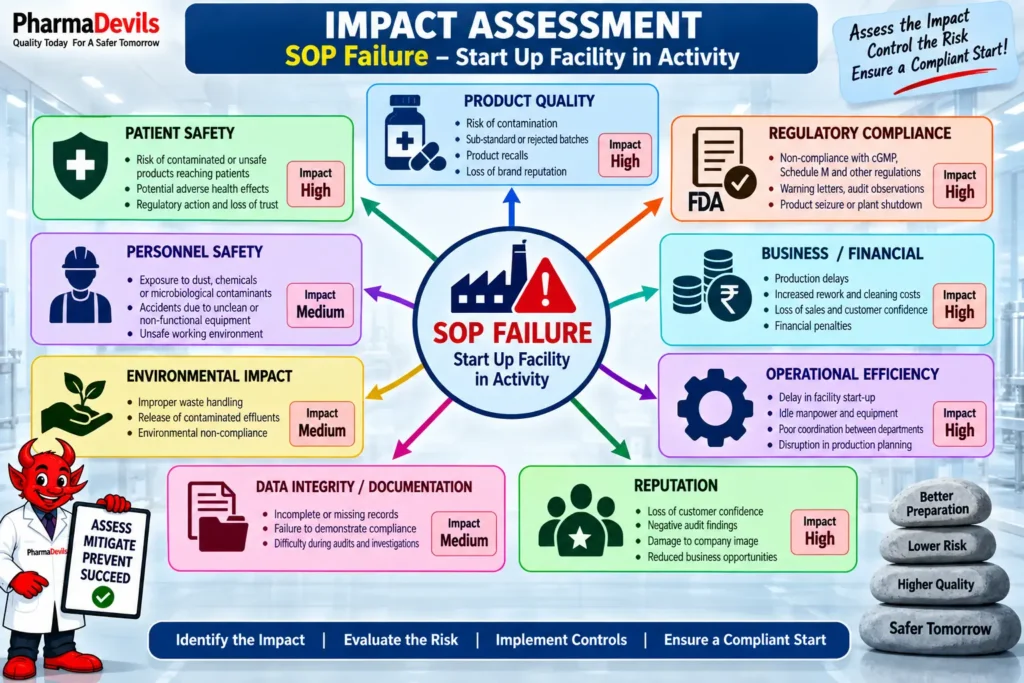
The assessment highlights product quality risks, including contamination, batch rejection, and potential recall. Patient safety may be affected if unsuitable or contaminated products are produced. Personnel safety can also be compromised due to unsafe equipment or an uncontrolled working environment. Regulatory impact may include GMP non-compliance, audit observations, warning actions, or operational restrictions. Additional effects can include production delays, rework, increased costs, incomplete documentation, reduced operational efficiency, and damage to company reputation. The assessment emphasizes identifying risks before facility start-up, implementing suitable controls, verifying readiness through Quality Assurance, and ensuring that the facility is clean, qualified, calibrated, and suitable for controlled pharmaceutical operations.
Questions & Answers – SOP for Start Up Facility in Activity
- Q: What is the objective of this SOP?
A: The objective is to provide guidelines for starting activities in a new facility, after major renovation, or when a facility has remained non-operational for more than four weeks. - Q: Where is this SOP applicable?
A: It is applicable to start-up activities in production, packing, stores, and Quality Control areas. - Q: Who is responsible for executing this SOP?
A: The Officer/Chemist-QA and concerned person are responsible for execution. - Q: Who is responsible for effective implementation of the SOP?
A: The Assistant Manager-QA and Head-QA/QC are responsible for effective implementation. - Q: What should be confirmed before starting facility activities?
A: All civil, electrical, and mechanical work, such as flooring, ceiling, wiring, lighting, and painting, should be completed. - Q: What should be checked regarding equipment and accessories?
A: Their operational status should be checked before use. - Q: How should the facility area be initially cleaned?
A: The entire area should be cleaned using a vacuum cleaner or mopping. - Q: Which surfaces and components require detailed cleaning?
A: Walls, ceilings, HVAC grills, risers, stainless-steel plates, light fixtures, window fixtures, glasses, floors, HVAC systems, blowers, and drain points should be cleaned and sanitized. - Q: Is fumigation required during facility start-up?
A: Yes. The area should be fumigated according to the respective SOP. - Q: What should be done with HVAC filters and utility service lines?
A: HVAC filters and service lines such as water, compressed air, steam, and vacuum should be cleaned according to their respective SOPs, and filters should be replaced if required. - Q: When should the HVAC system be started?
A: The HVAC system should be started before entering the area. - Q: Who approves cleaned equipment and accessories?
A: Quality Assurance should approve the cleaned equipment and accessories. - Q: Is area qualification required before start-up?
A: The area should be qualified if required. - Q: Who verifies area cleanliness?
A: Quality Assurance checks and approves area cleanliness. - Q: What must be confirmed before using equipment?
A: Equipment calibration must be ensured before use.
Reference Guidelines:
- WHO Technical Report Series (TRS) 986, Annex 2 – WHO Good Manufacturing Practices for Pharmaceutical Products: Main Principles. Covers premises, sanitation and hygiene, equipment, qualification, validation, documentation, and GMP controls. (World Health Organization)
- WHO Quality Assurance of Pharmaceuticals, Volume 2, 10th Edition (2024). Provides current WHO GMP and inspection guidance covering premises, equipment, validation, sanitation, and quality systems. (World Health Organization)
- EU GMP – EudraLex Volume 4, Part I, Chapter 3: Premises and Equipment. Relevant for facility design, maintenance, cleaning, environmental conditions, and equipment suitability. (Public Health)
- EU GMP Annex 15 – Qualification and Validation. Applicable where facility, utilities, systems, or equipment require qualification before routine use. (Public Health)
- PIC/S GMP Guide PE 009, Part I, Chapter 3 – Premises and Equipment. Requires premises and equipment to be appropriately designed, maintained, cleaned, and operated to minimize contamination and quality risks. (PicScheme)
- WHO TRS 1044, Annex 2 – GMP for Sterile Pharmaceutical Products, where the facility includes sterile or aseptic manufacturing areas. (World Health Organization)