






Brief Description
This SOP for Facility Qualification explains how pharmaceutical facilities and areas are checked and approved before they are used for manufacturing, packing, storage, or testing. It applies to production areas, warehouses, laboratories, change rooms, corridors, airlocks, and other supporting areas. Facility qualification is completed in planned steps. First, the User Requirement Specification (URS) defines what the area needs. Design Qualification (DQ) checks whether the design meets these needs. Installation Qualification (IQ) confirms that the area and utilities are installed correctly. Operational Qualification (OQ) checks that the area works properly within defined limits. Performance Qualification (PQ) confirms that the area performs consistently. The qualification team reviews test results, deviations, and documents before area handover. Requalification is required after major changes, HVAC changes, equipment changes, or periodically. The SOP also defines responsibilities, approvals, documentation, protocol numbering, and records needed to maintain the qualified status of the facility.
Skip to PDF content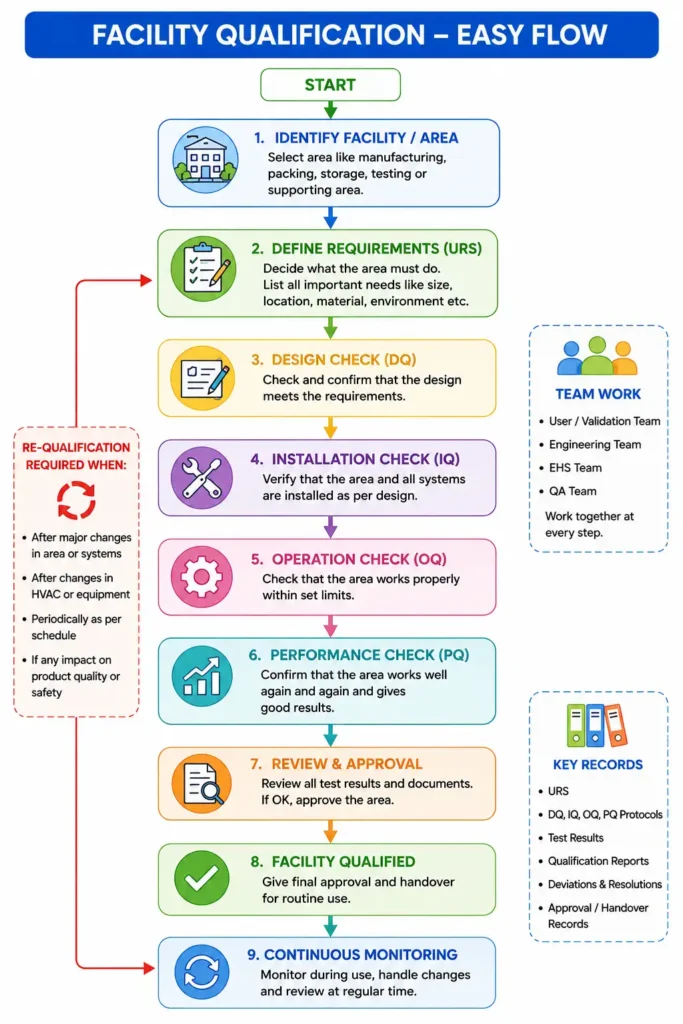
1. Brainstorming:
The brainstorming analysis identifies the potential reasons why the SOP for Facility Qualification is not effectively implemented. The main causes are grouped into areas such as awareness and training, documentation availability, manpower and resources, management oversight, practical implementation challenges, organizational culture, technical readiness, and external constraints. Possible issues include inadequate employee training, outdated or inaccessible SOP copies, unclear responsibilities, insufficient validation resources, competing priorities, incomplete facility design, pending utility qualification, and lack of management follow-up.
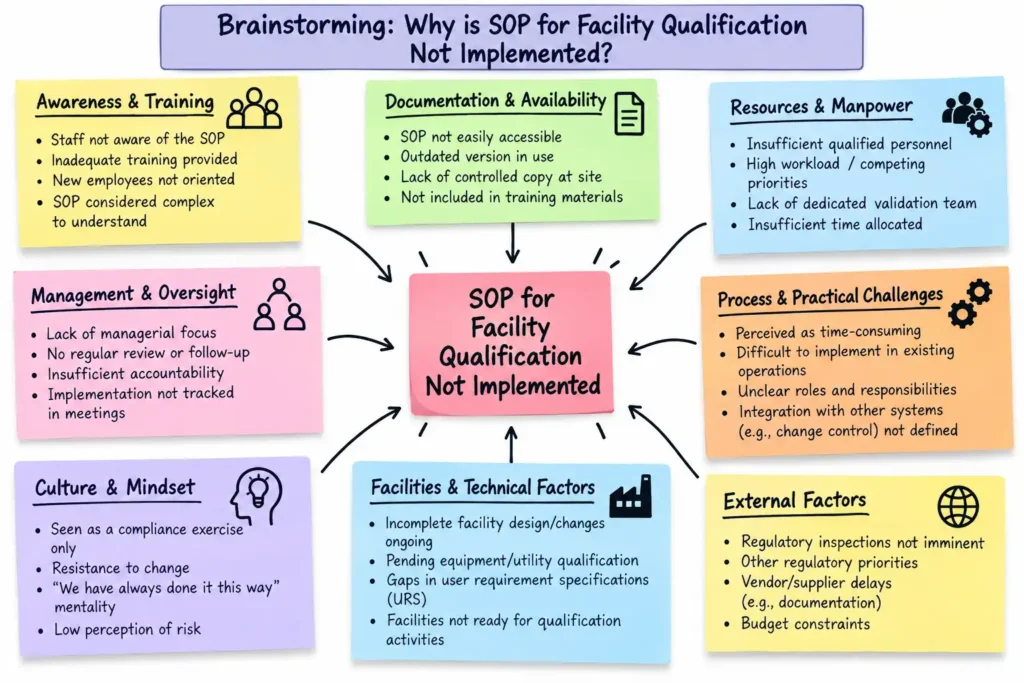
These causes are important because the Facility Qualification SOP requires a structured qualification approach covering URS, DQ, IQ, OQ and PQ, supported by approved protocols, defined acceptance criteria, trained personnel, documentation, and multidisciplinary coordination. The brainstorming exercise helps the investigation team identify likely contributing factors, prioritize further investigation, and develop suitable corrective and preventive actions to ensure consistent implementation of facility qualification requirements.
2. 5 Why Analysis:
The 5 Why Analysis is used to identify the underlying root cause for failure to implement the SOP for Facility Qualification. The analysis begins with the immediate problem that facility qualification activities were not initiated as required. It then traces the issue through unclear responsibilities and timelines, non-preparation or non-approval of required qualification documents, inadequate training and cross-functional coordination, and insufficient management follow-up. The final root cause indicates a weakness in quality-system implementation, resource planning, ownership, and compliance oversight. This is significant because the SOP assigns responsibilities to the user/validation team, Engineering, EHS, QC, QA, QA Head, and Plant Head for assessment, execution, review, approval, and implementation of facility qualification.
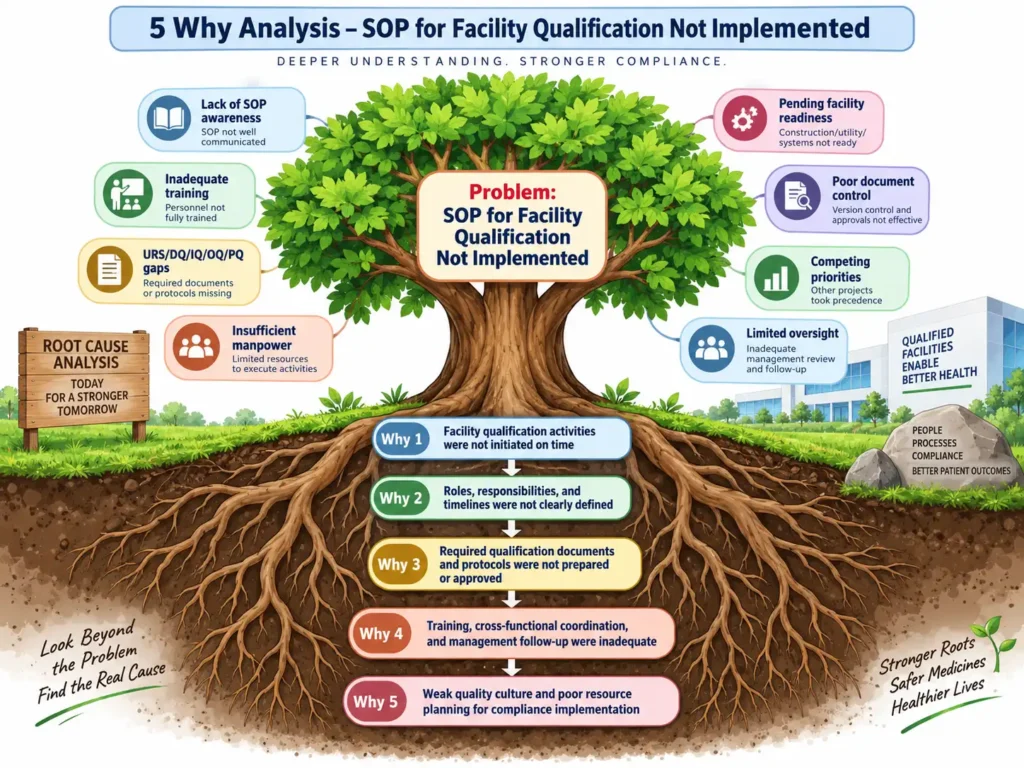
The analysis helps direct CAPA toward defined accountability, training, qualification planning, document preparation, management monitoring, and timely execution of URS, DQ, IQ, OQ and PQ activities.
3. FMEA:
The Failure Mode and Effects Analysis (FMEA) evaluates the risks associated with non-implementation of the SOP for Facility Qualification. Major failure modes include SOP unavailability, inadequate personnel training, missing URS/DQ/IQ/OQ/PQ documents, unclear responsibilities, absence of a qualification schedule, and insufficient management oversight. Each failure mode is assessed using Severity (S), Occurrence (O), and Detection (D) ratings to calculate the Risk Priority Number (RPN = S × O × D).
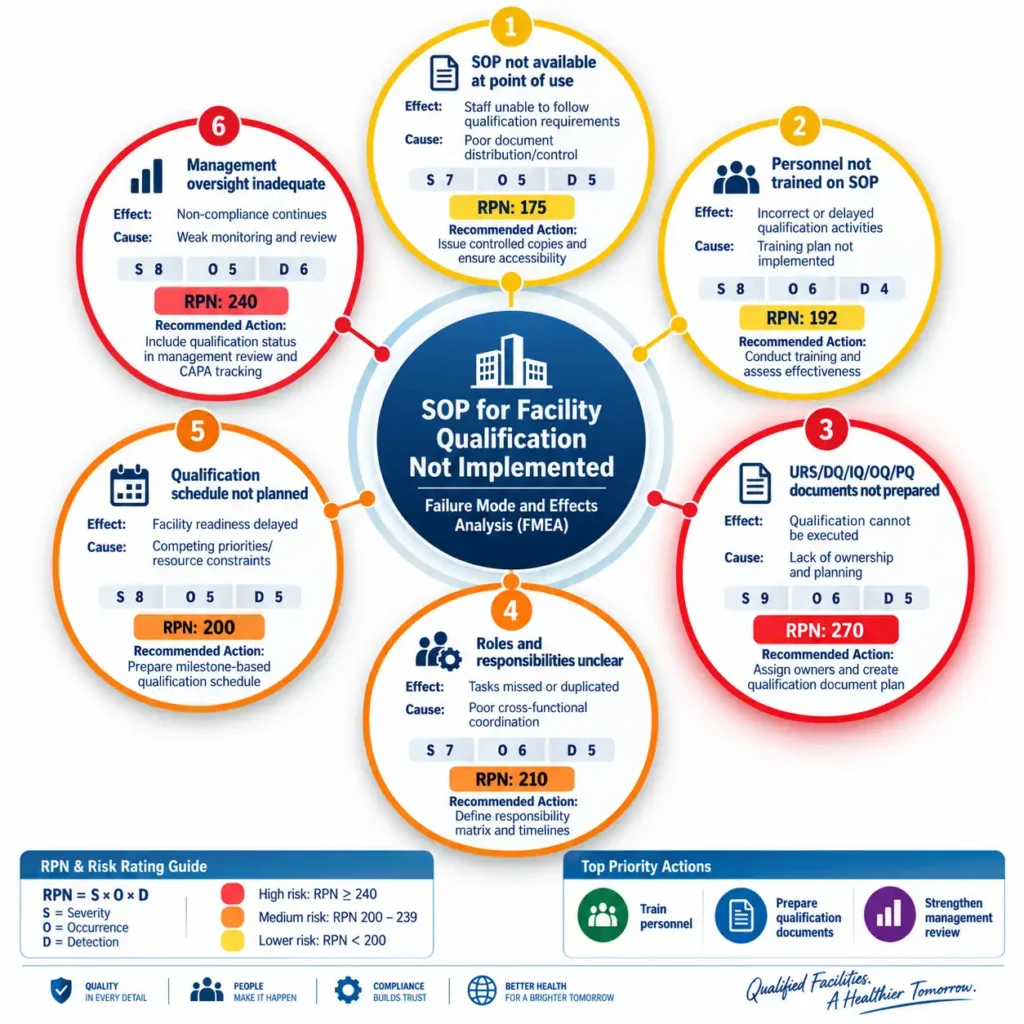
Higher-risk issues require priority corrective actions such as preparing and approving qualification documents, assigning clear ownership, training personnel, establishing milestone-based qualification schedules, and strengthening QA and management review. This approach supports the SOP requirement for coordinated qualification activities, approved documentation, execution and review by the qualification team, and successful completion of DQ, IQ, OQ and PQ before routine facility use.
4. Impact Assessment:
This SOP will have a positive impact on pharmaceutical facility qualification by giving a clear and controlled method to check areas before routine use. It ensures that manufacturing, packing, storage, testing, and supporting areas are properly designed, installed, operated, and performing as required. The use of URS, DQ, IQ, OQ, and PQ helps confirm each stage in a planned way. Proper review of test results, deviations, and documents reduces the chance of using an unsuitable facility. It also improves coordination between the User/Validation team, Engineering, EHS, Quality Control, and Quality Assurance. The SOP requires pre-approval, defined acceptance criteria, documented testing, and final area handover after successful qualification. Requalification after major changes or at defined intervals helps maintain the qualified status of the facility. Overall, this SOP supports product quality, patient safety, cGMP compliance, traceable records, and reliable operation of pharmaceutical areas during regular use and strengthens overall quality system control.
5. Questions & Answers:
Q1. What is the purpose of Facility Qualification?
Answer: The purpose is to confirm that pharmaceutical manufacturing, packaging, storage, and testing facilities are suitable before they are used for commercial products.
Q2. Which areas are covered under this SOP?
Answer: It covers processing, storage, packaging, microbiological testing areas, change rooms, corridors, airlocks, and other supporting areas.
Q3. What is Facility Qualification?
Answer: Facility Qualification is the planned testing and documentation used to prove that a facility or area performs as intended.
Q4. What are the main stages of Facility Qualification?
Answer: The main stages are:
- Design Qualification (DQ)
- Installation Qualification (IQ)
- Operational Qualification (OQ)
- Performance Qualification (PQ)
Q5. What is a User Requirement Specification (URS)?
Answer: URS defines what the facility or area should do and includes requirements such as dimensions, location, surface finish, construction material, and environmental conditions.
Q6. What is Design Qualification (DQ)?
Answer: DQ confirms that the proposed facility design meets the approved user requirements and required specifications.
Q7. What is Installation Qualification (IQ)?
Answer: IQ confirms that the facility, utilities, piping, services, and instruments are installed according to the approved design and engineering documents.
Q8. What is Operational Qualification (OQ)?
Answer: OQ checks whether the facility or area operates properly within its specified upper and lower operating limits.
Q9. What is Performance Qualification (PQ)?
Answer: PQ confirms that the facility performs consistently and meets predetermined requirements during repeated or extended operation.
Q10. When can an area be released for routine use?
Answer: The area can be released after successful completion of Performance Qualification and approval by the Qualification/Validation Team, QA Head, and Plant Head.
Q11. When is requalification required?
Answer: Requalification is required after major changes in the facility, changes in critical HVAC parameters, or addition/removal of major equipment involving civil work.
Q12. How often is periodic requalification performed?
Answer: Periodic requalification should be performed at a frequency not exceeding five years when no major changes have occurred.
Q13. Who is responsible for Facility Qualification activities?
Answer: The User/Validation Team, Engineering, EHS, Quality Control, Quality Assurance, QA Head, and Plant Head are involved in qualification activities according to their responsibilities.
Q14. Why are acceptance criteria important?
Answer: Acceptance criteria clearly define the expected requirements so that the qualification team can confirm whether each test has passed successfully.
Q15. What happens after completion of qualification testing?
Answer: The qualification team reviews all test results and deviations. After successful completion of PQ, the area handover certificate is issued and the area can be approved for routine use.
Reference Guidelines:
- EU GMP – EudraLex Volume 4, Annex 15: Qualification and Validation
Primary international reference for qualification and validation. It requires a risk-based approach and covers URS, DQ, FAT/SAT where applicable, IQ, OQ, PQ, requalification, change control and validation documentation.
EU GMP Annex 15 – Official European Commission - WHO TRS 1019, Annex 3 – Good Manufacturing Practices: Guidelines on Validation
Particularly relevant to facility qualification because WHO states that premises, systems, utilities and equipment should be appropriately designed, installed, qualified, operated and maintained throughout their lifecycle.
WHO TRS 1019 Annex 3 - PIC/S GMP Guide – Annex 15: Qualification and Validation
Provides internationally harmonized GMP expectations for lifecycle qualification and validation. PIC/S also maintains detailed recommendations on qualification and validation.
PIC/S Publications - PIC/S PI 006 – Recommendations on Qualification and Validation
Covers Validation Master Plan, DQ, IQ, OQ, premises, utilities, equipment and validation principles. A revised PI 006-4 was published in July 2026 and is scheduled to enter into force on 1 October 2026, superseding PI 006-3. - ICH Q9(R1) – Quality Risk Management
Appropriate reference for the FMEA performed for “Facility Qualification SOP Not Implemented.” It supports systematic assessment of severity, probability/occurrence and detectability and requires appropriate risk review and documentation.
ICH Quality Guidelines – Q9(R1) - ICH Q10 – Pharmaceutical Quality System
Supports management responsibility, CAPA, change management, continual improvement and lifecycle management. These principles are particularly relevant when the root cause of non-implementation involves inadequate ownership, oversight or quality-system effectiveness.
ICH Quality Guidelines – Q10 - India – Revised Schedule M, Drugs Rules, 1945 / CDSCO GMP Requirements
For Indian pharmaceutical facilities, Revised Schedule M should also be included. CDSCO inspection guidance specifically identifies qualification of premises and systems, utilities, facility design, equipment qualification, validation and personnel training as inspection considerations.
CDSCO Official Website – GMP/Guidance Documents
Recommended Reference
References: EU GMP Annex 15 – Qualification and Validation; WHO TRS 1019 Annex 3 – GMP Guidelines on Validation; PIC/S GMP Annex 15/PI 006; ICH Q9(R1) – Quality Risk Management; ICH Q10 – Pharmaceutical Quality System; and applicable Revised Schedule M requirements under the Drugs Rules, India.