







1. INTRODUCTION – SOP FOR UNIT OPERATION REVIEW:
The SOP for Unit Operation Review establishes a systematic procedure for reviewing various unit operations performed within the pharmaceutical facility. Its purpose is to verify that each operation or activity is carried out in accordance with the applicable approved SOP and established procedures. The review involves selecting the unit operation, observing the activity against the relevant SOP, recording observations, and identifying any deviations or deficiencies. Where gaps are observed, appropriate actions may include revision of the SOP and additional training of concerned personnel. The SOP applies to all unit operations and defines responsibilities for the User Department and Quality Assurance personnel. The review process is intended to support consistent execution of operations, effective implementation of procedures, identification of deficiencies, and appropriate follow-up actions through documented review and authorization.
Skip to PDF content2. Flow Diagram – SOP for Unit Operation Review:
The Unit Operation Review flow diagram describes the systematic process for evaluating pharmaceutical unit operations against approved procedures. The process begins by selecting the unit operation to be reviewed and observing the activity with reference to the applicable SOP. All observations are then documented in the prescribed review format. Any deviations or deficiencies identified during the review are evaluated for appropriate action.
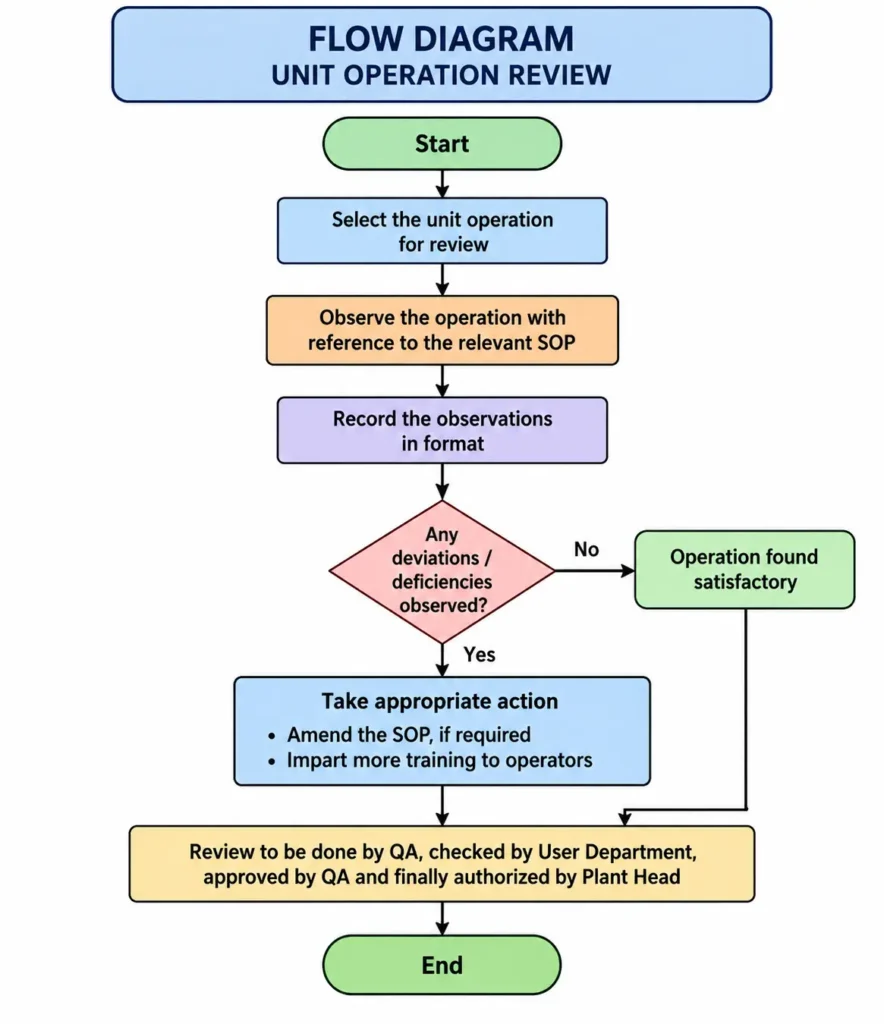
Where necessary, the SOP may be amended and additional training may be provided to operators. If no deficiencies are observed, the operation is considered satisfactory. The completed unit operation review is performed by Quality Assurance, checked by the User Department, approved by Quality Assurance, and finally authorized by the Plant Head. This structured approach supports documented oversight, procedural compliance, identification of operational gaps, and timely implementation of required improvements.
3. Benefits of Following SOP – SOP for Unit Operation Review:
Following the SOP for Unit Operation Review helps ensure that unit operations are performed consistently in accordance with approved procedures. It provides a structured method for observing activities, documenting findings, and identifying deviations or deficiencies during operation reviews. When gaps are detected, suitable actions such as SOP amendment or additional operator training can be initiated.
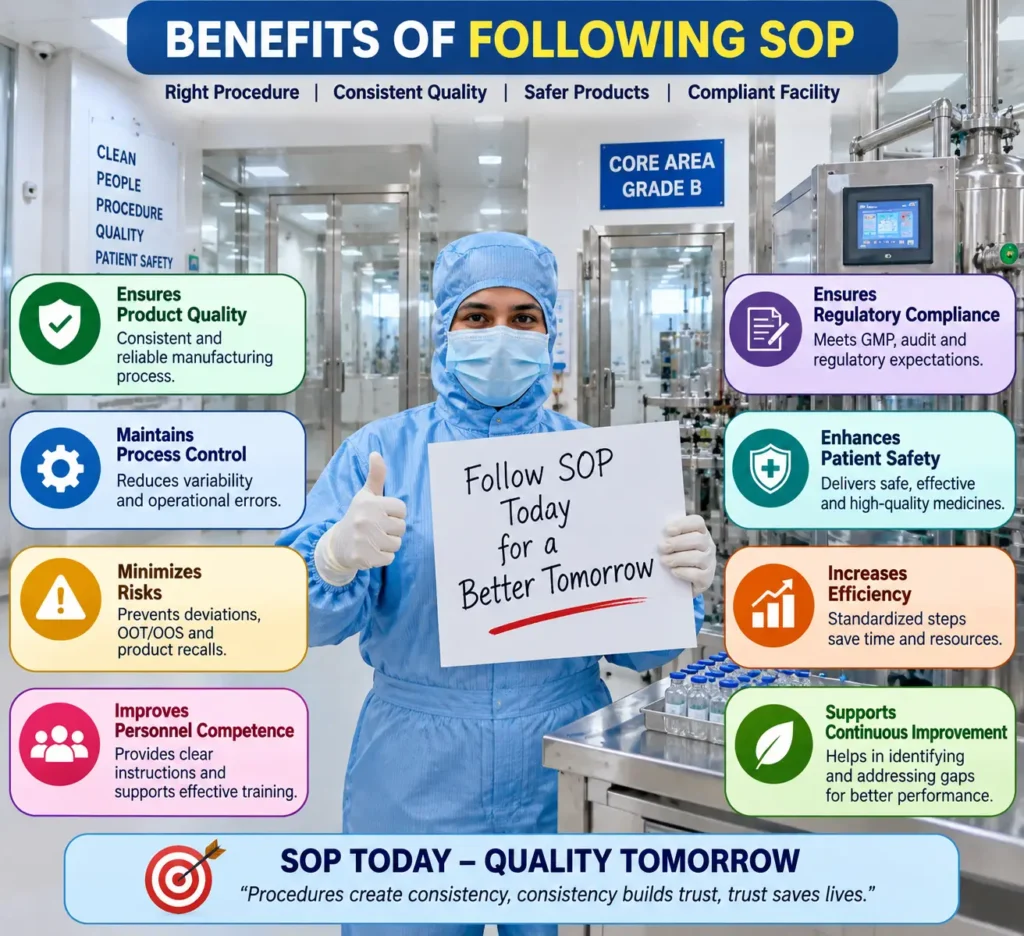
This supports better process control, improved personnel awareness, and more reliable execution of manufacturing and quality activities. The documented review process also strengthens traceability and accountability by involving Quality Assurance, the User Department, and Plant Head authorization. Overall, proper adherence to this SOP helps maintain procedural discipline, reduce operational errors, improve compliance, and support continual improvement of pharmaceutical operations.
4. Brainstorming for SOP Failure – SOP for Unit Operation Review:
The Brainstorming for SOP Failure analysis for the SOP for Unit Operation Review is intended to identify potential causes that may result in ineffective review, procedural non-compliance, or repeated operational deficiencies. The SOP requires the selected unit operation to be observed against the applicable procedure, observations to be recorded, and deviations or deficiencies to be identified for appropriate action.
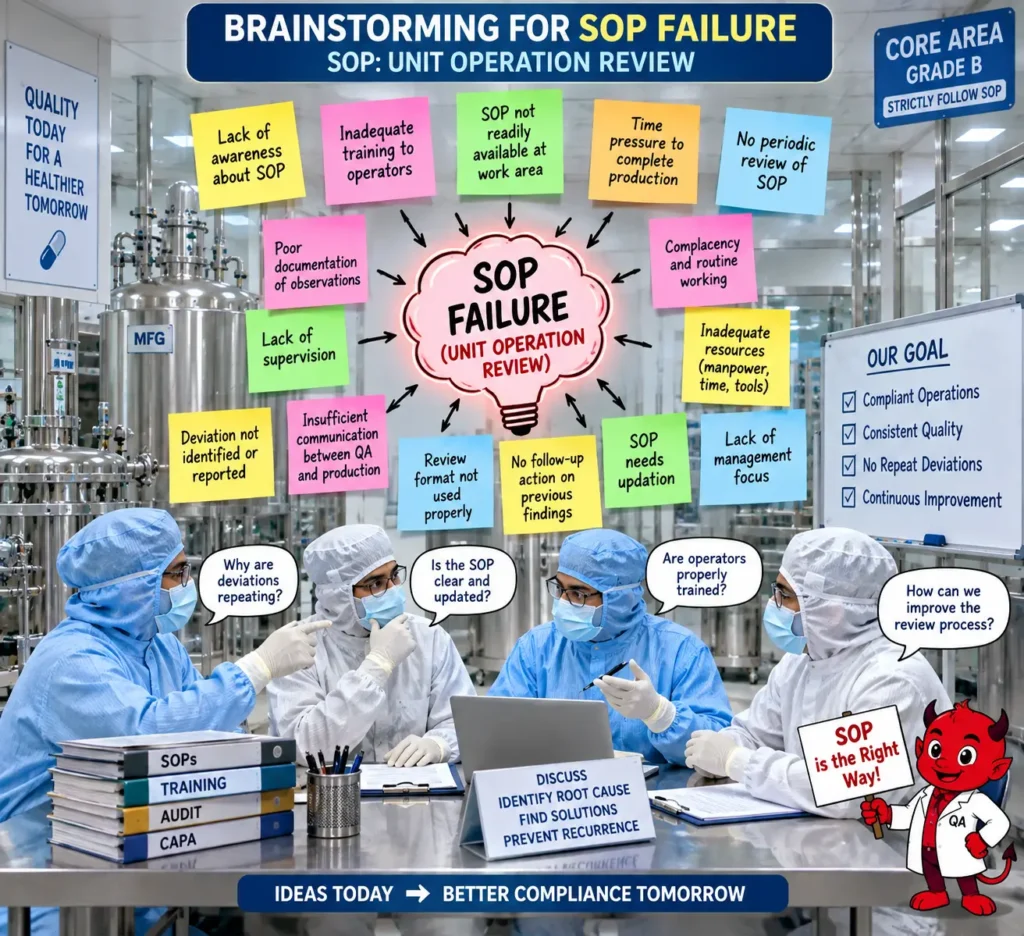
During brainstorming, possible contributing factors may include inadequate operator training, poor awareness of SOP requirements, outdated or unavailable procedures, incomplete documentation, weak supervision, insufficient communication between QA and the User Department, improper use of the review format, and inadequate follow-up of previous findings. Time pressure, insufficient resources, and lack of management attention may further contribute to SOP failure. Identifying these causes helps the investigation team determine suitable corrective and preventive actions, such as SOP revision, retraining, improved supervision, stronger documentation controls, and periodic effectiveness review to minimize recurrence.
5. 5-Why Analysis for SOP Failure – SOP for Unit Operation Review:
The 5-Why Analysis for SOP Failure under the SOP for Unit Operation Review is used to systematically identify the underlying reason for ineffective execution of the review process. The SOP requires selection of the unit operation, observation against the applicable procedure, recording of observations, identification of deviations or deficiencies, and implementation of appropriate actions such as SOP revision or additional training.
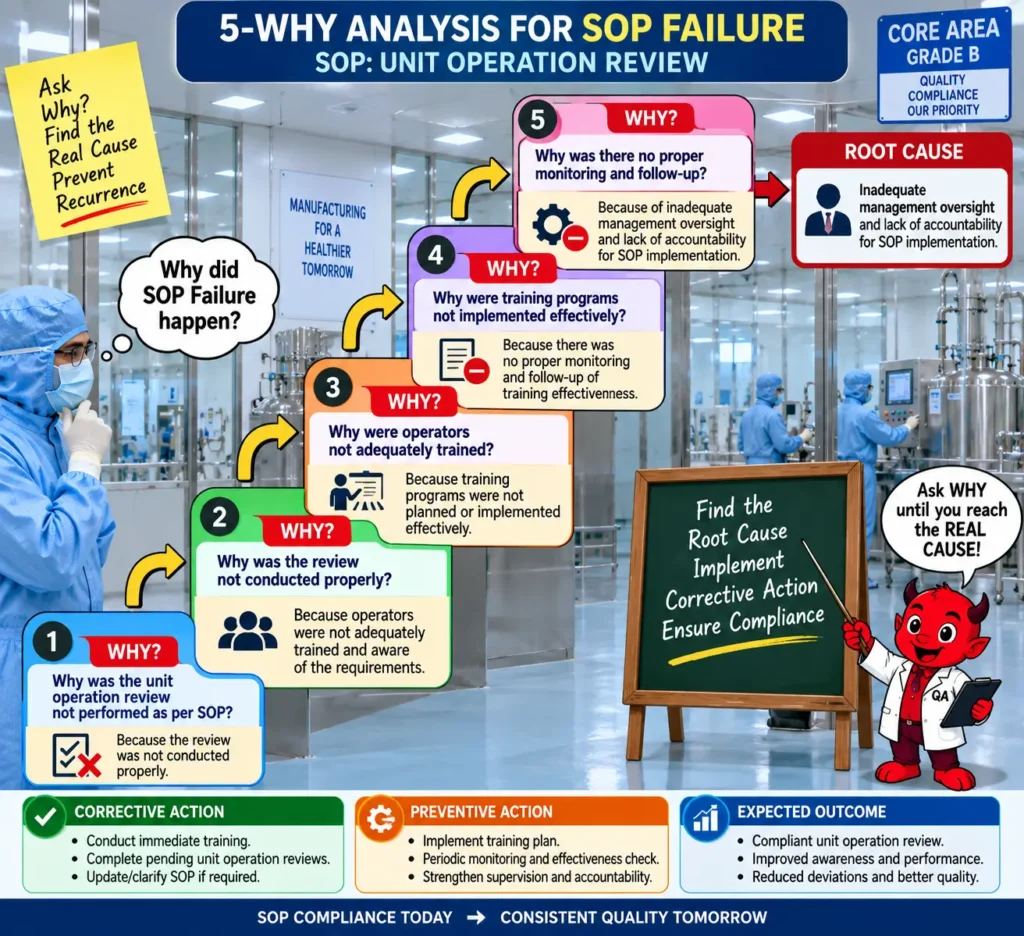
The analysis begins with the problem that the unit operation review was not performed as required. Successive “Why?” questions may reveal inadequate execution of the review, insufficient operator awareness, ineffective training, poor monitoring of training effectiveness, and weak follow-up or supervisory oversight. The final root cause may therefore relate to inadequate management control and accountability for SOP implementation. Appropriate corrective and preventive actions include completion of pending reviews, retraining personnel, strengthening supervision, periodically checking training effectiveness, and ensuring documented follow-up to prevent recurrence and improve procedural compliance.
6. Fishbone Analysis for SOP Failure – SOP for Unit Operation Review:
The Fishbone Analysis for SOP Failure for the SOP for Unit Operation Review provides a structured method for examining possible factors that may lead to ineffective execution of the review process. The SOP requires selection of the unit operation, observation against the relevant SOP, documentation of observations, identification of deviations or deficiencies, and appropriate follow-up actions.
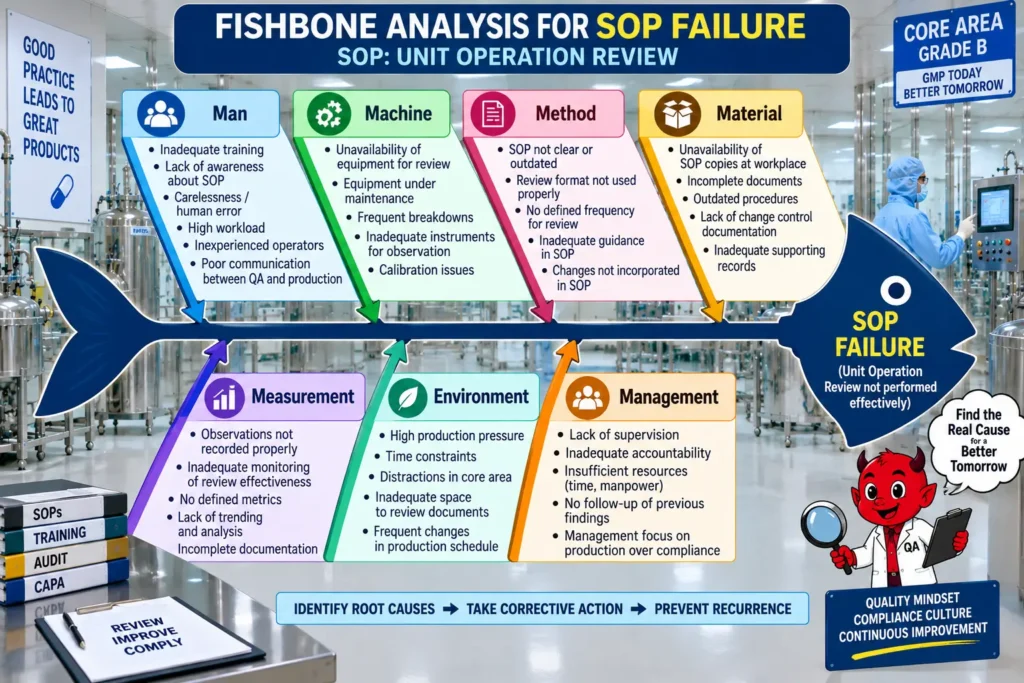
The fishbone diagram organizes potential causes under major categories such as Man, Machine, Method, Material, Measurement, Environment, and Management. These categories help the investigation team systematically consider issues such as inadequate training, unclear procedures, incomplete documentation, insufficient supervision, poor recording of observations, and weak follow-up. The analysis supports identification of the most probable root causes rather than treating only the visible failure. The findings can then guide actions such as SOP amendment, additional operator training, strengthened oversight, improved documentation, and better review controls to prevent recurrence and improve compliance.
7. Fault Tree Analysis for SOP Failure – SOP for Unit Operation Review:
The Fault Tree Analysis for SOP Failure under the SOP for Unit Operation Review systematically identifies potential causes that can lead to ineffective execution of the review process. The top event is defined as “SOP Failure – Unit Operation Review not performed effectively.” The analysis branches into major contributing areas such as inadequate personnel performance, deficient procedures and documentation, inadequate monitoring and follow-up, and environmental or resource-related issues.
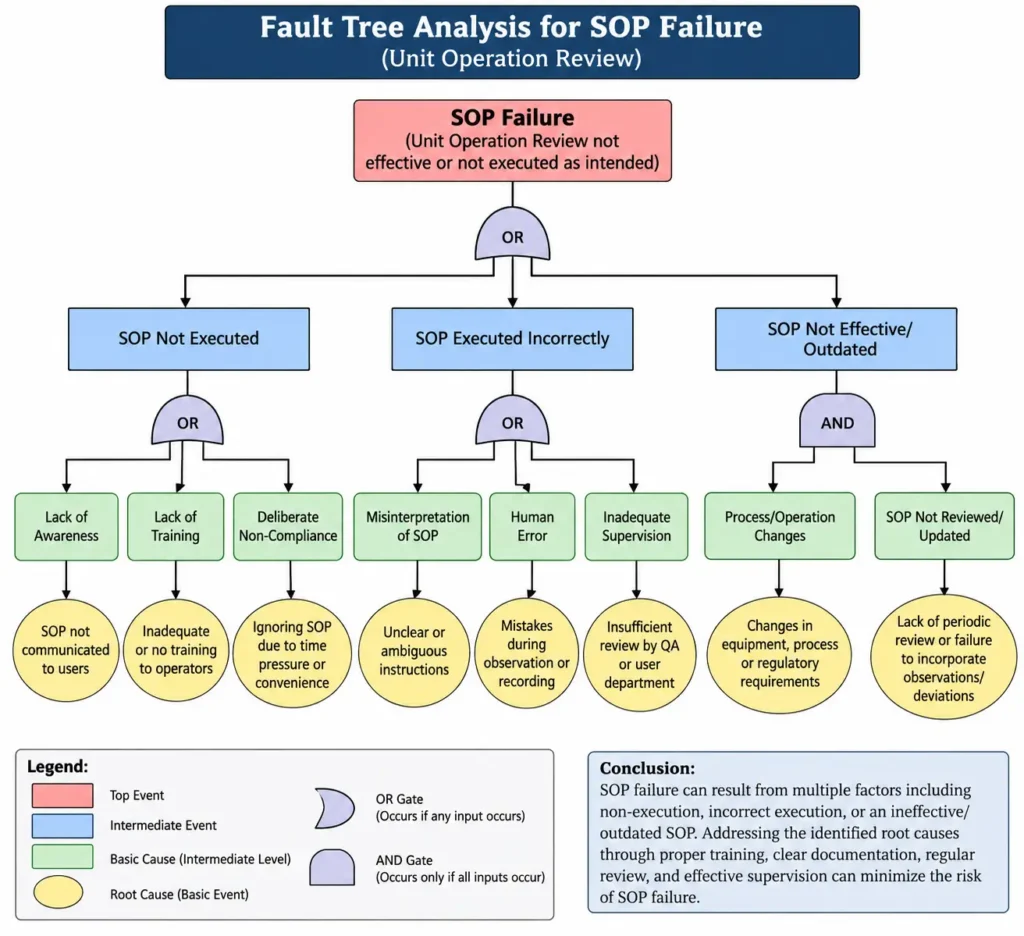
Possible underlying causes include insufficient training, poor SOP awareness, outdated or unavailable procedures, improper use of the review format, incomplete recording of observations, lack of follow-up on previous findings, time pressure, insufficient resources, and weak management support. The SOP requires observations to be documented, deficiencies to be identified, and appropriate actions such as SOP amendment or additional operator training to be taken. Fault Tree Analysis therefore helps identify root causes, strengthen controls, prevent recurrence, and improve consistent SOP compliance.
8. Impact Assessment – SOP for Unit Operation Review:
Failure to effectively implement the SOP for Unit Operation Review can adversely affect the consistency, compliance, and control of pharmaceutical manufacturing operations. The SOP requires selection of the unit operation, observation against the applicable SOP, recording of observations, identification of deviations or deficiencies, and appropriate actions such as SOP amendment or additional operator training.
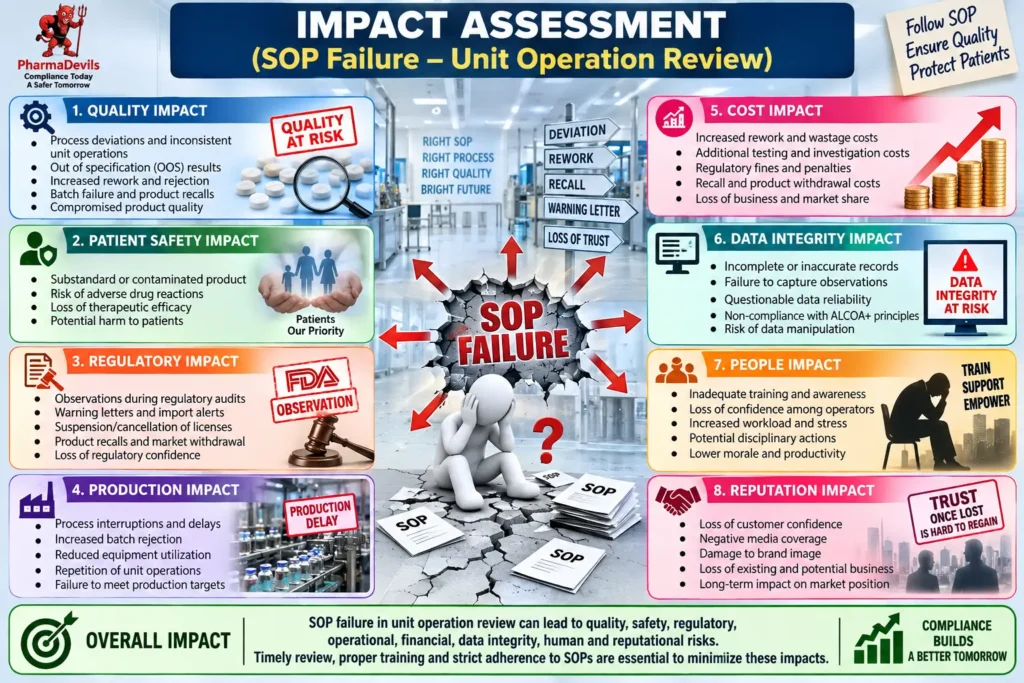
If these review activities are not performed properly, deviations may remain unidentified, incorrect operating practices may continue, and personnel may work without adequate procedural understanding. This can increase the possibility of process variation, documentation deficiencies, product-quality issues, repeat deviations, rework, investigation burden, and regulatory observations. Inadequate review may also delay necessary SOP revisions and training actions.Effective implementation of the SOP strengthens process control, operator compliance, documentation accuracy, deviation detection, training effectiveness, and overall GMP compliance. The defined responsibility of the user department and QA also supports proper execution and oversight of the review process.
Questions & Answers – SOP for Unit Operation Review:
Q1. What is the objective of the SOP for Unit Operation Review?
Answer: The objective is to provide a defined procedure for carrying out the review of unit operations.
Q2. What is the scope of the SOP?
Answer: The SOP is applicable to all unit operations.
Q3. Who is responsible for execution of this SOP?
Answer: The User Department is responsible for execution of the SOP.
Q4. Who is responsible for effective implementation of the SOP?
Answer: The Asst. Manager-QA and Head-QA/QC are responsible for effective implementation of the SOP.
Q5. What is the first step in unit operation review?
Answer: The first step is to select the unit operation that is to be reviewed.
Q6. How should the selected unit operation be reviewed?
Answer: The operation should be observed with reference to the relevant approved SOP.
Q7. What should be done with observations obtained during the review?
Answer: All observations should be recorded in the prescribed format.
Q8. What should be identified during the unit operation review?
Answer: Any deviations or deficiencies observed during the operation should be identified.
Q9. What action should be taken if the SOP requires modification?
Answer: The SOP should be amended, if required, based on observations, deviations, or deficiencies identified during the review.
Q10. What should be done if operators require additional knowledge or improvement?
Answer: Additional training should be imparted to the operators.
Q11. Who performs, checks, approves, and authorizes the unit operation review?
Answer: The unit operation review is performed by Quality Assurance, checked by the User Department, approved by Quality Assurance, and finally authorized by the Plant Head.
Q12. What information is recorded in the Unit Operation Review Format?
Answer: The format includes Date of Review, Operation/Activity, Observation, Status, Action Required, and Remark.
Q13. What is the reference mentioned in the SOP?
Answer: The reference specified in the SOP is In House.
Q14. What annexure is provided with this SOP?
Answer: Annexure-I – Unit Operation Review Format is provided for recording the review details.
Q15. What is the meaning of SOP, QA, and QC?
Answer: SOP means Standard Operating Procedure, QA means Quality Assurance, and QC means Quality Control.
Reference Guideline – SOP for Unit Operation Review:
1. No specific external regulatory guideline such as WHO GMP, US FDA, EU GMP, PIC/S, or ICH is cited in the SOP.