







1. INTRODUCTION – VALIDATION OF CHECKERS:
The Validation of Checkers procedure is established to ensure that personnel assigned for visual inspection and checking activities are properly trained, evaluated, and qualified before performing routine inspection work. The SOP applies to checker validation activities in the oral liquid, tablet packing, and ointment sections and defines responsibilities for Production and Quality Assurance personnel. Checker qualification is performed through training, periodic retraining, and challenge tests using specially prepared validation kits containing known defects. These defects include foreign particles, volume variations, sealing defects, labeling defects, tablet defects, blister/strip defects, and Lami-tube defects. Personnel are considered suitable for inspection duties when they successfully identify the specified rejects during the challenge exercise. The SOP also defines acceptance criteria such as specificity, sensitivity, predictive values, accuracy, eyesight requirements, and absence of color blindness, helping ensure that certified visual inspectors can reliably detect product and packaging defects.
Skip to PDF content2. FLOW DIAGRAM – VALIDATION OF CHECKERS:
The flow diagram for Validation of Checkers describes the systematic process used to train, evaluate, qualify, and periodically revalidate personnel performing visual inspection activities. The process begins with identification of the worker, followed by training by the QA Chemist and documentation of training in the attendance record. After one month, retraining is provided and the worker undergoes a challenge test using a validation kit containing known defects.
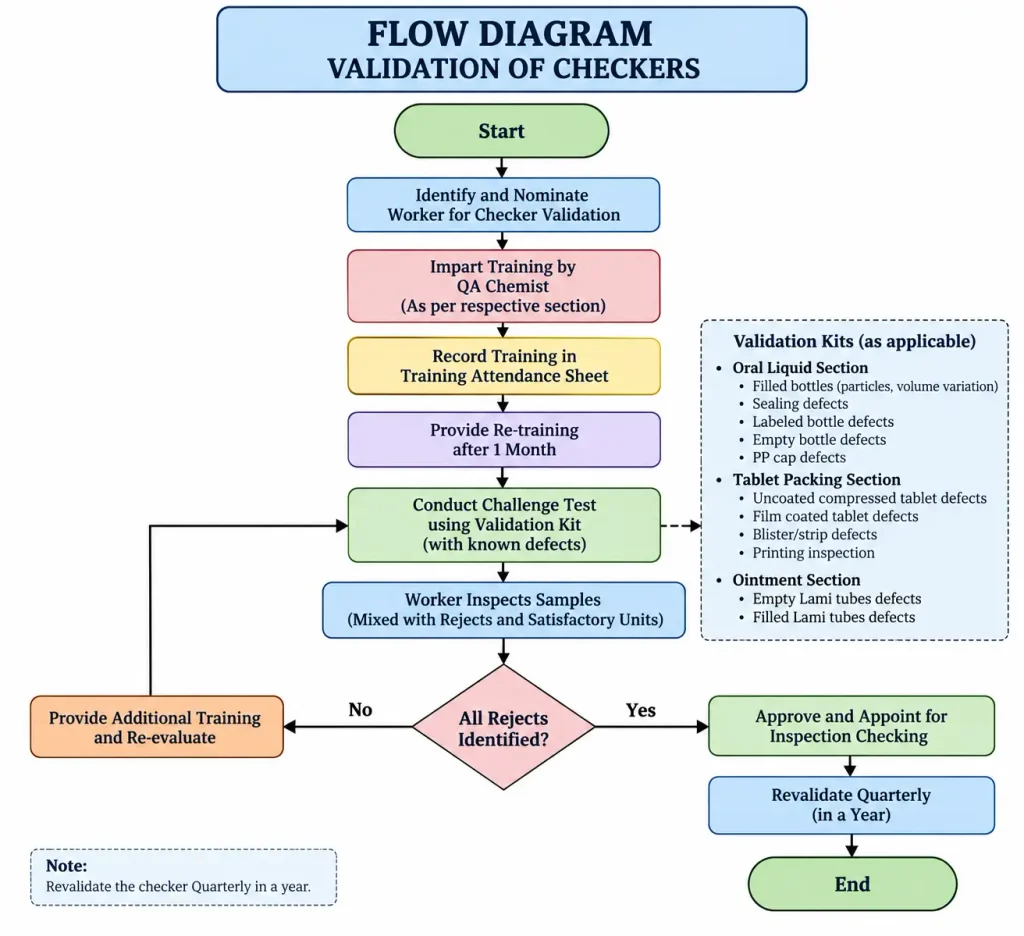
The worker inspects samples containing both acceptable and defective units. If all specified rejects are correctly identified, the worker is considered suitable for inspection checking. If defects are missed, additional training and re-evaluation are required. The validation kits cover oral liquid, tablet packing, and ointment sections, including bottle, sealing, labeling, tablet, blister/strip, and Lami-tube defects. The SOP also requires the checker to be revalidated quarterly to maintain continued inspection reliability.
2. BENEFITS OF FOLLOWING THE SOP -FOR VALIDATION OF CHECKERS:
Following the SOP for Validation of Checkers helps ensure that personnel involved in visual inspection are properly trained, evaluated, and qualified before carrying out checking activities. The procedure supports consistent training, documented attendance, challenge testing, and periodic revalidation, thereby improving the reliability of defect detection.
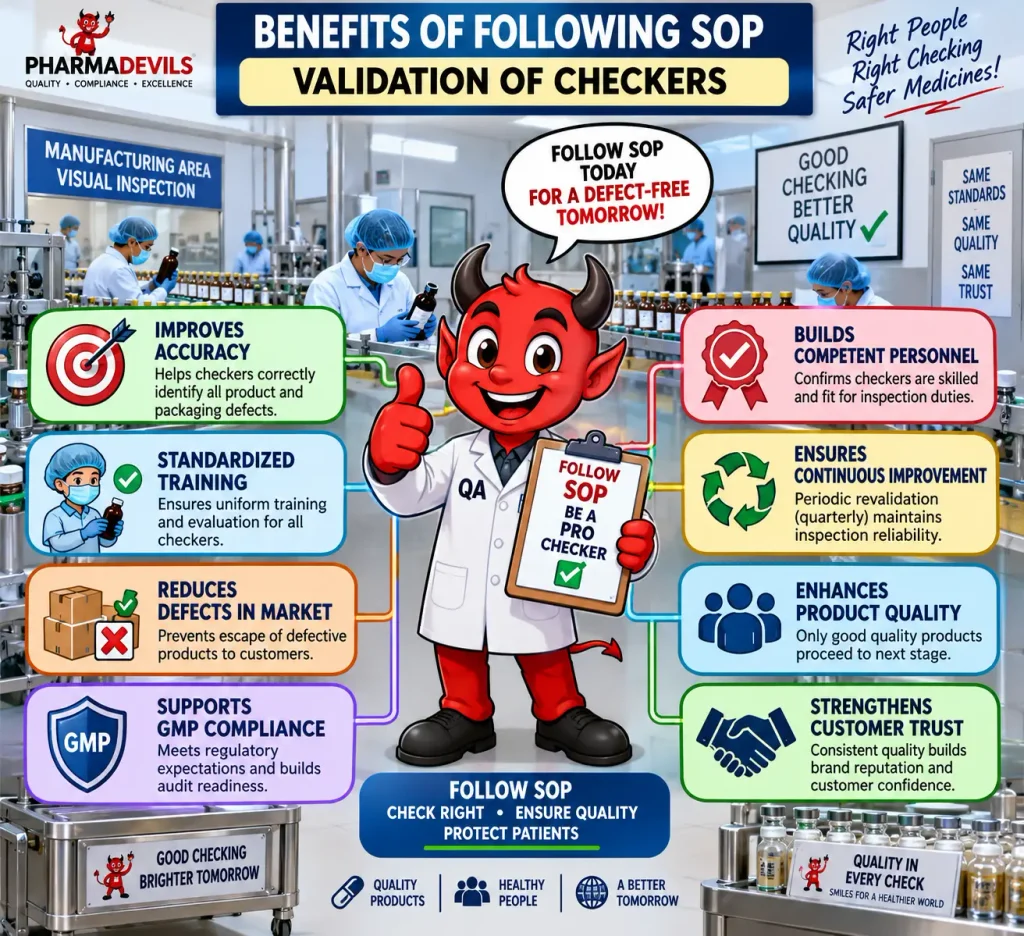
The diagram highlights key benefits such as improved inspection accuracy, standardized training, competent personnel, reduced chances of defective products reaching the market, stronger GMP compliance, better product quality, and increased customer confidence. Regular revalidation further helps maintain checker performance over time; the SOP specifically requires quarterly revalidation. By using validation kits containing known defects in bottles, labels, caps, tablets, blister/strip packs, and Lami tubes, the organization can confirm that checkers are capable of detecting relevant product and packaging defects. This supports consistent inspection practices and contributes to overall product quality and patient protection.
3. BRAINSTORMING FOR SOP FAILURE –VALIDATION OF CHECKERS:
The Brainstorming for SOP Failure – Validation of Checkers diagram identifies possible reasons why the checker validation procedure may not be followed effectively in the manufacturing area. The diagram highlights factors such as inadequate training, lack of SOP awareness, poor supervision, insufficient validation kits, time pressure, poor documentation, communication gaps, inadequate lighting, high manpower turnover, lack of motivation, and failure to perform periodic re-evaluation.
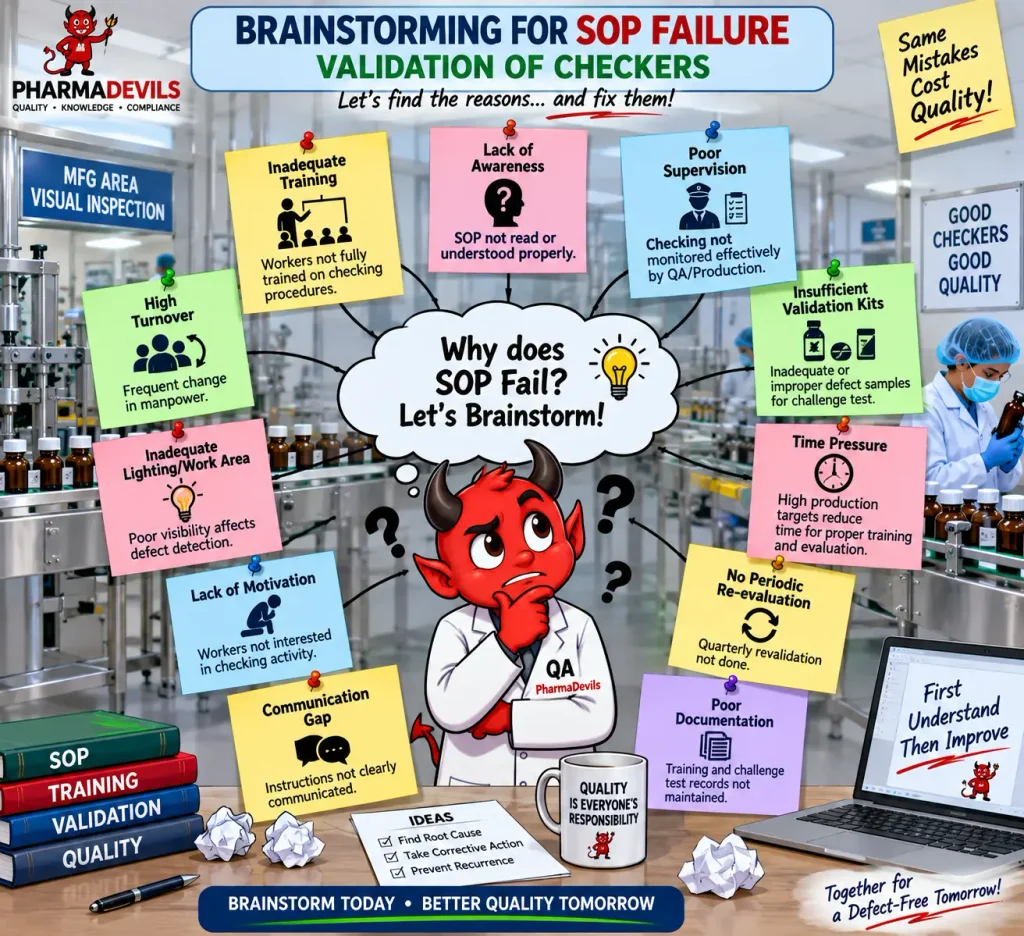
These brainstorming points help the QA and Production teams identify potential weaknesses before selecting the actual root cause. The SOP requires personnel to receive training, undergo challenge testing using validation kits containing known defects, and successfully identify rejects before being assigned inspection activities.The SOP also requires quarterly revalidation of checkers, making periodic evaluation an important control for maintaining inspection reliability. Overall, brainstorming supports structured investigation, stronger training, better supervision, improved documentation, and more reliable checker performance.
5. 5-WHY ANALYSIS FOR SOP FAILURE – VALIDATION OF CHECKERS:
The 5-Why Analysis for SOP Failure – Validation of Checkers diagram is used to identify the underlying cause of ineffective implementation of the checker validation procedure. The analysis begins with the main problem: the SOP for checker validation was not followed effectively. The first reasons may include workers not being properly trained or evaluated, followed by inadequate planning of training and challenge testing. The analysis then examines weaknesses in supervision, monitoring, follow-up, and communication of responsibilities. The attached SOP requires training by QA personnel, documentation of training, retraining after one month, and challenge testing using validation kits containing known defects. The SOP also states that a worker should be assigned inspection duties only after successfully identifying all rejects during the challenge test.
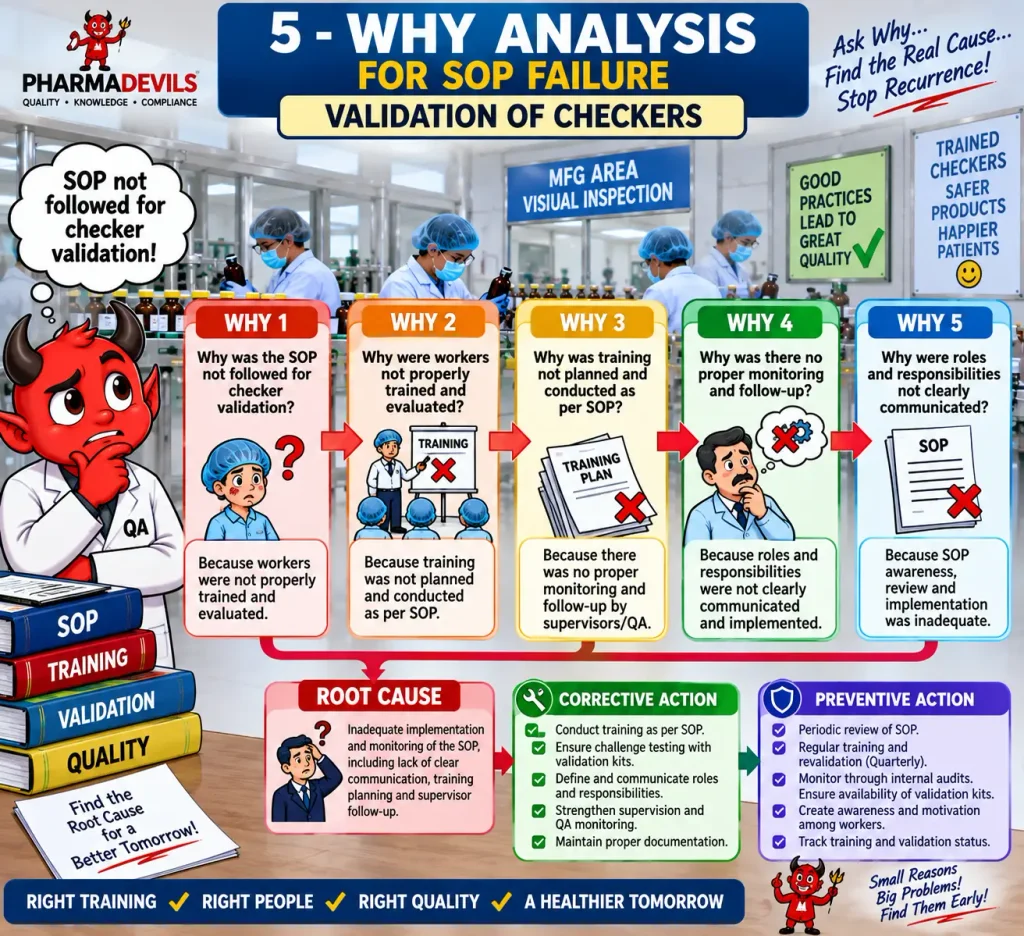
The 5-Why approach therefore helps focus attention on possible implementation gaps such as training, supervision, communication, and follow-up, so that appropriate corrective and preventive actions can be planned. The SOP further requires quarterly revalidation of checkers, supporting continued competency after initial qualification.
6. FISHBONE ANALYSIS FOR SOP FAILURE – VALIDATION OF CHECKERS:
The Fishbone Analysis for SOP Failure – Validation of Checkers diagram organizes possible causes that may contribute to ineffective implementation of the checker-validation procedure. The potential causes are grouped under categories such as Manpower, Machine/Equipment, Method, Material, Management, Measurement, Environment, and People. These are investigation hypotheses shown in the diagram rather than causes explicitly stated in the SOP. The SOP itself requires checker training, documentation of training, retraining, challenge testing, and inspection using validation kits containing known defects. It also requires periodic quarterly revalidation of checkers to maintain inspection capability.
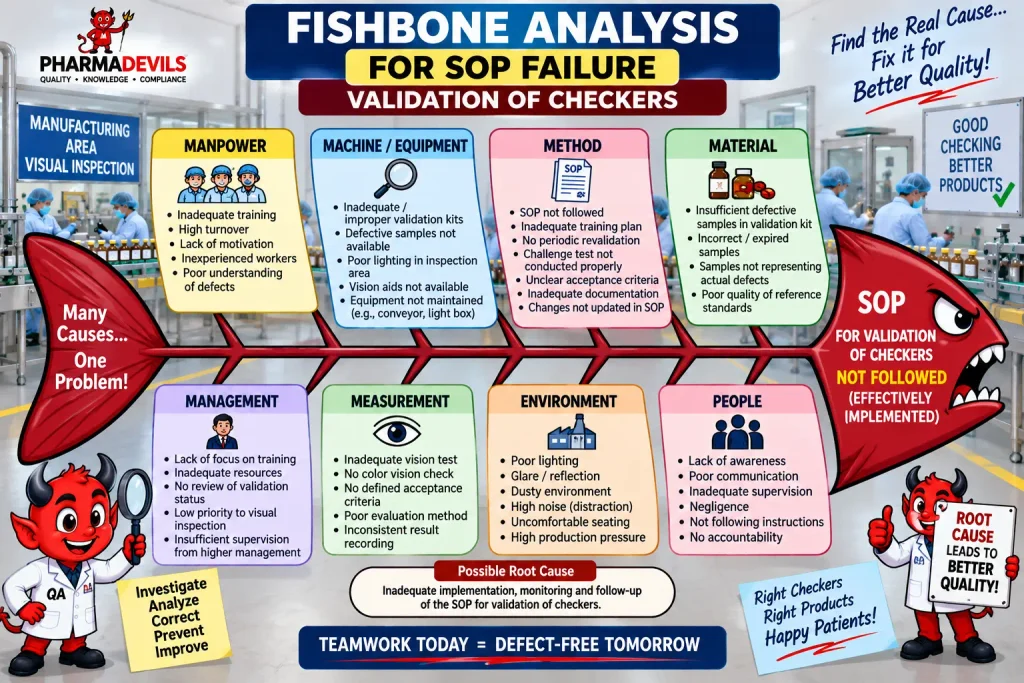
The fishbone diagram therefore helps the investigation team systematically examine possible weaknesses such as inadequate training, insufficient supervision, unsuitable validation samples, poor documentation, inadequate inspection conditions, and ineffective follow-up. This structured approach supports identification of the most likely root cause and selection of appropriate corrective and preventive actions.
7. FAULT TREE ANALYSIS FOR SOP FAILURE – VALIDATION OF CHECKERS:
The Fault Tree Analysis for SOP Failure – Validation of Checkers diagram presents a structured breakdown of the possible events that can lead to ineffective implementation of the checker-validation procedure. The top event is considered as “SOP for Validation of Checkers Not Followed.” From this point, the analysis branches into major failure areas such as unavailability of trained and qualified checkers, challenge testing not being conducted as required, inadequate documentation, and failure to perform periodic revalidation. The SOP requires personnel to be trained, their training to be documented, and challenge tests to be performed using validation kits containing known defects before they are assigned inspection activities. It also requires workers to correctly identify all rejects during evaluation before being appointed for inspection checking.
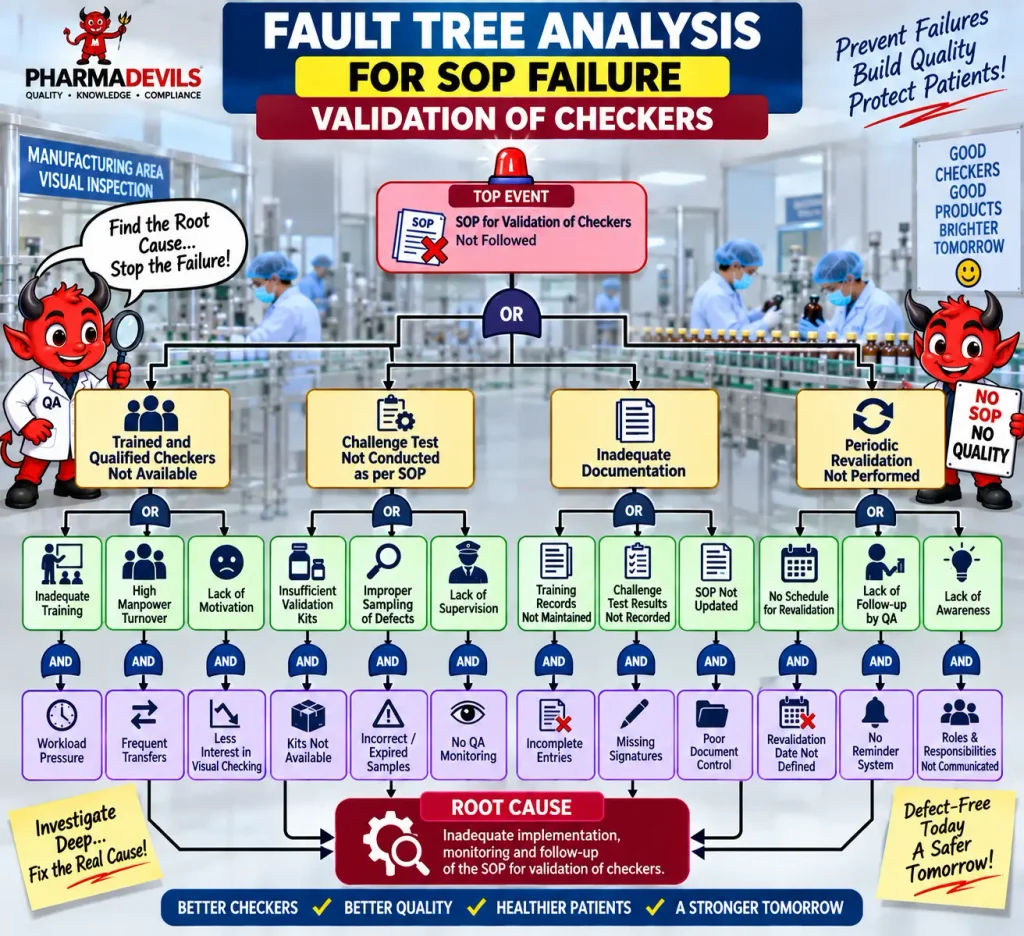
The lower branches of the diagram show potential contributing factors such as inadequate training, manpower turnover, insufficient validation kits, improper defect samples, weak supervision, incomplete records, missing challenge-test results, poor follow-up, and lack of awareness. The SOP further specifies quarterly revalidation, making missed revalidation an important failure path to investigate. Overall, the Fault Tree Analysis helps the investigation team trace the failure from the main event down to possible basic causes so that suitable corrective and preventive actions can be developed.
8. IMPACT ASSESSMENT FOR SOP FAILURE – VALIDATION OF CHECKERS:
The Impact Assessment for SOP Failure – Validation of Checkers diagram illustrates the potential consequences that may arise when the checker-validation procedure is not properly implemented. Possible impacts include reduced product quality, increased risk to patient safety, regulatory non-compliance, higher operational and financial burden, documentation deficiencies, reduced personnel confidence, and damage to organizational reputation. The SOP requires training, documented evaluation, challenge testing with known defects, and successful identification of rejects before a checker is assigned inspection duties. It also requires quarterly revalidation, which helps maintain continued inspection capability.
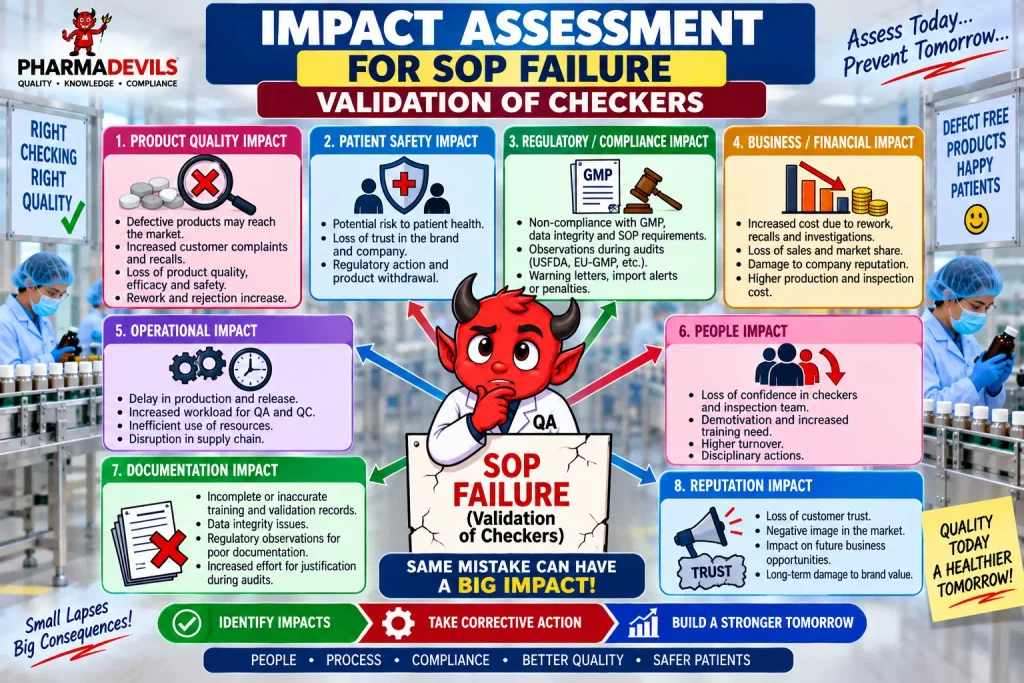
Failure to follow these controls may increase the possibility of defective products or packaging being missed during inspection and may create additional rework, investigation, retraining, and audit concerns. The impact assessment therefore helps QA and Production teams understand the seriousness of SOP non-compliance, prioritize corrective actions, and strengthen the overall checker-validation system.
QUESTIONS & ANSWERS – VALIDATION OF CHECKERS:
Q1. What is the objective of the SOP for Validation of Checkers?
Answer: The objective is to lay down a procedure for validation of personnel performing checking activities.
Q2. Who is responsible for execution of this SOP?
Answer: The Officer/Chemist – Production is responsible for execution of the SOP.
Q3. Who is responsible for effective implementation of the SOP?
Answer: Deputy Manager Production/AGM Production and Head-QA/QC are responsible for effective implementation.
Q4. Who provides training to workers for checker validation?
Answer: Training is imparted to workers by the QA Chemist on the respective checking procedure.
Q5. How is checker training documented?
Answer: The worker’s name and training topic are recorded in the training attendance sheet.
Q6. When is retraining provided to the checker?
Answer: According to the SOP, training is again provided after one month.
Q7. How is the competency of a checker evaluated?
Answer: The QA Chemist conducts a challenge test in which satisfactory units are mixed with known rejects and inspected by the worker.
Q8. When can a worker be appointed for inspection checking?
Answer: The worker can be appointed when he or she successfully identifies all rejects during the challenge test.
Q9. Which sections are covered under checker validation?
Answer: The SOP includes checker validation activities for the Oral Liquid Section, Tablet Packing Section, and Ointment Section.
Q10. What defects are included in the filled-bottle validation kit?
Answer: Defects include black particles, white particles, glass particles, fibers, low volume, and high volume.
Q11. What sealing defects are considered during checker validation?
Answer: The SOP lists defects such as dent, bridge break, threading, and seal cutting.
Q12. What types of tablet defects may be included in the validation kit?
Answer: Examples include sticking, broken or half tablets, capped tablets, black particles, broken edges, black spots, and foreign particles.
Q13. What blister/strip defects are checked during validation?
Answer: The validation kit may include empty pockets or missing tablets, improper stereo impression or smudging, broken or half tablets, extra tablet parts, standing tablets, and black-spot tablets.
Q14. What defects are considered for Lami tubes?
Answer: The SOP includes defects such as torn/dented tubes, color variation, foreign particles, sealing defects, cap defects, text-matter defects, leakage, crimping defects, and ‘I’ marking alignment defects.
Q15. How frequently should a checker be revalidated?
Answer: The checker should be revalidated quarterly in a year.
Q16. What eyesight requirement is specified for checker validation?
Answer: The SOP specifies eyesight of 20/20 (6/6) with no color-blindness symptoms.
Q17. What are the Inspector Reliability Test acceptance criteria?
Answer: The SOP specifies Specificity >0.9, Sensitivity >0.7, Positive Predictive Value >0.8, Negative Predictive Value >0.9, and an Accuracy score stated as >350 in the source document.
Q18. Why is periodic checker revalidation important?
Answer: Within this SOP, quarterly revalidation provides a recurring check that personnel continue to meet the defined checker-validation requirements before continuing inspection activities.
REFERENCE GUIDELINE – VALIDATION OF CHECKERS:
- Checker Validation Planner – prepared as per the applicable approved format number.
- Qualification Protocols and Reports for filled blister, tablet sorting, coated tablets, labeled bottles, empty bottles, PP caps, filled bottles, and Lami tubes are maintained as SOP annexures.
- Lists of Certified Visual Inspectors are maintained separately for the Tablet, Liquid, and Ointment sections.
- Standard Operating Procedure – Validation of Checkers should be followed for training, challenge testing, qualification, acceptance criteria, and periodic revalidation of personnel.