







1. Introduction – Zero Reading and Calibration of Weighing Scales:
Accurate weighing is essential in pharmaceutical operations because errors in weight measurement can directly affect material dispensing, manufacturing accuracy, in-process control, and product quality. The SOP for Zero Reading and Calibration of Weighing Scales establishes a systematic procedure for checking the zero reading and performing calibration of weighing scales used in the warehouse, production, and quality control departments. It defines requirements related to weighing capacity, standard calibration weights, calibration frequency, and acceptable tolerance limits. Before use, the weighing scale should be clean, properly leveled, switched on sufficiently in advance, and verified for correct zero indication. Zero-reading checks help identify problems caused by improper leveling, mechanical or electronic defects, an unclean platform, or obstruction of platform movement. Calibration with appropriate standard weights confirms that the weighing scale provides reliable and consistent results before it is used for GMP activities.
Skip to PDF content2. Flow Diagram – Zero Reading and Calibration of Weighing Scales:
The flow diagram illustrates the systematic sequence for zero reading verification and calibration of weighing scales used in pharmaceutical operations. The process begins by cleaning the weighing platform, checking the level with a spirit level, switching on the balance, and confirming that the display shows zero. Any zero error should be corrected using the zero key or through maintenance before use.
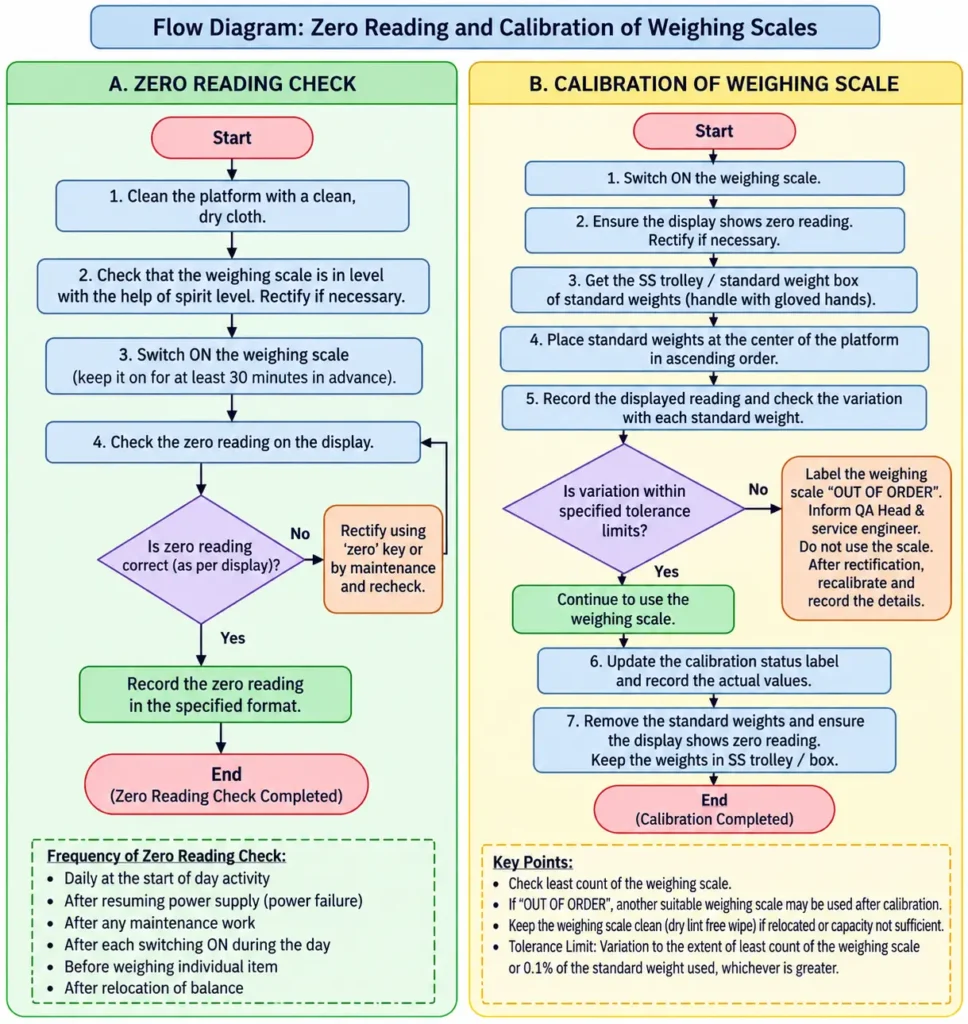
For calibration, the weighing scale is switched on, the zero display is verified, and appropriate standard weights are placed at the center of the platform in ascending order. The displayed values are recorded and compared with the specified tolerance limits. If results are acceptable, the scale may continue in use and the calibration status label is updated. If results are outside limits, the scale is labeled “OUT OF ORDER,” reported to responsible personnel, rectified, and recalibrated before reuse. This flow ensures accurate, traceable, and controlled weighing operations.
3. Benefits of Following SOP – Zero Reading and Calibration of Weighing Scales:
Following the SOP for Zero Reading and Calibration of Weighing Scales helps ensure accurate, consistent, and reliable weighing results across warehouse, production, and quality control activities. Regular zero verification helps identify errors caused by improper leveling, platform contamination, mechanical defects, or electronic malfunction before weighing is performed. Routine calibration using appropriate standard weights confirms that the weighing scale is operating within specified tolerance limits. Recording actual calibration values and updating the calibration status label provide documented evidence of equipment suitability and traceability.
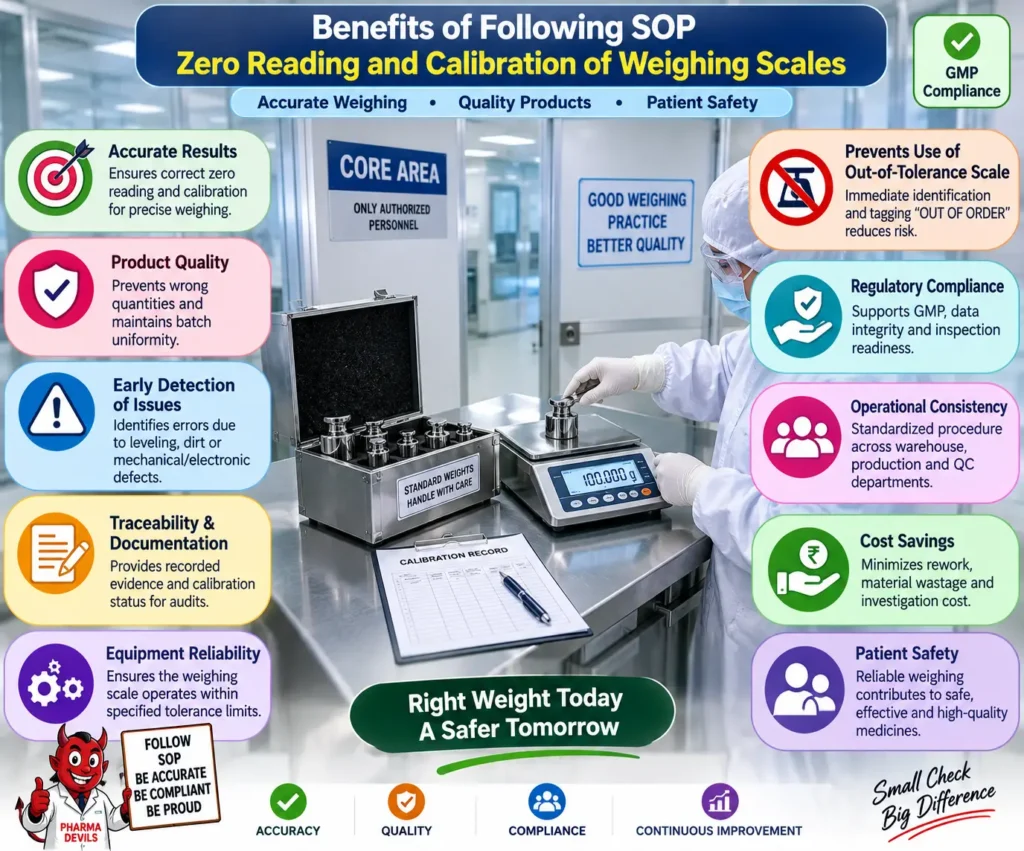
The SOP also ensures that an out-of-tolerance scale is immediately identified as “OUT OF ORDER” and is not used until rectification and recalibration are completed. This reduces the risk of weighing errors, incorrect material quantities, process variation, and unreliable analytical or manufacturing results. Overall, SOP compliance strengthens equipment control, documentation practices, operational consistency, and confidence in weighing activities.
5. 5-Why Analysis for SOP Failure – Zero Reading and Calibration of Weighing Scales:
The 5-Why Analysis identifies the underlying reasons for failure to follow the SOP for zero reading and calibration of weighing scales. The problem begins when the required zero reading and calibration checks are not performed before use. The first contributing reason is that the operator starts weighing without confirming the balance status or calibration schedule.
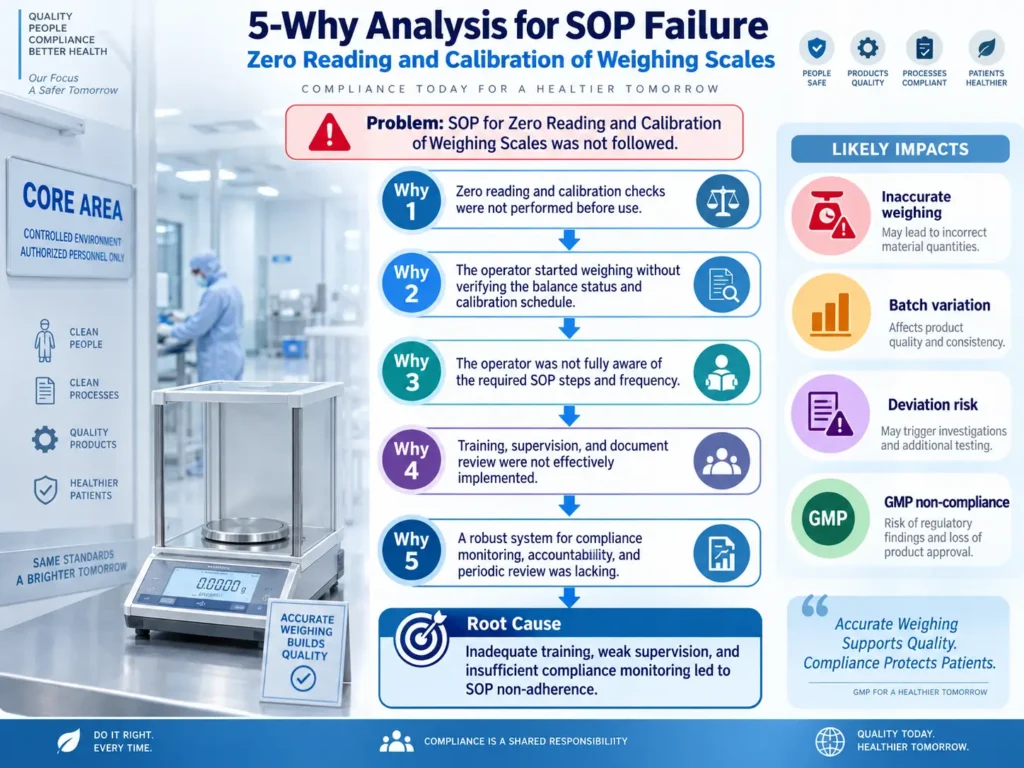
This may occur because the operator is not fully aware of the required SOP steps and checking frequency. Further investigation may reveal inadequate training, insufficient supervision, and ineffective review of weighing-scale records. Ultimately, the root cause can be linked to weaknesses in the compliance-monitoring system, accountability, periodic review, and reinforcement of SOP requirements. The SOP itself requires zero-reading verification before weighing and defines specific calibration activities and frequencies. Failure to follow these controls can increase the risk of inaccurate weighing, process variation, deviations, and GMP non-compliance.
6. Fishbone Analysis for SOP Failure – Zero Reading and Calibration of Weighing Scales:
The Fishbone Analysis identifies potential causes for failure to follow the SOP for zero reading and calibration of weighing scales. The diagram groups contributing factors under Man, Machine, Method, Material, Measurement, Environment, and Management. Personnel-related causes may include inadequate training, lack of SOP awareness, poor supervision, or hurried working. Equipment-related factors include improper leveling, mechanical or electronic defects, an unclean platform, and faulty zero indication.
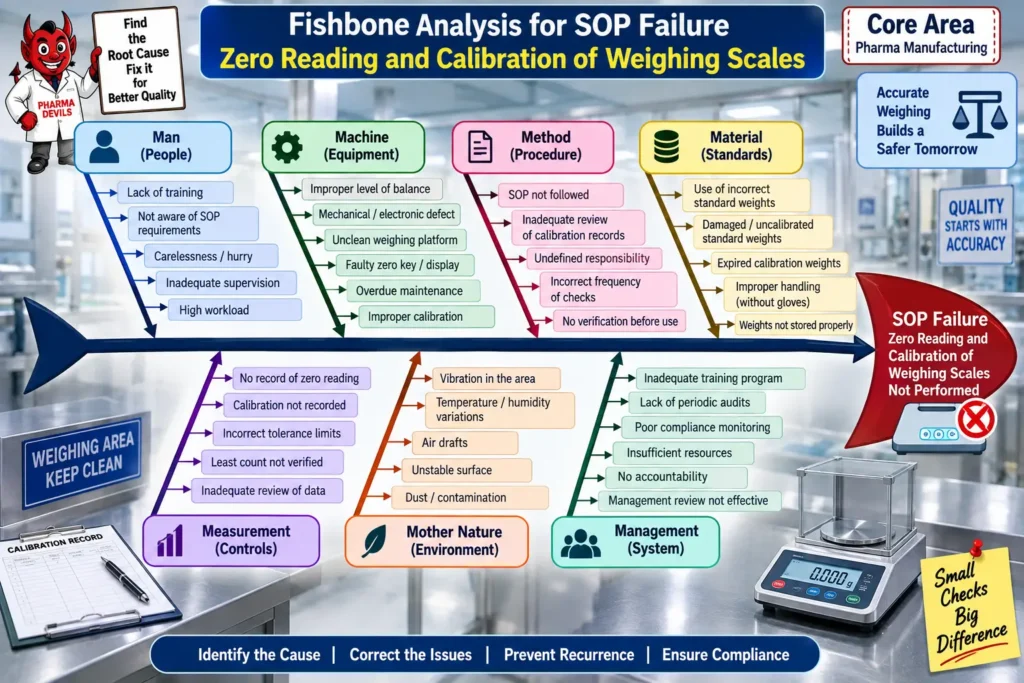
these potential zero-reading errors are specifically recognized in the SOP. Method-related failures include missing pre-use verification or failure to follow the defined calibration sequence. Standard-weight issues may involve improper handling or unsuitable weights. Measurement failures can include missing records, incorrect tolerance assessment, or failure to verify least count. The SOP requires calibration results to be recorded, tolerance limits checked, and unacceptable scales removed from use. This analysis supports systematic root-cause identification and corrective action.
7. Fault Tree Analysis for SOP Failure – Zero Reading and Calibration of Weighing Scales:
The Fault Tree Analysis (FTA) identifies the possible pathways that can lead to failure of the SOP for Zero Reading and Calibration of Weighing Scales. The top event is failure to perform or adequately control zero verification and calibration activities before use. Major contributing branches include failure to confirm zero reading, calibration not being performed as required, use of a weighing scale outside the specified tolerance, and inadequate supervisory control. The SOP requires the platform to be clean, the scale to be properly leveled, and the zero reading to be verified before use.
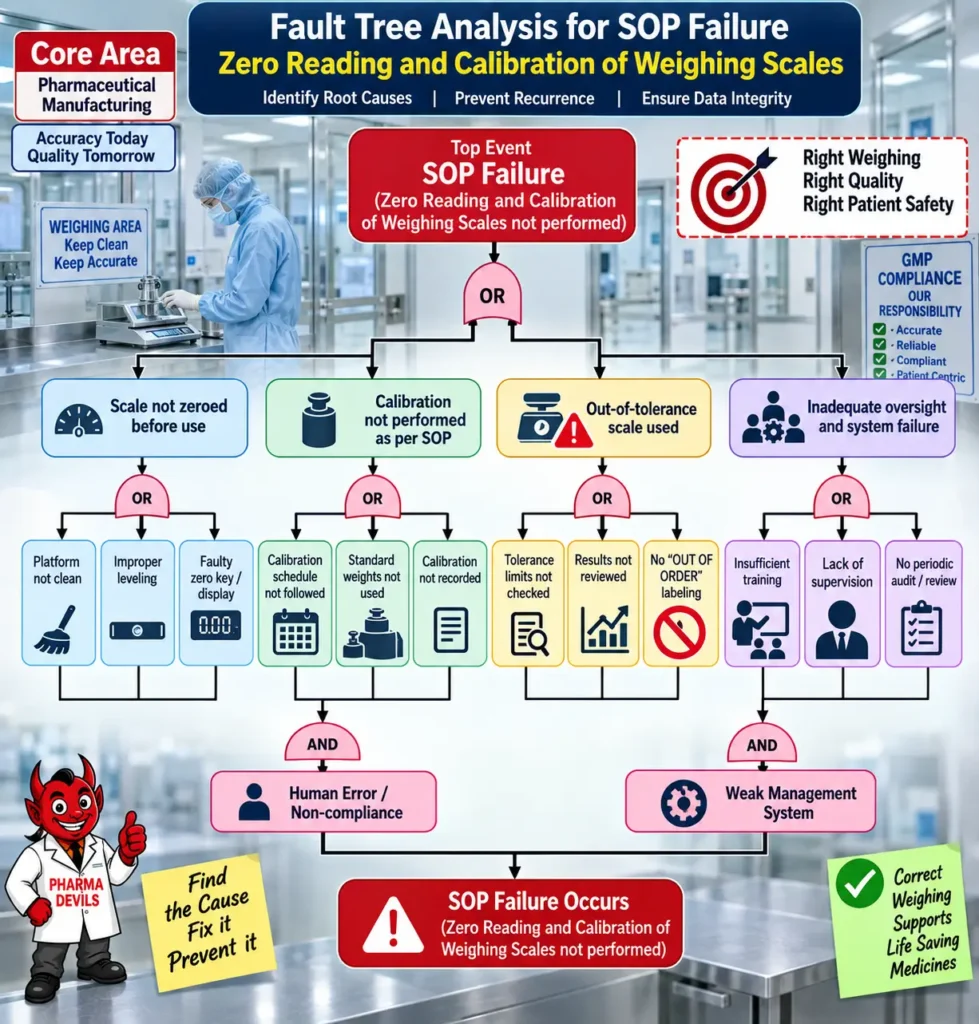
Calibration-related failures may arise when standard weights are not correctly used, results are not recorded, tolerance limits are not evaluated, or an unacceptable balance remains in service. The SOP requires out-of-tolerance scales to be labeled “OUT OF ORDER,” rectified, and recalibrated before reuse. FTA helps identify critical failure points and supports effective corrective and preventive actions.
8. Impact Assessment – SOP Failure in Zero Reading and Calibration of Weighing Scales:
The Impact Assessment shows the potential consequences of failing to follow the SOP for zero reading and calibration of weighing scales. Incorrect zero verification or inadequate calibration may result in inaccurate weighing, incorrect material quantities, process variability, and unreliable manufacturing or quality-control results. Such failures can affect product quality through potency variation, out-of-specification results, rework, or batch rejection. The SOP requires calibration results to be evaluated against specified tolerance limits and any unacceptable weighing scale to be labeled “OUT OF ORDER” until rectification and recalibration are completed.
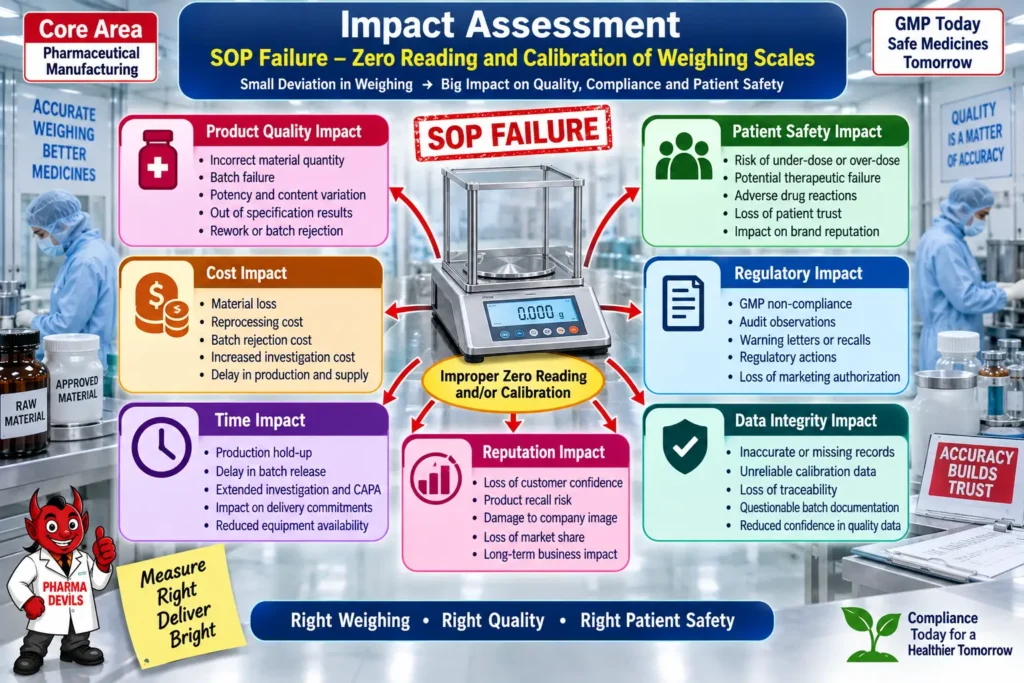
The assessment also highlights possible impacts on compliance, documentation, cost, production timelines, data reliability, and organizational reputation. Missing or inaccurate calibration records may reduce traceability and audit confidence. Overall, effective zero checks and calibration controls help maintain accurate weighing, reliable documentation, consistent operations, GMP compliance, product quality, and patient safety.
Questions & Answers – Zero Reading and Calibration of Weighing Scales:
- What is the objective of this SOP?
To provide a detailed procedure for checking zero reading and calibration of weighing scales used in warehouse, production, and quality control departments. - Who is responsible for executing the SOP?
Officer/Chemist-QA and the concerned person are responsible for execution of the SOP. - How long should the weighing scale be switched on before use?
The weighing scale should be switched on at least 30 minutes in advance to obtain accurate results. - Why is zero reading checked?
Zero reading indicates proper functioning of the weighing scale and helps prevent erroneous weighing results. - What can cause a zero-reading error?
Possible causes include improper leveling, mechanical or electronic defects, an unclean platform, or extraneous matter interfering with platform movement. - What should be done before checking zero reading?
Clean the platform, verify leveling using a spirit level, switch on the weighing scale, and then check the zero display. - When should zero reading be checked?
It should be checked at the start of the day, after power restoration, after maintenance, after switching on, before individual weighing, and after relocation of the balance. - How is calibration performed?
The scale is switched on, zero verified, standard weights obtained, and the weights are placed at the center of the platform in ascending order. Displayed readings are recorded and compared with tolerance limits. - How should standard weights be handled?
Standard weights should be handled with gloved hands during calibration. - What should be done if calibration results are within tolerance?
The weighing scale may continue to be used, and the calibration status label and actual values should be updated and recorded. - What should be done if calibration is outside tolerance?
Label the scale “OUT OF ORDER,” inform the Department Head, Quality Assurance, and service engineer, stop using the scale, rectify the error, and recalibrate before reuse. - What is the specified calibration tolerance limit?
The allowed variation is the least count of the weighing scale or 0.1% of the standard weight used, whichever is greater. - What calibration weights are used for scales above 310 g capacity?
The SOP specifies weights corresponding to 20 times the least count, 5%, 50%, and 80% of weighing-scale capacity. - What should be checked after removing the standard weights?
The display should return to zero, and the standard weights should be placed back in the SS trolley or standard-weight box. - Why are calibration records important?
They provide documented evidence that the weighing scale has been checked, found acceptable, and is suitable for use according to the defined SOP requirements.
Reference Guideline – Zero Reading and Calibration of Weighing Scales:
1. In-House Procedure / Internal Quality Management System – The SOP itself specifies “In House” under the reference section and does not cite any external pharmacopoeial or regulatory guideline.