






Brief Description
This Standard Operating Procedure (SOP) describes the method for cleaning HPLC vials and septa used in the Quality Control laboratory. Its purpose is to ensure that vials and septa are properly cleaned, dried, and stored before use, helping to prevent contamination and interference during HPLC analysis. The procedure is the responsibility of the Lab Attendant and QC Chemist.The cleaning process includes rinsing the vials and septa with running tap water, followed by immersion in 0.1% Laboline solution and sonication for 10 minutes. They are then rinsed thoroughly, treated with boiling water, sonicated again, and washed with purified water. After this, the vials and septa are immersed in methanol and sonicated for 10 minutes. Finally, they are dried in an oven at 60°C and stored in a clean container.The SOP also specifies training requirements, document distribution, and revision history controls.
Skip to PDF content1 Flow Diagram:
The flow diagram illustrates the complete cleaning process for HPLC vials and septa in a simple comic-style format using PharmaDevils characters. The process begins by collecting used vials and septa in the washing area, followed by rinsing with running tap water.
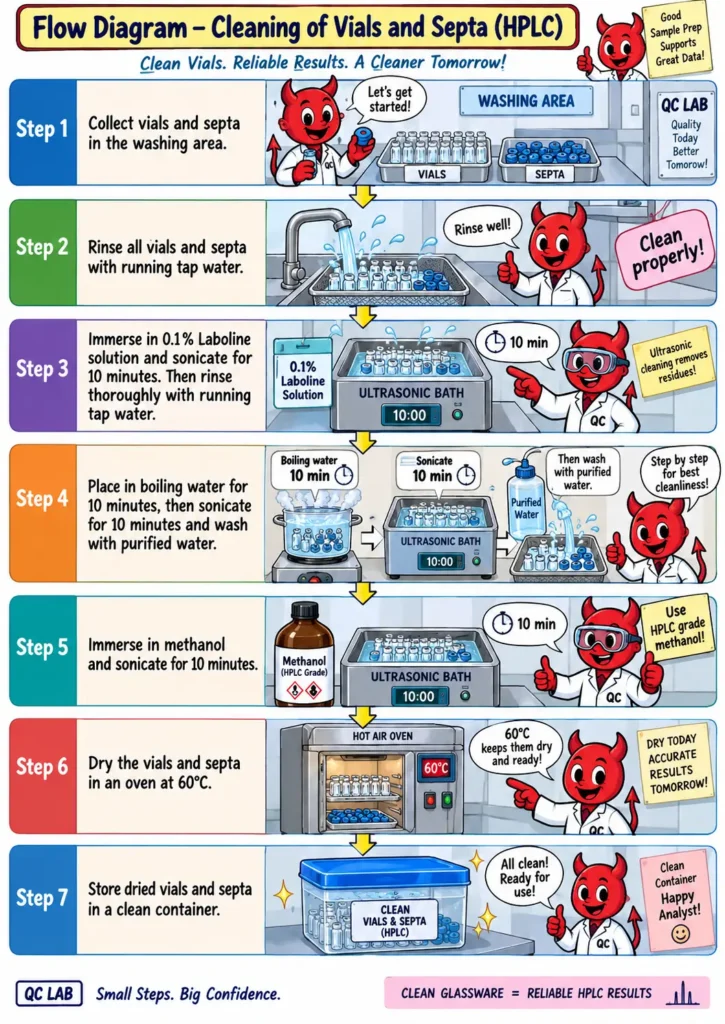
They are then immersed in 0.1% Laboline solution and sonicated for 10 minutes before thorough rinsing. Next, they are kept in boiling water for 10 minutes, sonicated again, and washed with purified water. Afterward, the vials and septa are immersed in methanol and sonicated for 10 minutes. Finally, they are dried in an oven at 60°C and stored in a clean container. This sequence supports consistent cleanliness and reliable HPLC analysis.
2. Brainstorming for SOP Failure:
The brainstorming diagram presents possible reasons for failure of the Cleaning of Vials and Septa (HPLC) SOP in a colorful sticky-note training format. It shows a pharmaceutical trainer guiding PharmaDevils characters to identify potential causes such as lack of training, procedure not followed, improper rinsing, incorrect Laboline concentration, skipped sonication, missed purified-water washing, skipped methanol treatment, incomplete oven drying, use of dirty containers, time pressure, poor supervision, and missing documentation.
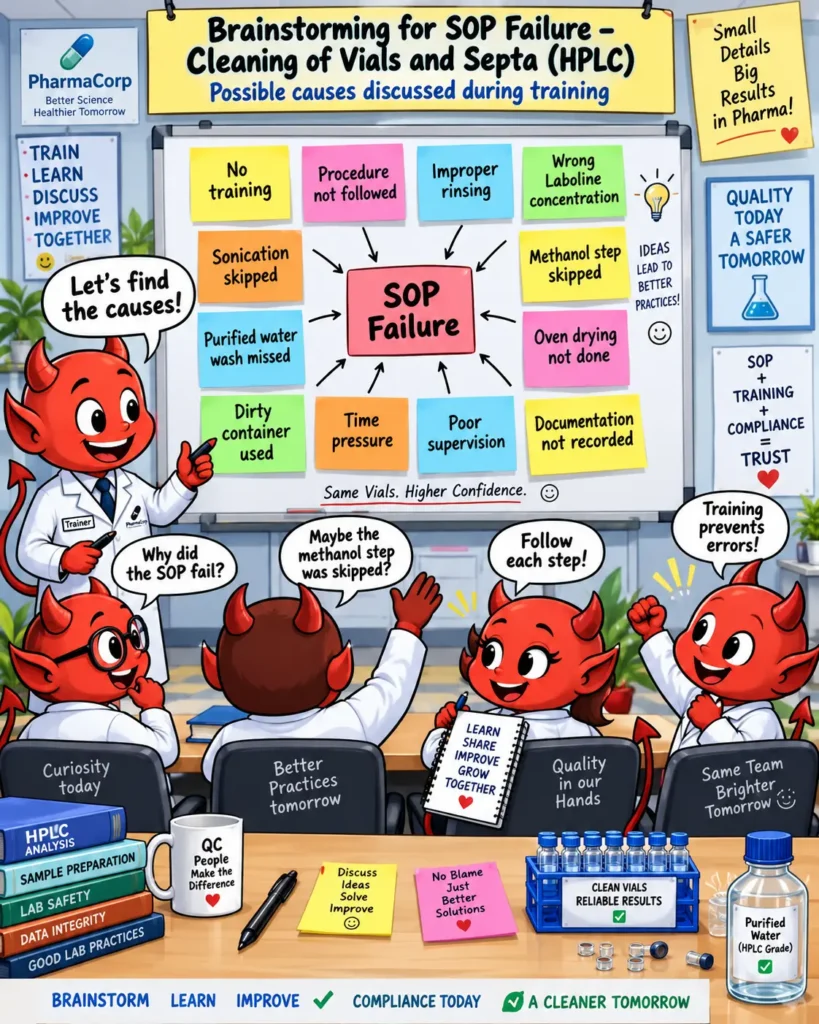
These are brainstorming causes used to support root-cause discussion; the SOP itself defines the required washing, sonication, methanol treatment, drying at 60°C, and clean storage steps.The comic-style training approach encourages team participation, process awareness, and identification of weak points before they lead to analytical errors.
3. 5-Why Analysis for SOP Failure:
The 5-Why analysis identifies the possible root cause behind failure of the Cleaning of Vials and Septa (HPLC) SOP. It starts with the problem that the cleaning procedure was not performed as required. The first why identifies that the cleaning steps were not followed correctly. The second why shows that some steps were skipped or completed inadequately. The third why points toward insufficient operator training and supervision. The fourth why indicates that checklist usage, refresher training, and review were not effective. The fifth why identifies a lack of regular compliance monitoring.
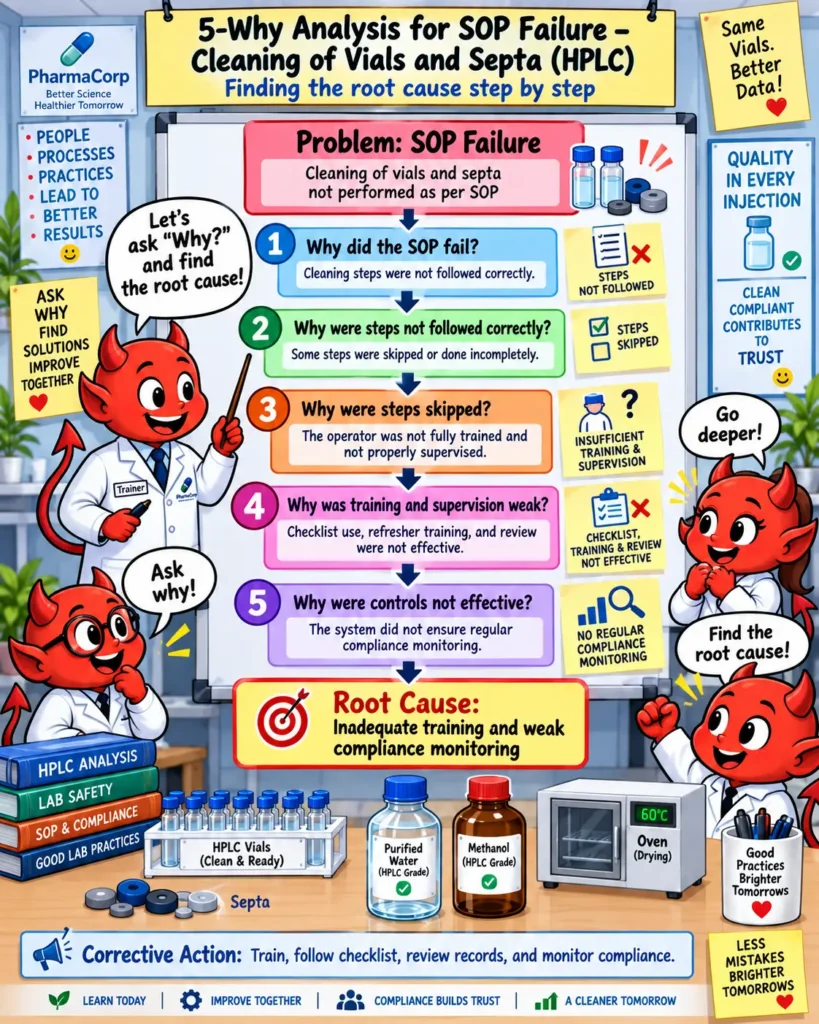
The analysis concludes that the likely root cause is inadequate training and weak compliance monitoring. Corrective actions should therefore focus on effective training, checklist adherence, record review, supervision, and routine monitoring to ensure all SOP cleaning steps are consistently followed.
4. Fishbone Analysis for SOP Failure:
The fishbone analysis diagram identifies possible causes of failure in the Cleaning of Vials and Septa (HPLC) SOP using an aeroplane-themed Ishikawa design. The main problem is that vial and septa cleaning was not performed as required. Potential causes are grouped under Manpower, Method, Machine, Material, Measurement, and Environment.
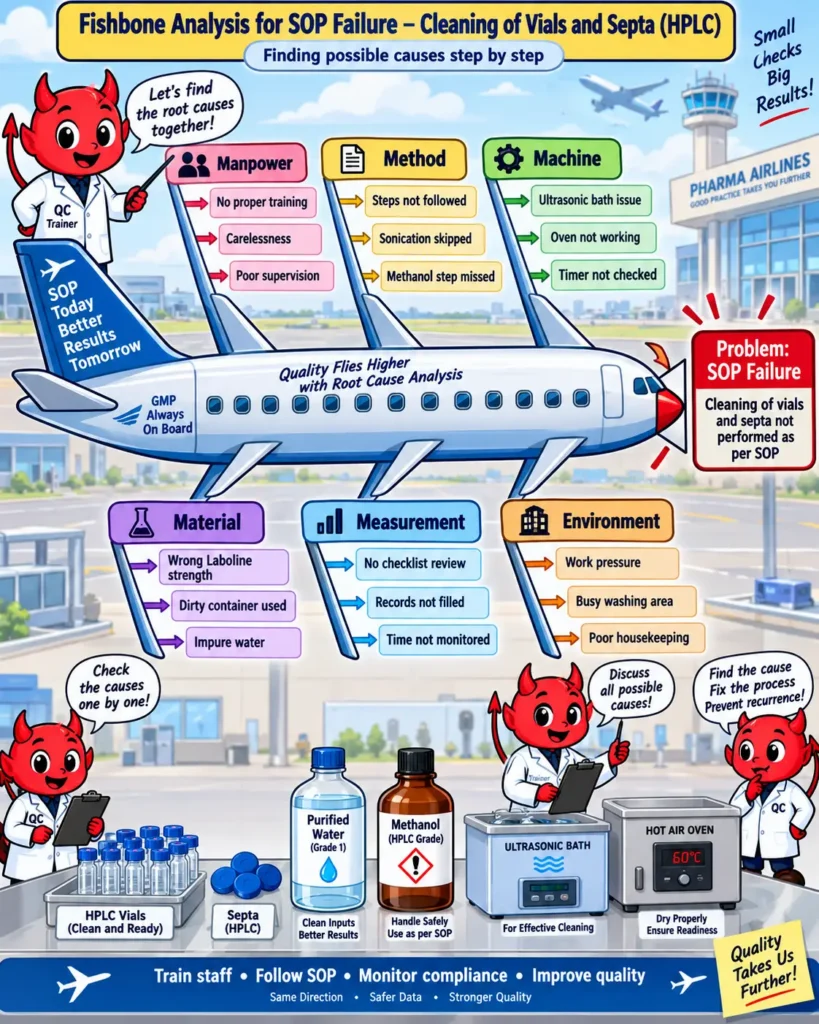
Manpower-related causes include inadequate training, carelessness, and poor supervision. Method issues include skipped sonication, missed methanol treatment, and failure to follow the defined cleaning sequence. Machine causes may involve problems with the ultrasonic bath, oven, or timer. Material-related causes include incorrect Laboline strength, dirty containers, or unsuitable water. Measurement and environmental factors include incomplete records, lack of checklist review, poor time monitoring, work pressure, and housekeeping issues.The analysis helps teams systematically identify contributing factors and supports focused corrective and preventive actions.
5. Fault Tree Analysis for SOP Failure:
The Fault Tree Analysis (FTA) diagram explains possible causes of failure in the Cleaning of Vials and Septa (HPLC) SOP using short, easy-to-understand terms. The top event is “SOP Failure – Vials and Septa not cleaned as per SOP.” The major cause groups include procedure not followed, inadequate cleaning, improper drying/storage, and contamination.
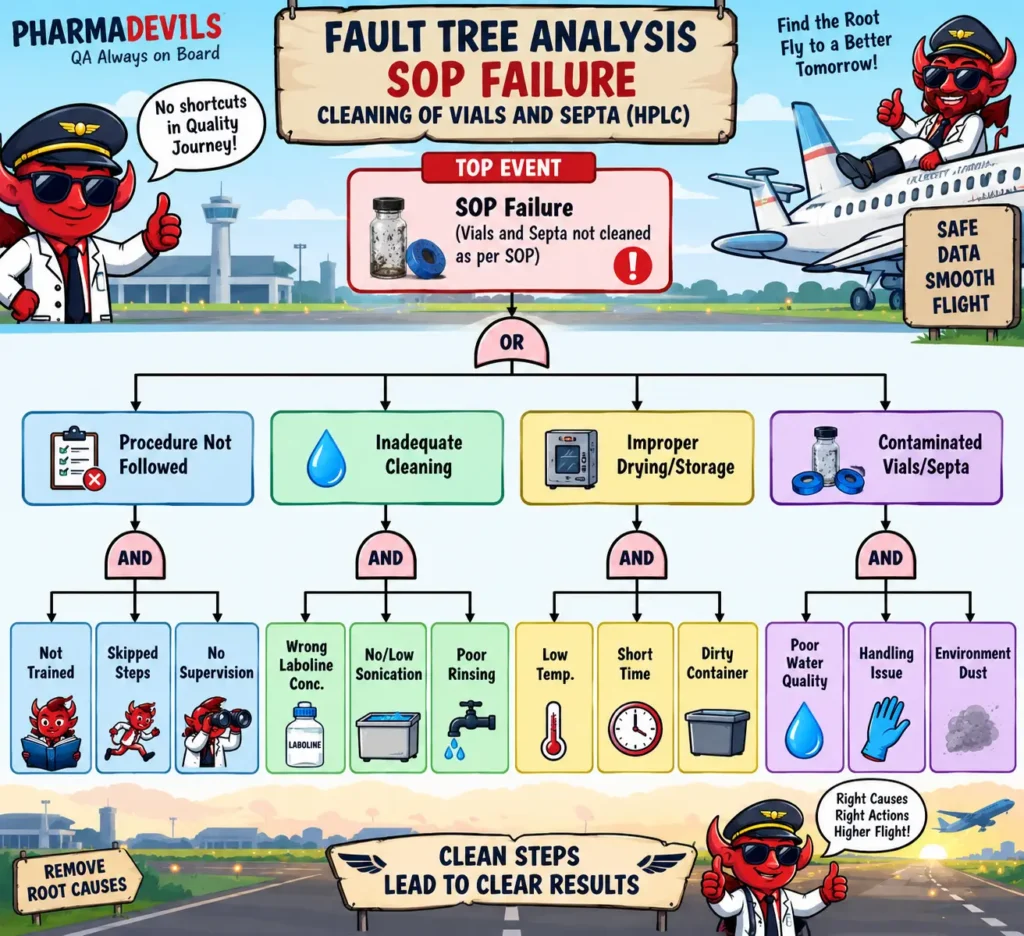
Possible contributing factors include lack of training, skipped steps, poor supervision, incorrect Laboline concentration, insufficient sonication, poor rinsing, low drying temperature, short drying time, dirty containers, poor water quality, handling issues, and environmental dust. The diagram helps the team understand how several small failures can combine to create the final SOP failure.FTA supports root-cause identification and helps define corrective actions such as better training, proper supervision, equipment checks, correct cleaning parameters, and controlled storage.
Questions & Answers – Cleaning of Vials and Septa (HPLC)
- Q: What is the objective of this SOP?
A: To define the procedure for cleaning HPLC vials and septa. - Q: Where is this SOP applicable?
A: It is applicable to the cleaning of HPLC vials and septa in the Quality Control laboratory. - Q: Who is responsible for performing this SOP?
A: The Lab Attendant and QC Chemist are responsible. - Q: What is the first step in cleaning the vials and septa?
A: Keep the vials and septa to be washed in the washing area. - Q: How should the vials and septa be initially rinsed?
A: They should be rinsed thoroughly with running tap water. - Q: What concentration of Laboline solution is used?
A: A 0.1% Laboline solution is used. - Q: How long are the vials and septa sonicated in Laboline solution?
A: They are sonicated for 10 minutes. - Q: What is done after washing with Laboline solution?
A: The vials and septa are kept in boiling water for 10 minutes, then sonicated for 10 minutes, and washed with purified water. - Q: What solvent is used after purified-water washing?
A: The vials and septa are immersed in methanol. - Q: How long are the vials and septa sonicated in methanol?
A: They are sonicated for 10 minutes. - Q: At what temperature are the cleaned vials and septa dried?
A: They are dried in an oven at 60°C. - Q: How are the vials and septa stored after drying?
A: They are kept in a clean container after drying. - Q: Who is the trainer for this SOP?
A: The Manager – Quality Control is the trainer. - Q: Who are the trainees for this SOP?
A: Quality Control personnel and Lab Attendant. - Q: What is the specified training duration?
A: The training period is two hours. - Q: What is the reference mentioned in the SOP?
A: The reference is In House. - Q: Are any enclosures mentioned in this SOP?
A: No. The SOP states Enclosures: Nil. - Q: What does SOP stand for?
A: SOP stands for Standard Operating Procedure. - Q: What does QC stand for?
A: QC stands for Quality Control. - Q: Where is Controlled Copy 1 maintained?
A: Controlled Copy 1 is maintained near the instrument.