






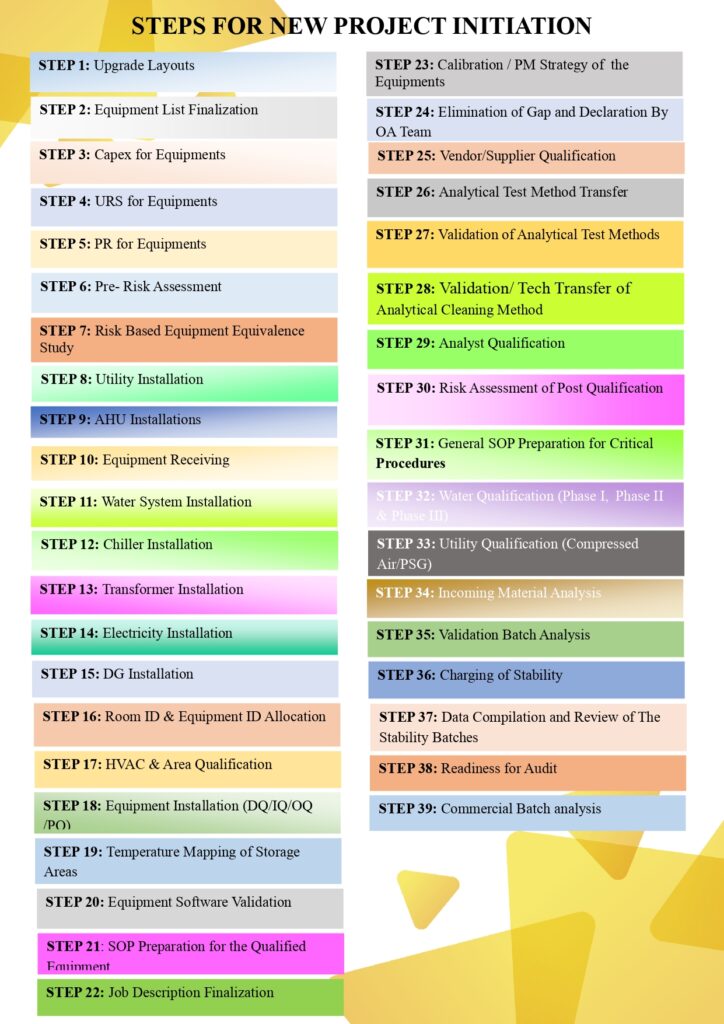
New project initiation in pharma (API, formulation, tech transfer, or facility/utility projects) should follow a structured, GMP- and risk-based pathway so scope, quality, timelines, and compliance are clear from day one.
1) Idea, need, and feasibility
Define the business/medical need, target market, and product concept (dosage form, strength, pack, route). Do an initial feasibility review: availability of API/excipients, IP status, regulatory pathway, manufacturing capability, and high-level cost/timeline.
2) Project charter and governance
Create a Project Charter stating scope, objectives, success criteria, major deliverables, budget estimate, and timelines. Appoint the Project Manager, core team, and steering committee. Establish RACI, communication plan, and meeting cadence.
3) Regulatory and quality strategy
Draft the regulatory plan (country filings, variation strategy, key guidelines). Define QMS requirements: validation approach, data integrity expectations, and documentation structure (protocols, reports, traceability). Confirm whether the project needs clinical batches, exhibit batches, or commercial batches.
4) Define QTPP and CQAs
For product projects, define the Quality Target Product Profile (QTPP) and Critical Quality Attributes (CQAs). Identify critical material attributes (CMAs) and critical process parameters (CPPs) using risk assessment (FMEA).
5) Technical plan and resources
Develop the development plan: formulation/process development, analytical method development/validation, stability plan, packaging development, and scale-up strategy. Confirm facility fit, equipment capacity, utilities, and EHS requirements. Finalize resource plan (people, labs, vendors, CRO/CMO).
6) Risk management and controls
Build the project risk register covering technical, quality, supply chain, regulatory, and schedule risks. Define mitigations, decision points, and change control triggers.
7) Procurement and supplier qualification
Qualify vendors for API, excipients, primary packaging, and critical services. Perform audits or quality agreements where required. Ensure lead times align with the schedule.
8) Detailed schedule and stage gates
Create a Gantt plan with milestones (development batches, method validation, stability pulls, PPQ, submission dates). Establish stage gates (Concept → Feasibility → Development → Scale-up → Validation → Launch) with clear go/no-go criteria.
9) Kick-off and documentation setup
Run a formal kick-off meeting, confirm deliverables, and open controlled documentation (project folder structure, templates, numbering). Ensure every activity is traceable, approved, and inspection-ready.