







1. Introduction to Syrup of Iron and Folic Acid – Batch Manufacturing and Packing Record (BMR/BPR):
Syrup of Iron and Folic Acid is a pharmaceutical oral liquid formulation designed to provide essential nutrients required for red blood cell formation, haemoglobin synthesis, and the prevention and treatment of iron and folic acid deficiency. The formulation contains Iron (III) Hydroxide Polymaltose Complex, equivalent to 50 mg of elemental iron, and Folic Acid IP 0.5 mg per 15 mL, in a flavoured syrup base. The Batch Manufacturing Record (BMR) and Batch Packing Record (BPR) are essential Good Manufacturing Practice (GMP) documents that ensure traceability, consistency, quality, and regulatory compliance throughout the manufacturing and packaging processes. These records provide systematic documentation of raw material dispensing, manufacturing operations, equipment identification, in-process quality checks, filling, sealing, labelling, and final packaging activities. Critical parameters, including product appearance, fill volume, container closure integrity, packaging material reconciliation, and finished product yield, are monitored to maintain product quality. The records also establish accountability through verification and approval by Production and Quality Assurance personnel. Proper documentation, adherence to approved procedures, and compliance with applicable GMP requirements help prevent manufacturing errors, contamination, and product mix-ups. The finished product should be stored below 30°C and protected from light to maintain its quality throughout the designated shelf life.
Skip to PDF contentDescription of Manufacturing and Packing Process Flow for Iron and Folic Acid Syrup
The manufacturing and packing process of Iron and Folic Acid Syrup involves a series of controlled operations designed to ensure product quality, safety, consistency, and compliance with Good Manufacturing Practices (GMP). The formulation contains Iron (III) Hydroxide Polymaltose Complex, equivalent to 50 mg of elemental iron, and Folic Acid IP 0.5 mg per 15 mL. The packing process begins with the receipt and verification of approved bulk syrup from the manufacturing department. Line clearance and equipment cleanliness are verified before initiating filling operations. Approved packaging materials, including bottles, caps, labels, cartons, and shippers, are dispensed according to the Batch Packing Record (BPR).
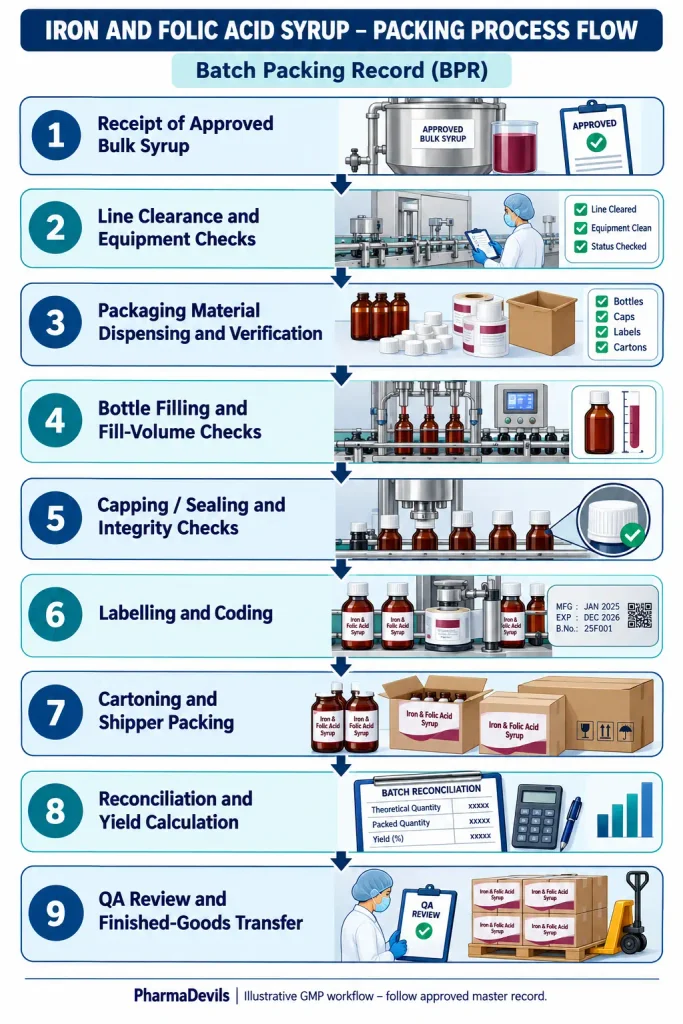
During filling, the syrup is transferred into suitable containers under controlled conditions. Critical parameters such as fill volume, container integrity, and sealing quality are monitored through in-process checks. Following filling and sealing, bottles undergo labelling, batch coding, and secondary packaging. Printed information, including batch number, manufacturing date, and expiry date, is verified for accuracy. The process concludes with packaging material reconciliation, finished product yield calculation, documentation review, and Quality Assurance verification. Proper implementation of these procedures ensures batch traceability, packaging accuracy, product integrity, and regulatory compliance throughout the manufacturing and packing operations.
Critical Process Parameters (CPPs) and Critical Quality Attributes (CQAs) of Iron and Folic Acid Syrup
Critical Process Parameters (CPPs) and Critical Quality Attributes (CQAs) play an essential role in ensuring the consistent quality, safety, efficacy, and regulatory compliance of Iron and Folic Acid Syrup. The formulation contains Iron (III) Hydroxide Polymaltose Complex equivalent to 50 mg elemental iron and Folic Acid IP 0.5 mg per 15 mL. Critical Process Parameters (CPPs) are process variables whose variability may significantly affect product quality and therefore require appropriate monitoring and control. Potential CPPs include mixing time, mixing speed, filling volume settings, filling line speed, capping torque, and sealing parameters. These parameters help maintain product uniformity, accurate dosing, and packaging integrity.
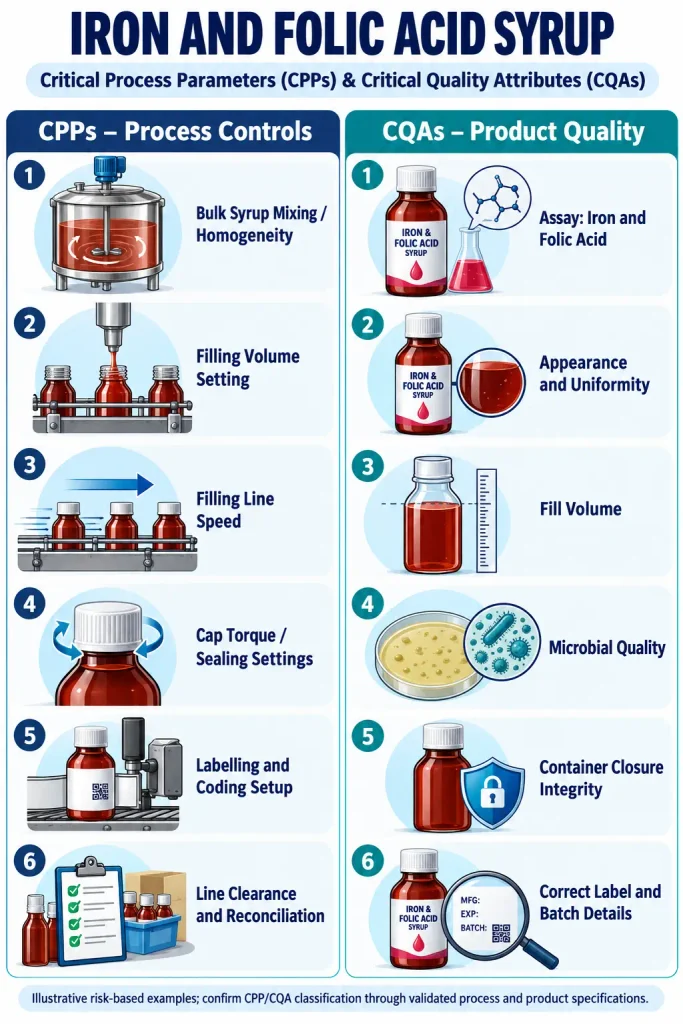
Critical Quality Attributes (CQAs) are physical, chemical, biological, or microbiological properties that must remain within established acceptance limits to ensure the desired product quality. Important CQAs include appearance, assay of iron and folic acid, content uniformity, pH, microbial quality, fill volume, and container closure integrity. During manufacturing and packaging, appropriate in-process controls, calibrated equipment, validated procedures, and documented quality checks help ensure compliance with approved specifications. Effective monitoring of CPPs and CQAs supports process consistency, minimizes batch failures, reduces quality risks, and strengthens GMP compliance.
Note: Final CPP and CQA classifications must be justified through product knowledge, quality risk assessment, process validation, and approved specifications.