





Brief Description
This SOP explains the system for training all personnel involved in manufacturing, testing, packing, storage, distribution, and other pharmaceutical activities. Its main purpose is to ensure that every employee is properly trained before starting work and understands cGMP, safety, SOPs, and job responsibilities. The procedure defines roles of QA, department heads, training coordinators, trainers, and employees. It covers trainer selection and qualification, annual training planning, training need identification, and competency assessment. Different types of training include induction, job-specific, cGMP/technical, on-the-job, refresher, re-training, need-based, self-training, and external training. Training may be conducted through classroom sessions, presentations, videos, demonstrations, workshops, or verbal instructions. After training, employees are evaluated through questionnaires or feedback, and a score below 80% requires re-training. Proper attendance, training records, log cards, competency matrices, and annual training planners are maintained to ensure continuous learning, compliance, and effective performance. This helps maintain employee competence, product quality, regulatory compliance, and safety.
1. Flow Diagram:
Training of personnel is an important part of the pharmaceutical quality system. Its purpose is to ensure that every employee has the required knowledge, skill and understanding before performing assigned work. Training needs are identified according to the employee’s job role, SOPs, responsibilities and competency requirements.
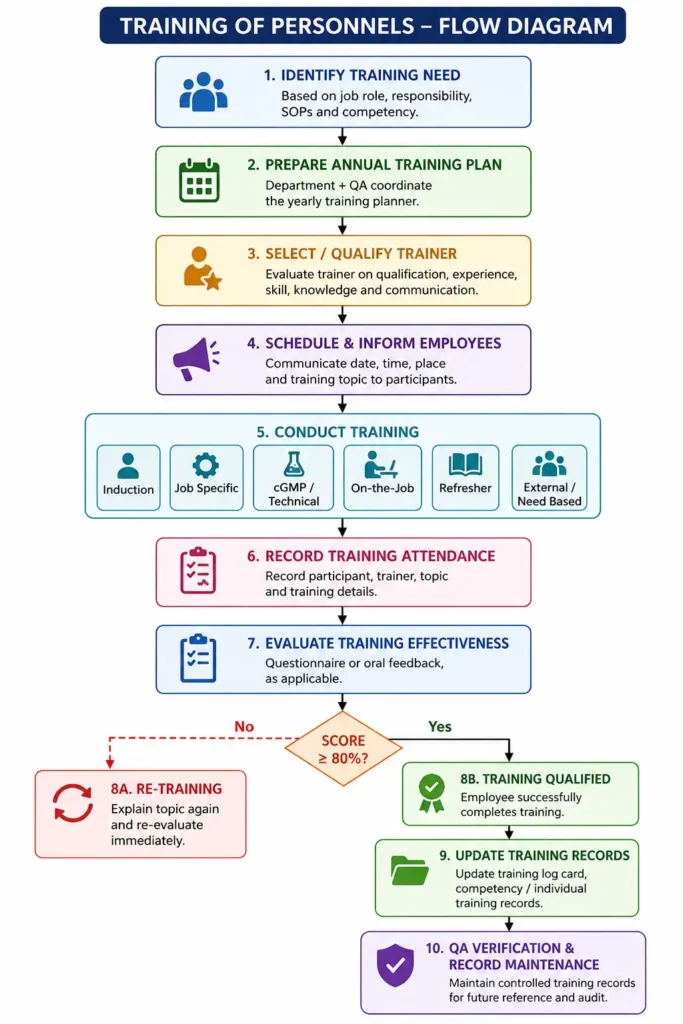
An annual training plan is prepared by the concerned departments in coordination with Quality Assurance. Suitable trainers are selected based on their qualification, experience, technical knowledge and communication skills. Employees may receive different types of training such as induction, job-specific, cGMP/technical, on-the-job, refresher, external and need-based training.
After training, attendance and training details are recorded. Training effectiveness is evaluated through questionnaires or oral feedback. Employees scoring 80% or above are considered qualified. If the score is below 80%, re-training and re-evaluation are required.
Finally, training records are updated and verified by QA to ensure proper documentation, compliance and continued employee competency.
2. Brainstorming for Training of Personnel:
Brainstorming is a simple team-based technique used to collect different ideas for improving the employee training system. In pharmaceutical organizations, effective training is important because every employee should understand their job responsibilities, SOPs, cGMP requirements, safety practices, and quality expectations before performing assigned work. The SOP requires personnel to be trained according to the nature of their job and responsibilities.
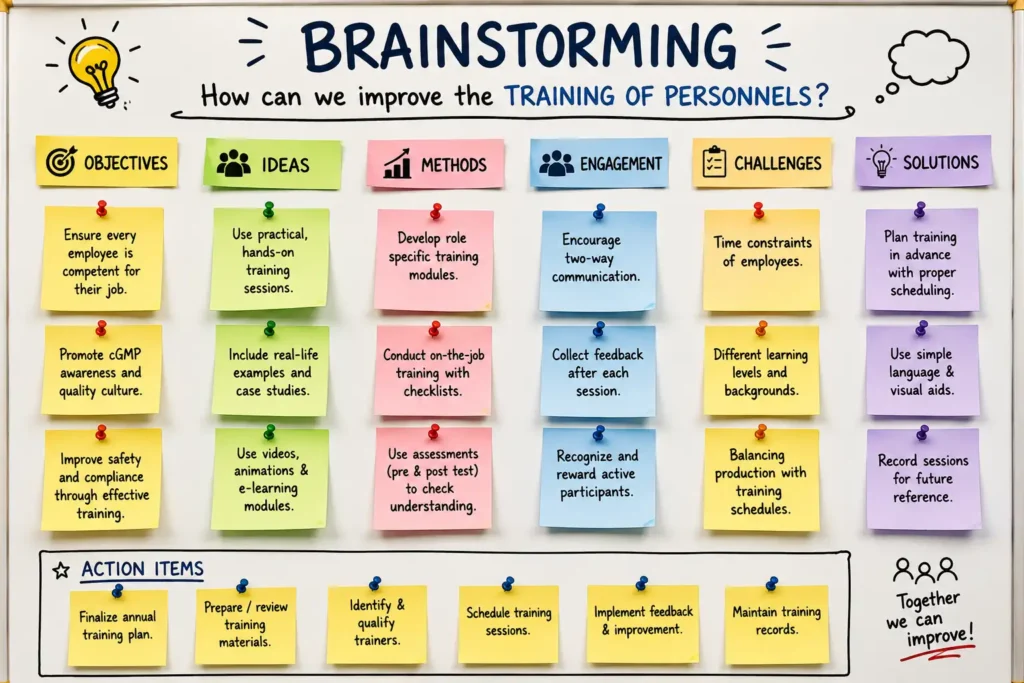
During brainstorming, representatives from departments such as QA, Production, QC, Engineering, Warehouse, HR and EHS can discuss training-related problems and suggest improvements. The training committee itself is intended to include members from these functions.
Typical brainstorming topics may include improving the annual training plan, selecting competent trainers, making training easier to understand, using practical demonstrations, PPTs, videos and case studies, improving employee participation, completing delayed training, and maintaining proper training records. The SOP recognizes different training types such as induction, cGMP/technical, job-specific, on-the-job, refresher and need-based/re-training.
Training effectiveness should also be discussed. Employees may be evaluated through a questionnaire or oral feedback. If the score is less than 80%, re-training and re-evaluation are required.
The final purpose of brainstorming is to identify practical actions that improve employee competency, GMP compliance, training effectiveness, documentation and prevention of repeated human errors. Need-based training may also be initiated following incidents, deviations, OOS, market complaints, OOT, audits or performance issues.
3. 5-Why Analysis – Failure in Training of Personnel:
Problem Statement:
An employee could not understand the training properly and failed the training evaluation.
| Why? | Analysis |
|---|---|
| Why 1 | Why did the employee fail the evaluation? Because the employee did not fully understand the training topic. |
| Why 2 | Why was the topic not understood? Because the training was not sufficiently clear or practical for the employee. |
| Why 3 | Why was the training not suitable? Because the training method/content was not adequately matched with the employee’s job responsibility and competency needs. |
| Why 4 | Why was it not properly matched? Because Training Need Identification and the competency matrix were not adequately reviewed before training. |
| Why 5 | Why was the training need not adequately reviewed? Because the departmental training planning and follow-up process was not effectively controlled. |
Root Cause
Inadequate identification and review of employee-specific training needs before conducting the training.
Corrective and Preventive Actions
- Review and update the Training Need Identification (TNI) according to job responsibilities.
- Update the competency matrix for concerned personnel. The SOP requires training needs to be identified based on job roles and responsibilities.
- Use simple language, demonstrations, PPTs, videos or practical training wherever appropriate.
- Provide training in Hindi/local language for workers who cannot adequately understand English.
- Re-train and re-evaluate employees scoring below 80%.
- Record the completed training and evaluation in the respective training records.
4. Fishbone Diagram (Ishikawa):
A Fishbone Diagram, also called an Ishikawa or Cause-and-Effect Diagram, is used to identify the possible causes of a problem in a structured way. In the case of training failure, the main problem is placed at the head of the fish, while possible causes are grouped into different categories.
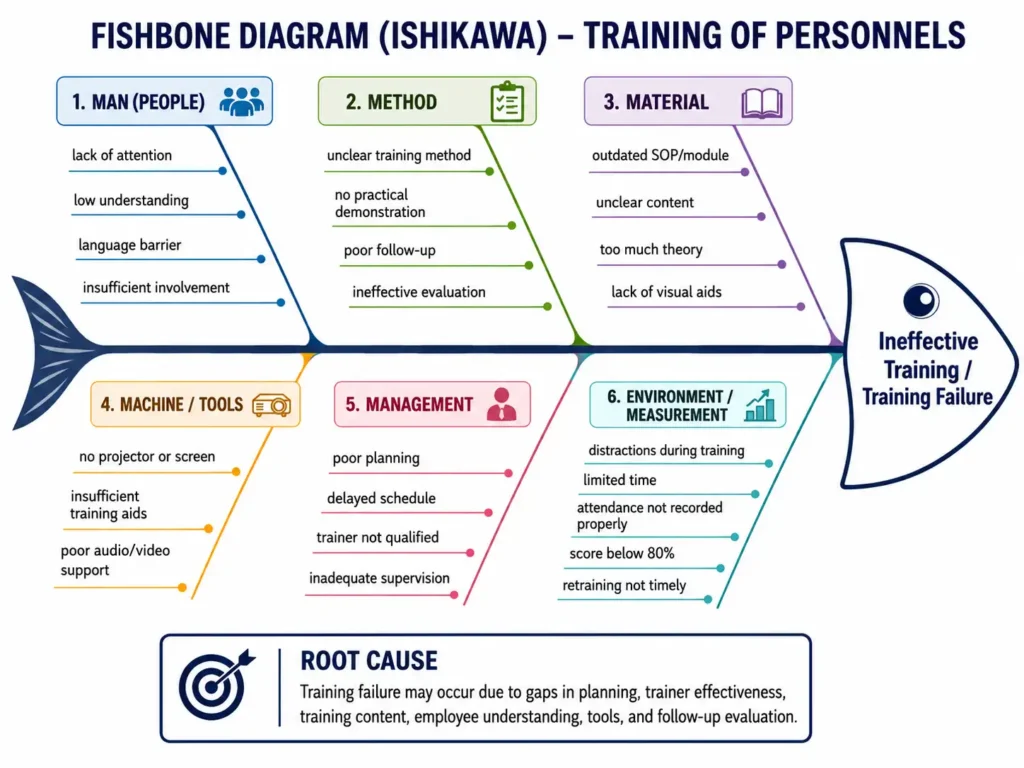
For personnel training, common categories include Man (People), Method, Material, Machine/Tools, Management, and Environment/Measurement. Possible causes may include poor understanding, language barriers, unclear training methods, outdated SOPs, lack of practical demonstrations, inadequate training aids, poor planning, unqualified trainers, limited training time, and ineffective evaluation.
The purpose of the Fishbone Diagram is to help the investigation team consider all possible contributing factors instead of focusing on only one cause. It supports systematic root cause identification and helps develop suitable corrective and preventive actions to improve training effectiveness and prevent recurrence.
5. Brief Description – Fault Tree Analysis (FTA):
Fault Tree Analysis (FTA) is a systematic method used to identify the possible causes that can lead to a specific failure. In the Training of Personnel process, the top event may be defined as “Training Failure” or “Employee Not Competent After Training.” The analysis starts with this main failure and breaks it down into possible contributing causes using logical AND/OR gates.
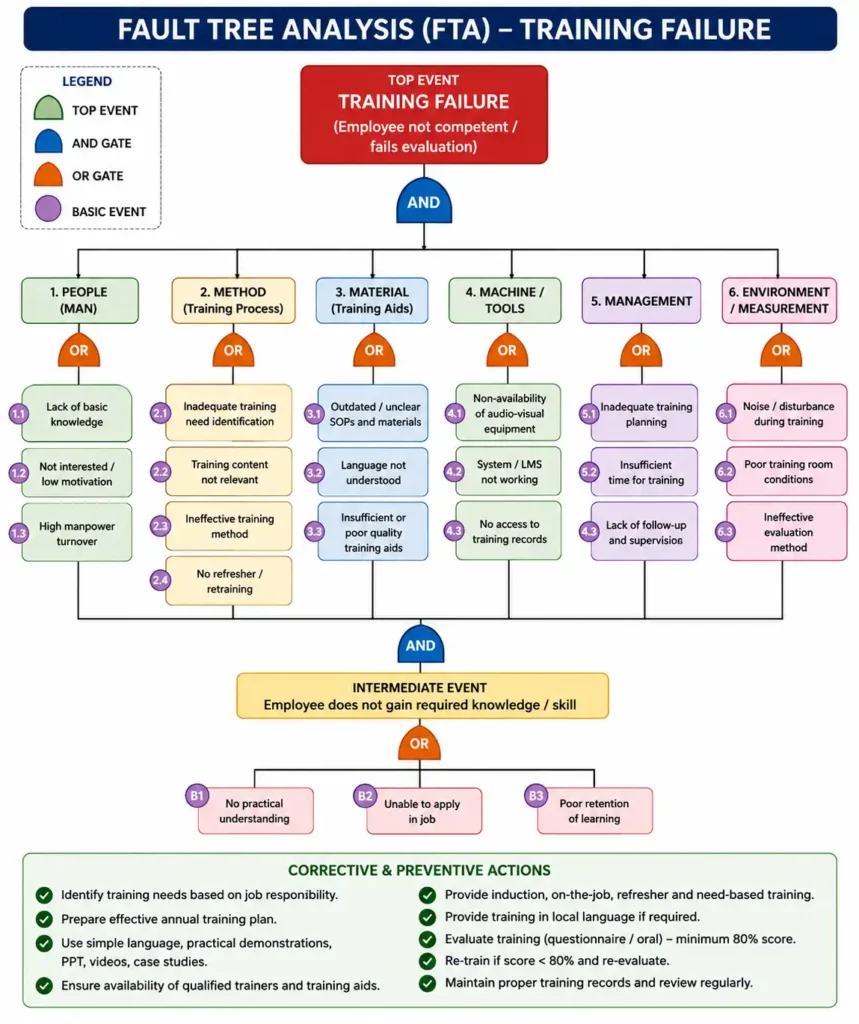
Possible causes may include inadequate training need identification, ineffective training methods, unclear or outdated SOPs, language barriers, insufficient training aids, unqualified trainers, poor planning, limited training time, and ineffective evaluation. These causes are further examined until the basic root causes are identified.
FTA helps the investigation team understand how different failures can combine to affect training effectiveness. It supports appropriate CAPA such as improving training planning, using practical demonstrations, providing suitable training materials, strengthening evaluation, and ensuring timely retraining when required.
6. Failure Mode and Effects Analysis (FMEA):
Failure Mode and Effects Analysis (FMEA) is a systematic risk assessment tool used to identify possible failures in the Training of Personnel process before they lead to problems. It evaluates each training step such as training need identification, annual training planning, trainer selection, training delivery, evaluation, record maintenance, and refresher/re-training.
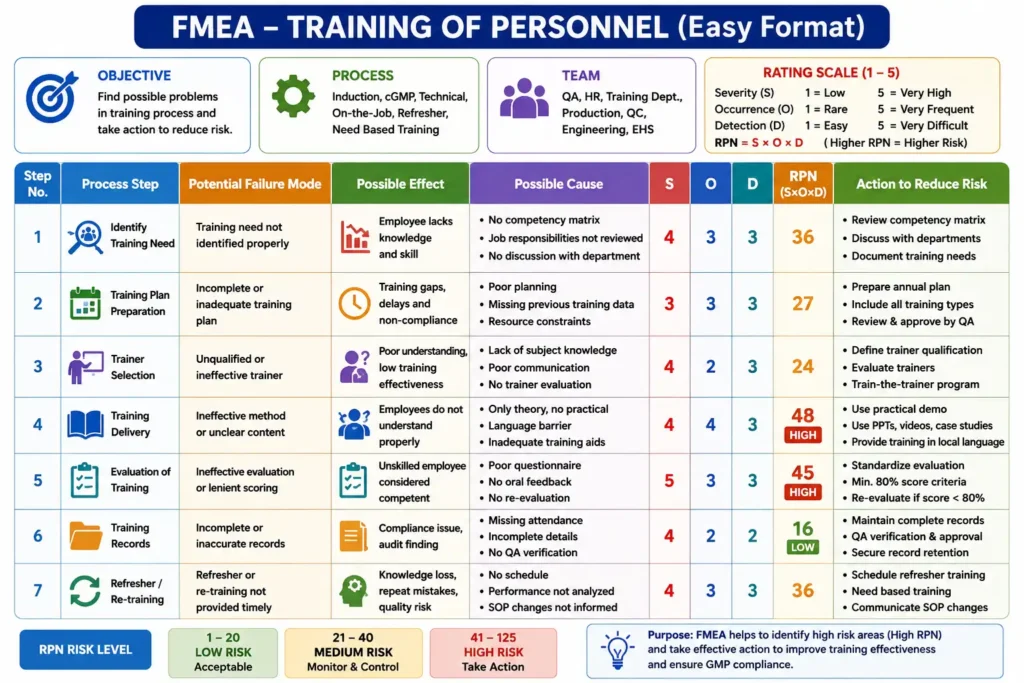
For every possible failure, the effect, cause, Severity (S), Occurrence (O), and Detection (D) are assessed. These values are multiplied to calculate the Risk Priority Number (RPN = S × O × D). Higher RPN values indicate areas requiring greater attention.
FMEA helps identify risks such as ineffective training, poor understanding, incomplete records, unqualified trainers, or delayed re-training. Appropriate actions can then be taken to reduce risk, improve employee competency, strengthen GMP compliance, and ensure effective and well-documented training.
7. Is / Is-Not Analysis:
Is / Is-Not Analysis is a simple investigation tool used to clearly define what is happening and what is not happening in the personnel training process. It helps the team compare the expected training practice with unacceptable or missing practices.
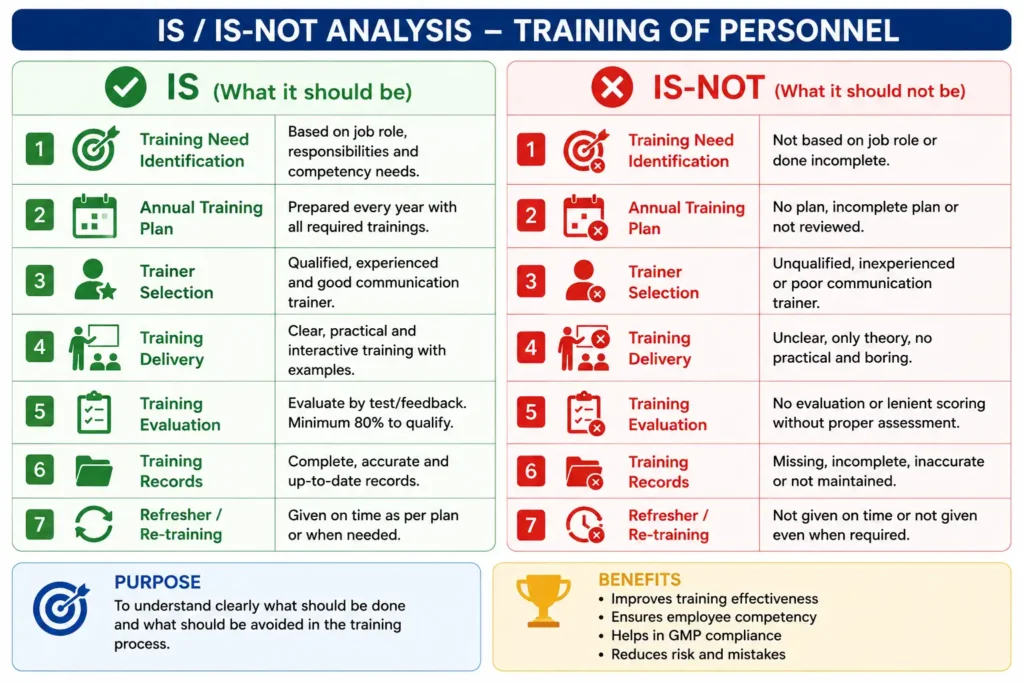
In training of personnel, “IS” includes proper training need identification, annual training planning, selection of qualified trainers, clear and practical training, evaluation of employees, complete training records, and timely refresher or re-training.
“IS-NOT” includes incomplete training needs, missing training plans, unqualified trainers, unclear or only theoretical training, lack of evaluation, incomplete records, and delayed or missed re-training.
This analysis helps narrow down the actual problem, avoid assumptions, and identify the area where the training system is failing. It supports better root cause analysis and helps improve employee competency, training effectiveness, GMP compliance, and documentation.
8. Pareto Chart:
A Pareto Chart is a simple problem-solving tool used to identify the most important causes of training-related issues. It arranges problems from the highest frequency to the lowest frequency using bars, while a cumulative percentage line shows how much each cause contributes to the total problem.
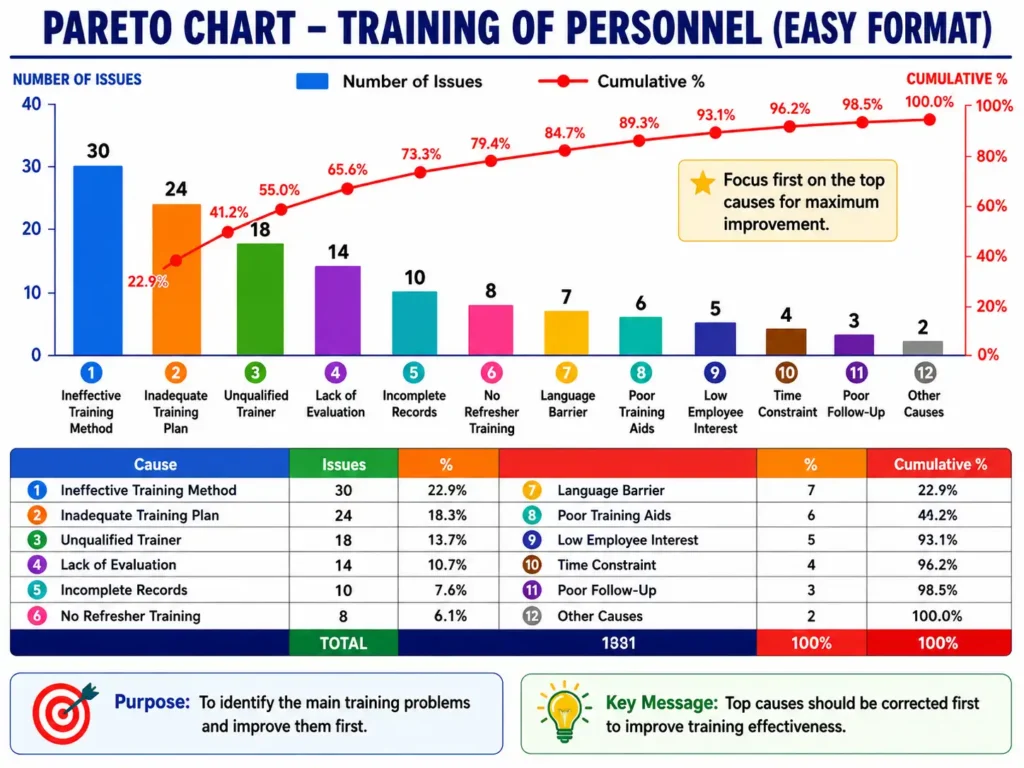
In the Training of Personnel process, common issues may include ineffective training methods, inadequate training planning, unqualified trainers, poor evaluation, incomplete training records, lack of refresher training, language barriers, poor training aids, and weak follow-up.
The Pareto Chart follows the 80/20 principle, which means that a small number of major causes may contribute to most of the problems. By focusing first on the highest bars, the organization can prioritize corrective actions, improve training effectiveness, strengthen employee competency, reduce repeated errors, and support better GMP com;pliance.
9. Timeline Analysis:
Timeline Analysis is an investigation tool used to arrange events in the order in which they happened. In the Training of Personnel process, it helps show when the training need was identified, when the training was planned, conducted, evaluated, recorded, and when any incident or failure occurred.
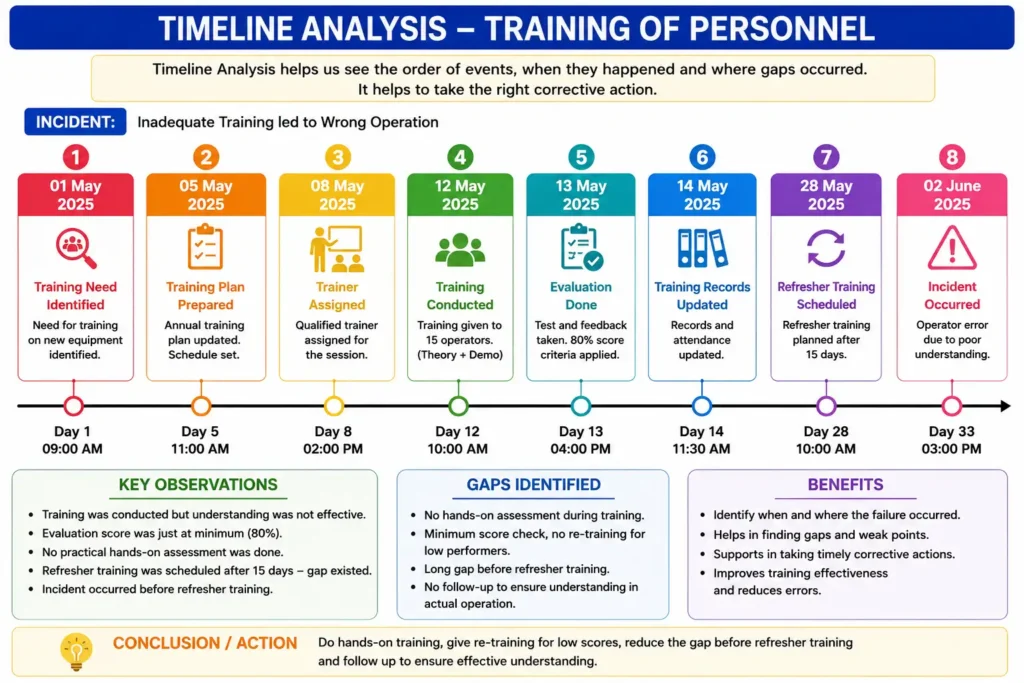
By reviewing the sequence of events, the investigation team can identify delays, missing activities, weak follow-up, late refresher training, or gaps between training and actual job performance. It also helps determine whether an incident occurred before or after proper training and evaluation.
Timeline Analysis makes the investigation easier to understand because it clearly shows what happened, when it happened, and where the gap occurred. This supports identification of the probable root cause and helps define suitable corrective and preventive actions such as timely re-training, practical assessment, improved follow-up, and better training scheduling.
10. Barrier Analysis:
Barrier Analysis is a simple investigation tool used to identify the controls or safeguards (barriers) that should prevent a problem from happening or reduce its impact after it happens. In the Training of Personnel process, barriers are the steps that help ensure employees are properly trained and competent before performing their work.
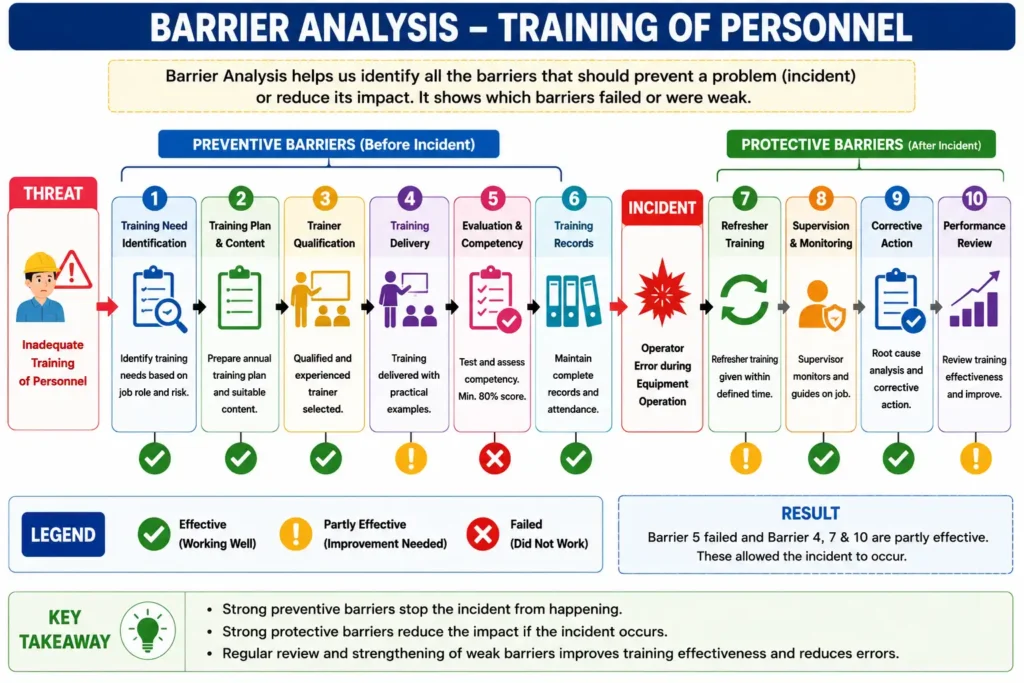
Examples of barriers include training need identification, training planning, trainer qualification, training delivery, evaluation of understanding, maintenance of training records, refresher training, supervision, corrective action, and performance review. These barriers may be effective, partly effective, or failed.
Barrier Analysis helps the team understand which barrier worked, which barrier was weak, and which barrier failed, allowing the incident or training gap to occur. This makes it easier to identify the real weakness in the training system and take corrective action.
Overall, Barrier Analysis helps improve employee competency, training effectiveness, GMP compliance, and prevention of repeated errors.
11. Human Error Analysis:
Human Error Analysis is a simple investigation tool used to understand why a person made a mistake and what factors contributed to it. In the Training of Personnel process, it helps identify whether the error happened because of poor understanding, lack of practice, unclear instructions, weak supervision, work pressure, or an ineffective training system.
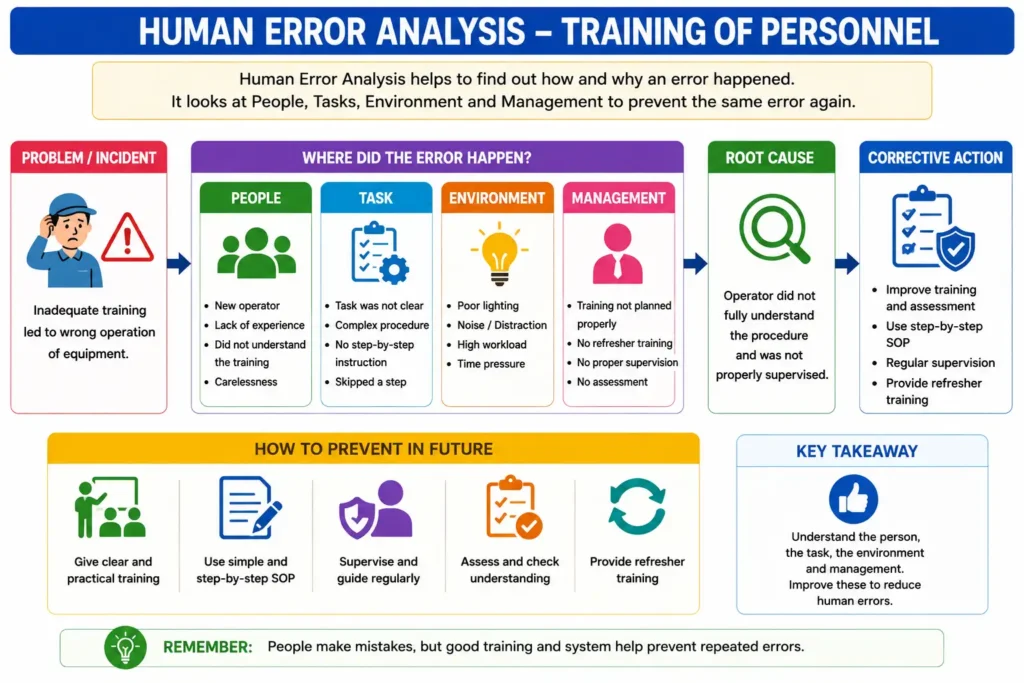
This analysis usually looks at different areas such as person factors, training factors, task factors, workplace conditions, and management factors. It helps determine whether the employee did not understand the procedure properly, followed the wrong step, lacked hands-on practice, or was not given enough guidance and follow-up.
Human Error Analysis is important because it focuses not only on the person, but also on the system behind the error. It helps the organization improve training methods, SOP explanation, supervision, evaluation, refresher training, and overall work practices.
Overall, it supports better employee competency, fewer repeated mistakes, improved compliance, and safer operations.