






Brief Description
The SOP for Trends Preparation for Microbiological Analysis describes the procedure for reviewing, compiling, analysing, and presenting microbiological monitoring data in a systematic trend format. It applies to environment monitoring and water monitoring activities. Monitoring results are entered in Excel, reviewed for individual samples, and subsequently used for trend generation. Environmental monitoring trends are prepared on a quarterly basis, while water monitoring trends are generally prepared monthly. Trend charts include relevant information such as total count or fungal count, department, monitoring technique, sampling location, period, monitoring dates, result values, and applicable alert and action limits. The SOP also requires review of atypical results, excursions, investigations, microorganism identification, seasonal changes, and unusual peaks. A Summary of Trends records sampling points, minimum and maximum total counts, limits, conclusions, and action plans, with preparation, review, and approval by designated personnel.
Skip to PDF content1. Flow Diagram:
The flow diagram describes the systematic process for environmental microbiological monitoring and trend preparation. The process begins with collection of environmental samples according to the approved monitoring schedule and defined frequency. Samples are analysed using the prescribed microbiological method, and results are recorded in the relevant Excel sheet or monitoring record. Each individual result is reviewed for accuracy and compliance before trend preparation.
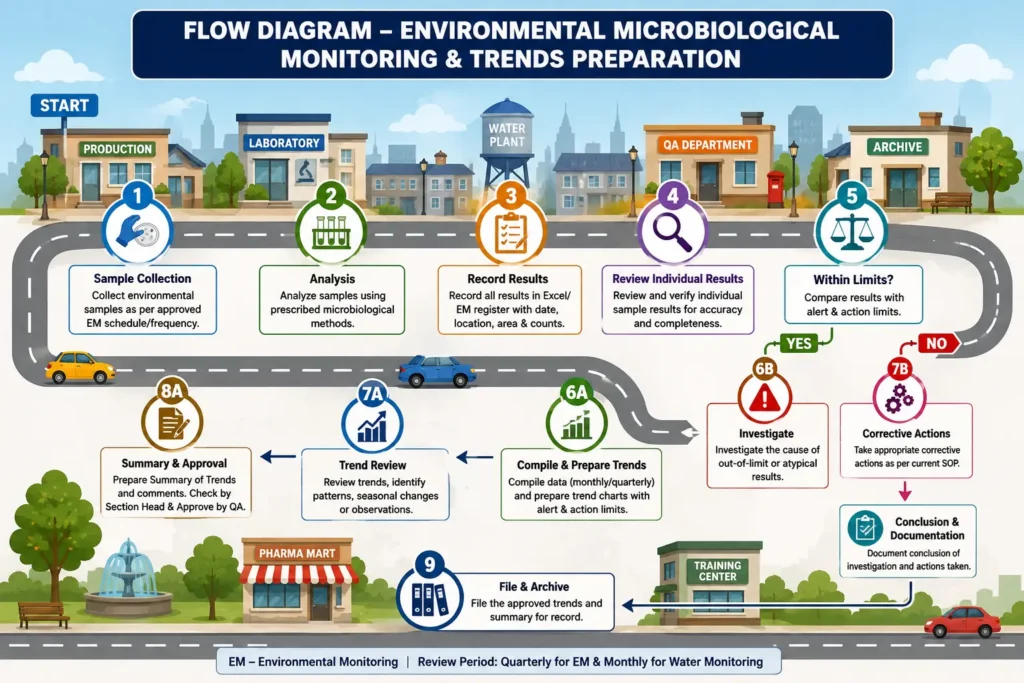
The results are compared with established alert and action limits. If results are acceptable, monitoring data are compiled and environmental trends are prepared on a quarterly basis. Trend charts include sampling dates, result values, locations, total/fungal counts, and applicable limits.If atypical or out-of-trend results are observed, investigation is initiated, conclusions are documented, and appropriate actions are taken. Finally, the trend summary is reviewed, approved, and maintained as an official quality record.
2. Brainstorming for SOP Failure:
The brainstorming diagram presents the possible reasons for failure of the SOP for Environmental Microbiological Monitoring and Trends Preparation in a simple government-school classroom style. It highlights key failure points such as missed monitoring schedules, improper sample collection, incorrect or incomplete data entry, inadequate review of individual results, delayed trend preparation, and missing alert or action limits. The SOP requires monitoring according to the approved schedule, proper recording of results, and review before trend generation.
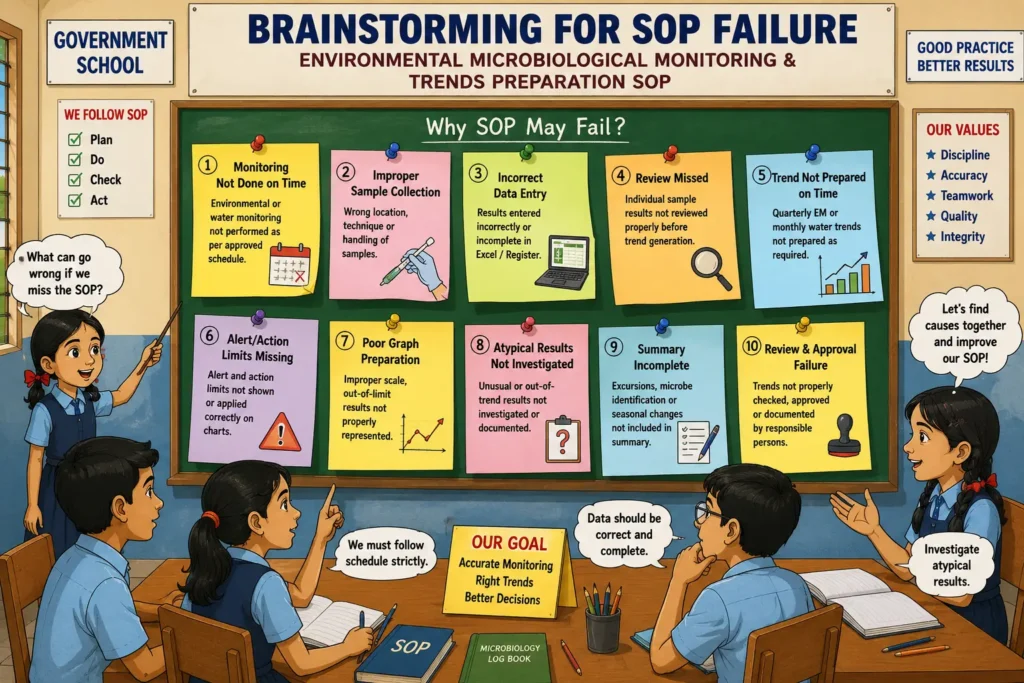
The diagram also identifies poor graph preparation, failure to investigate atypical or out-of-trend results, incomplete trend summaries, and inadequate review or approval as potential causes of SOP failure. Trend charts should clearly show monitoring results and applicable limits, while atypical results and excursions require evaluation and documented conclusions.This brainstorming approach helps the team identify weaknesses, discuss probable causes, and plan corrective actions to improve compliance, data accuracy, and microbiological trend reliability.
3. 5-Why Analysis for SOP Failure:
The 5-Why Analysis diagram identifies the root cause of failure in the SOP for Environmental Microbiological Monitoring and Trends Preparation. The analysis starts with the problem that microbiological monitoring trends were not prepared correctly or on time. The first causes relate to incomplete compilation and review of monitoring results, followed by delays in data entry and individual sample review. The SOP requires environmental and water monitoring data to be recorded, reviewed, and used for trend generation according to defined frequencies.
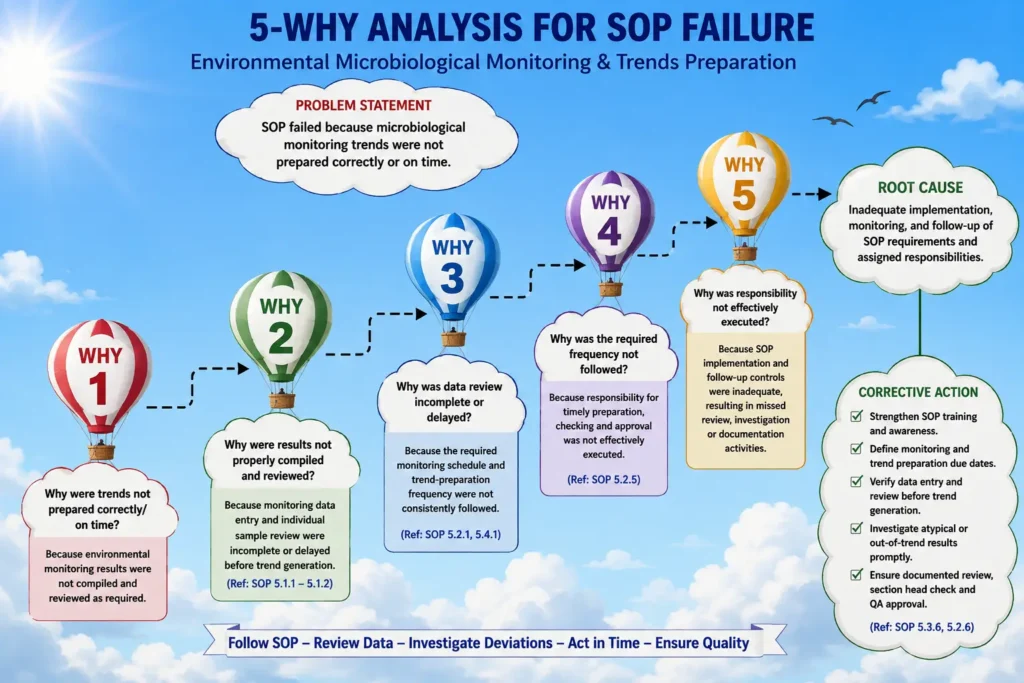
Further questioning identifies inadequate execution of responsibilities for trend preparation, checking, and approval. The SOP specifies that trends are prepared by the microbiologist, checked by the section head, and approved by Quality Assurance. The root cause is therefore inadequate SOP implementation, monitoring, and follow-up. Corrective actions include improved training, timely data review, prompt investigation of atypical results, and documented approval.
4. Fishbone Analysis for SOP Failure:
The Fishbone Analysis identifies the major potential causes responsible for failure of the SOP for Environmental Microbiological Monitoring and Trends Preparation. The diagram groups possible causes into key categories such as People, Procedure, Sampling, Data Entry, Trend Preparation, Investigation, and Review & Approval. Under People, causes may include inadequate training, missed review, lack of awareness, and unclear responsibility. Procedure-related causes include failure to follow the SOP, missed monitoring schedules, and delayed implementation. Sampling failures may involve incorrect locations, improper collection, or poor handling.
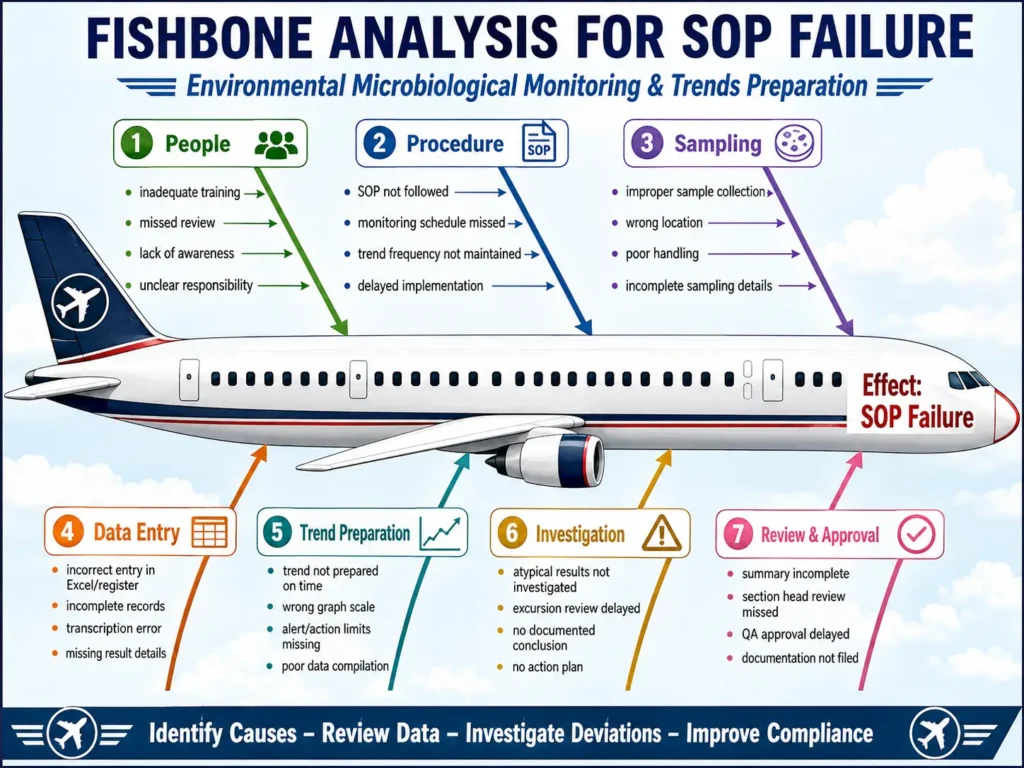
Data-related problems include incorrect entries, incomplete records, and transcription errors. Trend preparation may fail because of delayed preparation, incorrect graph scaling, missing alert/action limits, or poor data compilation. The analysis also highlights inadequate investigation of atypical results and delays in review or QA approval.Overall, the fishbone approach helps organize probable causes systematically so that the actual root cause can be identified and appropriate corrective and preventive actions can be implemented.
5. Fault Tree Analysis for SOP Failure:
The Fault Tree Analysis (FTA) diagram systematically identifies the possible causes that can lead to failure of the SOP for Environmental Microbiological Monitoring and Trends Preparation. The top event is defined as microbiological trends being incorrectly prepared or not completed on time. The fault tree breaks this failure into major contributing areas such as missed monitoring schedules, improper sample collection, incorrect data entry, inadequate review of individual results, trend-preparation errors, incomplete investigation of atypical results, and delayed review or approval.
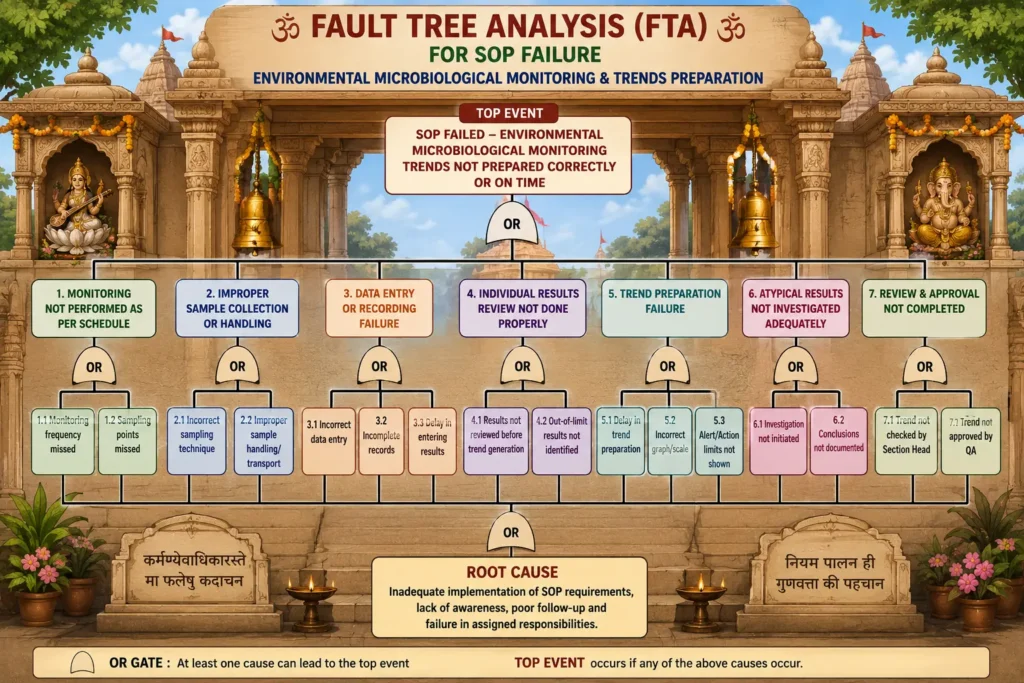
The SOP requires monitoring according to the approved frequency, recording and reviewing results before trend generation, and preparing environmental trends on a quarterly basis.It also requires proper representation of alert/action limits, investigation of atypical or out-of-trend results, and documented review and approval. The FTA helps trace these failures to a common root cause: inadequate SOP implementation, follow-up, awareness, and execution of assigned responsibilities.
Questions & Answers – Trends Preparation for Microbiological Analysis
- Q: What is the objective of this SOP?
A: To provide a procedure for preparation of trends for microbiological analysis. - Q: What is the scope of this SOP?
A: It applies to trend preparation for environment monitoring and water monitoring. - Q: Who is responsible for execution of the SOP?
A: The Microbiologist is responsible for execution of the SOP. - Q: How should environmental and water monitoring be performed?
A: Monitoring should be carried out according to the frequency specified in the respective environmental monitoring and water/system schedules. - Q: Where should monitoring results be recorded?
A: Results should be entered in Excel for environmental and water monitoring and reviewed for individual samples before trend generation. - Q: How frequently are trend charts prepared?
A: Environmental monitoring trends are prepared quarterly, while water system trends are prepared monthly. - Q: What should be shown on the X-axis and Y-axis of the trend chart?
A: The X-axis should show monitoring dates, and the Y-axis should show result values. - Q: Should alert and action limits appear on the trend chart?
A: Yes. Alert and action limits should be displayed on the trend chart. - Q: What should be done if an out-of-limit value is observed?
A: The out-of-limit point should be represented on the graph and should not fall outside the graph area. - Q: Who prepares, checks, and approves the trends?
A: Trends are prepared by the Microbiologist, checked by the Section Head, and approved by Quality Assurance. - Q: What should be included in trend summary comments?
A: The summary should include atypical results, related investigations, excursions, and routine identification of microorganisms with their impact on the product. - Q: What should be done when an atypical environmental monitoring result is observed?
A: The result should be evaluated, the reason should be assessed, and a conclusion for the out-of-trend result should be documented. - Q: What factors should be reviewed during water monitoring trend evaluation?
A: Seasonal changes, changes in flora, observed peaks, atypical results, excursions, and microorganism identification should be considered. - Q: What information is recorded in the Summary of Trends annexure?
A: It includes department, technique, frequency, duration of trend, reference method number, sampling point, minimum and maximum total counts, limits, conclusion, and action plan. - Q: What is the purpose of microbiological trend analysis?
A: It helps review monitoring data for variability, unusual patterns, excursions, and changes requiring investigation or action.