







1. Introduction to Batch Manufacturing Record (BMR) of Trimethoprim IP & Sulphamethoxazole IP Tablets:
Trimethoprim IP & Sulphamethoxazole IP Tablets are combination antibacterial medicines widely used for treating various bacterial infections, including urinary tract infections, respiratory tract infections, and certain gastrointestinal infections. The formulation contains Trimethoprim IP 160 mg and Sulphamethoxazole IP 800 mg per uncoated tablet. This combination, commonly known as co-trimoxazole, provides synergistic antibacterial activity by inhibiting two sequential stages of bacterial folate synthesis. The Batch Manufacturing Record (BMR) is an essential pharmaceutical document that provides detailed instructions and records for manufacturing each batch in accordance with Good Manufacturing Practices (GMP). It ensures product quality, consistency, traceability, and compliance with regulatory requirements. The manufacturing process involves several critical stages, including raw material dispensing, sifting, granulation, drying, blending, lubrication, tablet compression, and packaging. Each stage requires appropriate process controls, equipment verification, line clearance, and in-process quality checks. Critical quality attributes include tablet weight variation, hardness, thickness, friability, disintegration, dissolution, assay, and content uniformity, where applicable. Proper documentation, equipment cleaning, environmental monitoring, and Quality Assurance oversight help prevent contamination, mix-ups, and manufacturing deviations. The BMR serves as documented evidence that each batch is manufactured, tested, reviewed, and released according to approved specifications and established pharmaceutical quality standards.
Skip to PDF content2. Manufacturing Process Flow Diagram of Trimethoprim IP & Sulphamethoxazole IP Tablets:
The manufacturing process of Trimethoprim IP 160 mg and Sulphamethoxazole IP 800 mg Tablets involves a systematic sequence of pharmaceutical operations designed to ensure product quality, uniformity, safety, and compliance with Good Manufacturing Practices (GMP). The process begins with the receipt, sampling, testing, and Quality Control (QC) release of raw materials. Approved active pharmaceutical ingredients (APIs) and excipients are accurately dispensed and weighed according to the Batch Manufacturing Record (BMR).
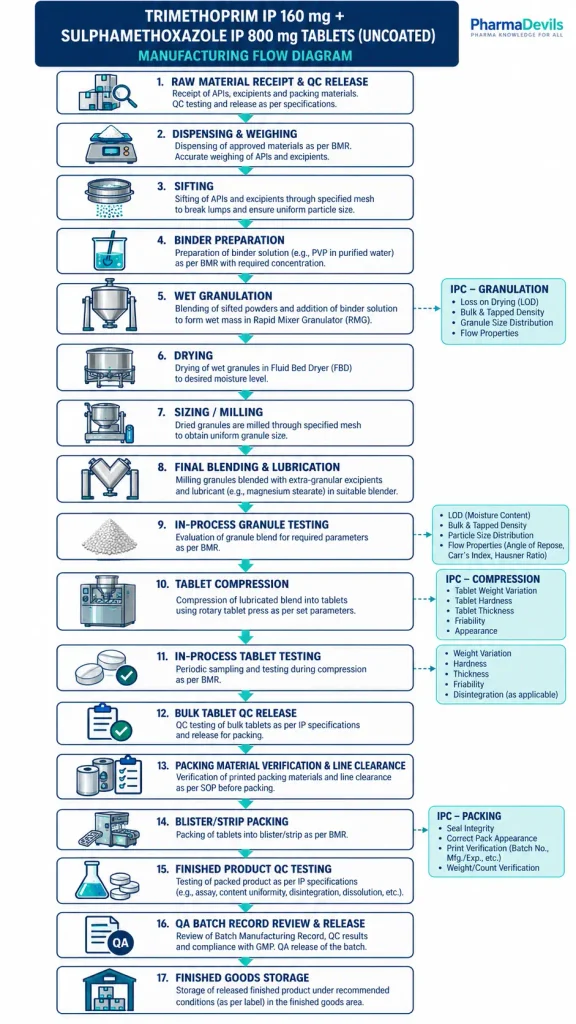
The materials undergo sifting, followed by binder preparation, wet granulation, drying, and sizing to achieve suitable granule characteristics. The dried granules are blended with approved excipients and lubricants to obtain a uniform mixture suitable for compression. During granulation, critical parameters such as moisture content, particle size distribution, and flow properties are monitored. The lubricated granules are compressed into tablets using a tablet compression machine. In-process quality checks include weight variation, hardness, thickness, friability, and appearance. Following satisfactory testing, bulk tablets are released for packaging. Packaging operations include line clearance, material verification, and integrity checks. Finally, finished tablets undergo quality testing, batch documentation review, and Quality Assurance (QA) release before transfer to the finished goods storage area under approved conditions.
Note: The manufacturing sequence and process parameters must follow the approved product-specific BMR.
3. Critical Process Parameters (CPPs) and Critical Quality Attributes (CQAs) of Trimethoprim IP & Sulphamethoxazole IP Tablets:
Critical Process Parameters (CPPs) and Critical Quality Attributes (CQAs) play an essential role in ensuring the consistent quality, safety, and efficacy of Trimethoprim IP 160 mg and Sulphamethoxazole IP 800 mg Tablets during pharmaceutical manufacturing.
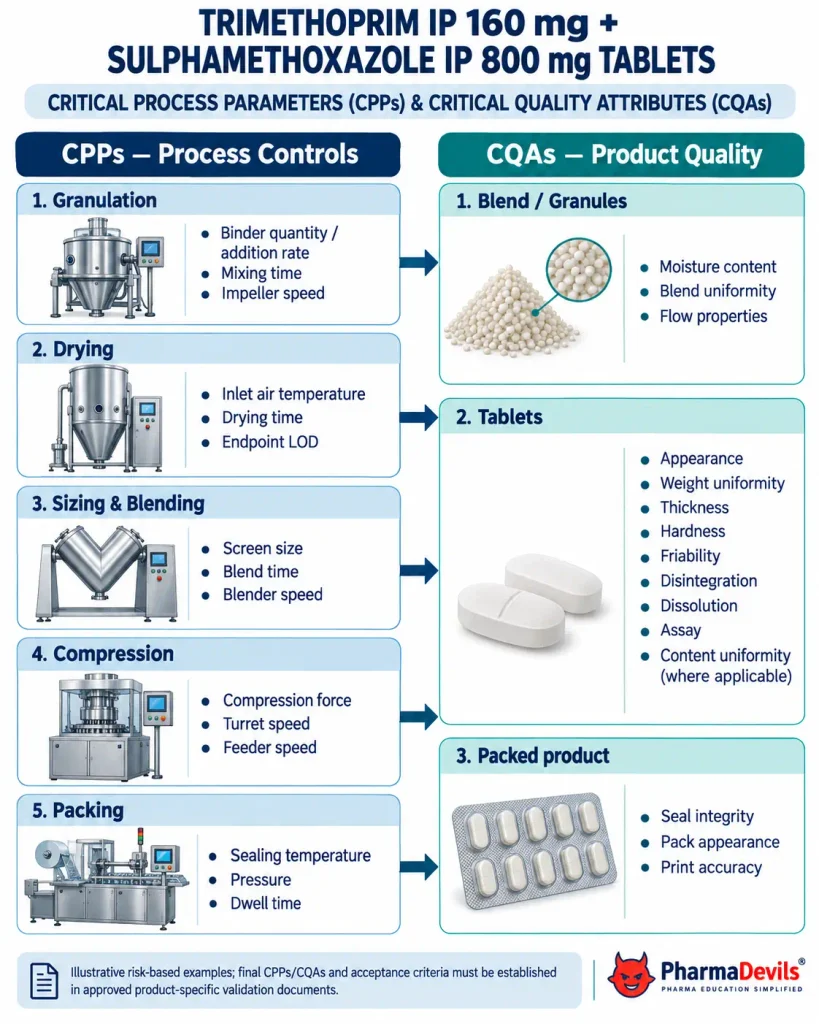
CPPs are manufacturing parameters whose variability can significantly affect product quality and therefore require appropriate monitoring and control. During wet granulation, important process parameters include binder quantity, addition rate, mixing time, and impeller speed. Drying parameters include inlet air temperature, drying duration, and moisture endpoint. During blending, mixing time and blender speed influence blend uniformity. In tablet compression, compression force, turret speed, and feeder speed affect tablet characteristics. Packaging parameters include sealing temperature, pressure, and dwell time. CQAs are measurable physical, chemical, biological, or microbiological properties that must remain within established acceptance limits. Important tablet CQAs include appearance, dosage-unit uniformity, hardness, friability, disintegration, dissolution, assay, and impurity levels. Packaging quality attributes include seal integrity, correct labeling, and protection against environmental exposure. Effective CPP monitoring and CQA evaluation support process validation, batch consistency, regulatory compliance, and pharmaceutical quality assurance.
Note: Final CPP classification and CQA acceptance criteria must be scientifically justified through product-specific risk assessment, development studies, and process validation.