







1. Introduction:
Trimethoprim IP & Sulphamethoxazole IP Tablets are solid oral pharmaceutical dosage forms manufactured through controlled dispensing, granulation, drying, sizing, blending, lubrication, compression, dedusting, sorting, and packing operations. The Batch Manufacturing Record (BMR) provides a documented framework for executing and recording each manufacturing stage in a consistent and traceable manner. The uploaded BMR identifies the product as Trimethoprim IP & Sulphamethoxazole IP Tablets and includes controls for batch details, manufacturing activities, packing operations, and authorized approvals. The manufacturing process incorporates defined equipment, material dispensing, assay-based quantity calculations, granulation, final drying, lubrication, and compression controls. Critical in-process parameters such as granule loss on drying, bulk density, percentage of fines, tablet weight, thickness, hardness, disintegration time, friability, temperature, and relative humidity are monitored to maintain process consistency and product quality. The BMR also includes line clearance, equipment cleanliness, sieve integrity checks, yield reconciliation, sampling, QC testing, deviation recording, and QA release requirements. Proper completion of this BMR ensures complete batch traceability, accountability of materials, verification of processing conditions, reconciliation of yields, and documentation of production and quality-control activities. It therefore serves as an essential GMP document for demonstrating that each batch has been manufactured and controlled according to the approved manufacturing procedure and predefined quality requirements.
Skip to PDF content2. Manufacturing Flow Diagram:
The manufacturing flow diagram for Trimethoprim IP & Sulphamethoxazole IP Tablets presents the sequential processing stages followed during tablet production. The process begins with raw material dispensing, followed by sifting of active pharmaceutical ingredients and excipients to remove lumps and ensure uniform particle distribution. Starch paste is then prepared and used during wet granulation in the Rapid Mixer Granulator. The wet mass is subjected to drying in a Fluid Bed Dryer, followed by wet milling and final drying. Moisture content is controlled through Loss on Drying (LOD) checks. The dried granules are then graded or sized before undergoing blending and lubrication, where uniform distribution of ingredients is important for consistent tablet quality.
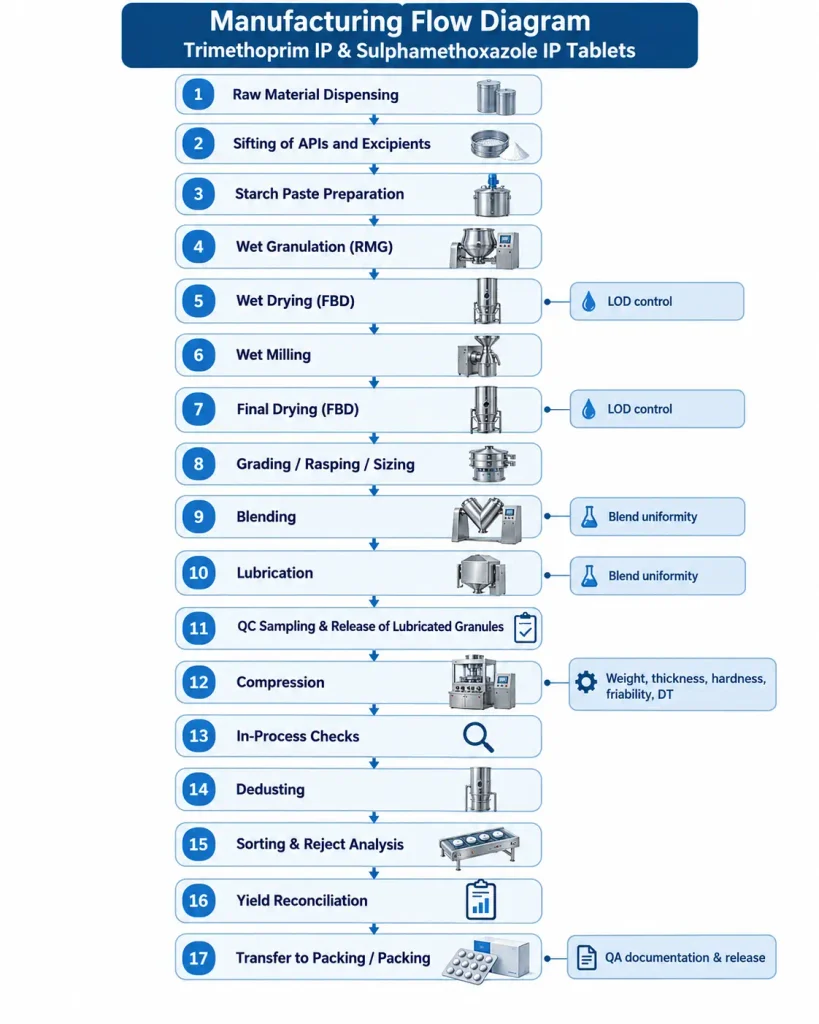
After lubrication, samples of the granules are sent for QC testing and release before compression. During compression, critical in-process parameters such as tablet weight, thickness, hardness, friability, and disintegration time are monitored. The compressed tablets are subsequently dedusted, sorted, and inspected for rejects. Yield reconciliation is performed to account for production quantities and losses. Finally, acceptable tablets are transferred to the packing section for further packaging and documented QA control.
3. Critical Process Parameters (CPP) and Critical Quality Attributes (CQA):
The Critical Process Parameters (CPP) and Critical Quality Attributes (CQA) for Trimethoprim IP & Sulphamethoxazole IP Tablets describe the key manufacturing controls required to achieve consistent product quality. During raw material dispensing and sifting, correct material quantity, sieve integrity, and environmental conditions are important for maintaining material identity, purity, and uniform particle distribution.
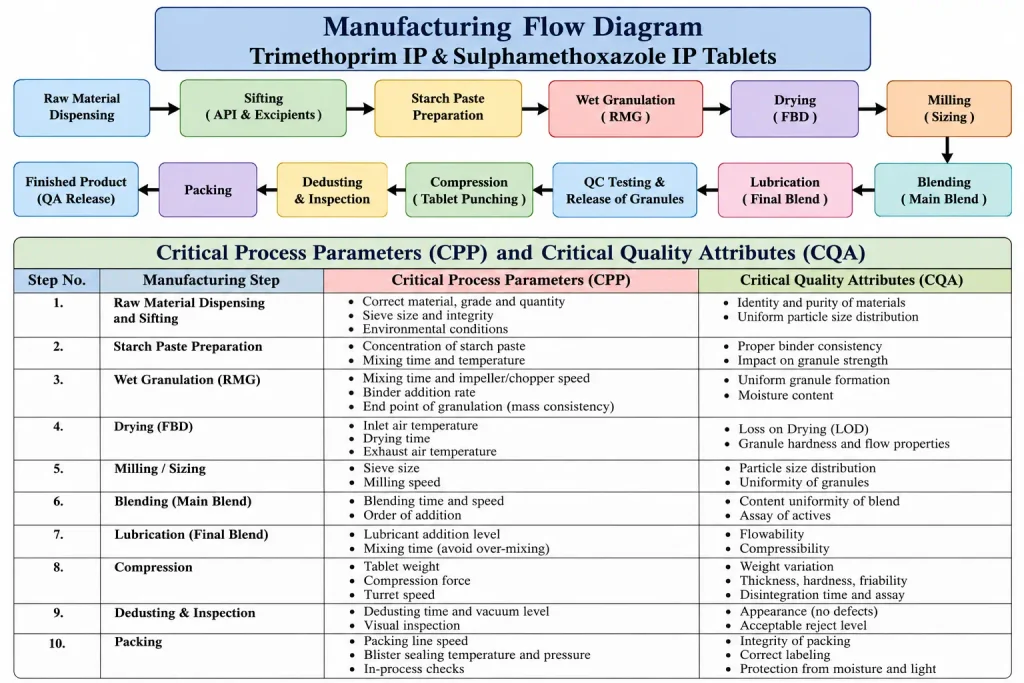
During starch paste preparation and wet granulation, parameters such as binder concentration, mixing time, temperature, impeller speed, and granulation endpoint influence granule formation and moisture content. Drying is controlled through inlet temperature, drying time, and moisture monitoring. The BMR specifies final drying at an inlet temperature of 60–70°C, with product temperature of 35–40°C and granule LOD between 1.8–2.4% w/w. Blending and lubrication require controlled mixing time and ingredient distribution to achieve uniformity and suitable flow characteristics. During compression, important CQAs include tablet weight, thickness, hardness, friability, and disintegration time. The BMR specifies an average tablet weight of 1095 mg, hardness NLT 112 N, friability NMT 1%, and disintegration time NMT 10 minutes. Effective control of these CPPs helps ensure consistent tablet quality throughout manufacturing.