







1. Brief Description:
This validation protocol is prepared to confirm that ingredients are blended uniformly in an IPC Blender and that the active ingredient is evenly distributed at the standard blending time mentioned in the Batch Manufacturing Record (BMR). Before validation, raw materials must meet specifications, analytical methods should be validated, equipment and testing instruments must be calibrated, and involved personnel should be properly trained. Ingredients are loaded into the blender according to the BMR sequence and the blender is operated as per the approved SOP. Samples are collected in triplicate from ten different positions using a sampling thief and are tested by Quality Control. The blend should meet the specified active ingredient limits, show uniform distribution, and have an RSD below 5%. All observations, deviations, test results, conclusions, recommendations, and approvals are documented in the final validation report.
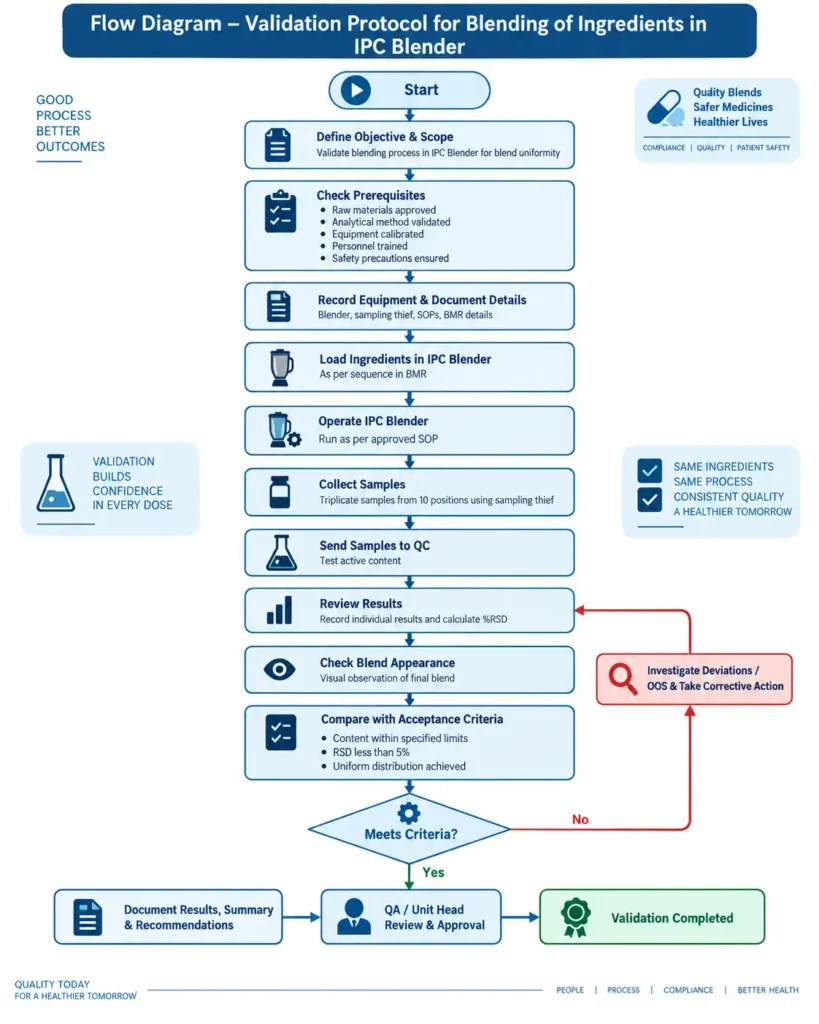
Skip to PDF content2. Flow Diagram:
The flow diagram explains the complete validation process for Blending of Ingredients in an IPC Blender. The process starts by defining the objective and scope of validation. Before blending, important prerequisites are checked, including approved raw materials, validated analytical methods, calibrated equipment, trained personnel, and required safety precautions. Equipment details, SOPs, sampling thief information, and BMR references are recorded. Ingredients are then loaded into the IPC Blender according to the sequence given in the BMR and blended as per the approved SOP. Samples are collected in triplicate from ten different positions and sent to Quality Control for active ingredient testing. Test results are reviewed, %RSD is calculated, and blend appearance is checked. The results are compared with acceptance criteria, including content within limits, uniform distribution, and RSD below 5%. Any deviation or OOS is investigated before final QA review, approval, and completion of validation.
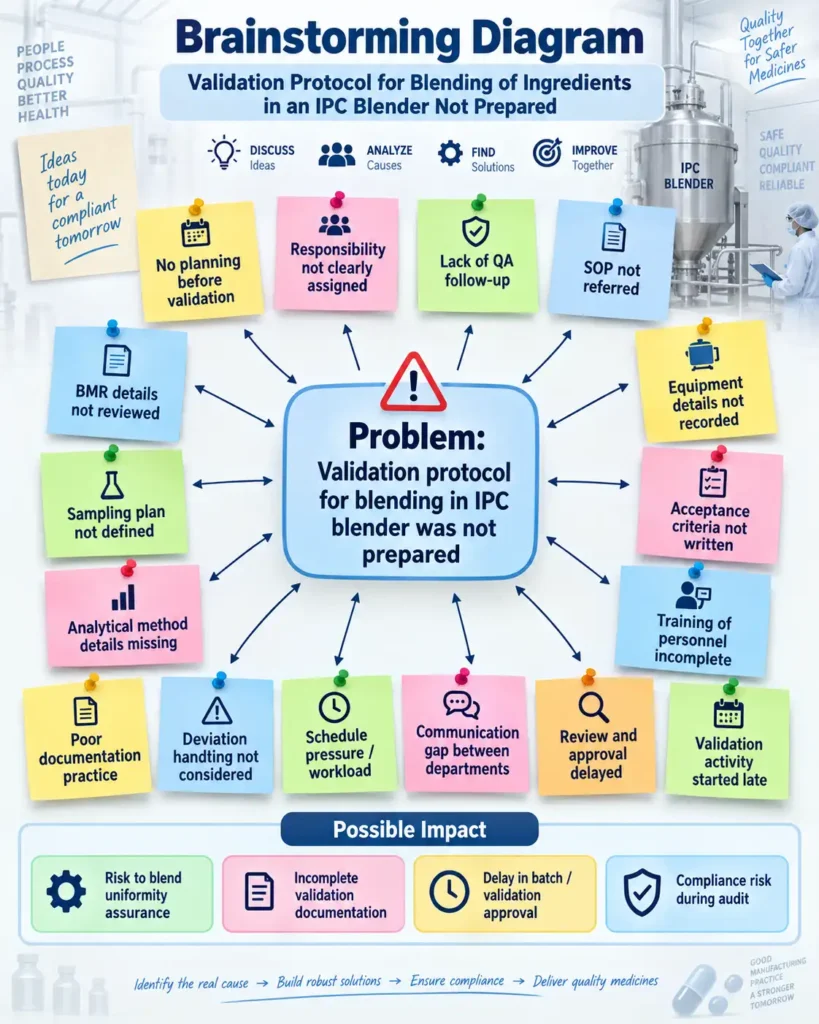
3. Brainstorming:
The brainstorming analysis identifies possible reasons why the Validation Protocol for Blending of Ingredients in the IPC Blender was not performed effectively. The main causes may include poor planning, unclear responsibility, lack of QA follow-up, failure to refer to the approved SOP and BMR, and delayed preparation of validation documents. Important equipment details, sampling locations, analytical method information, and acceptance criteria may also be missing. The protocol requires ingredients to be blended according to the BMR, samples to be collected from defined locations, and blend uniformity to be evaluated. Other contributing factors may include insufficient personnel training, workload pressure, poor communication between Production, QA, QC, and Engineering, weak documentation practices, and delayed review or approval. These issues can result in incomplete validation, inability to demonstrate uniform blending, delayed batch approval, deviations, and regulatory compliance risks. Brainstorming helps identify these causes so suitable CAPA can be planned.
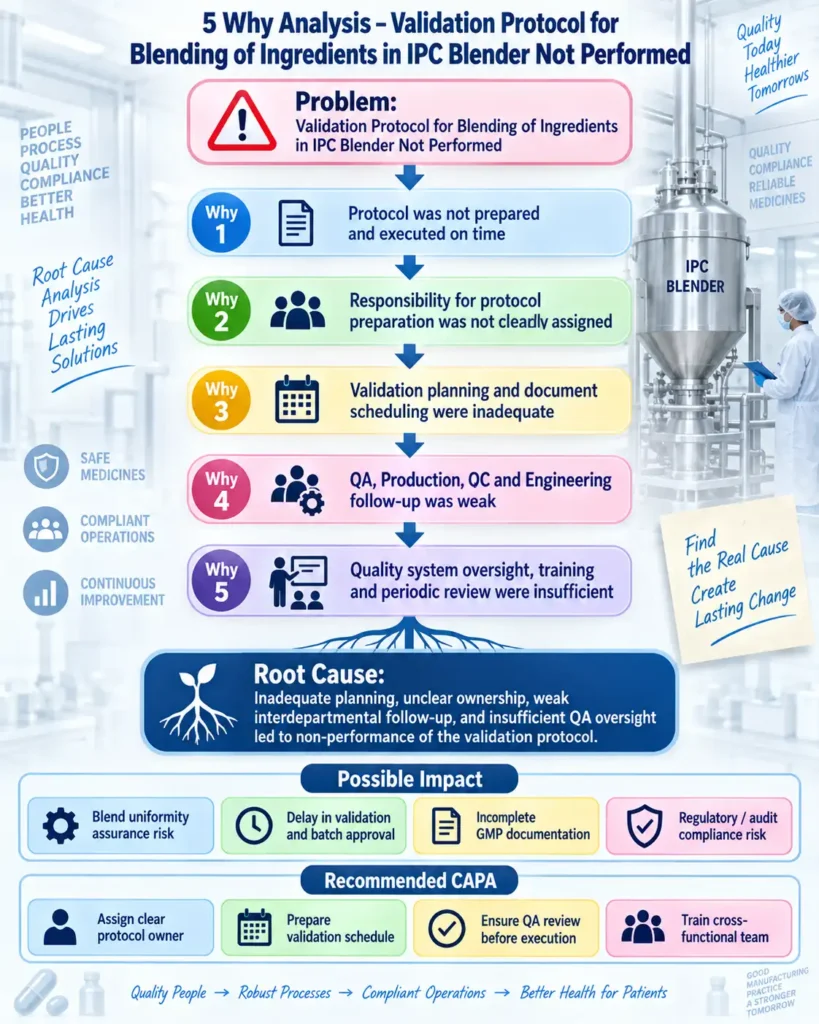
4. 5 Why Analysis:
The 5 Why Analysis explains the possible reasons why the Validation Protocol for Blending of Ingredients in the IPC Blender was not performed. The first reason is that the protocol was not prepared and executed on time. Further analysis shows that responsibility for protocol preparation may not have been clearly assigned. Poor validation planning and inadequate document scheduling could also contribute to the delay. Weak coordination and follow-up between QA, Production, QC, and Engineering may allow the activity to remain incomplete. At the deeper level, insufficient quality-system oversight, training, and periodic review may be the main contributing factors. The analysis identifies the potential root cause as inadequate planning, unclear ownership, weak interdepartmental follow-up, and insufficient QA monitoring. These issues may lead to incomplete GMP documentation, delayed validation, lack of assurance of blend uniformity, and audit compliance risks. Corrective actions should include clear responsibility, proper scheduling, QA review, and team training.
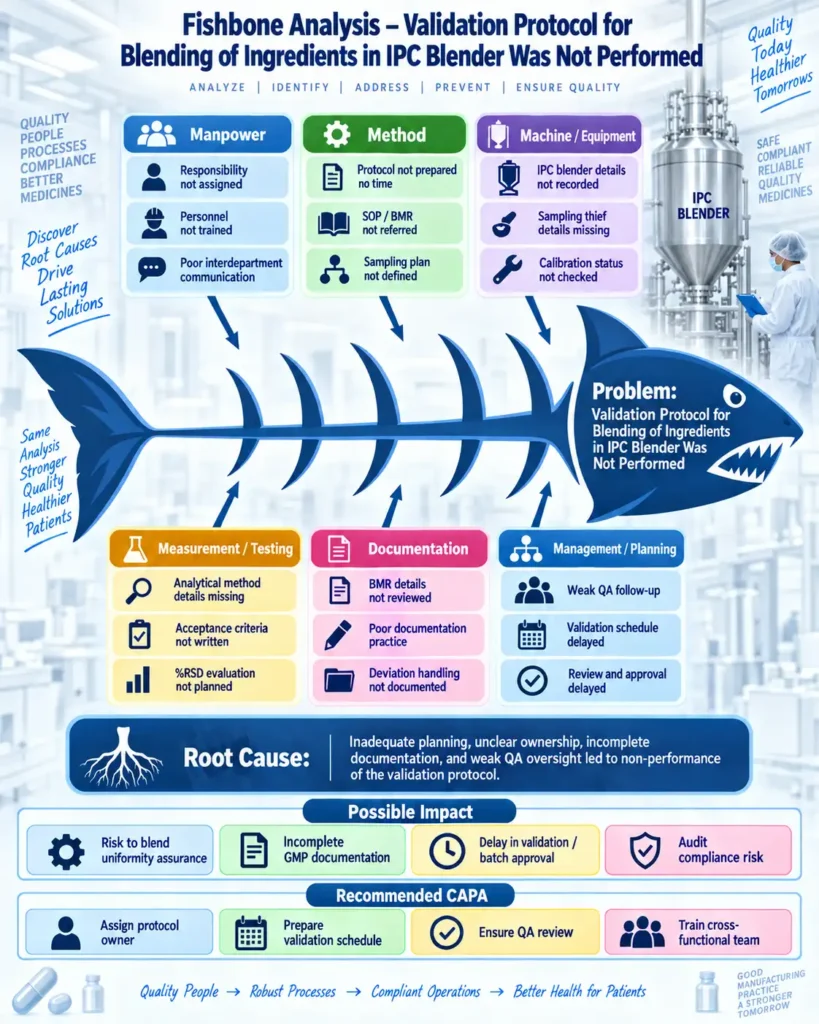
5. Fishbone Analysis:
The Fishbone Analysis identifies possible reasons why the Validation Protocol for Blending of Ingredients in the IPC Blender was not performed. The causes are grouped into six main categories: Manpower, Method, Machine/Equipment, Measurement/Testing, Documentation, and Management/Planning. Manpower issues may include unclear responsibility, inadequate training, and poor communication. Method-related causes include delayed protocol preparation, failure to refer to SOP/BMR, and an undefined sampling plan. Equipment-related causes include missing IPC Blender details, sampling thief information, and calibration status. Testing causes may involve missing analytical method details, acceptance criteria, and %RSD planning. Documentation issues include incomplete BMR review, poor documentation, and inadequate deviation handling. Management causes include weak QA follow-up, delayed validation scheduling, and slow approval. The analysis indicates that poor planning, unclear ownership, weak documentation, and insufficient QA oversight are major root causes. Corrective actions should focus on responsibility, scheduling, training, documentation, and timely QA review.
6. Fault Tree Analysis:
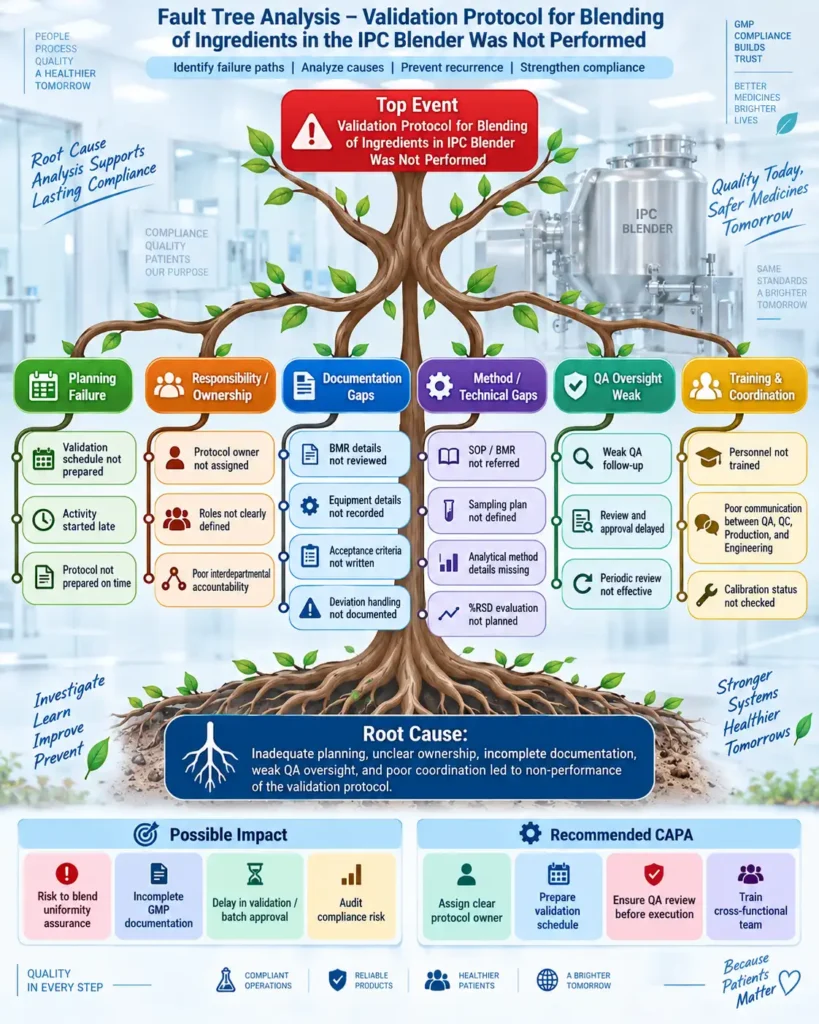
The Fault Tree Analysis explains why the Validation Protocol for Blending of Ingredients in the IPC Blender was not performed. The top event is the failure to prepare and execute the validation protocol. The analysis breaks this problem into major cause groups such as planning failure, unclear responsibility, documentation gaps, technical or method gaps, weak QA oversight, and poor training or coordination. Possible causes include delayed validation scheduling, no assigned protocol owner, missing BMR and equipment details, undefined sampling plans, missing acceptance criteria, delayed review and approval, and inadequate personnel training. Weak communication between QA, QC, Production, and Engineering may also contribute to the failure. The analysis shows that inadequate planning, unclear ownership, incomplete documentation, and weak QA monitoring are important root causes. These issues may cause delayed validation, incomplete GMP records, poor assurance of blend uniformity, and audit risks. CAPA should focus on responsibility, planning, training, documentation, and timely QA review.
7. Heat Map Analysis:
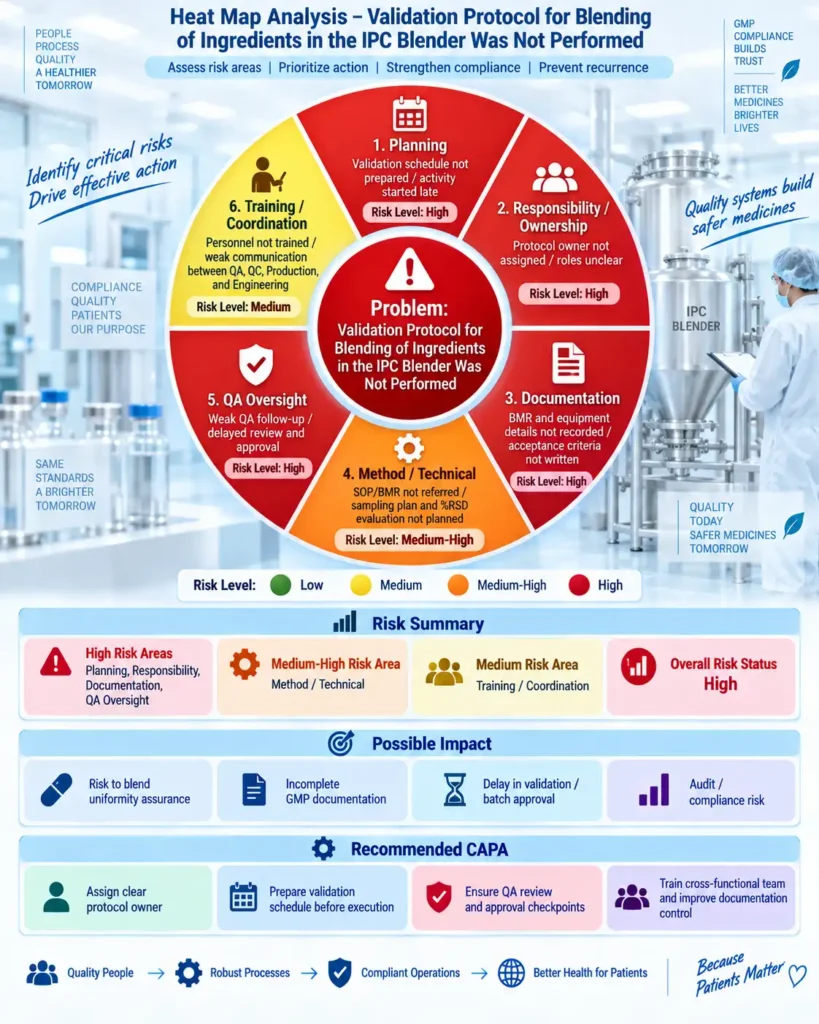
The Heat Map Analysis shows the major risk areas related to the Validation Protocol for Blending of Ingredients in the IPC Blender not being performed. The risks are divided into six categories: Planning, Responsibility/Ownership, Documentation, Method/Technical, QA Oversight, and Training/Coordination. Planning, responsibility, documentation, and QA oversight are considered high-risk areas because failure in these controls can directly delay validation and weaken GMP compliance. Method and technical gaps are rated medium-high, while training and coordination are rated medium risk. The analysis helps identify which issues need immediate attention. Major concerns include missing validation schedules, unclear protocol ownership, incomplete BMR and equipment details, weak QA follow-up, undefined sampling plans, and poor communication. The overall risk level is considered high. Recommended actions include assigning clear responsibility, preparing the validation schedule, strengthening QA review, improving documentation, and providing cross-functional training to prevent recurrence.
8. Pareto Analysis:
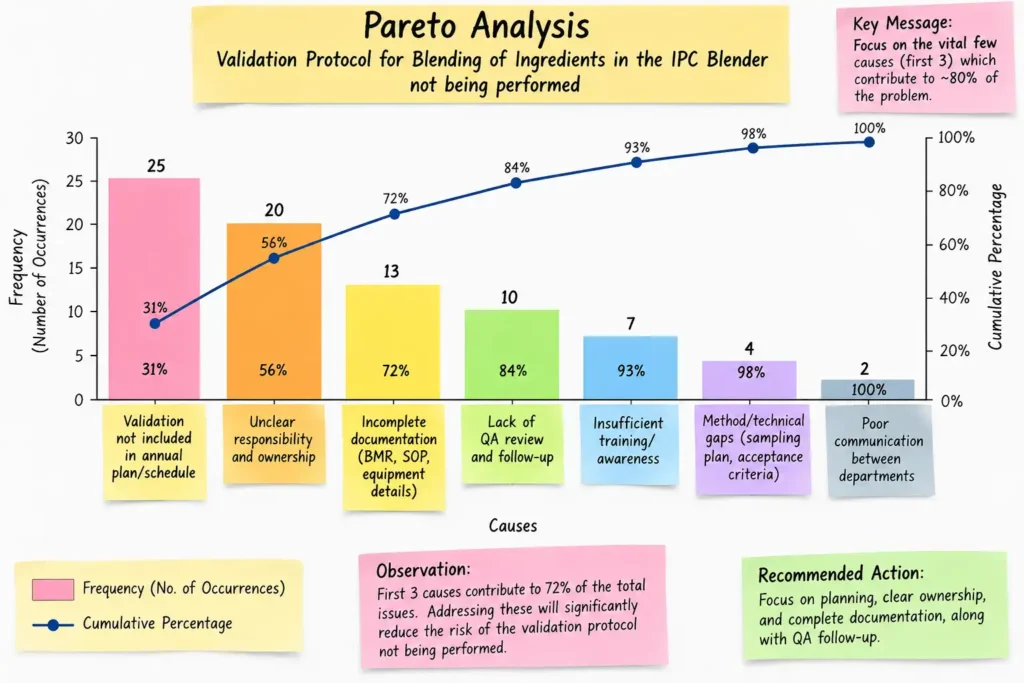
The Pareto Analysis helps identify the main reasons why the Validation Protocol for Blending of Ingredients in the IPC Blender was not performed. The analysis arranges possible causes according to their frequency and importance. Major causes include validation not being included in the planned schedule, unclear responsibility, incomplete documentation, weak QA review, insufficient training, technical gaps, and poor communication between departments. The chart shows that a small number of major causes contribute to most of the problem. Therefore, priority should be given to proper validation planning, assigning clear responsibility, and completing required documents such as BMR, SOP, equipment details, sampling plans, and acceptance criteria. The original protocol requires defined equipment information, approved procedures, sampling, testing, and documented results. Addressing the major causes first can improve compliance, reduce validation delays, strengthen documentation, and prevent recurrence of similar failures.
Questions & Answers:
- Q: What is the objective of this validation protocol?
A: To confirm that blending produces uniform distribution of the active ingredient at the standard blending time mentioned in the BMR. - Q: Where is this validation protocol applicable?
A: It is applicable to the blending of ingredients in an IPC Blender. - Q: Which departments are involved in the validation activity?
A: Production, Quality Assurance, Quality Control, and Engineering are involved. - Q: What equipment information should be recorded?
A: IPC Blender code number, capacity, RPM, qualification date, sampling thief code, and bulk sampler details should be recorded. - Q: Which documents should be followed during blending validation?
A: The approved IPC Blender operating SOP, sampling thief SOP, and Batch Manufacturing Record should be followed. - Q: What should be checked before starting validation?
A: Raw material compliance, validated analytical method, equipment calibration, personnel training, and safety precautions should be confirmed. - Q: How should ingredients be loaded into the IPC Blender?
A: Ingredients should be loaded according to the sequence specified in the approved BMR. - Q: How many sampling positions are used for blend validation?
A: Samples are collected from 10 different positions of the blender. - Q: How are samples collected?
A: A quantity equivalent to one to three unit doses is collected in triplicate using a sampling thief. - Q: What testing is performed on the blend samples?
A: Samples are sent to Quality Control for active ingredient content analysis, and individual results with %RSD are reported. - Q: What is the acceptance criterion for %RSD?
A: The Relative Standard Deviation of blend uniformity should be less than 5% at the standard blending time. - Q: What should be done if deviation or OOS occurs?
A: Deviations and OOS results should be investigated, justified where applicable, and documented in the validation report. - Q: How many batches are required for concurrent validation?
A: Three consecutive validation exercises are required. - Q: What is the periodic revalidation frequency?
A: One revalidation exercise should be performed within a period not exceeding five years. - Q: Who finally reviews and approves the validation report?
A: The Validation Report should be reviewed and finally approved by Unit Quality Assurance and Unit Head.
Reference Guidelines:
- CDSCO – Revised Schedule M, Drugs Rules, 1945, G.S.R. 922(E), 28 December 2023 – Indian GMP requirements covering pharmaceutical quality systems, qualification, validation, documentation and manufacturing controls.
CDSCO Gazette Notifications – Revised Schedule M - WHO Technical Report Series No. 1019, Annex 3 – Good Manufacturing Practices: Guidelines on Validation (2019) – particularly Appendix 7: Non-sterile Process Validation. This is one of the most directly applicable international references for blending-process validation.
WHO TRS 1019 Annex 3 - EU GMP, EudraLex Volume 4, Annex 15 – Qualification and Validation – provides requirements for validation planning, protocols, acceptance criteria, process validation, documentation, deviations and lifecycle review.
European Commission EudraLex Volume 4 - US FDA – Process Validation: General Principles and Practices, January 2011 – describes the lifecycle approach to demonstrating that a manufacturing process can consistently produce material meeting predetermined quality requirements.
FDA Process Validation Guidance - 21 CFR Part 211.110 – Sampling and Testing of In-Process Materials and Drug Products – relevant to establishment of appropriate in-process controls, sampling and testing during manufacturing.
21 CFR 211.110 – eCFR - ICH Q8(R2) – Pharmaceutical Development – useful for process understanding, identification of critical material attributes, process parameters and development of a scientifically justified manufacturing process.
ICH Q8(R2) Guideline - ICH Q9(R1) – Quality Risk Management – supports risk assessment of blending parameters, sampling locations, equipment, personnel, documentation and failure modes. It specifically recognizes tools such as FMEA, FTA, HACCP and HAZOP.
ICH Q9(R1) Guideline - ICH Q10 – Pharmaceutical Quality System – applicable to management responsibility, change management, CAPA, process performance monitoring and continual improvement throughout the product lifecycle.
ICH Q10 Guideline - PIC/S GMP Guide PE 009-17 – Annex 15, Qualification and Validation – an additional international GMP reference for process validation and qualification.
PIC/S Publications