







1. Introduction for Validation of Blending of Ingredients in IPC Blender:
The validation of blending of ingredients in an IPC Blender is performed to demonstrate that the blending process consistently produces a homogeneous mixture with uniform distribution of the active ingredient at the established blending time. The study covers equipment identification and qualification, raw-material status, calibrated testing instruments, trained personnel, approved SOPs and BMR requirements. Blend samples are evaluated through chemical analysis to verify content uniformity and process consistency. The acceptance criteria include compliance with the specified assay limits, RSD of active ingredient below 5%, and uniform distribution of active ingredients. Deviations, OOS results, observations, findings, recommendations, and approvals are documented.
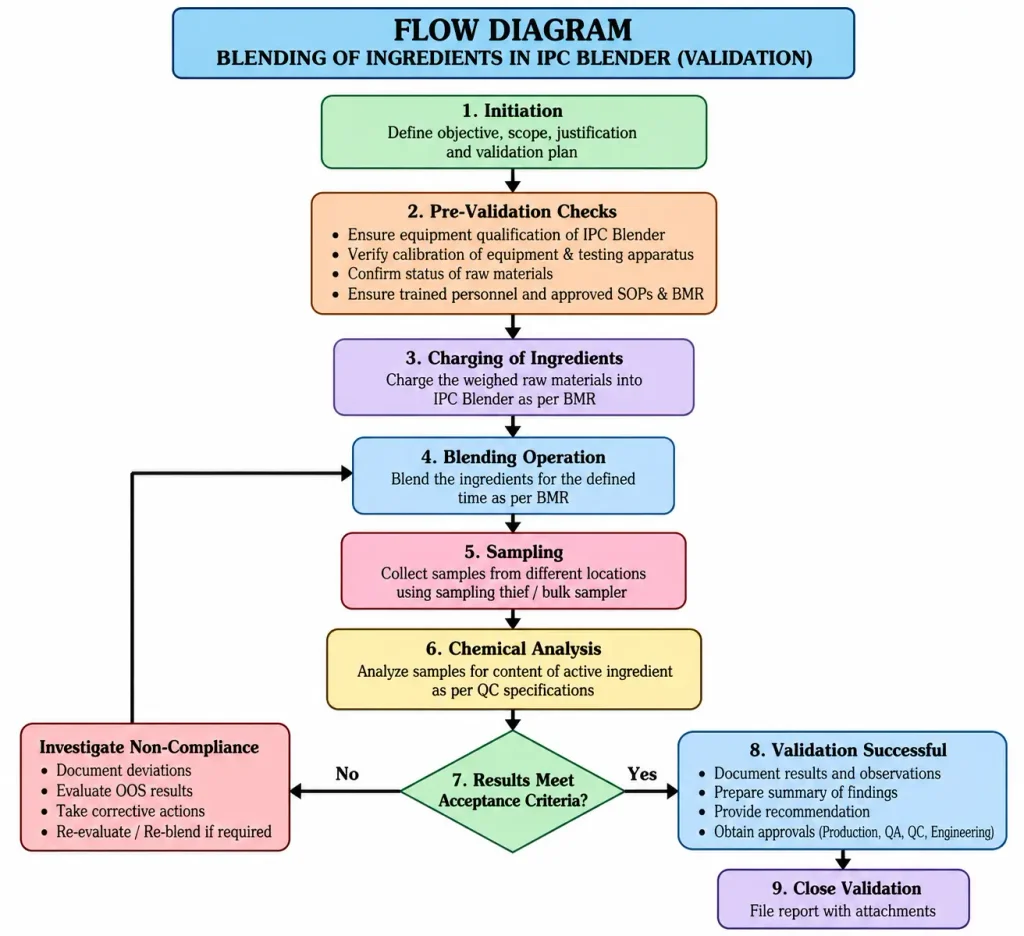
Skip to PDF content2. Flow Diagram – Blending of Ingredients in IPC Blender:
The flow diagram describes the validation process for blending of ingredients in an IPC Blender. The process begins with initiation and pre-validation checks, including equipment qualification, calibration, raw material status, approved SOPs, BMR availability, and trained personnel. Ingredients are then charged into the IPC Blender and blended for the specified time. Samples are collected from different locations and subjected to chemical analysis for active ingredient content. Results are evaluated against predefined acceptance criteria. Compliant results lead to documentation, review, recommendation, approval, and validation closure. Non-compliant results require deviation or OOS investigation, corrective actions, and re-evaluation of the blending process. Validation Report for Blending … Validation Report for Blending …
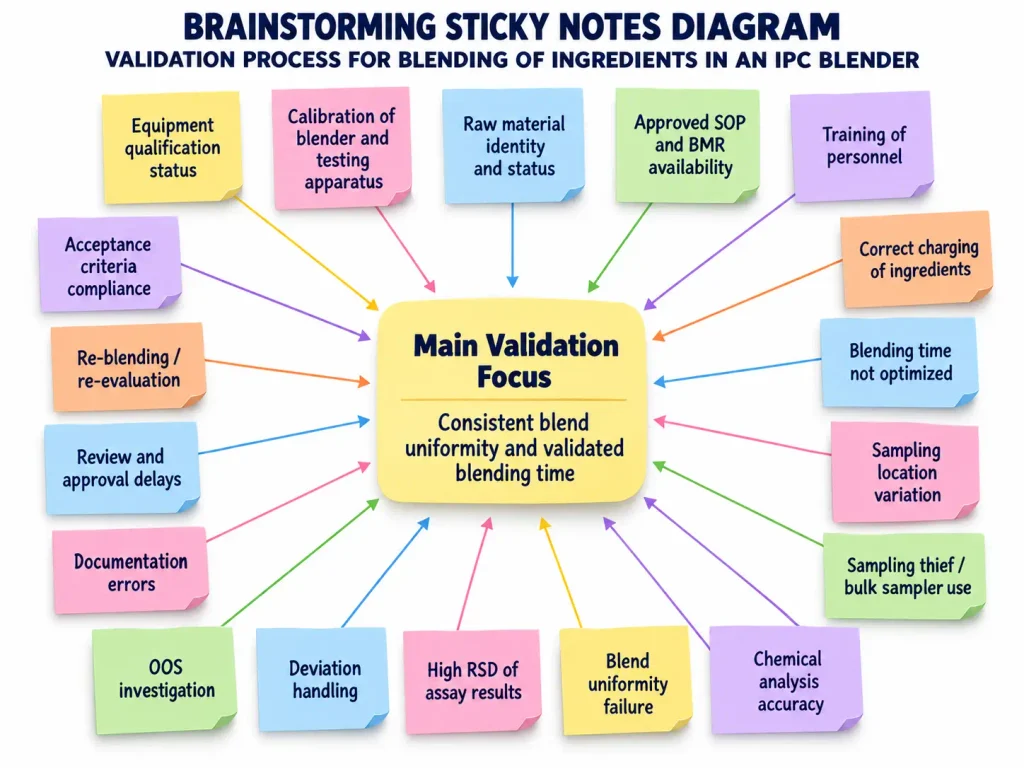
3. Brainstorming Analysis – Validation Process for Blending of Ingredients in an IPC Blender:
The brainstorming analysis identifies key factors that may influence the successful validation of blending in an IPC Blender. Important considerations include equipment qualification, calibration status, raw material verification, approved SOP and BMR availability, personnel training, correct charging of ingredients, optimized blending time, and proper sampling practices. The analysis also considers risks such as sampling location variation, high RSD, blend uniformity failure, documentation errors, deviations, OOS results, and delays in review or approval. By evaluating these factors collectively, the validation team can recognize potential causes of process failure, establish suitable controls, and ensure consistent blend uniformity and reliable validation results.
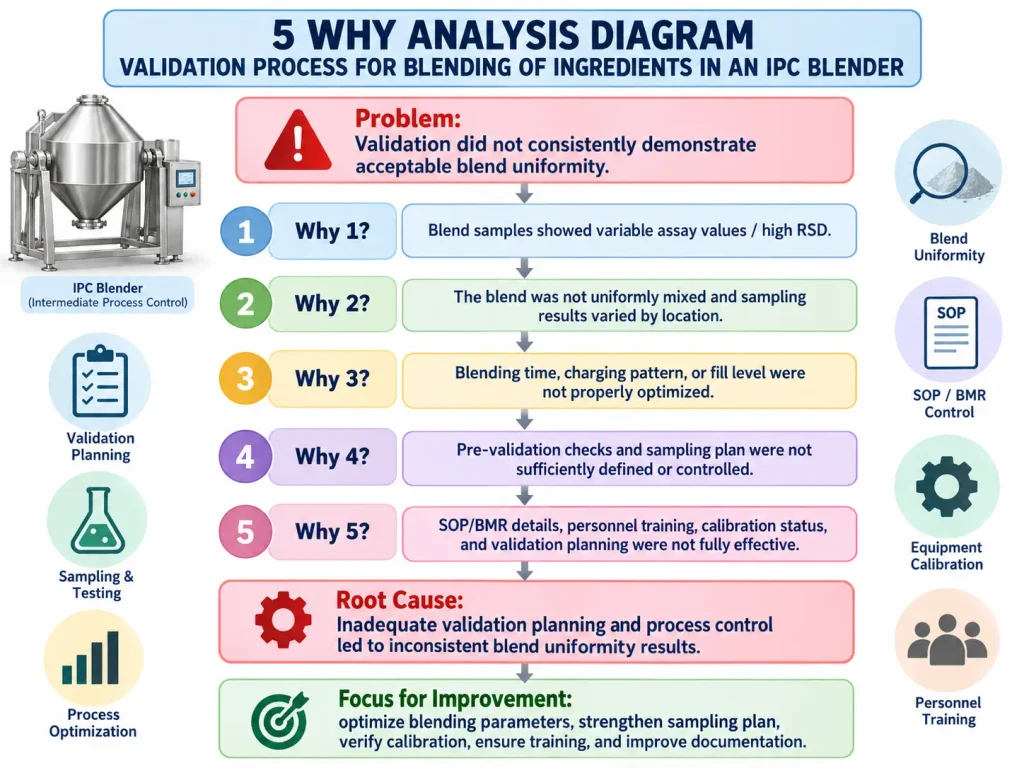
4. 5 Why Analysis – Validation Process for Blending of Ingredients in an IPC Blender:
The 5 Why Analysis is used to identify the root cause of inconsistent blend uniformity during validation of the IPC Blender process. The analysis begins with variable assay results or high RSD and investigates why the blend was not uniformly mixed. Possible causes include unsuitable blending time, charging pattern, fill level, sampling variation, inadequate pre-validation checks, and insufficient control of SOP/BMR requirements. Further analysis considers equipment calibration, personnel training, sampling planning, and validation documentation. The identified root cause is inadequate validation planning and process control, requiring optimization of blending parameters, improved sampling strategy, effective training, calibration verification, and stronger documentation controls.
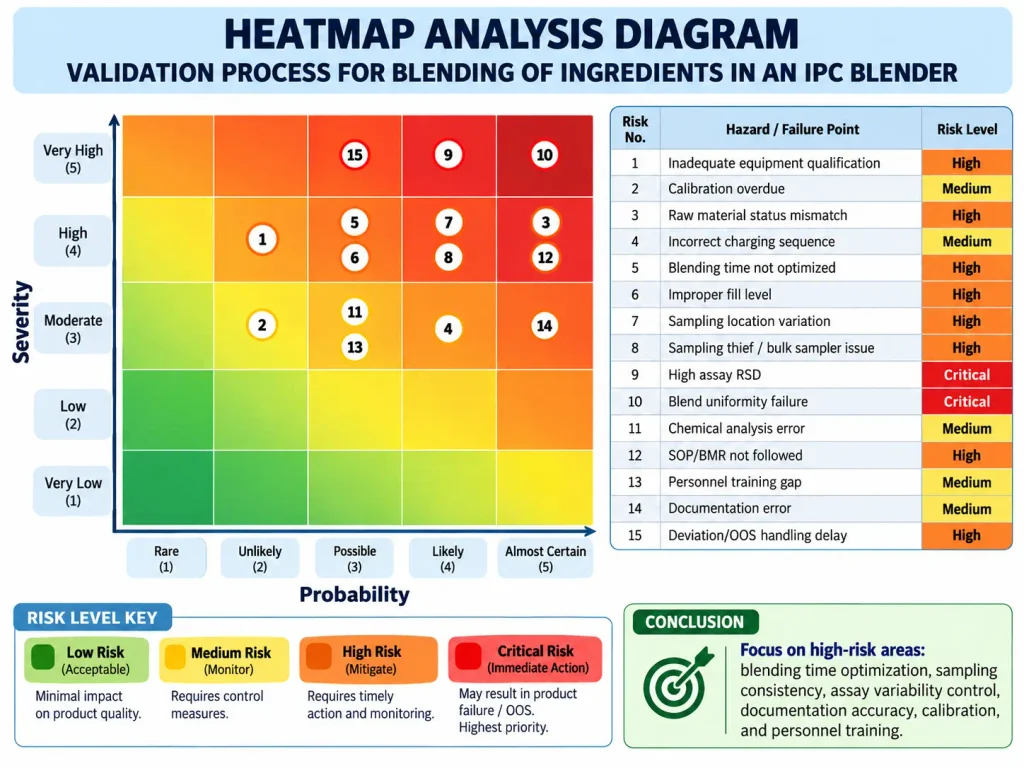
5. Heat Map Analysis – Validation Process for Blending of Ingredients in an IPC Blender:
The Heat Map Analysis evaluates potential risks associated with validation of the blending process by considering their probability and severity. Major risk areas include equipment qualification, calibration status, raw material verification, charging sequence, blending time, fill level, sampling variation, sampler performance, assay RSD, blend uniformity, chemical analysis, SOP/BMR compliance, personnel training, documentation, and deviation/OOS handling. Critical risks such as high assay RSD and blend uniformity failure require immediate attention. High-risk areas should be controlled through optimized blending parameters, consistent sampling, proper calibration, trained personnel, accurate documentation, and effective investigation to ensure reliable and reproducible validation results.
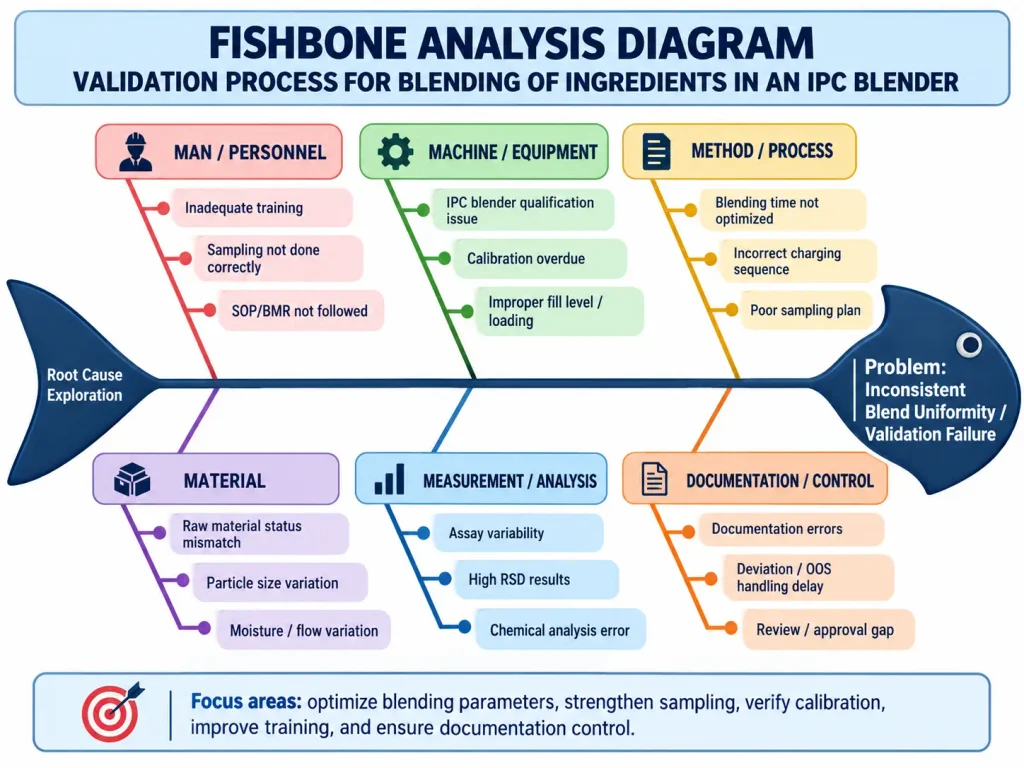
6. Fishbone Analysis – Validation Process for Blending of Ingredients in an IPC Blender:
The Fishbone Analysis identifies possible causes of inconsistent blend uniformity or validation failure during blending in an IPC Blender. The causes are grouped under key categories such as personnel, machine/equipment, method/process, material, measurement/analysis, and documentation/control. Potential issues include inadequate training, incorrect sampling, unqualified or poorly calibrated equipment, unsuitable blending time, incorrect charging sequence, raw material variability, high RSD, assay variation, and documentation or OOS handling gaps. Evaluating these causes helps the validation team identify contributing factors, strengthen process controls, improve sampling and testing practices, optimize blending parameters, and support consistent achievement of acceptable blend uniformity.
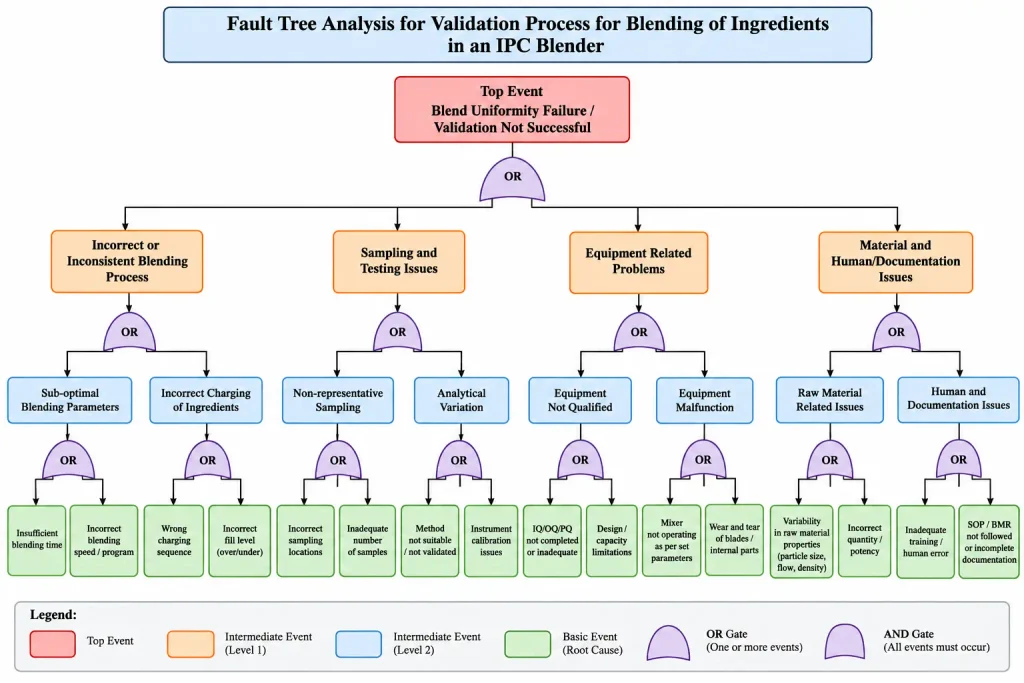
7. Fault Tree Analysis – Validation Process for Blending of Ingredients in an IPC Blender:
The Fault Tree Analysis (FTA) evaluates possible causes leading to blend uniformity failure or unsuccessful validation of the IPC Blender process. The top event is linked to major contributors such as inconsistent blending, sampling and testing problems, equipment-related issues, raw material variability, and human or documentation errors. These are further divided into basic causes including inadequate blending time, incorrect charging sequence, improper fill level, poor sampling locations, insufficient samples, analytical variation, equipment qualification gaps, malfunction, material property variation, inadequate training, and SOP/BMR non-compliance. FTA helps identify critical failure pathways and supports focused corrective and preventive actions.
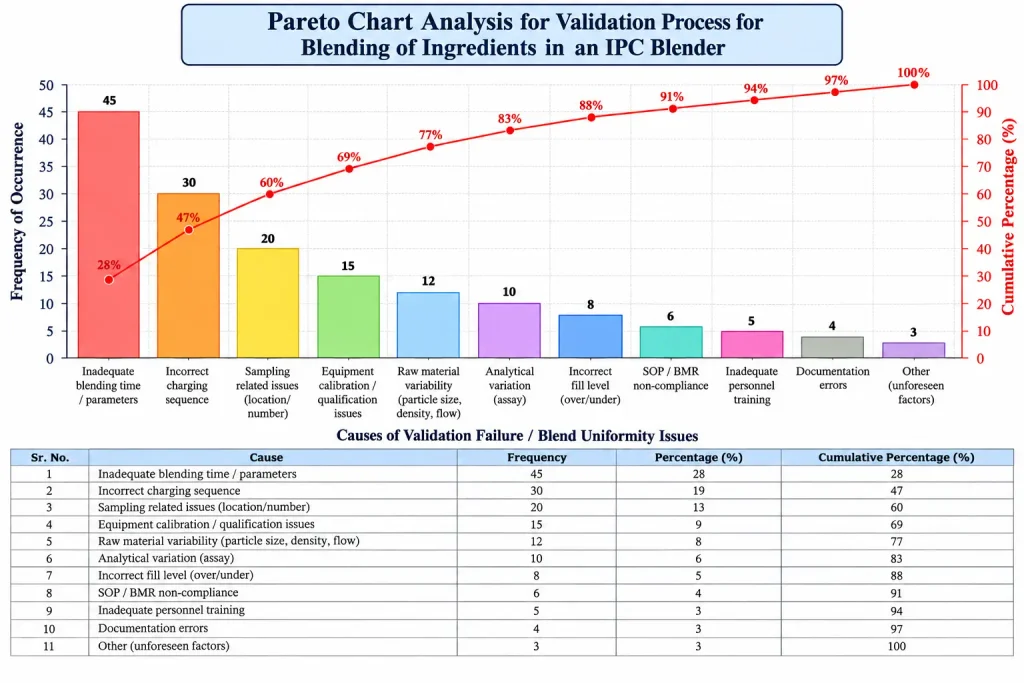
8. Pareto Chart Analysis – Validation Process for Blending of Ingredients in an IPC Blender:
The Pareto Chart Analysis helps identify and prioritize the major causes contributing to blend uniformity or validation failure in an IPC Blender. The chart ranks potential causes according to their frequency and cumulative percentage. Major contributors include inadequate blending time or parameters, incorrect charging sequence, sampling-related issues, equipment calibration or qualification problems, raw material variability, analytical variation, incorrect fill level, SOP/BMR non-compliance, inadequate personnel training, and documentation errors. By focusing first on the few causes contributing most significantly to overall failures, the validation team can prioritize corrective actions, improve process control, and enhance blending consistency and validation reliability.
9. Corrective Action & Preventive Action with Effectiveness Review – Validation Process for Blending of Ingredients in an IPC Blender:
| S. No. | Identified Issue | Corrective Action | Preventive Action | Effectiveness Review |
|---|---|---|---|---|
| 1 | Blend uniformity failure / high RSD | Investigate the affected validation batch, review blending time, sampling locations, charging sequence and analytical results. Repeat blending or validation where justified. | Establish and approve optimized blending time and defined process parameters in the BMR/SOP. | Review subsequent validation batches for acceptable blend uniformity and RSD below 5%. |
| 2 | Incorrect blending time | Reassess blending duration using validation samples collected at defined intervals. | Define validated blending time and permissible operating range in the BMR. | Confirm that three consecutive validation exercises meet assay and uniformity requirements. |
| 3 | Sampling location variation | Re-sample from scientifically defined locations using the approved sampling thief/bulk sampler. | Prepare a standardized sampling plan defining location, number of samples, quantity and technique. | Compare location-wise assay results and confirm consistent distribution of active ingredient. |
| 4 | Equipment qualification/calibration gap | Stop validation activity until qualification or calibration is completed and verified. | Introduce pre-validation verification of IPC Blender qualification and calibration status of all testing equipment. | QA shall verify that calibration and qualification remain valid during subsequent studies. |
| 5 | Incorrect charging sequence or fill level | Review actual charging sequence and blender loading against the BMR and investigate any deviation. | Clearly specify charging sequence, batch size and blender operating capacity in approved manufacturing instructions. | Observe subsequent batches and confirm compliance with approved loading and charging requirements. |
| 6 | Raw material variability | Review raw material identity, quantity, analytical status and relevant physical characteristics. | Ensure only approved materials with verified status are issued for validation batches. | Review subsequent validation results to confirm no material-related blend variability. |
| 7 | Personnel training deficiency | Retrain Production, QA, QC and relevant personnel on blending, sampling and validation requirements. | Include IPC Blender validation and sampling procedures in the training matrix with periodic assessment. | Verify training records and perform competency assessment during the next validation exercise. |
| 8 | Analytical variation / OOS result | Initiate OOS investigation, review test method, instrument calibration, analyst performance and sample handling. | Ensure approved analytical procedures, calibrated instruments and trained analysts are used. | Confirm repeat/subsequent testing produces consistent and specification-compliant results. |
| 9 | SOP/BMR non-compliance | Document the deviation and assess its impact on validation results. | Strengthen line clearance and pre-execution QA verification of current SOP and BMR availability. | QA review should confirm no recurrence in subsequent validation batches. |
| 10 | Documentation errors | Correct records according to GDP requirements and assess data integrity impact. | Use controlled validation formats with mandatory fields, checks and QA review. | Review completed validation documentation for accuracy, completeness and traceability. |
| 11 | Deviation/OOS handling delay | Complete pending investigation and assess its impact before validation closure. | Define timelines and responsibilities for deviation and OOS investigation in the validation process. | Confirm timely closure of deviations/OOS before approval of the validation report. |
Effectiveness Review Conclusion
CAPA effectiveness should be considered satisfactory when subsequent validation demonstrates uniform distribution of the active ingredient, assay results within the approved specification, and RSD of active ingredient below 5%, with no recurring critical deviation or OOS attributable to the blending process. The review should also confirm valid equipment qualification and calibration, trained personnel, adherence to approved SOP/BMR requirements, complete documentation, and satisfactory QA/QC review before final validation approval. Validation Report for Blending.
10. Questions & Answers – Validation Process for Blending of Ingredients in an IPC Blender:
Q1. What is the objective of validation of blending in an IPC Blender?
Answer: To demonstrate that the blending process achieves uniform distribution of the active ingredient at the established blending time and that chemical analysis results remain within specified limits.
Q2. What equipment is covered in this validation?
Answer: The validation is applicable to the blending process carried out in an IPC Blender.
Q3. Which departments are involved in the validation study?
Answer: Production, Quality Assurance, Quality Control, and Engineering are involved in the validation activity and approval process.
Q4. What should be checked before starting validation?
Answer: Equipment qualification, calibration of equipment and testing apparatus, raw material status, analytical references, training of personnel, applicable SOPs, and BMR requirements should be verified. Validation Report for Blending.
Q5. Why is personnel training important?
Answer: Trained personnel help ensure that blending, sampling, testing, and documentation activities are performed consistently according to approved procedures.
Q6. What is the main parameter verified during blending validation?
Answer: The main parameter is blend uniformity of the active ingredient at the established blending time.
Q7. What is the acceptance criterion for RSD?
Answer: The RSD of the content of active ingredient should be less than 5%.
Q8. What should the assay results comply with?
Answer: The content of active ingredient should comply with the limits specified in the applicable Quality Control specification.
Q9. Why are samples collected from different locations?
Answer: Samples from different locations are used to confirm uniform distribution of the active ingredient throughout the blend.
Q10. What happens if a deviation occurs during validation?
Answer: The deviation should be documented, reviewed, investigated, and its impact on the validation outcome should be assessed.
Q11. How should OOS results be handled?
Answer: OOS results should be documented and investigated according to the applicable OOS procedure before the validation is concluded.
Q12. What type of validation is mentioned in the report?
Answer: The report provides for concurrent validation and revalidation.
Q13. How many successful exercises are required for concurrent validation?
Answer: Three consecutive successful validation exercises are specified.
Q14. When is periodic revalidation performed?
Answer: The report states that periodic revalidation should not exceed five years.
Q15. What is required after a major change?
Answer: Three consecutive validation exercises are specified for revalidation after a major change.
Q16. What results are reviewed after completion of blending?
Answer: Chemical analysis results, appearance of the lubricated mix, reviewer comments, findings, and recommendations are reviewed.
Q17. Who approves the validation report?
Answer: The validation is reviewed and approved through Production, Quality Assurance, Quality Control, Engineering, Unit Quality Assurance, and Unit Head approvals.
Q18. What is the final purpose of the validation report?
Answer: It provides documented evidence that the IPC Blender process can consistently produce a uniform blend under the defined operating conditions.
11. Reference Guidelines – Validation Process for Blending of Ingredients in an IPC Blender:
- US FDA – Process Validation: General Principles and Practices, January 2011
Provides lifecycle principles for process design, process qualification, and continued process verification. - EU GMP – EudraLex Volume 4, Annex 15: Qualification and Validation
Provides requirements for process validation, qualification, revalidation, change assessment, and documentation. - PIC/S Guide to GMP – Annex 15: Qualification and Validation
Provides internationally recognized expectations for validation planning, execution, acceptance criteria, deviation management, and reporting. - ICH Q8(R2) – Pharmaceutical Development
Useful for understanding critical material attributes, process parameters, blending time, and development of a controlled manufacturing process. - ICH Q9(R1) – Quality Risk Management
Applicable for risk assessment of blending parameters, equipment, sampling, material variability, and potential blend-uniformity failures. - ICH Q10 – Pharmaceutical Quality System
Supports change management, CAPA, process monitoring, continual improvement, and maintenance of a validated state. - 21 CFR Part 211.100 – Written Procedures; Deviations
Requires documented production and process-control procedures and appropriate recording and justification of deviations. - 21 CFR Part 211.110 – Sampling and Testing of In-Process Materials and Drug Products
Relevant to establishing in-process controls and testing to assure batch uniformity and process performance. - WHO GMP – Guidelines on Validation / Good Manufacturing Practices for Pharmaceutical Products
Provides general principles for process validation, qualification, documentation, sampling, and maintaining validated processes. - Approved Product-Specific BMR, IPC Blender SOP, Sampling SOP, Analytical Method and Specification
These controlled site documents should define the actual blending time, charging sequence, blender loading, sampling locations, test methods, and acceptance criteria used during the validation study. The uploaded report itself requires use of the approved IPC Blender SOP, sampling SOP, and BMR.